
Let's get straight to it. The number of business days per month in the UK isn't set in stone; it usually shakes out to somewhere between 20 and 22. This wiggle room comes down to a few things: the month's total length, how the weekends fall, and the real wild card – bank holidays.
Your Quick Guide to UK Business Days Per Month
Getting a handle on the typical number of business days is essential for everything from running payroll accurately to mapping out project timelines. While you can work with a rough average, the truth is that each month has its own unique rhythm.
For most UK businesses running on a standard Monday to Friday week, you're looking at an average of 20 to 22 business days a month. That number accounts for weekends, but the final, official count always depends on where the bank holidays land. And remember, these can differ across England, Scotland, Wales, and Northern Ireland. You can get a deeper understanding of how these work days are calculated across the UK on Timetastic's blog.
It's a classic mistake to assume every month has the same number of working days. A month like May, for instance, often has two bank holidays, which can really eat into its business day count compared to a quieter month like July.
To give you a clear baseline, it helps to see the numbers before we start subtracting those pesky holidays. Think of this as your foundation for more precise planning.
Estimated UK Business Days Per Month At a Glance
Here’s a quick snapshot of the business days you can typically expect each month. This table factors in the standard weekends but doesn't deduct any bank holidays just yet. It's the perfect starting point for any calculation.
| Month | Total Days | Typical Weekends (Sat/Sun) | Estimated Business Days |
|---|---|---|---|
| January | 31 | 8 | 23 |
| February | 28/29 | 8 | 20/21 |
| March | 31 | 9 | 22 |
| April | 30 | 8 | 22 |
| May | 31 | 9 | 22 |
| June | 30 | 9 | 21 |
| July | 31 | 8 | 23 |
| August | 31 | 9 | 22 |
| September | 30 | 8 | 22 |
| October | 31 | 8 | 23 |
| November | 30 | 9 | 21 |
| December | 31 | 8 | 23 |
Using this table gives you a solid number to work with right away. From here, we can dig deeper into how these figures affect everything from salaries and resource allocation to hitting those all-important project deadlines.
What Actually Counts as a Business Day in the UK
Before you can start counting up business days per month, we first need to get on the same page about what a ‘business day’ actually means here in the UK. It's more than just a box on the calendar; it’s a concept tied up in British work culture, employment law, and the unique rhythm of different industries. For most people, the answer seems obvious: Monday to Friday.
This traditional view is the foundation for a huge number of businesses. For decades, the UK's legal and cultural framework has treated the standard Monday-to-Friday, 35 to 40-hour workweek as the default for countless office-based roles. UK labour law even establishes a maximum average of 48 hours per week (calculated over a 17-week period), though employees can choose to opt out of this limit. You can get more background on the standard workweek on Wikipedia.
But here’s the thing: sticking rigidly to this definition can cause some serious planning headaches. The modern UK economy is a rich tapestry of different working patterns, and the Monday-to-Friday model just doesn't fit everyone.
Beyond the Monday to Friday Model
For a massive chunk of the UK workforce, the whole idea of a standard business day looks completely different. Think about sectors like retail, hospitality, healthcare, and manufacturing. Many of these industries run seven days a week, using complex shift patterns that have little in common with a typical 9-to-5 schedule.
Just consider a few common examples where 'business day' gets a bit more complicated:
- Retail and Hospitality: For your local pub or high-street shop, Saturday is probably the busiest day of the entire week. It's absolutely a 'business day' for their operations and staff rotas.
- Healthcare: Hospitals and care homes never close. They provide 24/7 services, which means every single day of the year is a working day for some of their staff, dictated by rotas instead of the calendar week.
- Logistics and Warehousing: To meet our demand for next-day delivery, many distribution centres operate around the clock. For their staff, working nights and weekends is just part of the job.
So, a 'business day' isn't some universal constant. It’s a relative term, defined by the real-world operational needs of a company and the specific agreements it has with its employees.
The Legal and Contractual Foundation
At the end of the day, what really counts as a business day for any given employee comes down to one thing: their employment contract. This legal document is your single source of truth, spelling out exactly which days and hours an individual is expected to work.
This is where the UK's Working Time Regulations become so important. These laws don't actually dictate which specific days someone has to work. Instead, they govern rest periods and, crucially, entitle most workers to 5.6 weeks of paid holiday each year. This entitlement is a key piece of the puzzle, as it directly reduces the total number of available working days for an employee—no matter if they work a standard week or a flexible shift pattern. For any kind of accurate workforce planning, the contract is always the place to start.
The Step-by-Step Method for Calculating Business Days
Figuring out the exact number of business days per month isn't rocket science, but it does need a clear, methodical approach to sidestep what could be costly mistakes. Let’s break down the process into simple steps you can use for any month, whether you're managing payroll or planning a project.
The core idea is simple: start with the total number of days in the month, and then just subtract the non-working ones.
Think of it this way: a 31-day month with nine weekend days (Saturdays and Sundays) would give you a starting point of 22 potential business days. Easy enough.
But that initial count is just a baseline—it’s not the full picture. The single biggest variable you need to account for is bank holidays. These public holidays are the number one reason for miscalculations in monthly working day counts.
To help you visualise this, here’s a simple guide to counting your business days accurately.
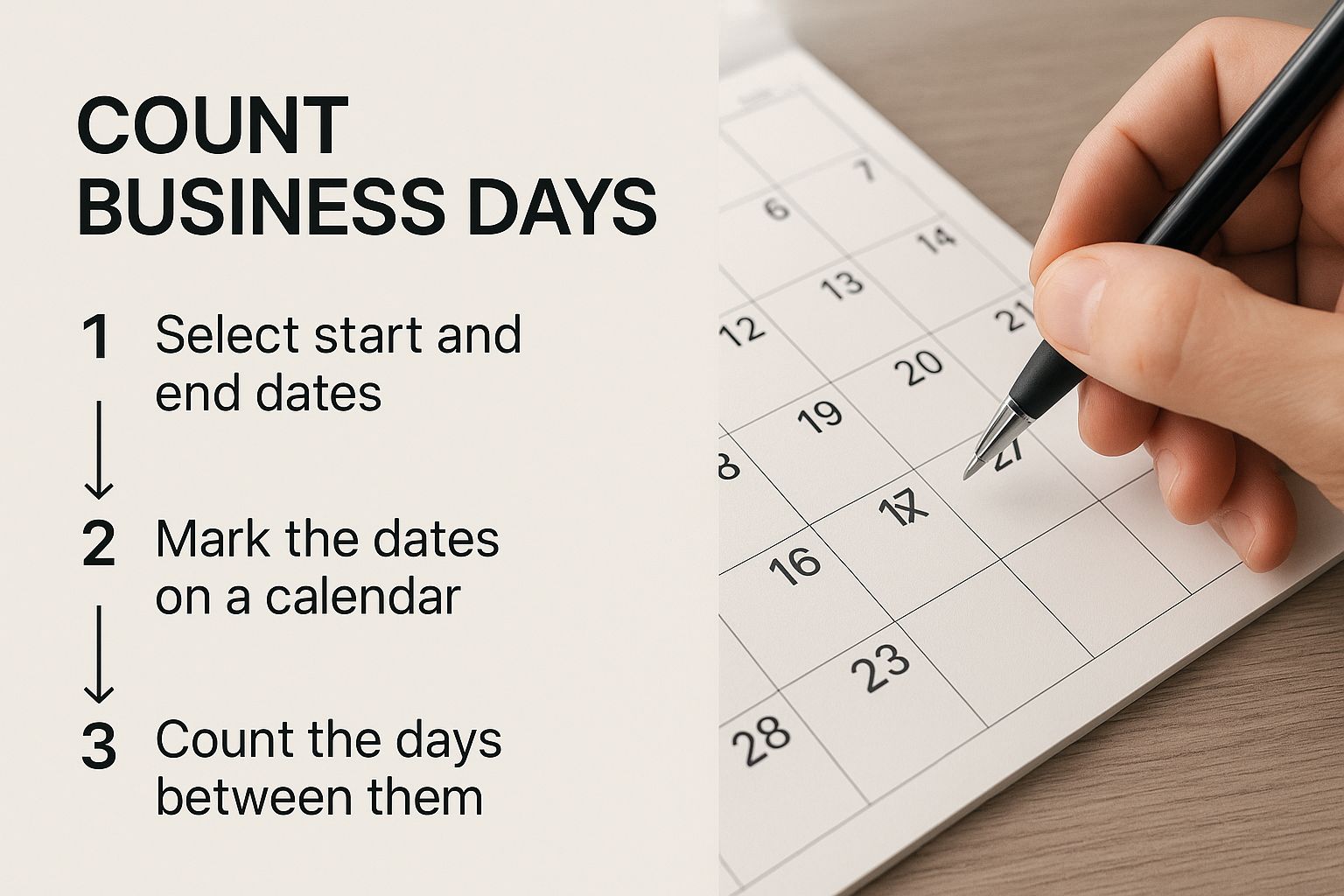
As you can see, the key is to tick off the weekends and holidays methodically. What’s left is your true number of available workdays.
The Complete Calculation in Action
Right, let's put this into practice with a real-world scenario. Imagine you're a project manager in England. You have a task that needs to start on 1st May and you've estimated it will take exactly 20 business days to complete.
- Count Total Days and Weekends: May has 31 days. A quick glance at the calendar shows it has nine weekend days (four full weekends and one extra Saturday). This leaves you with 22 potential business days (31 – 9).
- Identify and Subtract Bank Holidays: This is where you need to be precise. In England, May has two bank holidays: the Early May Bank Holiday and the Spring Bank Holiday.
- Final Calculation: Now, subtract those two holidays from your initial count. So, 22 potential business days minus 2 bank holidays equals 20 actual business days.
This careful process reveals that a project estimated to take 20 business days will consume the entire working month of May. Relying on a generic average would have led to an inaccurate deadline.
Why Regional Holiday Schedules Are Crucial
One of the most common mistakes people make is using a generic UK calendar. But the bank holiday schedule isn't the same across the United Kingdom. Scotland, Northern Ireland, and England/Wales all have their own unique holidays that you absolutely must factor in.
Forgetting about St Andrew's Day in Scotland or the Battle of the Boyne in Northern Ireland can throw your payroll and project planning into chaos if you have teams in those regions. For a wider perspective on annual planning, check out our detailed guide on the number of working days in a year. This will help you zoom out from the monthly view to see the bigger picture.
How Bank Holidays Reshape Your Monthly Calendar
Beyond the usual weekends, bank holidays are the biggest variable when it comes to figuring out your actual working days in a month. They aren't just a welcome day off; for anyone trying to plan ahead, they're immovable dates that can completely alter your schedule. Simply ignoring them or relying on a vague average is a surefire way to end up with missed deadlines and planning chaos.
The ripple effect of a bank holiday is bigger than just one lost day. Take May, for example, which often has two bank holidays in England. Losing two days out of a potential 22 might not sound like much, but it’s a nearly 10% reduction in your available working time. That kind of drop can seriously impact everything from project timelines and production targets to your customer service capacity.
This is precisely why a one-size-fits-all average for business days just doesn't cut it. You have to look at each month individually, taking its unique holiday schedule into account.
UK Regional Holiday Variations
A classic mistake for businesses operating across the UK is to assume everyone shares the same holiday calendar. The truth is, England, Wales, Scotland, and Northern Ireland each have their own specific bank holidays. Overlooking these differences can lead to some serious operational blunders – like scheduling a crucial meeting only to find your Scottish team is off celebrating St Andrew's Day.
The term 'UK Bank Holiday' is a bit of a generalisation. In reality, you're dealing with four distinct national calendars. Forgetting this can easily disrupt collaboration between teams in different nations and leave you with unexpected gaps in your resources.
To see just how different things can be, here’s a quick look at how some key holidays vary across the UK.
UK Bank Holiday Comparison by Nation
This table highlights just a few of the regional differences. You can see immediately why a business needs to be aware of which holidays apply to which teams.
| Holiday Name | England & Wales | Scotland | Northern Ireland |
|---|---|---|---|
| St Patrick's Day | No | No | Yes (17th March) |
| Summer Bank Holiday | Last Monday in Aug | First Monday in Aug | Last Monday in Aug |
| St Andrew's Day | No | Yes (30th Nov) | No |
| Battle of the Boyne | No | No | Yes (12th July) |
As you can tell, a localised approach is absolutely essential for accurate planning. If you're curious about where these days off came from, you can dive into some interesting facts about UK bank holidays and their history.
The Substitute Day Rule
Another detail that often catches people out is the 'substitute day' rule. What happens when a bank holiday's official date lands on a weekend? Simple: a substitute weekday – almost always the following Monday – becomes the public holiday instead.
This happens all the time with fixed-date holidays like Christmas Day, Boxing Day, and New Year's Day. For instance, if the 25th of December is a Saturday and the 26th is a Sunday, the bank holidays get pushed to the following Monday and Tuesday. This directly changes the business day count for that week, turning what would have been working days into official holidays. It's a dynamic factor that changes every year, making a careful calendar check vital for any long-term planning.
Factoring in Leave for a Realistic Working Day Count
An empty desk because of annual leave has the exact same knock-on effect on your workflow as a bank holiday. So far, we've focused on calculating the theoretical number of business days per month, but now it’s time to get real. The figure you get after subtracting weekends and bank holidays is just a starting point. To get a truly accurate picture, you have to account for employee leave.
Both planned annual leave and unplanned absences, like sickness, are critical variables that reduce your team's effective capacity. Ignoring them is like planning a road trip without checking if your car has a full tank of fuel. You need to know how many 'effective' working days you actually have at your disposal for realistic project and resource planning.
The Hidden Impact of Sickness Absence
While you can forecast planned holidays, unplanned absences are a significant and often overlooked drain on productivity. The scale of this issue in the UK is staggering.
According to the Health and Safety Executive (HSE), an estimated 33.7 million working days were lost in 2023/24 due to work-related ill health and non-fatal injuries. Of these, a massive 29.6 million days were lost to work-related ill health alone. This data highlights that sickness isn't just a minor inconvenience; it's a major factor in your team's availability that must be included in any serious planning.
Building a Realistic Forecast
So, how do you move from a theoretical count to a practical one? The key is to build a buffer for absences into your monthly and annual plans. Instead of being surprised by leave, you can anticipate it.
- Analyse Historical Data: Look at your own company’s absence records from the previous one to two years. This will help you establish an average rate of sickness per employee or team.
- Account for Statutory Leave: Remember that every full-time employee is entitled to 5.6 weeks of paid holiday. This is a known quantity that can be factored directly into your capacity planning. You might find our article on the government changes to annual leave carry-over rules helpful here.
- Track Leave Proactively: Use a centralised system to get a clear, real-time view of all approved holidays and other planned time off.
By combining the baseline business day count with your company's average absence rate, you create a far more realistic forecast. This 'effective working days' figure is the number you should use for setting project deadlines, managing workloads, and forecasting revenue.
This proactive approach turns absence from an unpredictable problem into a manageable variable. It allows you to plan resources with confidence, ensuring projects stay on track and teams aren't overloaded, even when desks are temporarily empty.
Why Accurate Business Day Calculations Matter
So, why bother drilling down into the number of business days per month? You might think it’s just a bit of admin, but getting this right is fundamental to the health and efficiency of your whole operation. It’s more than just a number on a calendar—it directly impacts your finances, client relationships, and even your legal obligations.
Think about it. Forgetting a single bank holiday or misjudging a month's working days can have a real-world ripple effect. One small mistake can easily snowball, throwing multiple departments off track and creating a mess that’s a real headache to sort out later.
The Bedrock of Business Operations
Nailing this calculation is the foundation for so many critical business functions. When you know exactly how many workdays you have, you give your teams the power to plan with confidence and execute with precision. This clarity prevents a whole host of operational problems before they even start.
Let’s look at how it plays out across the business:
- HR and Payroll: For someone starting mid-month or an employee who is leaving, calculating their pro-rata salary depends entirely on the exact number of working days. Get it wrong, and you’re looking at payroll errors and unhappy staff.
- Project Management: When you promise a client a "10 business day turnaround," that promise is built on this very calculation. An inaccurate count means you're setting unrealistic deadlines from the get-go, risking both client trust and your company’s reputation.
- Financial Planning: Your finance team relies on this for solid revenue forecasting and budget management. The number of productive days in a month helps them predict output, sales cycles, and cash flow with far greater accuracy.
Ultimately, understanding the true number of business days per month isn't just about counting. It's about recognising that every single working day is a valuable resource—one that needs to be managed just as carefully as your budget or inventory.
This single figure is also vital for staying on the right side of the law. Many contracts and Service Level Agreements (SLAs) have clauses tied to business day response times. Failing to meet these obligations because of a simple calendar error can lead to financial penalties or legal disputes, making accuracy an essential part of managing risk.
Common Questions About Business Days Answered

As you get the hang of tracking working days, a few tricky scenarios will inevitably pop up. Let's walk through some of the most common questions to make sure your planning stays sharp and accurate, no matter what.
How Do I Calculate Business Days for Part-Time Employees?
This is a great question, as a one-size-fits-all approach just won't work here. For part-time staff, you need to tailor the calculation to their specific rota. Instead of just removing all weekend days, you focus only on the days they are actually scheduled to work each month.
Imagine an employee works every Monday, Tuesday, and Wednesday. To find their working days for the month, you'd simply count how many Mondays, Tuesdays, and Wednesdays fall in that period. Then, you'd subtract any bank holidays that land on one of their scheduled workdays.
Getting this right is absolutely essential for accurate payroll and leave entitlement. Modern HR software can usually handle this automatically based on each employee's set schedule, which is a massive time-saver that also cuts down on human error.
Are There Tools to Automatically Calculate Business Days?
Yes, absolutely! You don't have to do all this with a pen and paper. Spreadsheet software like Microsoft Excel or Google Sheets has handy built-in functions. The NETWORKDAYS function, for example, is brilliant—it calculates the working days between two dates, automatically skipping weekends and any public holidays you tell it to.
Beyond spreadsheets, most modern project management tools (like Asana or Jira) and nearly all dedicated HR platforms have calendars that do the heavy lifting for you. They factor in regional bank holidays and approved leave when you're setting project deadlines or just trying to see who is available.
How Do Leap Years Affect Business Day Counts?
It's easy to forget about leap years, but they can make a difference in long-term planning. A leap year adds an extra day, the 29th of February, which can add one business day to your annual total.
If the 29th falls on a weekday (Monday to Friday), it bumps February's business day count up from 20 to 21, assuming there are no bank holidays that month. If it lands on a Saturday or Sunday, it makes no difference to your working day tally. It's a small detail, but a crucial one for accurate annual forecasting.


