
Figuring out holiday entitlement can feel like a minefield. That’s why a holiday calculator for the UK is such a useful tool, but first, it helps to understand what you’re actually calculating: your statutory annual leave.
For nearly every worker in the UK, this legal right amounts to 5.6 weeks of paid holiday per year. It’s proportional, too. This means part-time staff get a fair slice of the full-time equivalent. This isn’t just a company perk; it’s a legal minimum your employer must provide.
This article is an in-depth explanation of how to calculate holiday entitlement. We already have a free and easy to use Holiday Entitlement Calculator so why not use it now?
Understanding Your UK Holiday Entitlement
Before you start crunching any numbers, it’s vital to get the basics down. UK law is crystal clear on this: paid time off is a right for almost everyone, including people on zero-hour contracts and part-time staff. It’s a core part of supporting employee well-being.
The cornerstone of this right is the 5.6 weeks of statutory paid holiday each year.
Let’s put that into perspective. If you work a standard five-day week, this translates directly to 28 days of paid leave (5.6 weeks x 5 days). This is the figure most full-time employees are familiar with.
But remember, this is just the minimum. Many companies offer more generous leave as part of their benefits package, which is known as contractual holiday entitlement. Always check your employment contract to see exactly what you’re entitled to.
UK Statutory Holiday Entitlement at a Glance
To see what that 5.6 weeks looks like in practice for different working patterns, here’s a quick breakdown. This table shows the minimum paid holiday days you’re legally entitled to based on how many days you work each week.
| Working Days per Week | Minimum Weeks of Paid Leave | Equivalent Days of Paid Leave |
|---|---|---|
| 5 Days | 5.6 Weeks | 28 Days |
| 4 Days | 5.6 Weeks | 22.4 Days |
| 3 Days | 5.6 Weeks | 16.8 Days |
| 2 Days | 5.6 Weeks | 11.2 Days |
| 1 Day | 5.6 Weeks | 5.6 Days |
You’ll notice that some of these calculations result in a fraction of a day, like 22.4. By law, your employer cannot round this down. They must round it up to the next half or full day. So, someone working four days a week should get at least 22.5 days, though many employers will simply round up to 23 days.
The Role of Bank Holidays
One of the most common points of confusion is how bank holidays fit into all of this. An employer can choose to include public holidays as part of your statutory 5.6 weeks.
For example, the UK has eight bank holidays for England and Wales in 2025. If your employer includes these in your leave, a full-time employee would have 20 days of leave to book freely, plus the 8 bank holidays. You can get more details on upcoming UK public holidays to stay informed.
Key Takeaway: Your contract must spell out whether your holiday entitlement includes bank holidays. If it doesn’t say, then you are entitled to the full 28 days (or your pro-rata equivalent) in addition to any paid bank holidays.
This is especially important for part-time workers. If a bank holiday lands on a day you don’t normally work, you shouldn’t lose out. Your entitlement should be calculated pro-rata to ensure you get your fair share of paid time off, no matter which days of the week you happen to work.
Once you have these core rules down, using a holiday calculator in the UK for your specific situation becomes much easier.
Calculating Leave for Full-Time Employees

On the surface, calculating holiday for a full-time employee seems simple enough. For someone on a standard five-day week, the statutory minimum is 5.6 weeks. A quick multiplication gives you that familiar 28 days of annual leave. Job done, right?
Not quite. The real world is rarely that straightforward. What if your company offers a more generous leave policy? And what happens when someone joins part-way through the holiday year? This is where a solid grasp of the calculations becomes absolutely essential.
It all comes down to the difference between statutory and contractual holiday entitlement. Statutory leave is the legal minimum everyone’s entitled to. Contractual leave is any extra time off your employer offers, and your employment contract is the ultimate source of truth for this.
Understanding Pro Rata Calculations for New Starters
When someone joins your team mid-way through the leave year, you can’t just give them the full annual allowance. Their entitlement needs to be calculated on a pro-rata basis, which simply means they get a fair proportion of the total leave based on how much of the year they’ll actually be working for you.
Let’s walk through a practical example to see how it works.
Scenario A: New Employee Starts in October
Imagine a new starter, Alex, joins the company on 1st October. The company’s holiday year runs from January to December, and they offer a contractual entitlement of 30 days (which includes bank holidays).
First, you need to figure out what proportion of the year Alex will be with the company.
- Months remaining in the year: October, November, December (3 months)
- Proportion of the year: 3 months ÷ 12 months = 0.25 (or 25%)
Now, you just apply this percentage to the full annual entitlement:
- Calculation: 30 days × 0.25 = 7.5 days
So, Alex is entitled to 7.5 days of paid holiday for the rest of that leave year. The same principle applies no matter when someone starts. For businesses dealing with complex entitlement rules, using tools like Robotic Process Automation for payroll processing can be a game-changer for accuracy and efficiency.
Important Tip: You must always round fractional holiday entitlements up, never down. Alex’s 7.5 days is fine as it is, but if the calculation had ended up as 7.2 days, you would need to round it up to the next half day, making it 7.5 days.
What About Generous Company Policies?
If your organisation offers more than the statutory 28 days, this is your contractual entitlement. This extra leave is a company benefit, and the specific rules around it—like carry-over limits or whether it gets paid out when you leave—are all dictated by what’s in your employment contract.
Let’s tweak our example slightly to see this in action.
Scenario B: Enhanced Contractual Leave
Suppose the same company had a more generous policy, offering 33 days of annual leave. If Alex still starts on 1st October, the method is the same, but we use the new base figure.
- Calculation: 33 days × 0.25 = 8.25 days
In this case, Alex’s entitlement is 8.25 days. It’s common practice for employers to round this up to the nearest half day, so he would likely be credited with 8.5 days.
While a dedicated holiday calculator for the UK is a fantastic shortcut, knowing the formula behind it empowers everyone. For a deeper dive into the specific formulas, you can explore this detailed UK annual leave calculation formula guide.
This pro-rata approach ensures total fairness for every employee, guaranteeing they get the correct holiday allowance from day one. It takes the guesswork out of the equation and keeps you legally compliant, which is vital for any business.
Mastering Pro Rata Holiday for Part-Time Workers

Calculating annual leave for part-time workers is where many businesses get tangled up. The principle is simple enough: your part-time staff are legally entitled to the same 5.6 weeks of paid holiday as full-timers, just scaled down to match their hours. This is what we call pro rata leave, and getting it right isn’t just good practice—it’s the law.
The whole point is to ensure fairness and avoid treating part-time employees less favourably. It doesn’t matter if someone works fixed days or totally variable hours; the core entitlement remains. Let’s walk through a couple of real-world scenarios that any decent holiday calculator in the UK would handle.
Calculating for Fixed Part-Time Days
This is the most straightforward situation you’ll come across. You just need to multiply the number of days the employee works each week by the statutory entitlement of 5.6 weeks.
Scenario: The Three-Day Week Employee
Let’s meet Sarah. She has a set work pattern, coming in every Monday, Tuesday, and Wednesday. To figure out her annual holiday in days, the calculation is a piece of cake:
- Days worked per week: 3
- Statutory leave weeks: 5.6
- Calculation: 3 days × 5.6 weeks = 16.8 days
Now, the law is clear that employers cannot round holiday entitlement down. Sarah is entitled to a minimum of 16.8 days of paid leave for the year. To keep things simple and as a gesture of goodwill, most employers would round this up to the nearest half or full day, giving her 17 days.
This method ensures Sarah gets the same proportional holiday as a full-time colleague working five days, who would receive 28 days (5 x 5.6). It’s all about fairness.
Calculating for Variable Part-Time Hours
What about staff who work a set number of hours but on different days each week? This is incredibly common in sectors like retail and hospitality. For these employees, calculating their entitlement in hours is a much more accurate and fair approach.
Scenario: The 20-Hour Week Employee
Now, let’s look at Ben. He works 20 hours a week, but his shifts could be on any day. At his company, a full-time week is 37.5 hours. First, let’s work out the total holiday hours a full-timer gets.
- Full-time hours per week: 37.5
- Statutory leave weeks: 5.6
- Full-time holiday hours: 37.5 hours × 5.6 weeks = 210 hours
With that number, we can now calculate Ben’s pro rata share.
- Ben’s hours per week: 20
- Statutory leave weeks: 5.6
- Calculation: 20 hours × 5.6 weeks = 112 hours
So, Ben is entitled to 112 hours of paid holiday per year. Whenever he books time off, the number of hours he was scheduled to work that day is deducted from his total. It’s a far more precise system than trying to force his leave into a ‘days’ format when his shift lengths vary.
If you’re looking to dive deeper into these calculations, our guide on how to calculate prorated leave has even more detailed examples to make sure you nail it every time.
The Essential Pro Rata Formula
The most direct way to calculate pro rata holiday for a part-time employee is to find the full-time equivalent (FTE) and apply it to the full-time holiday allowance.
(Part-time hours per week ÷ Full-time hours per week) × Full-time holiday entitlement = Pro rata holiday entitlement
Handling Bank Holidays for Part-Timers
Ah, bank holidays. This is a classic HR headache. If a part-timer’s usual working day lands on a bank holiday, they get that day off as paid leave. But what if their working days never fall on a bank holiday? Are they just out of luck?
Not at all. To keep things fair, the best practice is to give them a pro rata entitlement for bank holidays.
Here’s a simple way to do it:
- Count the full-time bank holidays: In England and Wales, there are typically 8 bank holidays in a year.
- Calculate the pro rata share: Use the same FTE percentage. For Sarah, working 3 days a week makes her a 0.6 FTE (3 ÷ 5). Her share of bank holidays is 8 days × 0.6 = 4.8 days.
- Add it to their allowance: Credit these 4.8 days (or the equivalent hours) to her overall leave pot. This simple step stops her from being penalised just because she happens to work on Mondays, while a colleague who only works Thursday and Friday misses out.
This approach guarantees every part-time employee receives their fair share of paid time off for public holidays, no matter what their work schedule looks like. It’s a cornerstone of compliant and fair leave management.
Handling Irregular Hours and Zero-Hour Contracts
Calculating holiday pay for workers with irregular hours or on zero-hour contracts has moved right into the spotlight, and frankly, the old methods just aren’t compliant anymore. The once-common practice of “rolled-up” holiday pay—tacking a bit extra onto each payslip to cover leave—is now unlawful. Why? Because it can actively discourage workers from taking their much-needed time off.
Instead, the legally required approach makes sure that everyone, no matter their working pattern, gets fair holiday pay based on their average earnings. This method uses a 52-week reference period to calculate a worker’s average weekly pay, giving a much more accurate picture of their real income. This is a critical detail for any UK holiday calculator.
The 52-Week Reference Period Explained
The core idea is simple: to figure out a “week’s pay” for holiday purposes, you look back over the previous 52 weeks that the person actually worked and earned money. It’s crucial that you ignore any weeks where they didn’t work at all and therefore had zero earnings.
This is a key distinction. If an employee had a few weeks with no shifts over the past year, you have to skip those and go further back until you have 52 weeks of pay data. In practice, you can look back up to a maximum of 104 weeks to find these 52 weeks of earnings.
This process ensures that holiday pay isn’t unfairly diluted by periods of inactivity, which is a common reality for those on flexible contracts.
A Practical Walkthrough with a Zero-Hour Contract
Let’s put this into a real-world context. Imagine a hospitality worker named Chloe who is on a zero-hour contract. Her hours fluctuate massively depending on the season and event bookings.
To calculate her holiday pay for a week’s leave, her employer needs to follow a clear process:
- Total the Pay: First, they must add up Chloe’s total earnings over the last 52 weeks she actually worked. Let’s say this comes to £15,600.
- Calculate the Average: Next, they divide this total by 52 to find her average weekly pay. The calculation is £15,600 ÷ 52 weeks = £300.
- Determine Holiday Pay: This means Chloe’s holiday pay for one week of leave is £300. If she takes a single day off, it would be calculated as a fifth of this, which is £60.
This approach ensures her holiday pay accurately reflects her typical earnings, including any overtime or variable pay she might have picked up. For those managing these calculations, our in-depth guide provides more detail on holiday entitlement on a zero hours contract.
This infographic shows a simplified flow for calculating pro-rata entitlement, which is a core concept for part-time and irregular hour workers.
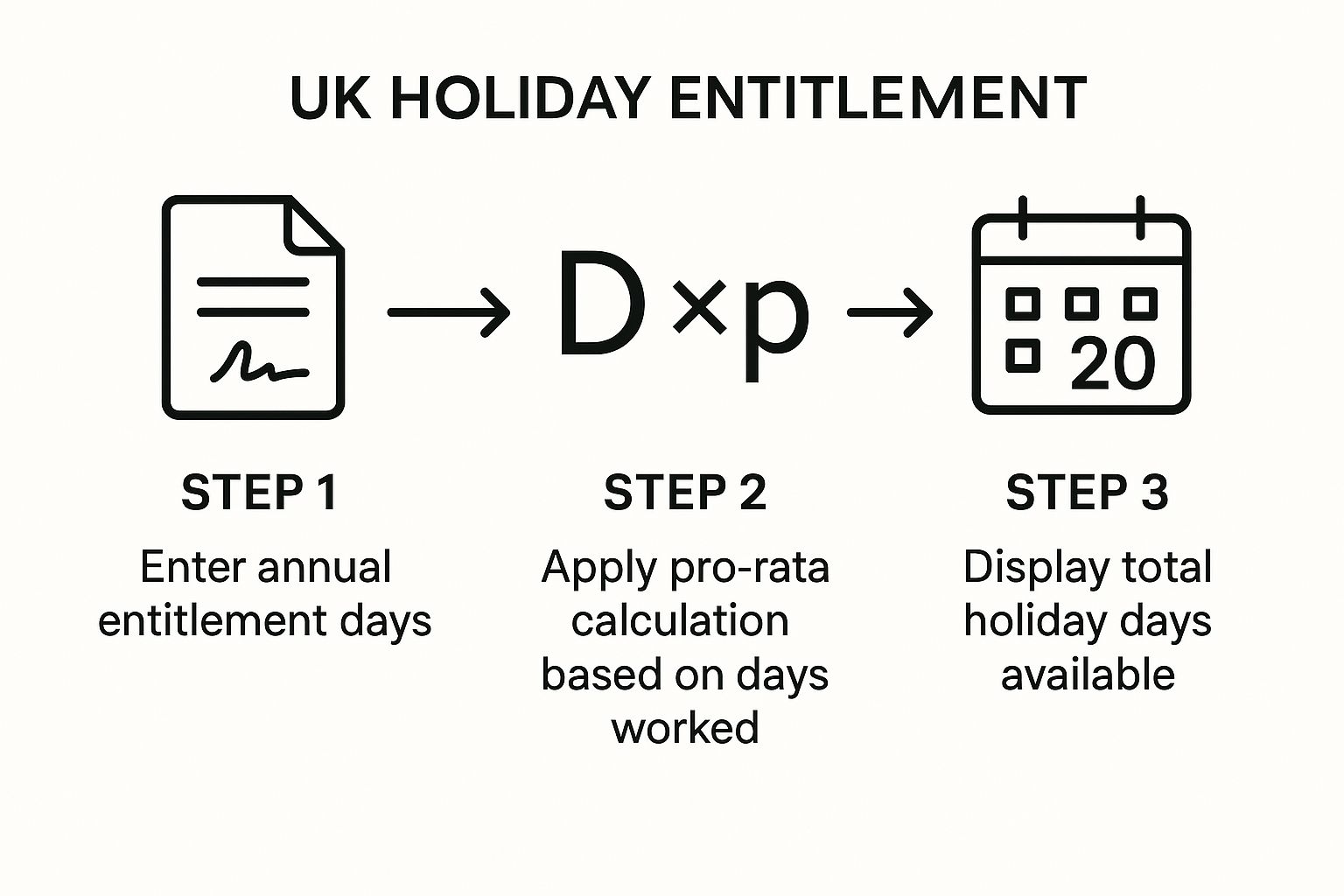
As the visual highlights, the process always starts with the base entitlement, which is then proportionally adjusted based on the actual time worked to arrive at a fair result.
What About Holiday Entitlement Accrual?
For workers on zero-hour or irregular contracts, holiday entitlement is often calculated as it’s accrued. The statutory holiday entitlement of 5.6 weeks is equivalent to 12.07% of hours worked over a year.
This percentage isn’t just a random number; it’s derived from a simple calculation:
- There are 52 weeks in a year.
- Statutory leave is 5.6 weeks.
- This leaves 46.4 working weeks in the year (52 – 5.6).
- The calculation is: (5.6 ÷ 46.4) × 100 = 12.07%.
Key Insight: An employee on a zero-hour contract accrues holiday time at a rate of 12.07% for every hour they work. So, if they work 10 hours, they accrue roughly 1.2 hours of paid leave.
Using this percentage allows for a fair and continuous accrual of holiday time that directly reflects the amount of work someone has put in. It’s a transparent system that helps both employers and employees track leave entitlement accurately. Mastering this calculation is vital for staying compliant and ensuring your team is treated fairly, removing all the guesswork from holiday management.
What Happens With Leave Carry-Over, Sickness, and Final Pay?

Holiday entitlement can get particularly tricky when real-life situations get in the way. Things like long-term sickness, leaving a job, or simply having a few days left at the end of the year can throw a spanner in the works.
Knowing the rules around these common scenarios is crucial. For employers, it’s about staying compliant; for employees, it’s about getting what you’re owed. While a good holiday calculator uk can do the heavy lifting, it’s always smart to understand the principles behind the numbers. These areas are all governed by UK employment law, and getting the calculations right is the best way to avoid disputes and ensure everyone is treated fairly.
The Rules for Carrying Over Annual Leave
It’s the question on everyone’s mind as the holiday year draws to a close: what happens to my unused days? The answer isn’t always straightforward and usually depends on the type of leave and what’s written in your employment contract.
Under UK law, every worker has to take a minimum of four weeks of their statutory holiday entitlement within the leave year it was earned. This rule comes from European working time law and is there to make sure people get a proper rest.
The remaining 1.6 weeks (which often includes bank holidays) can be carried over, but only if there’s a written agreement with your employer that says so. Beyond that, it’s all down to company policy.
- Statutory Leave: You can carry over a maximum of 1.6 weeks if your contract allows it. The first four weeks cannot be carried over, period.
- Contractual Leave: Any holiday your employer offers on top of the statutory minimum is governed by the rules in your contract. Some companies are flexible and let you carry over a few days, while others have a strict ‘use it or lose it’ policy.
Important Takeaway: Your employment contract is your bible here. It’s the definitive guide on your company’s policy for carrying over unused holiday. If it says nothing, assume the basic statutory rules apply.
How Holiday Accrues During Sickness Absence
One of the biggest areas of confusion is what happens to holiday entitlement during long-term sickness. The law, thankfully, is crystal clear on this: employees continue to accrue their statutory holiday leave even when they’re off sick, no matter how long they’re away.
Someone on sick leave can also choose to take paid holiday during their absence. This can be a real help if they’re only getting Statutory Sick Pay (SSP) and need to top up their income. An employer, however, can never force an employee to use their annual leave while they’re signed off sick.
If an employee can’t take their statutory holiday because they’ve been on sick leave, they have the right to carry over up to four weeks of that leave into the next holiday year. There is a time limit, though – this untaken leave must be used within 18 months of the end of the leave year in which it was accrued.
Calculating Final Pay When Leaving a Job
When someone hands in their notice or their contract is terminated, one of the final bits of admin is working out their outstanding holiday pay. This makes sure they’re paid for any leave they’ve earned but haven’t had a chance to take.
The calculation is a simple pro-rata assessment based on how much of the leave year the person has worked.
Let’s walk through a practical example. Imagine an employee, David, works a five-day week and gets the full 28 days of holiday. His company’s leave year runs from January to December. David resigns, and his last day is 30th June.
- Work out the accrued leave: By 30th June, David has worked for exactly half the year (6 of 12 months). So, his accrued holiday is 28 days × 0.5 = 14 days.
- Check leave already taken: You then need to see how many days David has already used. Let’s say he’s taken 10 days off so far.
- Find the final figure: Simply subtract the leave taken from the leave accrued. 14 days – 10 days = 4 days.
In this scenario, David is owed payment for 4 days of unused holiday in his final payslip.
This becomes especially important around bank holidays, which are a popular time for people to book longer trips. As many people in the UK plan their breaks around these dates, getting final pay calculations wrong can create a real headache. You can see more about UK travel trends during public holidays on rac.co.uk.
But what if it goes the other way? If David had already taken 15 days of leave by 30th June, he’d have used one day more than he had actually earned. An employer is allowed to deduct this overpayment from his final salary, but only if this is clearly stated in the employment contract.
Use our free and easy Holiday Entitlement Calculator instead!
Common Questions About UK Holiday Calculation
Even with the best tools, you’re bound to run into some specific questions about holiday entitlement. The world of work throws up all sorts of unique scenarios, and knowing your rights and obligations is absolutely key.
Think of this section as your go-to reference for those tricky “what if” moments. We’ll cover some of the most common queries we see, from employer control over leave dates to how bank holidays affect part-time staff, giving you the clear, practical guidance you need.
Can My Employer Tell Me When to Take Holiday?
Yes, they absolutely can. An employer has the right to decide when their staff take annual leave, as long as they provide the correct amount of notice.
The standard rule is that they must give you notice that is double the length of the leave they want you to take. So, if they want you to take a one-week holiday, they need to give you at least two weeks’ notice. This is a common practice for company-wide shutdowns, like over the Christmas period, and it’s perfectly legal. It’s always a good idea to check your contract for any specific clauses about enforced leave.
What Happens to Holiday During Maternity Leave?
This is a big one. An employee on maternity leave continues to build up their full contractual holiday entitlement, just as if they were still at work. This includes both the statutory minimum and any extra days your company offers.
Because they can’t take annual leave while on maternity leave, this holiday has to be carried over. The best approach is for employers and employees to agree on how this accrued leave will be taken before the maternity leave begins. It can either be tacked onto the end of the maternity period or taken once they’re back at work.
Key Insight: Holiday entitlement is protected during maternity, paternity, adoption, and shared parental leave. An employee must not lose out on their leave just because they are taking a period of family-related leave.
How Do Bank Holidays Work for Part-Time Staff?
This causes a lot of confusion, but the principle is about fairness. Part-time employees should get a pro-rata entitlement to bank holidays, no matter which days they normally work.
For example, a full-time employee gets eight paid bank holidays. A colleague working three days a week (which is a 0.6 full-time equivalent) is entitled to 4.8 of those days (8 x 0.6). This amount is usually added to their total annual leave allowance, which they can then book off whenever they choose. This ensures they aren’t treated less favourably than their full-time colleagues.


