
The Bradford Factor formula is a deceptively simple calculation (S² x D) that UK businesses use to get a clearer picture of employee absence. Its real value lies in how it flags the disruptive effect of frequent, short-term absences, which are often more chaotic for a business than a single, longer spell of leave.
What Is the Bradford Factor and Why It Matters

Ever had that feeling where one team member is off for a planned week, and everything runs smoothly, but another person calls in sick for a single day five different times, and it throws everything into chaos? That’s the exact problem the Bradford Factor was invented to measure.
It’s more than just another piece of HR jargon. Think of it as a tool that helps you see the hidden patterns in your team's attendance.
The core idea is simple: frequent, unplanned absences are far more disruptive to workflow, team morale, and deadlines than longer, continuous periods of leave. You can plan around a single extended absence. It’s the constant, short-notice ones that are tricky.
Quantifying Disruption with a Simple Formula
The Bradford Factor takes this fuzzy idea of "disruption" and turns it into a hard number—a score. This allows managers and small business owners to stop relying on gut feelings and start using objective data to understand what’s really going on with attendance. The Bradford Factor formula gives you a consistent benchmark to measure the impact of absenteeism across your entire company.
Its purpose isn’t to punish people. Instead, it’s about identifying patterns that might point to a bigger issue. A high Bradford Factor score can be an early warning sign for problems that need your attention, such as:
- Low employee morale or burnout.
- Underlying health issues that need support.
- Disengagement with a role or the company culture.
- Personal challenges outside of work that are spilling over.
The Bradford Factor helps you shift from simply counting sick days to strategically analysing attendance patterns. It shows you exactly where your support as a manager is needed most.
A UK Management Tool Since the 1980s
The Bradford Factor formula has been a staple in UK human resources since the 1980s. It was specifically designed to put a number on absenteeism by highlighting the chaos caused by frequent, short spells of sickness.
It’s calculated as S² x D, where 'S' is the number of separate absence spells and 'D' is the total number of days absent.
For example, an employee with five separate two-day absences (10 days total) would score a hefty 250 points (5² x 10). In contrast, someone who takes a single 10-day absence scores just 10 points (1² x 10). This perfectly illustrates how the system zeroes in on disruption, not just duration. You can learn more about the history and application of the Bradford Factor.
How to Calculate Scores Using the Bradford Factor Formula
At its heart, the Bradford Factor formula is a simple piece of multiplication that tells a surprisingly powerful story about workplace disruption. Getting to grips with the calculation is the first step in turning raw attendance data into something you can actually use for management insights.
The formula itself is thankfully straightforward.
The core calculation is: B = S² x D
Let's unpack what each letter means, because each part plays a crucial role in the final score.
Defining The Formula Components
To use the formula correctly, you just need two key bits of information. These are usually tallied up over a rolling 52-week period to give you a full year's view of someone's attendance patterns.
- S stands for 'Spells' or instances of absence. This is the total number of separate, non-consecutive times an employee is off work. Each separate instance, no matter how long, counts as one spell.
- D stands for 'Duration'. This is the total number of days the employee was absent across all their spells within that 52-week period.
So, what exactly is a 'spell'? Think of it as a continuous period of absence. If an employee is off sick from Monday to Wednesday, that’s one spell with a duration of three days. Simple enough. But if they come back to work on Thursday and then call in sick again on Friday, that Friday counts as a brand-new, separate spell.
Bringing The Calculation to Life with Examples
The best way to see the formula's real impact is to put it to work. Let's look at a couple of scenarios.
The table below compares different absence patterns for three employees over a 52-week period. Even when the total days off are similar, you'll see how the formula penalises those frequent, short-term absences that can be so disruptive.
Bradford Factor Score Calculation Examples
| Employee | Absence Pattern | Total Days (D) | Number of Spells (S) | Bradford Factor Formula (S² x D) | Bradford Score |
|---|---|---|---|---|---|
| Liam | 1 continuous absence | 10 | 1 | 1² x 10 | 10 |
| Chloe | 5 separate absences of 2 days each | 10 | 5 | 5² x 10 | 250 |
| Sam | 10 separate absences of 1 day each | 10 | 10 | 10² x 10 | 1000 |
As you can see, Liam, Chloe, and Sam all missed the same number of days. But their scores couldn't be more different. Chloe's score is 25 times higher than Liam's, and Sam's is a whopping 100 times higher. This isn't a mistake; it's by design. The formula heavily weights the frequency of absence, reflecting the greater operational headache caused by lots of separate, unplanned days off.
For more detailed scenarios and to test your own calculations, check out this complete guide to measuring employee attendance.
The infographic below really drives this point home, showing how quickly scores can escalate as the number of instances climbs.
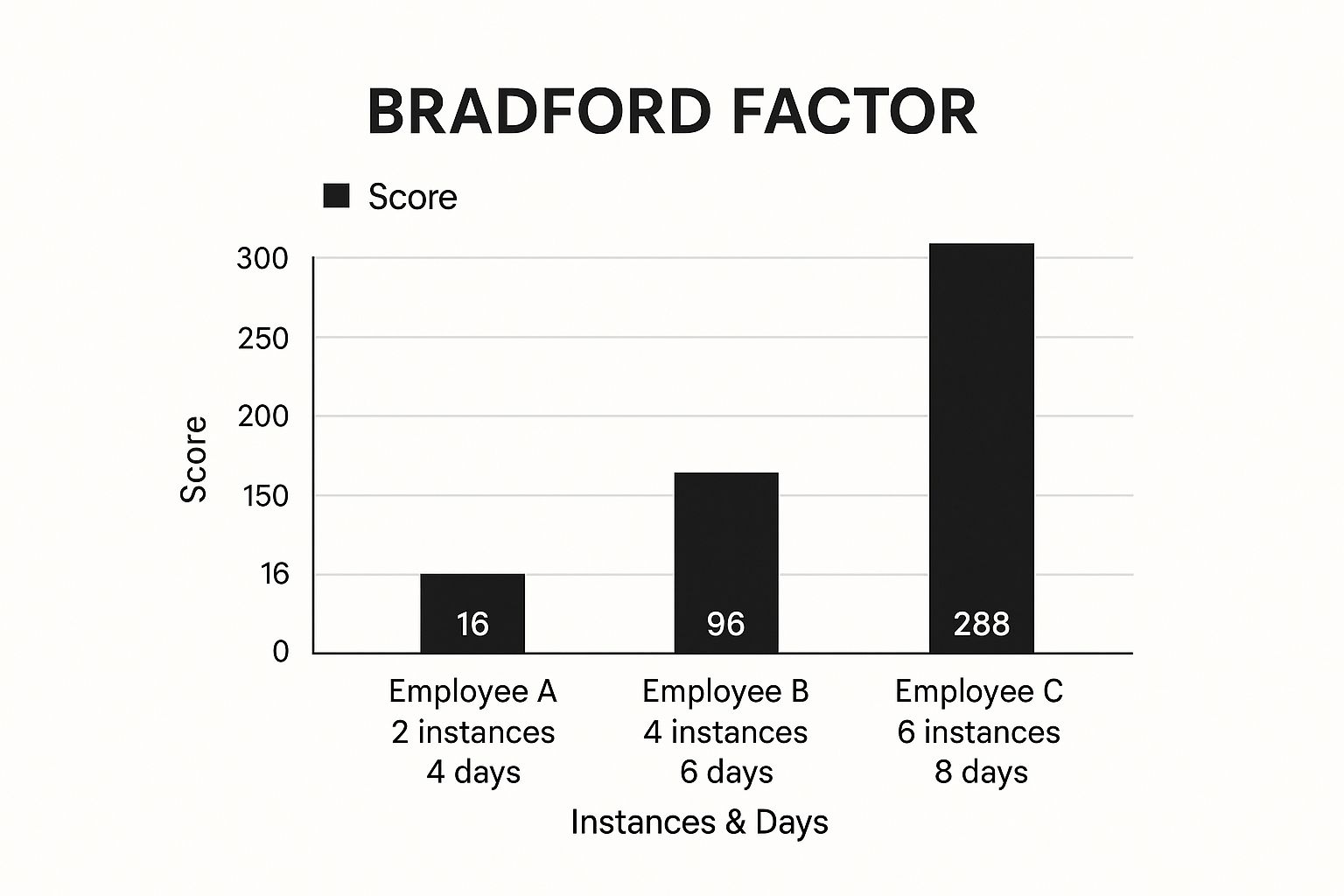
This chart clearly shows that just a few more spells of absence can cause the score to shoot up exponentially, highlighting exactly why it’s so sensitive to frequent disruptions.
Interpreting Bradford Factor Scores and Setting Trigger Points

So, you've calculated a score using the Bradford Factor formula. But what now? A score on its own is just a number. Its real value comes from understanding what it means and, crucially, knowing how to act on it. This is where 'trigger points' come into play.
Think of trigger points as pre-agreed score thresholds that prompt a specific management action. They're what turn the abstract score into a clear and practical framework, helping ensure every manager responds to attendance patterns consistently and fairly across the board.
It's best to see them not as rigid, unbending rules, but as conversation starters. A score crossing a certain line doesn't automatically equal discipline; it's an objective signal that it’s time to check in and find out the story behind the numbers.
Establishing Your Company Trigger Points
Setting your company’s trigger points is a fundamental step in building an absence management policy that's both transparent and effective. While there isn’t a legally mandated scale you have to follow, there's a widely accepted structure that gives you a solid place to start.
These thresholds help you categorise the level of disruption caused by someone's absence pattern, guiding you on the right response—from a quick, informal chat to a more formal review. The key is to make sure these guidelines are tailored to your company culture and what your business actually needs to run smoothly.
Example Bradford Factor Trigger Points and Actions
The table below lays out a typical framework for interpreting scores. Remember, this is a starting point. You should adapt these ranges and the recommended actions to fit your organisation’s specific policies and values.
| Bradford Score Range | Interpretation | Recommended Management Action |
|---|---|---|
| 0 – 50 | No concern | Represents a normal attendance pattern. No action is needed. |
| 51 – 200 | Initial Concern | The score suggests a potential for disruption. A good time for an informal, supportive chat during a return-to-work interview to understand the reasons. |
| 201 – 400 | Medium Concern | The frequency of absences is likely impacting workflow. A formal verbal warning may be issued, alongside a discussion about required improvements and available support. |
| 401 – 600 | Serious Concern | This indicates persistent absenteeism that is causing significant disruption. A first written warning may be appropriate, setting clear goals for attendance improvement. |
| 601+ | Critical Concern | This is a severe and unacceptable level of absence. May lead to a final written warning or, after a fair and thorough process, dismissal. |
It's vital that you communicate these trigger points clearly to all employees. When everyone understands how the system works and what to expect, it removes ambiguity and fosters a much stronger sense of fairness and transparency. For a deeper dive into this, you can learn more about how to set effective Bradford Factor trigger points.
A Tool for Conversation, Not Accusation
Within the UK workforce, the Bradford Factor formula is great at showing how different absence patterns impact a business. For example, an employee off for one continuous 7-day stretch scores just 7 points (1² x 7). But someone else with three separate absences that also add up to seven days scores 63 points (3² x 7). The formula correctly flags the far greater disruption caused by frequent, short-term absences.
However, UK trade unions often criticise the formula when it's paired with overly rigid trigger points, which can lead to disciplinary action without considering individual context.
Ultimately, a high score should be viewed as an objective signal to explore the root causes of an employee's absence. It's a prompt to manage with empathy and find supportive solutions.
Approaching it this way ensures you address the real issues—whether they're related to health, morale, or personal challenges—in a constructive manner. You can maintain productivity while also nurturing a positive and supportive workplace culture.
Applying the Bradford Factor Fairly and Legally in the UK
Using the Bradford Factor formula as an HR tool is perfectly acceptable in the UK, but it’s a tool that needs to be handled with real care. Think of the score it produces as a conversation starter, not a final verdict. To use it properly, it needs to be part of a wider, transparent, and legally sound absence management policy that protects both your business and your people.
Your first step should always be clear communication. Your team needs to understand how this system works long before it ever affects them. Make sure your absence policy clearly lays out how the scores are calculated, what the different trigger points mean, and what might happen if someone reaches a certain threshold.
When everyone knows the rules of the game from the start, it removes suspicion and helps build a foundation of trust. That kind of transparency is your best defence against any future claims of unfair treatment.
Critical Legal Considerations
While the Bradford Factor itself isn't a legal framework, how you use it falls squarely under UK employment law. Using it carelessly can lead to some serious legal headaches, especially around discrimination. The most important piece of legislation to keep in mind here is the Equality Act 2010.
This act puts a legal duty on employers to make reasonable adjustments for employees with disabilities. A disability is defined as a physical or mental impairment that has a substantial and long-term negative effect on a person's ability to carry out normal day-to-day activities.
A rigid, automated application of the Bradford Factor formula could indirectly discriminate against an employee whose disability results in more frequent, short-term absences. Failing to adjust for this could lead to a costly employment tribunal.
For instance, an employee with a chronic condition like Crohn's disease or multiple sclerosis might have flare-ups that require short, unpredictable absences. Punishing them based on a high score generated by these disability-related absences would almost certainly be unlawful. The key is to discount or adjust for any absences that are directly linked to a known disability.
Managing Protected Characteristics
Beyond the Equality Act, you have to be mindful of other protected characteristics. Absences related to pregnancy are a classic example. Any sickness absence that is pregnancy-related should never be counted towards an employee’s Bradford Factor score. If you do, it could easily be seen as pregnancy and maternity discrimination.
To keep your application of the formula both fair and legal, follow these essential steps:
- Communicate Clearly: Get your policy documented and make it easy for all staff to find. Explain what you're measuring and, just as importantly, why.
- Investigate Absences: Always hold a return-to-work interview. This is your chance to understand the real reasons behind an absence before taking any formal steps.
- Consider Underlying Conditions: Proactively and sensitively ask if there are any underlying health issues or disabilities an employee wants to make you aware of.
- Make Reasonable Adjustments: For employees with disabilities, this could mean anything from discounting all disability-related absences to setting higher trigger points just for them.
- Treat People as Individuals: Use the score as a prompt for a supportive conversation, not as an trigger for an automated disciplinary process.
A fair system is a consistent one. Make sure you document every conversation and decision, and treat similar situations in a similar way across the entire organisation. To get the full picture, it's really helpful to understand exactly how the Bradford Factor works as part of your bigger HR strategy. This ensures the Bradford Factor formula stays a useful management tool and doesn’t become a legal liability.
Understanding the Limitations of the Bradford Factor

While the Bradford Factor formula offers a clear, data-driven way to flag potentially disruptive absence patterns, it’s crucial to remember that no single tool is perfect. In fact, its greatest strength—its rigid, mathematical simplicity—is also its biggest downfall. The formula is a blunt instrument; it treats all absences equally, unable to tell the difference between a string of genuine short-term illnesses and less sincere reasons for being off.
This lack of nuance means the score itself gives you no context. It can't tell you if an employee is struggling with a chronic health condition, dealing with a family emergency, or is simply feeling disengaged from their role. If you rely solely on the number, you risk turning a supportive management opportunity into a punitive, one-size-fits-all process.
Potential for Unfairness
One of the major criticisms levelled against the Bradford Factor is its potential to be unfair, especially towards employees with disabilities or long-term health issues. Certain conditions naturally lead to more frequent, short absences, which can result in unfairly high scores. This can place vulnerable employees under undue stress and scrutiny—a critical consideration under the UK’s Equality Act 2010.
In the same way, it can unintentionally penalise parents of young children, who might need to take short-notice leave for childcare emergencies. Without a manager applying discretion and a human-first approach, the formula can create a culture where people feel pressured to come to work ill, a phenomenon we all know as presenteeism.
The Bradford Factor should be seen as one data point in a much larger picture of an employee's wellbeing and performance, not as a definitive judgment on its own.
Questioning Its Modern Relevance
The world of work has changed dramatically since the formula was first developed. With its roots in the 1980s UK workplace, the Bradford Factor is facing increasing questions about whether it's still fit for purpose in today’s flexible working culture.
When it was devised, physical presence was the norm. But the rise of remote and hybrid models makes you question the relevance of penalising someone with a high score. An employee could be working productively from home while mildly unwell, yet they might still be marked absent, generating a score that doesn't reflect their actual contribution. Critics argue its rigid scoring system fails to account for these modern nuances, creating a real tension between historical absence tools and 21st-century work practices. You can read more about how the Bradford Factor is viewed in today's workplace.
Ultimately, a high score should trigger support, not just scrutiny. It’s a signal to open a dialogue, understand what’s going on behind the scenes, and find a solution that helps both the employee and the business.
Common Questions About the Bradford Factor Formula
Once you get your head around the maths, the Bradford Factor formula seems straightforward enough. But using it in the real world, with real people, brings up a whole host of practical and legal questions. It’s a tool that straddles the line between data analysis, people management, and employment law, so it’s completely normal to want to be sure you’re on solid ground.
Getting these details right is the key to using the formula confidently and, most importantly, fairly. Let’s walk through some of the most common questions managers have.
Is the Bradford Factor a Legal Requirement in the UK?
This is a big point of confusion, so let's be crystal clear: No, the Bradford Factor is not a legal requirement. It’s a management tool, not a law passed by Parliament. There’s no UK legislation that forces companies to use it, nor are there any official "legal" trigger scores.
Think of it as an internal KPI for attendance. Your company decides if it wants to use it, and you're the one who sets the policy for how scores are interpreted and what happens next.
Can You Dismiss Someone Based Only on Their Score?
Absolutely not. Relying solely on a high Bradford Factor score to dismiss someone is asking for trouble and is incredibly risky. A high score should be seen as a red flag that prompts a conversation, not a trigger for immediate dismissal.
If a case ever ended up before an employment tribunal, they would look for evidence that you followed a fair and reasonable process. That means you need to show you’ve:
- Investigated the reasons for the absences, usually through return-to-work interviews.
- Held formal meetings to discuss the pattern of absence and its impact.
- Issued warnings (starting with verbal, then moving to written) and set clear goals for improvement.
- Considered any underlying issues, like health problems or disabilities.
Just pointing to a number on a spreadsheet won't cut it. The score is a piece of the puzzle, not the whole picture.
The formula gives you the 'what' (a pattern of frequent, short-term absences), but it's the manager's job to find out the 'why' before any action is taken.
How Should Absences Related to Disabilities Be Handled?
This is probably the most critical legal minefield to navigate. Under the Equality Act 2010, employers are legally required to make "reasonable adjustments" for employees with disabilities. A disability is defined as a long-term physical or mental condition that has a substantial effect on their ability to carry out day-to-day activities.
If you discipline an employee for absences directly caused by their disability without considering adjustments, you're likely heading into disability discrimination territory.
So, what does a "reasonable adjustment" look like here?
- Discounting Absences: The most common approach is to simply exclude any disability-related absences from the Bradford Factor calculation altogether.
- Adjusting Trigger Points: You could also set higher, more lenient trigger scores for an employee with a known disability.
- Holistic Review: This is about stepping back from the numbers. The focus should be on supporting the employee in managing their condition at work, not just tracking their time off.
The key is to have open, sensitive conversations with the employee to understand what they need. Never make assumptions. Your actions should always be guided by good communication and, if necessary, professional medical advice.
Does the Score Ever Reset?
Yes, it does. The Bradford Factor formula is nearly always calculated over a rolling 52-week period. This means the score is a live reflection of an employee's attendance over the past year.
As each new week starts, the data from the corresponding week a year ago is dropped from the calculation. This rolling system is great because it ensures the score is always current. It also gives employees a clear path to lowering their score—as older instances of absence fall away, their score will naturally improve with better attendance.


