
The Bradford Factor is an HR formula that gets to the heart of employee absence. It’s not just about counting the days someone is off; it’s about measuring the impact of those absences.
The core idea is simple but powerful: frequent, short-term absences are given a much higher weight than a single, long-term leave. This helps to shine a light on patterns of disruption, rather than just tallying up total days missed.
What The Bradford Factor Reveals About Absence

Imagine two employees are both away from work for 10 days over a year. On paper, the impact seems identical. But when you dig a little deeper, the Bradford Factor tells a completely different story about how their absences affect your business.
One employee takes a single, continuous two-week leave. Think of it like a planned road closure. It’s definitely a disruption, but you can prepare for it. You can re-route tasks, manage client expectations, and contain the operational strain to a single event.
Now, think about the second employee. They take 10 separate, individual days off. This is more like having 10 random, unannounced roadblocks pop up throughout the year. Each instance creates fresh chaos, throws a spanner in the works, and forces the team to reshuffle at the last minute. This pattern creates far more cumulative strain and unpredictability.
Highlighting Disruption Over Duration
This is exactly what the Bradford Factor is built to capture. It’s an objective tool used by UK businesses to put a number on the disruptive effect of frequent, short-term absences. Its real value is its ability to flag underlying attendance patterns that you’d completely miss if you were only looking at the total number of days absent.
The model was developed from research at the Bradford University School of Management back in the 1980s. The researchers set out to prove how frequent, unplanned time off causes significantly more operational headaches than longer, less frequent periods of leave.
The core principle is that frequency, not duration, is the primary driver of operational disruption. A high score doesn't automatically mean an employee is unreliable; it signals a pattern that warrants a supportive conversation.
To properly get to grips with the Bradford Factor, it's helpful to break down its core components. The table below gives a quick rundown of the key terms and what they mean for managing your workforce.
Core Concepts of the Bradford Factor
| Concept | What It Means for Your Business | Why It Matters |
|---|---|---|
| Absence Instances (S) | The number of separate, non-consecutive periods of absence, regardless of how long they are. | This is the multiplier. A high number of instances, even for short absences, quickly increases the score, highlighting a pattern of frequent disruption. |
| Total Days Absent (D) | The total number of days an employee was absent across all instances within a set period (usually 52 weeks). | This figure provides the scale of the absence but is less influential than the number of instances. It helps to contextualise the overall time lost. |
| Bradford Score | The final calculated score (S² x D). A higher score indicates a more disruptive absence pattern. | It provides an objective, data-driven starting point for managers to address potential issues fairly and consistently across the team. |
Ultimately, these concepts come together to provide a clear, objective measure that moves the conversation away from assumptions and towards data-backed insights.
A Tool For Conversation, Not Punishment
Let’s be clear: a high Bradford Factor score isn’t a guilty verdict. It’s an objective trigger point for a conversation. It gives managers a consistent and fair basis to check in with an employee and uncover what might be going on behind the scenes.
Often, a high score can point to issues like:
- Underlying health problems
- Poor morale or disengagement
- Workplace stress or burnout
While the Bradford Factor zooms in on absence, it’s just one piece of the puzzle. It sits alongside other important metrics for measuring overall team performance. By using it as a diagnostic tool rather than a disciplinary one, you can tackle problems proactively and give your team the support they actually need.
Breaking Down the Bradford Factor Formula
To really get to grips with the Bradford Factor, you need to look past the concept and get comfortable with the simple maths driving it. The formula itself is straightforward, but its power lies in how it pinpoints frequent, disruptive absences over the total time an employee is away.
The calculation is: B = S² x D
Let's unpack what each part of that means:
- B is the final Bradford Factor score. This is the number you’ll use to spot attendance patterns.
- S stands for ‘spells’ of absence. A spell is any single, continuous period of time off. Whether it's one day or ten consecutive days, it still only counts as one spell.
- D is the total number of days an employee was absent during the period you're measuring (this is usually a rolling 52 weeks).
The most important part of this equation is S² (spells squared). By multiplying the number of spells by itself, the formula puts a much heavier mathematical weight on frequent, separate absences. This is the secret sauce that highlights chronic, short-term disruption.
Why Squaring the Spells Matters
The 'spells squared' element is what gives the Bradford Factor its unique insight. It exponentially increases the score for each separate instance of absence, perfectly reflecting the escalating strain that unpredictability puts on your operations. A single, planned long absence is often manageable; multiple short, unexpected ones can create ongoing chaos for the rest of the team.
This is how the different parts of the formula work together to create the final score.
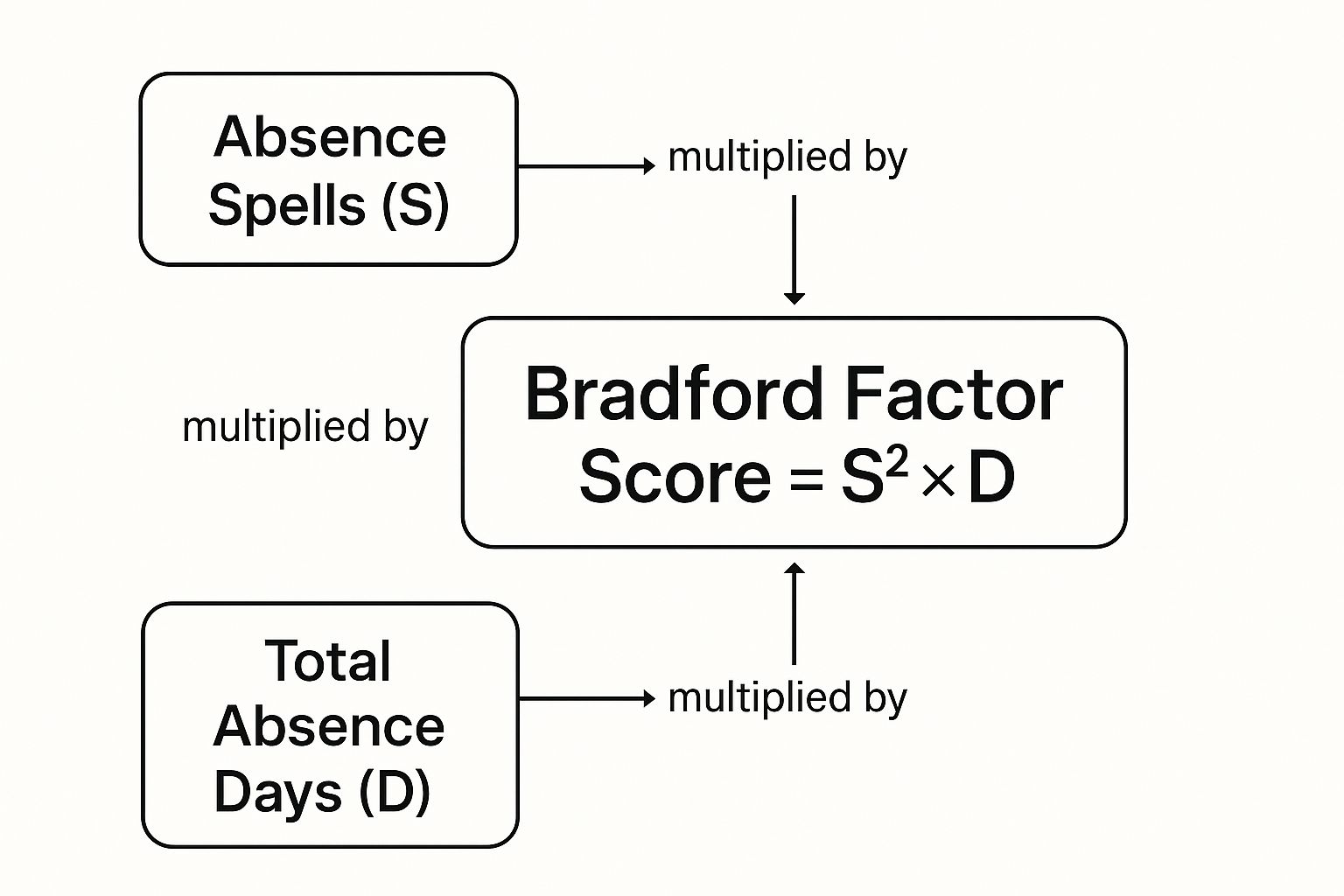
As you can see, while the total days off (D) do contribute to the score, it’s the number of spells (S) that has the most dramatic impact because it's squared.
Let's look at this in action by comparing two employees. Both were absent for a total of 10 days over the year.
Employee A: One Long Absence
This person takes a single, continuous 10-day period of leave to recover from an operation.
- Spells (S) = 1
- Days (D) = 10
- Calculation: 1² x 10 = 10
- Bradford Score = 10
Employee B: Ten Short Absences
This person takes ten separate, individual days off for various minor illnesses throughout the year.
- Spells (S) = 10
- Days (D) = 10
- Calculation: 10² x 10 = 1,000
- Bradford Score = 1,000
The difference is stark. Both employees missed the exact same amount of work, but Employee B’s score is 100 times higher. This accurately reflects the huge disruption their frequent, unpredictable absences caused compared to Employee A’s single, contained period of leave.
This simple calculation gives you an objective, data-driven starting point for a conversation about attendance. If you're looking for an easy way to run these numbers without doing it all by hand, our complete guide to the Bradford Factor score calculator can help you get started quickly and accurately. This ensures you're being fair and consistent when you address potential attendance issues across your team.
Calculating Scores with Real-World Scenarios

Understanding the theory is a great start, but the real magic happens when you see the formula in action. Let's step away from the abstract and walk through a few common workplace scenarios. This is where you'll see just how the Bradford Factor works to turn raw absence data into a genuinely useful score.
For each employee, we'll apply the same formula: Spells (S)² x Total Days (D) = Bradford Score. It's important to remember that a 'spell' is any single, unbroken period of absence, and we'll be looking at a standard rolling 52-week period.
You’ll quickly notice that the final score isn't just a random number. It's a powerful diagnostic tool that shines a light on different attendance patterns and how they might affect your business.
Scenario A: The Employee with a Single, Long Absence
First up is Sarah, a reliable team member who unfortunately gets hit with a nasty case of the flu. She needs a full week to get back on her feet, so she's off for five consecutive days.
- Spells of absence (S): 1 (her illness was one continuous event)
- Total days absent (D): 5
- Her Calculation: 1 x 1 x 5 = 5
Sarah’s Bradford Score is a mere 5 points. This incredibly low score tells an accurate story: while she was away for a week, it was a single, contained event. From a management perspective, this pattern is not disruptive and wouldn't raise any flags.
Scenario B: The Employee with a Few Separate Absences
Now, let's look at David's record over the same 52-week period. He has three separate absences: one day for a migraine, two days for a stomach bug a few months later, and another two-day absence for a family emergency.
- Spells of absence (S): 3
- Total days absent (D): 5 (1 + 2 + 2)
- His Calculation: 3 x 3 x 5 = 45
Even though David was absent for the exact same number of days as Sarah, his score is nine times higher. A score of 45 is still quite low and unlikely to cause concern, but it perfectly shows how the formula begins to penalise multiple instances of absence, reflecting a slightly more disruptive pattern.
Scenario C: The Employee with Frequent, Short Absences
Finally, we have Mark. Throughout the year, he takes five separate, single days off for various minor, unrelated issues.
- Spells of absence (S): 5
- Total days absent (D): 5
- His Calculation: 5 x 5 x 5 = 125
Mark's total time off is identical to Sarah's and David's, yet his Bradford Score skyrockets to 125. This is where you see the core principle of the Bradford Factor in its full effect. Those five separate, unpredictable 'here today, gone tomorrow' absences are considered far more disruptive to planning and operations than one solid block of leave.
A score like this would probably cross a company's first trigger point, prompting a manager to have an informal, supportive chat. It’s a clear signal to investigate the pattern and see what's going on.
These examples make it clear how the score works as a consistent, objective indicator of disruptive absence patterns. For a deeper dive, you can find excellent resources on various Bradford Factor calculations that cover even more complex situations.
Right, let's talk about what happens after you've calculated a Bradford Factor score. On its own, the score is just a number. It doesn't tell you what to do next. To make it truly useful, you need a clear framework that turns that number into a fair, consistent, and supportive management process.
This is exactly where Bradford Factor trigger points come in.
Think of trigger points as pre-agreed thresholds. When an employee's score crosses one of these lines, it prompts a specific, predetermined action from their manager. This structure is brilliant because it removes guesswork and potential bias from managing absence, ensuring every person on your team is treated the same way.
The goal isn't to build a heavy-handed disciplinary system. It's about creating a structured approach that helps managers start conversations at the right time. A low score might not need any action, while a slightly higher one could just be a cue for an informal chat to see if everything is alright.
Creating a Tiered Response System
Most UK organisations that use the Bradford Factor set up a tiered system. Different score ranges trigger different management actions. It's vital to remember these are internal company policies, not legal mandates, and they must always be applied with compassion and a real understanding of individual circumstances.
There's no one-size-fits-all model, but a common structure often looks something like this:
- Low Scores (e.g., 0-50): This is business as usual. These scores represent minor, one-off absences with a low impact on the team and typically require no action.
- Moderate Scores (e.g., 51-200): A score in this range could trigger a friendly, informal conversation. It’s a chance for a manager to check in, ask if there are any underlying problems, and offer support.
- High Scores (e.g., 201-400): This might prompt a more formal discussion. This could lead to a first or verbal warning that gets documented in the employee's file.
- Very High Scores (e.g., 401+): A score this high usually signals a serious pattern of absence. It could result in a final warning or other disciplinary action, depending on the situation and your policies.
The real purpose of a trigger point is to start a conversation, not end one. It's an objective signal that a pattern has emerged, giving managers a fair and consistent reason to engage with an employee and find a supportive path forward.
It's essential to develop your own framework. Our guide on creating effective Bradford Factor trigger points is a great resource that can walk you through setting up a system that fits your business perfectly.
While these aren't legally standardised, many UK businesses have settled on similar tiers. For instance, scores from 51-124 might prompt a verbal warning, and 125-399 could lead to a written one. Higher scores, perhaps from 400-649, might trigger a final written warning, with anything above 650 potentially resulting in dismissal, provided a fair process is followed.
By setting out these trigger points clearly in your absence policy, you create a transparent system for everyone. Your team understands how the Bradford Factor is used and what to expect, which helps build a culture of proactive support instead of just reactive punishment.
Of course. Here is the rewritten section, crafted to sound completely natural and human-written, following all your specified requirements.


