
Understanding Bradford Factor Trigger Points: The Foundation That Changes Everything
Imagine two employees, both absent for 20 days. One takes a single, 20-day block of leave. The other takes 20 separate, one-day absences. Which scenario disrupts your team more? This highlights the core idea behind Bradford Factor trigger points: they address the frequency of absence, not just the total duration.
Think of it like a delayed train. One hour-long delay on a single route is inconvenient, but 60 one-minute delays across different routes create widespread chaos. The total delay time is the same, but the overall impact is dramatically different.
Frequent, short-term absences often create more hidden costs than long-term absences. These costs relate to productivity, team morale, and workflow disruption. A football team can adjust to a player being out for a season with a serious injury. But a player constantly missing practice due to minor issues creates ongoing uncertainty and disrupts the team’s rhythm.

The screenshot above illustrates the Bradford Factor formula (S² × D, where S is the number of absence spells and D is the total days absent) and its emphasis on absence spells. Notice how multiple short absences have an exponential impact on the score. This underscores the importance of managing frequent absences for optimal team efficiency and smooth operations. Discover more insights.
The Bradford Factor has been a tool for measuring employee absenteeism in the UK since its creation. Let's compare: an employee with ten one-day absences in a year has a Bradford Factor score of 1,000. An employee with a single ten-day absence has a score of just 10. This drastic difference highlights the weighting given to frequency. For a deeper dive into calculating these scores, check out our comprehensive guide: Bradford Factor Score Calculator: The Complete Guide to Measuring Employee Attendance.
This focus on frequency is what makes Bradford Factor trigger points so effective. They give you a clear system to identify potentially disruptive absence patterns. This allows you to address these patterns proactively before they snowball into larger problems for your business.
The Psychology Behind Bradford Factor: Why Your Instincts Were Right All Along

Ever noticed how covering for a colleague who's always "calling in sick" feels far more draining than covering for someone on planned leave? There's a real psychological reason for that, and grasping it is key to effectively using Bradford Factor trigger points.
Think of your team as a finely tuned orchestra. When a musician takes a sabbatical, the music might sound a little different, but the orchestra can adapt and continue playing harmoniously.
But what if a musician keeps missing individual rehearsals or performances sporadically? It throws off the entire rhythm, forces last-minute adjustments, and stresses everyone out. That constant disruption is what the Bradford Factor aims to measure. That's why understanding the human impact of unplanned absences is so crucial.
The Ripple Effect of Unpredictable Absences
Studies in workplace psychology show that unpredictable, frequent absences create stress for managers and colleagues in a way that planned absences don't. The administrative headache alone—constantly juggling schedules, reassigning tasks, and finding cover—has a knock-on effect. This impacts team morale, productivity, and even the wellbeing of reliable team members who pick up the slack.
Furthermore, frequent unplanned absences breed uncertainty and resentment, making it tough to build trust and a positive team dynamic. Imagine if one team member constantly takes short, unplanned days off. Others might feel they're shouldering an unfair burden.
Bradford Factor and the Psychology of Disruption
The Bradford Factor's focus on frequency over duration isn't just a mathematical quirk; it reflects decades of workplace research and real-world management experience. By emphasizing the disruptive impact of frequent absences, it helps businesses create a more stable and productive environment.
To illustrate this, let's look at two hypothetical employees with the same total days absent, but different absence patterns:
Let's introduce a table to really drive this point home:
Bradford Factor Score Comparison: Frequent vs. Infrequent Absences
A detailed comparison showing how different absence patterns result in vastly different Bradford Factor scores, demonstrating the formula's effectiveness
| Absence Pattern | Days Absent | Absence Spells | Bradford Score | Disruption Level |
|---|---|---|---|---|
| Frequent Short Absences | 10 | 10 | 100 | High |
| Single Long Absence | 10 | 1 | 10 | Low |
As you can see, even though both employees were absent for the same total duration, the employee with frequent short absences has a significantly higher Bradford Factor score. This highlights how the formula prioritizes the disruptive effect of frequent absences on the workplace. This isn't about punishing employees, but about understanding the overall impact on the team and the organization. Tools like LeaveWizard can help you track and manage these patterns effectively, contributing to a healthier and more productive work environment.
Setting Effective Bradford Factor Thresholds: Finding Your Workplace Sweet Spot
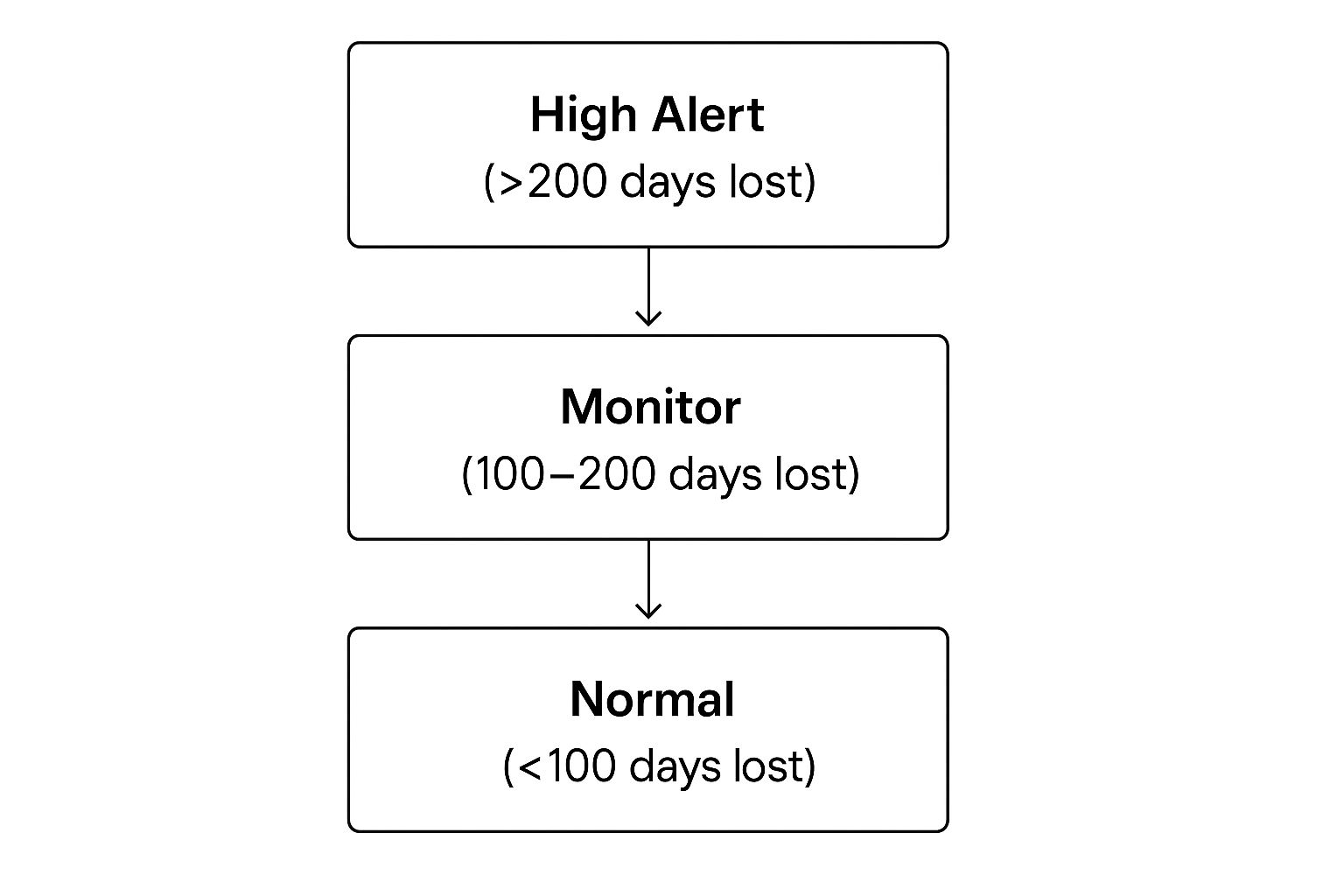
The infographic above gives us a visual guide to understanding Bradford Factor trigger points. It uses a tiered approach, highlighting three levels of concern based on the cumulative days lost due to absence: Normal (less than 100 days), Monitor (between 100 and 200 days), and High Alert (greater than 200 days). Think of it like a traffic light system – green, amber, and red – guiding you towards appropriate interventions.
Getting your Bradford Factor thresholds right is crucial. It's a delicate balancing act. Set them too low, and you risk ongoing absence problems. Set them too high, and employees might feel pressured to come to work even when they're genuinely ill.
Let's say you're comparing a busy restaurant with a design agency. In the restaurant, every absence creates immediate ripples. Customers wait longer, orders get mixed up, and the overall experience suffers. A design agency, on the other hand, has more flexibility. Work can often be rearranged, lessening the immediate impact of individual absences.
This highlights the importance of aligning your trigger points with your operational reality. There's no one-size-fits-all answer. The Bradford Factor plays a key role in UK absence management, but applying it effectively requires understanding the specific context of your business. Generally, Bradford Factor scores are grouped into ranges that suggest certain actions. A score of 0-50 usually requires no action. 51-124 might trigger an informal chat. 125-399 often leads to written warnings. Anything over 400 could result in disciplinary procedures. Discover more insights.
Tailoring Thresholds to Your Industry and Culture
Different industries have different tolerances for absence. Think about a manufacturing plant where safety relies on a full team being present. They'll likely have stricter thresholds than a tech company with flexible schedules and remote work options. Even within the same industry, individual workplaces can vary significantly.
Bradford Factor Calculations can offer valuable guidance. The key isn't simply borrowing someone else's numbers. It's about understanding your own workplace dynamics. What works for one company might not work for another.
Testing and Refining Your Approach
Setting your initial thresholds is just the beginning. Successful UK businesses regularly review and adjust their Bradford Factor trigger points. They seek feedback from both managers and employees, ensuring the system is perceived as fair and effective.
This ongoing refinement helps create a system that balances operational needs with employee well-being. Think of it as a continuous improvement process. By actively engaging with your team and analyzing the impact of your thresholds, you create a system that benefits everyone.
To help illustrate typical actions and responses to different Bradford Factor scores, the following table provides a general guide:
Standard Bradford Factor Trigger Points and Actions
Common threshold ranges used across UK businesses with corresponding management actions and intervention strategies
| Score Range | Typical Action | Management Approach | Documentation Required | Next Steps |
|---|---|---|---|---|
| 0-50 | No Action | None | None | Monitor attendance |
| 51-124 | Informal Discussion | Verbal feedback, explore any underlying issues | Informal notes of the conversation | Monitor attendance, schedule follow-up if necessary |
| 125-399 | Formal Meeting, Written Warning | Written warning, performance improvement plan | Formal written warning, performance improvement plan documentation | Regular review of attendance, potential further disciplinary action |
| 400+ | Disciplinary Action, Potential Dismissal | Investigation, formal disciplinary hearing | Full documentation of the disciplinary process | Potential suspension or dismissal |
This table presents common practices. Remember, each organization will adapt these to fit their unique circumstances. It’s a starting point for crafting a system that works for your specific context. Always consult with HR professionals to ensure compliance with all applicable laws and regulations.
Implementing Bradford Factor Systems: From Spreadsheet to Success Story

Introducing Bradford Factor trigger points is more nuanced than simply presenting new numbers. For successful implementation, your employees need to grasp the reasoning behind the system, not just the rules. Think of it like altering traffic flow in a busy town – you need clear signage, public awareness campaigns, and a good dose of patience.
The most effective HR teams approach this change with the finesse of experienced consultants. They initiate open conversations, explaining how the system fosters fairness and consistency for everyone. This transparency cultivates trust from the outset.
For instance, demonstrating how the system highlights disruptive absence patterns, allowing for early support and intervention, can alleviate employee concerns. Focusing on assistance, not penalties, is vital for acceptance.
Training and Consistency: The Cornerstones of Success
Comprehensive manager training is essential. The system must be applied uniformly, avoiding personal bias or favoritism. This reinforces confidence in the system’s impartiality.
Anticipating questions and addressing potential anxieties head-on is also key. Prepared, thoughtful responses demonstrate that employee concerns are valued. This proactive approach minimizes resistance.
Learning from Real-World Implementations
Let's explore how UK businesses have successfully navigated these systems, gleaning wisdom from both their triumphs and their missteps. These real-world case studies offer valuable lessons.
A frequent pitfall is fixating solely on the numbers, devoid of context. Successful implementations prioritize transparent communication and employee well-being. This comprehensive approach builds trust and fosters a positive environment.
From Pilot Programs to Polished Policies
Pilot programs are incredibly useful, providing an opportunity to test the system and gather feedback before a company-wide launch. This iterative method allows for refinements based on real-world data and experience.
Naturally, some employees might prefer less structured approaches, leading to potential resistance. Addressing these concerns directly and highlighting the advantages for everyone can smooth the transition.
LeaveWizard: Your Partner in Bradford Factor Success
From basic spreadsheets to sophisticated software, selecting the right tools is crucial. LeaveWizard offers a comprehensive solution for managing absence data, calculating Bradford Factor scores, and streamlining your entire absence management process. This automation frees up valuable time for more strategic HR initiatives.
By combining clear communication, thorough training, and effective tools like LeaveWizard, you can transform Bradford Factor theory into a tangible success story within your workplace. This proactive strategy fosters a healthier, more productive environment for everyone.
Bradford Factor in Action: Real Workplace Dilemmas and Smart Solutions
Navigating absence management can be tricky. The Bradford Factor gives us a helpful structure, but real-life situations often call for a more thoughtful approach. Let's look at some common workplace issues and how smart managers use the Bradford Factor as a guide, not a strict set of rules.
The High-Performer with a Chronic Condition
Imagine Jennifer, a top performer whose chronic illness leads to unpredictable flare-ups. Her Bradford Factor score is climbing, but her work is excellent when she's there. How do you balance fairness with compassion? Open communication is key. Talk to Jennifer, explore reasonable adjustments, and consider flexible work options. Documenting these conversations and agreed-upon plans protects both Jennifer and the company. The Bradford Factor highlights the pattern, but your judgment determines the best way forward.
Remember, the Bradford Factor isn't about punishment; it's about understanding.
The Employee with Suspicious Absence Patterns
Now, meet Tom. His frequent absences always seem to land on Mondays or Fridays. He claims each absence is legitimate, but the Bradford Factor raises a red flag. How do you investigate without seeming accusatory? Begin with a casual chat. Express concern, not suspicion. Find out if there are underlying problems contributing to the pattern. Sometimes, a small change to working hours or tasks can make all the difference. Perhaps Tom's workload is overwhelming him at the start and end of the week.
Often, there's a simple solution hidden beneath the surface.
Balancing Consistency and Compassion
These scenarios highlight the importance of balancing consistent application of Bradford Factor trigger points with understanding individual circumstances. Successful companies realize that being inflexible can lead to resentment and even legal problems. Instead, they use the Bradford Factor to start conversations, explore solutions, and offer support.
It's about building a supportive environment, not policing attendance.
When the System Reveals Hidden Problems
The Bradford Factor can sometimes uncover patterns that might otherwise go unnoticed. Maybe an employee's increasing absences point to a developing mental health concern or a difficult family situation. By spotting these patterns early, managers can step in with support and resources before things get worse.
Think of the Bradford Factor as an early warning system, not a disciplinary tool.
Real-World Examples, Real-World Solutions
These aren't made-up scenarios; they reflect the everyday challenges faced by HR professionals and managers. By learning from these examples and using good judgment, you can use Bradford Factor trigger points to build a fairer, more supportive, and ultimately more productive workplace. The key takeaway? Use the system as a conversation starter, not a disciplinary endpoint. Moving from manual tracking to automated systems often involves analyzing existing data. If you're using Microsoft Excel, consider exploring proven methods for data analysis in Excel. This can help you transition smoothly and make the most of your absence data.
Common Pitfalls and How to Avoid Them: Learning from Hard-Won Experience
Even with the best of intentions, Bradford Factor trigger points can sometimes do more harm than good. One common mistake is treating the Bradford Factor like a disciplinary robot instead of a helpful management tool. Companies that focus only on the numbers, ignoring the individual circumstances behind absences, can face discrimination claims, lose valuable employees, and create a culture of fear rather than accountability.
Let's say an employee has a chronic illness requiring frequent, short hospital visits. A rigid Bradford Factor system might flag them for disciplinary action, even if their work is excellent. This is where the human touch becomes crucial.
Navigating the Legal Landscape
Poorly implemented systems can be a legal minefield, especially regarding disability discrimination and reasonable adjustments. Some companies have found themselves in employment tribunals, discovering their Bradford Factor policies didn't hold up under scrutiny. It's essential to ensure your policies align with UK employment law. Properly conducted workplace investigations are crucial when facing potential disciplinary issues, ensuring a legal and effective process.
Consider an employee whose disability requires regular medical appointments. Ignoring these needs while rigidly applying the Bradford Factor could be discriminatory. Flexibility and individual consideration are key.
The Importance of Consistent Application
Inconsistent application is another common pitfall. When managers apply the system differently based on personal biases, the whole system loses credibility. Successful organizations maintain consistency while still allowing for managerial judgment. Documenting these decisions protects both the employee and the company, building trust and ensuring fair treatment.
For instance, imagine a manager who overlooks absences for favored team members but strictly enforces the Bradford Factor for others. This creates an environment of perceived unfairness.
Communicating Effectively
Communication failures can turn a helpful tool into a source of workplace anxiety. Transparency is important, but it shouldn't create unnecessary stress for employees taking legitimate time off. Regular communication and open dialogue prevent misunderstandings and foster a supportive culture. Think of it like regular health check-ups: proactive communication prevents small issues from becoming big problems.
Picture a new employee who isn't sure how the Bradford Factor works. Their anxiety about taking time off, even for valid reasons, could affect their performance and morale. Clear, empathetic communication can prevent this unnecessary worry.
Maximizing Success: Best Practices for Long-Term Implementation
Setting up a Bradford Factor system isn't a one-time deal. It's an ongoing process that requires attention and care, much like tending a garden. Truly successful companies understand this and cultivate their systems for long-term effectiveness.
Regular Review and Refinement
Think of your Bradford Factor trigger points as living guidelines. Successful companies regularly review these thresholds, checking if they still fit their evolving business needs. It's not about constantly shifting the goalposts, but rather ensuring the system remains relevant and fair.
Imagine a company embracing flexible working. Their existing trigger points might need adjusting to reflect this new way of working. Regular reviews prevent the system from becoming outdated and, frankly, unhelpful.
Furthermore, feedback from both managers and employees is invaluable. Managers can offer insights into the system's practicality, while employees provide crucial perspectives on fairness. This open dialogue builds trust and ensures everyone's on board. One common pitfall is misinterpreting the reasons behind absences; check out these absence management strategies for a deeper understanding.
Adapting to Change and Staying Compliant
UK employment law is a dynamic landscape. Staying informed about changes is crucial. Your policies need to adapt to these updates, guaranteeing compliance and protecting both your employees and the organization. This proactive approach avoids potential legal headaches and ensures a fair and transparent process. You might also be interested in exploring the latest trends: Top 10 Leave Management Systems for 2025.
Leveraging Technology for Enhanced Insights
Technology can be a powerful ally. Modern HR software, like LeaveWizard, offers automated Bradford Factor calculations, real-time absence tracking, and insightful reporting. This automation frees HR professionals from tedious tasks, allowing them to focus on more strategic initiatives, such as supporting employee well-being and fostering a positive workplace culture.
Communication and Employee Buy-In
Clear and consistent communication is the cornerstone of long-term success. Keeping employees in the loop about policy adjustments, explaining the "why" behind changes, and addressing concerns openly build a foundation of transparency and trust. This open communication reinforces the system's fairness and maintains employee buy-in, even as your organization grows and changes.
Beyond Discipline: Using Data for Positive Change
Finally, the most successful organizations see Bradford Factor data as more than just a disciplinary tool. They recognize its potential to identify training needs, address workload imbalances, and promote employee well-being. By using the data proactively, companies can create a more supportive and productive environment for everyone. This positive approach transforms the Bradford Factor from a stick to a valuable tool for continuous improvement.
Ready to streamline your absence management and empower your workforce? Explore how LeaveWizard can help you build a fairer, more supportive, and ultimately more productive workplace. Visit LeaveWizard today!


