
Statutory Maternity Pay, or SMP, isn't just a company perk or a nice-to-have benefit. It's a legal requirement, a crucial financial safety net to support you when you take time off to have a baby. Think of it as your right to a protected income, paid directly through your employer's payroll just like your regular salary.
Understanding Your Maternity Pay Entitlement
So, what does Statutory Maternity Pay look like in the real world? It's a support system designed to give new mothers a steady income. This isn't a benefit you have to apply for from the government; your employer handles it all. They'll pay it to you on your usual payday, with tax and National Insurance deducted just as they always are.
At its core, SMP exists to allow mothers the time they need to recover from childbirth and bond with their newborn, without the stress of losing their entire income. It’s a cornerstone of UK employment law, recognising just how important this life-changing event is.
The Two-Phase Payment Structure
SMP is cleverly structured in two parts. The idea is to give you a higher level of support right after the birth, which then settles into a standard rate for the rest of your paid leave. This tapering approach is designed to be straightforward for both you and your employer.
Let's take a look at the essential features of SMP to get a clearer picture.
Key Features of Statutory Maternity Pay (SMP)
| Feature | Description |
|---|---|
| Duration | Paid for up to 39 weeks in total. |
| Eligibility | Depends on length of service and average earnings. |
| Payment Method | Paid by your employer through regular payroll. |
| Tax & NI | Tax and National Insurance are deducted as normal. |
| Purpose | To provide financial support during maternity leave. |
This table gives you a quick overview, but the payment rates are where the two-phase structure really comes into play.
In total, you can receive SMP for up to 39 weeks. Here’s how it breaks down:
- The first 6 weeks: You'll get 90% of your average weekly earnings (before tax). There’s no upper cap on this amount, giving you the maximum financial support when you need it most.
- The next 33 weeks: You'll receive either a standard weekly rate set by the government each year, or 90% of your average weekly earnings—whichever is lower.
This two-tier system is the heart of how SMP works. That initial higher-rate period is there to help with the immediate costs and adjustments of a new baby, while the second phase provides a consistent, predictable income you can plan around. Getting your head around this structure is the first step to budgeting effectively for your maternity leave.
While SMP covers a huge chunk of your time off, remember that the full maternity leave entitlement is 52 weeks. This means the final 13 weeks are usually unpaid, unless your company offers a more generous contractual maternity scheme. It's always worth checking your contract for those details. You can find more official information on how SMP is worked out to see the finer points.
Who Qualifies for Statutory Maternity Pay

Figuring out if you qualify for Statutory Maternity Pay (SMP) can feel a bit like navigating a maze. But don't worry, it really just boils down to meeting a few clear conditions. These rules are in place to make sure SMP supports employees who have a consistent work history leading up to their maternity leave.
To get SMP, there are two main hoops to jump through: one is about how long you've worked for your employer, and the other is about how much you earn. Think of them as two keys you need to unlock your entitlement. Let's break down exactly what they mean.
The Continuous Employment Rule
The first and most important test is all about your length of service. This is the real cornerstone of qualifying for SMP.
To be eligible, you must have been working for your current employer continuously for at least 26 weeks up to the 'qualifying week'. This qualifying week is a key date—it’s the 15th week before your baby’s expected due date. In simple terms, this means you need to have been on the payroll for about six months before you hit that crucial point in your pregnancy.
This rule is there to establish a solid employment relationship. It ensures that SMP goes to employees with a proven track record, not someone who has only just started.
For example, if your qualifying week falls in the first week of December, you must have started your job no later than the middle of May that same year.
The term 'continuous employment' is critical. Even a short break in your contract could reset the clock, so it’s always a good idea to double-check your official start date to make sure there are no gaps that could trip you up.
This is a hard deadline. Being even one day short of the 26-week requirement can unfortunately mean you don't qualify for SMP.
The Minimum Earnings Threshold
Alongside the service rule, there's also an earnings test. This is to ensure SMP is paid to people who have been contributing to National Insurance.
To qualify, your average weekly earnings during a specific eight-week 'relevant period' (just before your qualifying week) must be at least the lower earnings limit for National Insurance contributions. This figure is updated by the government every tax year, so it's worth checking the current rate.
The whole point of this rule is to link SMP to a minimum level of economic activity. It just confirms you've been earning enough to be part of the National Insurance system, which is what funds these statutory payments in the first place.
If your hours are variable or your pay goes up and down, this eight-week period is particularly important. Your employer will calculate your average earnings based on what you were actually paid during that specific window to see if you meet the threshold.
Common Scenarios and Special Cases
Eligibility isn't always a straightforward tick-box exercise, especially if you don't work a typical 9-to-5. Here’s how the rules apply in a few common situations:
- Part-Time Workers: As long as you meet the 26-week continuous employment rule and your average earnings are above the lower earnings limit, you are absolutely eligible for SMP. Being part-time doesn’t disqualify you.
- Agency Workers: You can still qualify for SMP as an agency worker if you meet the criteria. For SMP purposes, the agency that pays your wages is considered your employer.
- Zero-Hours Contracts: It's a common myth that you can't get SMP on a zero-hours contract, but you can. The key is whether you have worked continuously for 26 weeks and if your average earnings in the relevant period meet the minimum threshold.
It’s also important to remember that SMP is just the legal minimum. Many employers offer more generous schemes, often called 'enhanced' or 'occupational' maternity pay. You can learn more by understanding occupational maternity pay and your complete guide to enhanced benefits, as this could mean a higher income during your leave. Always check your employment contract to see what your own company offers.
How Your Statutory Maternity Pay Is Calculated
Figuring out the maths behind Statutory Maternity Pay (SMP) is the key to planning your finances for your leave. It can look a bit complicated at first glance, but it all boils down to one crucial figure: your Average Weekly Earnings (AWE).
This isn't some random number pulled from your entire work history. Instead, your AWE is based on a specific snapshot of your earnings during what’s called the 'relevant period'. Think of it as an eight-week window that ends in your 'qualifying week'—that’s the 15th week before your baby is due.
Let's walk through how to find this period and calculate the AWE that will determine what you get paid for the full 39 weeks.
Identifying Your Relevant Period
First things first, you need to pinpoint the exact dates of your relevant period. The calculation changes slightly depending on how often you get paid, but the principle is the same.
For most employees, it’s a simple process:
- Find your qualifying week: Count 15 weeks back from the week your baby is due to arrive.
- Find the end date: The relevant period finishes on the last normal payday that falls on or before the Saturday of your qualifying week.
- Find the start date: The period begins the day after your last normal payday that was at least eight weeks before that end date.
Essentially, your employer is looking at the gross pay you received (that's before tax and National Insurance) during this specific two-month window to work out your average.
This method ensures your SMP is a fair reflection of your recent, typical earnings just before you go on leave. It smooths out any small ups and downs in your pay and gives a solid baseline for the calculation.
Getting these dates right is the foundation of an accurate SMP payment. Once that’s sorted, we can work out the average itself.
Calculating Your Average Weekly Earnings
With the relevant period locked in, calculating your AWE is just a bit of simple arithmetic. The whole point is to figure out what you earned on average each week during those eight weeks.
If you’re paid monthly, your employer will:
- Add together the total gross earnings from the two payslips that fall within the relevant period.
- Divide this by two to get an average monthly figure.
- Multiply that by 12 to get an annual figure.
- Finally, divide the annual figure by 52 to land on your Average Weekly Earnings.
If you’re paid weekly, it’s even more straightforward. Your employer will just add up the gross pay from the eight weekly payslips in the relevant period and divide the total by eight. Simple as that. This average figure is then used to work out what you’ll be paid during the two different stages of SMP.
How AWE Translates into Your Payments
Your AWE is the magic number that directly determines what lands in your bank account for the next 39 weeks. As we've mentioned, SMP is paid in two distinct stages.
Stage 1: The First Six Weeks
For the first six weeks of your maternity leave, you’ll receive 90% of your calculated Average Weekly Earnings. There's no upper cap on this, so it’s a direct reflection of your recent income.
- Example: If your AWE works out to be £500, your SMP for the first six weeks will be £450 per week (£500 x 0.90).
Stage 2: The Following 33 Weeks
After those initial six weeks are up, the payment structure changes. For the next 33 weeks, you'll get one of two amounts:
- The standard weekly statutory rate set by the government (this changes every tax year).
- 90% of your Average Weekly Earnings.
You’ll be paid whichever of these two figures is lower. This is a really important detail to remember. And while this is the legal minimum for SMP, don’t forget about other leave entitlements. Many new parents find it helpful to understand how to calculate annual leave that they continue to build up during their time off.
Let's look at how this plays out in a couple of examples.
SMP Calculation Examples Based on Average Weekly Earnings (AWE)
This table shows how the two-tier payment structure works in practice, based on different weekly earnings. Notice how the payment for the final 33 weeks changes depending on whether 90% of your earnings is higher or lower than the standard rate.
| Average Weekly Earnings (AWE) | Payment for First 6 Weeks (per week) | Payment for Remaining 33 Weeks (per week) |
|---|---|---|
| £600 | £540 (90% of £600) | £184.03 (The lower of £540 and the standard rate) |
| £350 | £315 (90% of £350) | £184.03 (The lower of £315 and the standard rate) |
| £180 | £162 (90% of £180) | £162 (The lower of £162 and the standard rate) |
Note: The standard rate used in the table is £184.03 for the 2024/25 tax year. This figure is reviewed annually.
As you can see, for most people, the payment for the final 33 weeks defaults to the standard statutory rate. But for those on lower incomes, the 90% rule ensures their maternity pay isn't more than what they’d normally earn. It’s a system designed to be fair and balanced.
By getting a handle on how your AWE is calculated, you can accurately forecast your income and budget properly for a financially secure maternity leave.
Understanding the SMP Timeline and Key Deadlines
Getting your head around the timeline for Statutory Maternity Pay (SMP) is a must for both expecting employees and their employers. When you're preparing for a baby, the last thing you need is stress caused by a missed deadline. Think of the SMP timeline as a simple roadmap with a few key milestones – hitting them ensures everything runs smoothly, from your first request to your final payment.
This isn't just about ticking boxes and filling out forms; it's about making sure communication is crystal clear. Sticking to the official deadlines gives your employer everything they need to process your pay correctly and on time. That way, you can focus on the exciting part: getting ready for your new arrival.
The Earliest You Can Start Your Leave
You might be surprised to learn how early you can kick off your maternity leave and SMP payments. The official starting block is the 11th week before your baby's expected due date.
Of course, you have plenty of flexibility here. Many mums-to-be prefer to work a bit closer to their due date, and you can choose to start your leave on any day you like after that 11-week point. The only real exception is if your baby decides to make an early appearance – in that case, your leave and pay automatically begin the day after the birth.
Giving Notice: The 15th Week Rule
If there's one date to circle on your calendar, this is it. The most critical deadline is the end of the 15th week before your baby is due. This is what's known as the 'qualifying week', and it’s the final cut-off for letting your employer know your plans.
By this date, you need to have told your employer three key things:
- That you are pregnant.
- Your baby's expected due date.
- The date you want your maternity leave to begin.
To get the ball rolling on your statutory maternity pay, you'll usually submit a formal request. Using something like a Parental Leave Request Form Template is a great way to formalise your intentions and kickstart the whole process on their end.
It's always best to put this notice in writing. It gives both you and your employer a clear record, preventing any mix-ups or confusion about when you plan to start your leave.
Once you’ve submitted your notice, the clock starts ticking for your employer. They have 28 days to get back to you, confirming whether you're eligible and spelling out the start and end dates of your SMP. This response is a crucial part of their legal responsibility.
Submitting Your MATB1 Certificate
The final piece of the puzzle is your proof of pregnancy, which comes in the form of a MATB1 certificate. This is a simple medical certificate that your midwife or doctor will give you, usually sometime after you've had your 20-week scan.
You have to give this certificate to your employer to get your SMP. You don't need it right when you first give notice, but it's a good idea to hand it over as soon as you get it. This helps avoid any hold-ups with your payments.
This timeline infographic helps visualise how the standard 39-week SMP payment structure works.
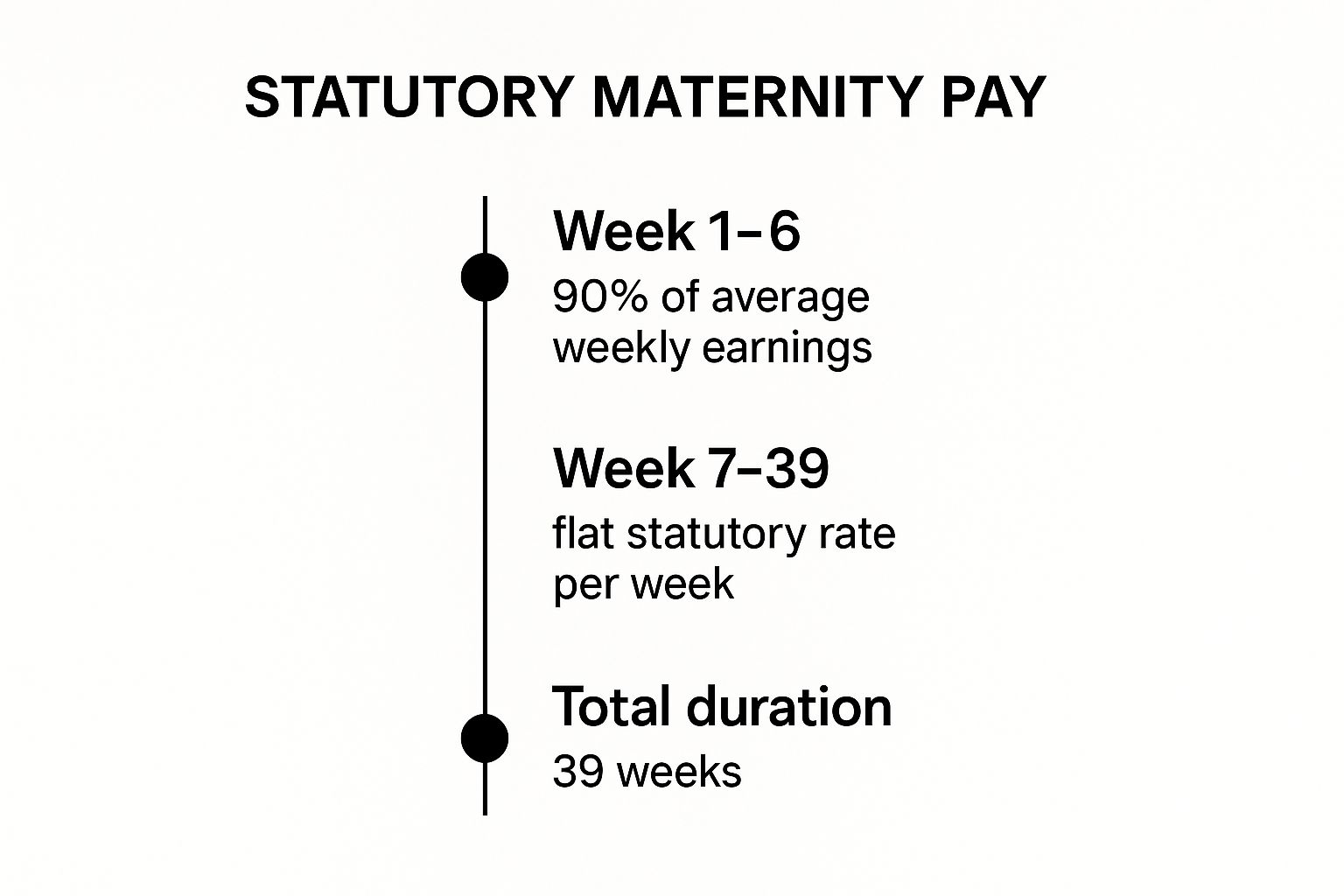
As you can see, it's a two-stage system. You get a higher rate for the first few weeks, followed by a longer period at the standard rate.
Employer Responsibilities for Handling SMP
For any employer, managing Statutory Maternity Pay (SMP) is much more than a simple payroll task. It's a legal responsibility that supports your team members during one of the biggest moments of their lives. Getting it right ensures you stay compliant, builds goodwill, and cements your reputation as a supportive place to work.
At its core, your duty is to process SMP payments accurately through your usual payroll. Think of it as a temporary, regulated salary—it needs to be paid on the employee's normal payday, with the correct income tax and National Insurance (NI) contributions deducted just like any other wage.
Beyond the payments themselves, you’re also required to keep meticulous records for at least three years after the end of the tax year they relate to. This paperwork is your proof of compliance if HMRC ever comes knocking.
Processing Payments and Deductions
The first step is always to confirm if your employee is actually eligible for SMP. Once they’ve given you their notice and the MATB1 certificate, the clock starts ticking: you have 28 days to write to them, confirming they qualify and spelling out the start and end dates of their payments.
What if they aren't eligible? You must give them an SMP1 form within seven days of making that decision. This form is vital. It explains why they don't qualify and is the key they need to potentially claim Maternity Allowance directly from the government instead.
Correctly calculating and deducting tax and NI is a non-negotiable part of the process. Most modern payroll software handles this automatically, but it’s crucial to double-check that it's set up correctly for statutory payments. It's also wise to stay on top of your broader tax duties; seeking professional guidance on payroll tax obligations can save a lot of headaches down the line.
The SMP Reclaim Process
A common worry for business owners, especially those running smaller companies, is the hit to cash flow from paying SMP. The good news is that the government has a straightforward system to help you manage this cost. Employers can reclaim a huge chunk—and sometimes more than they paid out—directly from HMRC.
This isn't some complicated grant application. You simply deduct the amount you're reclaiming from the total PAYE bill (that’s tax and National Insurance) you owe to HMRC in your regular payroll submission. It’s a clean, direct way to manage your finances while fulfilling your duties.
How much you can reclaim hinges on the size of your business:
- Larger Employers can get back 92% of the SMP they pay. You fall into this category if your total employer and employee Class 1 National Insurance contributions were over £45,000 in the last tax year.
- Smaller Employers can reclaim 103% of their SMP payments. That extra 3% is a bonus from the Small Employers' Relief scheme, designed to give an extra boost to businesses with NI contributions of £45,000 or less.
This reclaim system is fundamental to how statutory maternity pay works, ensuring the financial weight doesn't just sit on the employer's shoulders.
You can think of the reclaim mechanism as turning employers into administrators of a government-funded scheme. By paying SMP upfront and clawing it back, you're the crucial link that ensures your employee gets their money on time.
If you're worried that your SMP payments will be more than your entire PAYE bill for the month, you can even apply to HMRC for funding in advance. This ensures even the smallest businesses can support their team without running into cash flow problems.
Frequently Asked Questions About SMP
Even when you've got a handle on the basics, real life often throws a few curveballs. Questions about Statutory Maternity Pay can pop up when you least expect them, especially when things like changing jobs, getting a bonus, or thinking about your pension come into play.
This section tackles the most common queries we hear from both employees and employers. We’ll give you clear, straightforward answers to cut through the confusion and help you manage the finer points of maternity leave and pay with confidence.
Can I Get SMP if I Change Jobs?
This is a classic question, and the answer is all about timing. Your eligibility for SMP is locked into your continuous service with one specific employer right up to the 'qualifying week'—that's the 15th week before your baby is due.
If you leave your job before hitting this crucial qualifying week, you unfortunately break your continuous service. This means you won't meet the 26-week employment rule with your new company, so neither your old nor your new employer has to pay you SMP.
However, if you hand in your notice after your qualifying week, your previous employer is still legally on the hook to pay your full SMP entitlement. This is true even if you have no intention of returning to work for them once your maternity leave is over.
The key takeaway? Your SMP entitlement is fixed with the employer you were with during your qualifying week. As long as you met all the conditions at that point, that right to SMP stays with you.
What Happens if I Get a Pay Rise or Bonus?
How a pay rise or bonus impacts your SMP depends entirely on when it lands in your bank account. Your Average Weekly Earnings (AWE) are calculated based on a very specific eight-week 'relevant period' just before your qualifying week.
- If a bonus or pay rise is paid during this eight-week period: Great news! It gets included in your AWE calculation. This can give your SMP a nice boost, especially for the first six weeks, which are paid at 90% of your AWE.
- If a pay rise is awarded before but paid after the relevant period: The rules are on your side. For any pay rise awarded between the start of the relevant period and the end of your maternity leave, your SMP has to be recalculated and backdated. This applies even if the pay rise took effect after your SMP had already started.
- If a bonus is paid outside the relevant period: It usually won't affect your SMP. Because it falls outside that specific calculation window, it isn’t factored into your average earnings.
How Does SMP Affect My Pension Contributions?
Your pension is a vital part of your financial future, and thankfully, it's well-protected while you're on maternity leave. As long as you're receiving SMP, your employer must continue making their usual pension contributions.
Here’s the important bit: your employer’s contributions must be based on your normal salary, not the lower SMP amount you're actually receiving. This ensures your pension pot keeps growing just as it would if you were working.
Your own contributions, on the other hand, are based on the pay you actually get. This means your personal pension payments will be lower while you're on SMP, simply because your income is reduced. Some people choose to make extra voluntary contributions later to make up the difference, but you're not required to.
Do I Still Build Up Holiday Entitlement on Maternity Leave?
Yes, you absolutely do. This is a crucial point that many people miss. Your statutory holiday entitlement continues to build up throughout your entire maternity leave, even during any unpaid portion at the end.
This means you’ll return to work with a healthy bank of annual leave to use. Many new parents use this accrued holiday to extend their time at home with their baby, tacking it onto the end of their maternity leave before they officially head back to the office. Understanding what is accumulated holiday and discovering your benefits is key to planning your return smartly.
For instance, an employee on a full year of maternity leave would still rack up their full 5.6 weeks of statutory holiday (that’s 28 days for someone working full-time).
Can My Employer Pay Me More Than the Statutory Rate?
Yes, and many companies do. Any pay that goes above and beyond the legal minimum SMP is called Occupational Maternity Pay (OMP) or sometimes 'enhanced maternity pay'. It's a contractual benefit that businesses offer to attract and keep great people.
OMP schemes can vary wildly from one company to the next. Some might offer full pay for a few weeks, while others might give you half-pay for a longer stretch.
There are a few things to keep in mind with OMP:
- It's completely up to the employer and has to be written down in your employment contract or company handbook.
- It often comes with strings attached. For example, you might have to return to work for a minimum period after your leave. If you decide not to go back, you may have to repay the 'enhanced' part of your pay (but never the SMP portion).
- Your employer still reclaims the SMP element from HMRC; they just cover the cost of the extra top-up themselves.
The only way to know for sure is to check your contract and company policies to see what, if any, enhanced package your employer offers.


