
In the UK, nearly every single person in a job is legally entitled to 5.6 weeks of paid annual leave each year. This isn't a perk or a bonus; it's a fundamental right that kicks in from your very first day on the job, whether you're a full-time employee, an agency worker, or on a zero-hour contract.
What Is Your Core Holiday Entitlement

Let's break down what "statutory holiday entitlement" really means. Think of it as a mandatory "holiday pot" that every worker can draw from, making sure they get paid time off to rest and recharge. It’s a core protection for employee wellbeing, and no employer can legally sidestep it.
The magic number is 5.6 weeks. For someone working a standard five-day week, this works out neatly as 28 days of paid holiday per year (5 days × 5.6 weeks = 28 days). It’s important to remember this is the legal minimum—many companies offer more generous leave as part of their benefits package to attract and retain talent.
A quick look at the numbers for different work patterns gives a clearer picture.
UK Statutory Holiday Entitlement At a Glance
Here’s a simple table to show how the 5.6-week rule translates into actual days off for different working schedules.
| Working Pattern | Calculation | Minimum Annual Leave Days |
|---|---|---|
| 5 days a week | 5.6 weeks x 5 days | 28 days |
| 4 days a week | 5.6 weeks x 4 days | 22.4 days |
| 3 days a week | 5.6 weeks x 3 days | 16.8 days |
| 2 days a week | 5.6 weeks x 2 days | 11.2 days |
| 1 day a week | 5.6 weeks x 1 day | 5.6 days |
As you can see, the entitlement is proportional. It’s all about ensuring fairness, regardless of how many days a week someone works.
The Role of Bank Holidays
One of the biggest points of confusion for both employers and employees is how bank holidays fit into all this. Are they extra days off? The short answer is: it depends on your contract.
An employer can choose to include the eight bank holidays as part of the statutory 28-day entitlement. For example, your contract might say you get "28 days of annual leave, inclusive of bank holidays." This means when a bank holiday comes around, a day is simply taken from your total holiday allowance.
On the other hand, a more generous contract might offer "20 days plus bank holidays." In this case, you get your 20 days to book whenever you like, plus the bank holidays are given as additional paid days off.
Your employment contract is the ultimate source of truth here. It must clearly spell out how bank holidays are treated. If the contract is silent on the matter, you'll need to use one of your holiday days if you want to take a bank holiday off.
How Entitlement Builds Over Time
Holiday entitlement starts building—or accruing—from the moment an employee begins their job. For a full-time employee, this works out at a rate of about 2.33 days per month. This system is especially relevant during the first year of employment.
It means a new starter doesn't get their full 28 days on day one. Instead, they earn it progressively throughout the year. For more on how recent holiday pay reforms might affect this, it’s worth checking the latest guidance from sources like Armstrong Watson.
Once you've got your head around the basic 5.6-week rule and the role of the employment contract, you're in a much better position to handle the trickier situations. From here, we can dive into how these rules apply to part-time workers, staff with irregular hours, and other non-standard working patterns.
Calculating Leave for Different Work Patterns
Applying the foundational 5.6-week rule is a piece of cake for a standard full-time, Monday-to-Friday employee. But let’s be honest, the modern workplace is a lot more varied than that.
From part-time staff and shift workers to those on zero-hours contracts, getting the holiday entitlement right is crucial for staying compliant. Let's break down how to handle the calculations for each scenario, step by step.
This flow chart gives a great visual overview of the process for figuring out leave based on an employee's schedule.
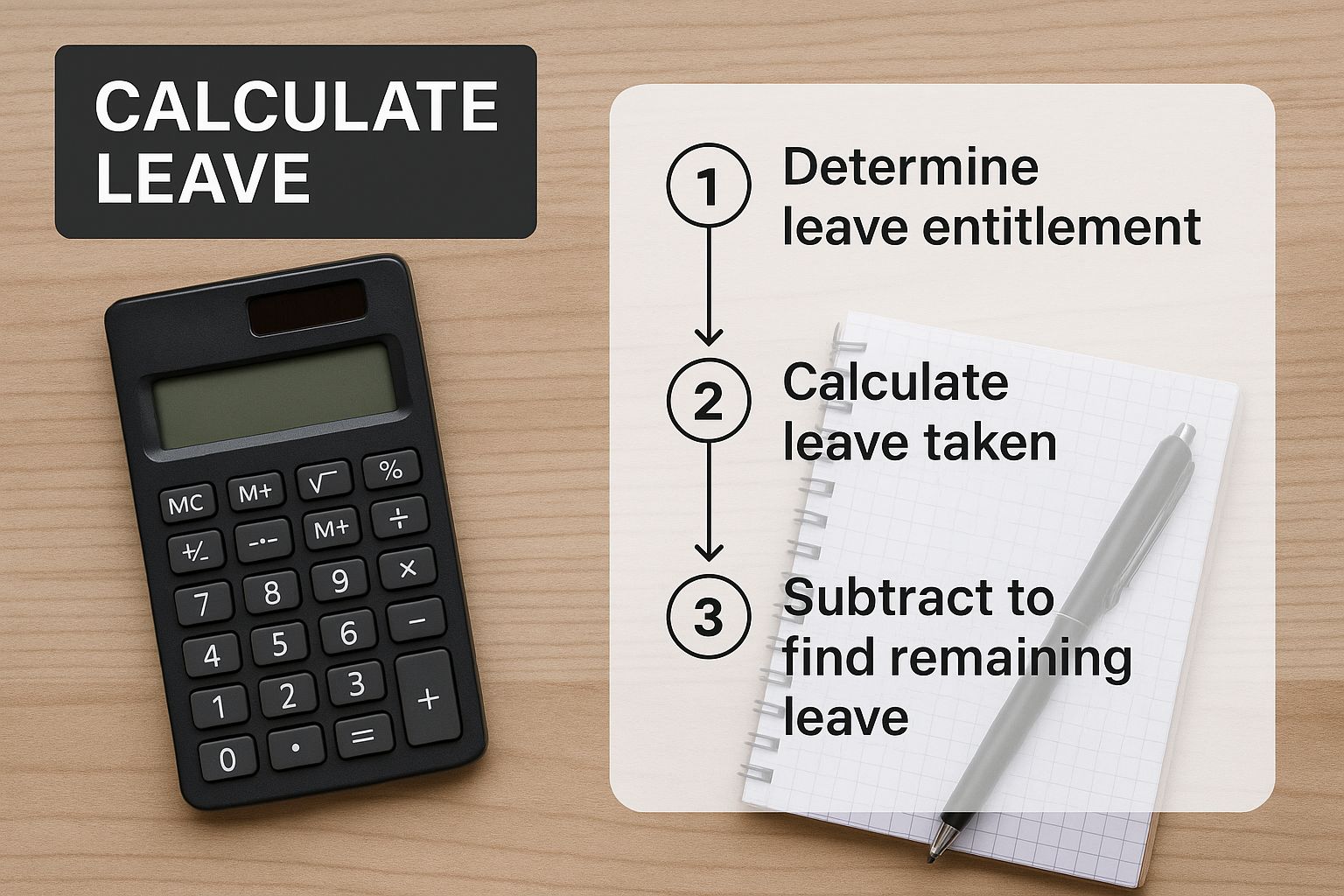
The main takeaway here? The calculation method has to fit the work pattern. This ensures every single employee gets their fair, proportional entitlement, no matter how they work.
Calculating for Part-Time Employees
When you have part-time employees working a set number of days each week, the maths is just a straightforward pro-rata adjustment. You simply multiply the number of days they work per week by the statutory 5.6 weeks. This keeps their holiday pot directly in proportion to their working time.
Here's how it looks in the real world.
Example: A Part-Time Retail Assistant
- Maria works 3 fixed days per week.
- The calculation is: 3 days × 5.6 weeks = 16.8 days of paid annual leave.
It’s pretty common for employers to round this figure up to the nearest half or full day (say, to 17 days), because managing part-days off can be a headache. Just remember, rounding down is illegal.
Handling Staff with Irregular or Variable Hours
Things get a bit more nuanced for employees whose hours fluctuate, like casual staff or those on zero-hours contracts. For these workers, you can't base holiday on a fixed number of days. Instead, their entitlement accrues based on the hours they actually work.
The go-to method for this is the 12.07% accrual system. This percentage isn't just a random number; it's derived directly from the statutory holiday rules.
The Maths Behind 12.07%: A standard year has 52 weeks. Take away the 5.6 weeks of statutory holiday, and you're left with 46.4 working weeks. To figure out holiday as a percentage of working time, you calculate (5.6 weeks ÷ 46.4 weeks) × 100, which gives you 12.07%.
This means for every single hour an employee on irregular hours works, they earn 12.07% of that hour as paid holiday. Let's put it into practice.
Example: A Zero-Hours Contract Barista
- Alex works 80 hours in a month.
- To calculate his holiday accrual for that month, you multiply his hours by the percentage: 80 hours × 12.07% = 9.656 hours of paid leave.
You'd typically do this calculation at the end of each pay period (weekly or monthly) and add the accrued time to the employee's "holiday pot" for them to use later.
Calculating for Shift Workers
Shift workers often have complex rotas that don't fit into a neat five-day week. Their entitlement is still 5.6 weeks, but it's usually far more practical to calculate it in hours rather than days. This neatly accommodates all the different shift lengths.
To do this, you first need to figure out the average number of hours worked per week over a typical rota cycle (the law uses a 52-week reference period for this now). Then, just multiply that average by 5.6.
- Step 1: Calculate the average weekly hours over a representative period.
- Step 2: Multiply those average weekly hours by 5.6.
Example: A Care Worker on a Rota
- Ben works a pattern of four 12-hour shifts one week, then three 12-hour shifts the next. Over two weeks, he works 84 hours, which averages out to 42 hours per week.
- His total annual holiday entitlement in hours is: 42 hours × 5.6 weeks = 235.2 hours.
Now, when Ben books a 12-hour shift off as holiday, 12 hours simply gets deducted from his total allowance of 235.2 hours. This system keeps everything fair, regardless of whether he's taking a long or short shift off.
If you find yourself managing complex rotas and calculations, our guide on how to determine annual leave entitlement might be just what you need.
How Bank Holidays Affect Your Annual Leave

Here’s a question that catches a lot of people out: are bank holidays a guaranteed paid day off for everyone? The answer, surprisingly, is no. In the UK, there's no automatic legal right for an employee to have a paid day off just because it's a bank holiday.
So, who decides? It all comes down to the employment contract. This single document is the ultimate authority, spelling out whether bank holidays are included within the minimum 5.6 weeks of statutory leave or if they’re an extra perk on top.
Getting to grips with the specific wording in your contract is the only way to avoid confusion and make sure everyone is on the same page.
Inclusive vs Exclusive Holiday Clauses
Employment contracts usually handle bank holidays in one of two ways. The phrasing can seem like a small detail, but it makes a big difference to your total time off. It's crucial to know which camp you fall into.
Let's break down the two most common approaches:
- "28 days inclusive of bank holidays": This means your total paid time off for the year is 28 days (for a full-time worker). When a bank holiday comes around and you take the day off, it's simply deducted from this 28-day pot. You’re using one of your allocated holiday days to cover it.
- "20 days plus bank holidays": This is a much more generous setup. You get 20 days of annual leave to book whenever you like, and the bank holidays are given as additional paid days off. This brings your total paid leave to at least 28 days, and sometimes more if an extra bank holiday is declared.
This contractual detail is often the source of workplace disagreements. Having a clear, well-written policy is an employer’s best friend for managing expectations and preventing headaches down the line.
The core takeaway is that the law provides a minimum entitlement of 5.6 weeks paid leave. It doesn't legislate how bank holidays must be treated within that framework; it leaves that detail to the agreement between the employer and employee.
What If You Have to Work on a Bank Holiday?
Given there's no automatic right to have bank holidays off, many people in sectors like retail, hospitality, and healthcare are expected to work. What happens then? Once again, it all goes back to the contract.
If your contract states you get "28 days inclusive of bank holidays" and you end up working on one, that day simply stays in your holiday pot. You haven't lost it; you’ve just deferred it to take at another time.
It’s also a common myth that employers must offer extra pay—like "time and a half"—for working on a public holiday. Unless your contract specifically says so, there's no legal requirement for this. The only firm obligation is to ensure you receive your full statutory leave entitlement over the year.
The Impact of Your Holiday Year
The timing of your company's holiday year can also throw a spanner in the works, especially for contracts that specify "20 days plus bank holidays." Imagine an employee whose holiday year runs from April to March. It's entirely possible for fewer than the standard eight bank holidays to fall within that 12-month period.
If a contract is worded this way, it could accidentally leave a worker short of their 28-day statutory minimum. This is a perfect example of why employers must carefully review and update their holiday policies to ensure full compliance.
Ultimately, understanding the ins and outs of your statutory holiday entitlement in the UK is vital for both staff and managers. For a deeper look at all the rules, check out our primary guide to UK holiday entitlement.
Understanding Holiday Accrual, Carry Over, and Pay
Holiday entitlement isn't just a static number of days you get off each year. Think of it more as a dynamic benefit that you earn and manage throughout your time with a company. Getting to grips with how leave builds up for new starters, when it can be carried over, and how it’s paid out is crucial for both sides of the employment relationship.
The process kicks off the moment a new employee walks through the door. Holiday entitlement doesn't just appear as a lump sum on day one; it accrues progressively. For a typical full-time employee, this works out at about 2.33 days for each full month they work. This system ensures that someone joining part-way through the year gets a fair, pro-rata slice of the holiday pie.
If you want to dig deeper into the nuts and bolts of this, our in-depth guide explains how to calculate annual leave accrual in more detail.
It works the other way, too. When an employee leaves, their final pay packet must include any holiday they’ve earned but haven't taken. The calculation is done right up to their last day, making sure they're paid for every bit of leave they're owed.
The Rules on Carrying Over Unused Leave
One of the most common questions we hear is what happens to holiday days that aren't used up by the end of the leave year. You'll often hear the phrase 'use it or lose it', and for the most part, that's the general idea. For the first 4 weeks of statutory leave (that's 20 days for a full-timer), the law is pretty clear: it must be taken within the year it's given.
However, the extra 1.6 weeks (or 8 days for someone full-time) is a bit more flexible. These days can be carried over into the next leave year, but only if there's a written agreement in place between the employer and the employee.
Beyond that, there are a few important, legally protected exceptions where carrying leave forward isn't just a courtesy—it's a right.
These scenarios are set in stone:
- Long-Term Sickness: If an employee is on long-term sick leave and simply can't take their holiday, they can carry over up to 4 weeks of unused leave. The catch is that this carried-over leave must be used within 18 months from the end of the year in which it was accrued.
- Family-Related Leave: Someone on maternity, paternity, adoption, or shared parental leave continues to build up their holiday entitlement as normal. If they can't use it all up within the leave year, they have the right to carry it over to the next one.
These rules are there for a reason. They stop employees from losing out on their fundamental right to paid rest just because of things like illness or starting a family. An employer can't legally refuse to carry over leave in these specific situations.
Getting Holiday Pay Right
Calculating holiday pay correctly is, without a doubt, one of the biggest compliance headaches for UK businesses. The law says holiday pay must reflect an employee’s 'normal remuneration'. In plain English, that means what they would have actually earned if they’d been at work. And for many people, that’s more than just their basic salary.
For the first 4 weeks of statutory leave, employers have to include any payments that are fundamentally linked to the job itself. This is a critical detail that many businesses miss.
So, what counts as 'normal pay'?
- Regular Overtime: If someone consistently works and gets paid for overtime, those payments have to be included in their holiday pay calculation.
- Commission Payments: Any commission that's a regular part of their earnings needs to be factored in.
- Performance-Related Bonuses: Bonuses tied directly to the work they do must also be included.
To figure this out, employers need to look back at the employee's pay over the previous 52 paid weeks (skipping any weeks they weren't paid) to work out their average weekly pay. That average becomes the rate for a week of their holiday.
Getting this wrong is a breach of the Working Time Regulations and can lead straight to an employment tribunal. Nailing this financial aspect of statutory holiday entitlement in the UK isn't just good practice; it's essential for staying on the right side of the law.
Getting it Right: Employer Responsibilities and Common Pitfalls
Knowing the rules around holiday entitlement is one thing. Actually putting them into practice day-in, day-out is where the real challenge begins for any UK business owner. Get it wrong, and you're not just looking at a few admin headaches; you could be facing formal grievances, a nosedive in staff morale, or even a costly trip to an employment tribunal.
Managing annual leave is a fundamental part of being a compliant employer. It’s far more than just ticking days off a calendar. It means having a clear, easy-to-find holiday policy, a transparent system for requests and approvals, and a fair way of handling those inevitable clashes when everyone wants the same week off. Nailing these basics is the bedrock of a healthy, respectful workplace.
A vague or unwritten holiday policy is a fast track to confusion and arguments. Think of your policy as the official rulebook. It needs to be a written document that every single employee can get their hands on, preventing misunderstandings and making sure everyone gets treated the same way.
Crafting a Clear and Fair Holiday Policy
Your company’s holiday policy is your first and best line of defence against compliance chaos. It sets the ground rules, manages expectations, and gives you a solid framework for handling leave requests fairly. For any business, big or small, a robust policy isn't a 'nice-to-have'—it's essential.
As a bare minimum, your policy needs to spell out:
- The leave year: Be crystal clear about when your holiday year runs. Is it 1st January to 31st December, or something else?
- The request process: How do people actually book time off? Whether it's through a slick digital system like LeaveWizard, a simple email, or a dedicated form, everyone needs to know the drill.
- Notice periods: How much warning does an employee need to give? A common and fair rule of thumb is asking for double the notice for the length of the holiday requested.
- Rules for peak times: If there are blackout periods when leave is restricted due to business demand, define them. Just be sure these rules apply fairly across the board.
Getting this down in black and white and sharing it with the team answers most questions before they’re even asked. It shows you’re committed to being transparent and can head off countless problems down the line.
The Dangers of Unused Holiday Entitlement
One of the biggest traps for employers right now is the trend of staff not taking all their holiday. It might feel like a short-term productivity boost, but it’s a massive red flag for employee wellbeing and the long-term health of your business. A burnt-out team isn't engaged or productive, and they're far more likely to start looking elsewhere.
The data paints a worrying picture. Between 2022 and 2023, the average amount of leave UK employees took dropped by a significant 7.67%. This continues a slide that started back in 2020, with the average falling from 38 days to just 34 days in 2023—that's a cumulative drop of almost 12%. You can dig deeper into these UK annual leave trends to see the bigger picture.
This isn't just a set of numbers; it points to a cultural problem of ‘leaveism’, where people feel they can't switch off. As a manager, you have to actively encourage your team to take their statutory holiday. It's vital for preventing burnout and building a positive, sustainable company culture.
A Compliance Checklist for Business Owners
To stay on the right side of the law and avoid these common tripwires, it’s smart to give your processes a regular check-up. A quick audit can spot weaknesses before they mushroom into serious legal headaches.
Run through this practical checklist to see how your business stacks up:
- Review Employment Contracts: Are holiday entitlements and the rules for bank holidays clearly stated in your contracts? Any ambiguity here is a potential dispute waiting to happen.
- Check Your Record-Keeping: Can you prove you’re accurately tracking all leave taken and accrued for every single employee? This includes part-timers and casual workers. Remember, this is a legal requirement.
- Assess Your Refusal Process: When you have to say no to a leave request, is it for a genuine, solid business reason? If you’re seen to be consistently refusing leave without good cause, it could be seen as grounds for a constructive dismissal claim.
- Monitor Leave Balances: Are you giving your team regular nudges to book their time off? A bit of proactive communication can prevent that mad rush to use up days at the end of the holiday year.
Your Holiday Entitlement Questions Answered
Trying to get your head around holiday entitlement can sometimes feel like solving a puzzle where the pieces keep changing shape. Even when you think you've got the main rules down, a specific situation crops up and throws a new question into the mix.
This section is all about tackling those common queries head-on. We'll give you clear, direct answers to help you feel confident about your rights and responsibilities. Think of this as your go-to guide for those tricky, real-world scenarios, from sick leave crossovers to the truth about "unlimited" holiday policies.
What Happens to My Holiday Entitlement If I Am on Sick Leave?
Being off sick doesn't mean your right to paid rest just vanishes. It’s a common myth that holiday accrual hits the pause button when you're ill, but the reality is your statutory holiday entitlement keeps building up as normal. Your rights are protected.
You can also choose to take paid holiday during your sick leave, which can be useful if you’re only on Statutory Sick Pay and want to top up your income. However, your employer can't force you to do this.
The most crucial rule here is about unused leave. If you couldn't take your holiday because you were off sick, you are legally allowed to carry over up to 4 weeks (20 days for a full-timer) into the next leave year. This carried-over holiday must be used within 18 months from the end of the year it was accrued.
Can My Employer Dictate When I Take My Holiday?
In a word, yes. Your employer can tell you when to take your holiday. The classic example is a company-wide shutdown over Christmas, where everyone is required to use some of their annual leave. This is completely above board, as long as they give you enough notice.
The rule is pretty simple: the notice period must be at least twice as long as the leave they want you to take.
- For example: If they need you to take one week of leave (5 working days), they have to tell you at least two weeks in advance.
- For example: If it's a two-day mandatory break, they must give you at least four days' notice.
To avoid any nasty surprises, these conditions should always be spelled out clearly in your employment contract or company holiday policy.
How Is Holiday Pay Calculated If My Pay Varies Each Week?
This is a really common point of confusion for people with fluctuating earnings. If your pay changes from week to week—maybe you do shift work, regular overtime, or earn commission—your holiday pay should reflect what you normally earn. It wouldn't be fair otherwise.
To work this out, your employer needs to look at your average weekly pay over the last 52 weeks you were actually paid. Any weeks you didn't work (and therefore didn't get paid) are skipped, so they might have to go back further than 52 calendar weeks to get 52 weeks of pay data. This ensures your holiday pay is a fair representation of your typical earnings.
My Contract Offers Unlimited Holiday. What Are My Rights?
"Unlimited holiday" policies sound brilliant, but they don't replace UK law. You are still legally entitled to be paid for a minimum of 5.6 weeks of holiday each year. That's your non-negotiable statutory right.
This really comes into play if you leave the company. In your final payslip, your employer has to calculate and pay you for any of that statutory minimum (the 5.6 weeks) that you've accrued but haven't taken. To stay compliant and look after their team's wellbeing, companies with these policies still need to track leave to make sure everyone is taking at least their legal minimum.


