Let's cut through the confusion around UK holiday entitlement. It can feel like a bit of a minefield, but the core principle is actually quite simple. The absolute statutory minimum is 5.6 weeks of paid leave each year.
For a typical full-time employee working a standard five-day week, this works out to a neat 28 days of paid time off.
Understanding Your Core Holiday Entitlement

It’s best to think of your holiday entitlement as a foundational workplace right, not just a company perk. It’s a mandatory rest and recharge period written into UK law, designed to look after employee wellbeing and prevent burnout. This entitlement applies to all workers—not just permanent employees—right from their very first day on the job.
The 5.6-week figure is the legal floor, not the ceiling. Your employment contract is the key document here; it can absolutely offer more generous leave, but it can never dip below that statutory minimum. Many companies offer this enhanced, or ‘contractual’, holiday as a way to attract and keep great people.
Where Do the 28 Days Come From?
So, how does the law get from 5.6 weeks to the 28 days everyone talks about? It's simple maths: 5.6 statutory weeks multiplied by a standard 5-day working week equals 28 days.
For many businesses, this total is often broken down into two pots:
- 20 days of flexible leave that an employee can book off whenever they like (with approval, of course).
- 8 days that are often allocated to the bank holidays in England and Wales.
But here’s a common tripwire: there’s no automatic legal right to have bank holidays off. An employer can perfectly legally ask you to work on these days, provided you still get your total of 28 days of leave at other times. How your company handles bank holidays must be spelled out clearly in your employment contract.
In the UK, full-time workers are legally entitled to a minimum of 28 days of paid annual leave per year, equivalent to 5.6 weeks. Typically, this is composed of 20 flexible days and 8 bank holidays, but employers can offer bank holidays in addition to the 28 days, depending on the contract.
UK Statutory Holiday Entitlement at a Glance
To make this crystal clear, here’s a quick summary of the legal minimums for a full-time worker.
| Entitlement Metric | Statutory Minimum |
|---|---|
| In Weeks | 5.6 weeks |
| In Days (5-day week) | 28 days |
This table represents the absolute baseline required by law. Always remember that your specific entitlement could be higher based on your contract.
Contractual vs. Statutory Entitlement: What's the Difference?
It's vital to know the difference between what the law demands and what your company actually provides. Think of it this way: the law sets the floor, but your contract builds the house.
If your contract says you get "28 days of annual leave including bank holidays," your employer is meeting their basic legal duty. If it states "20 days of annual leave plus bank holidays," you still effectively get 28 days.
But a contract offering "28 days annual leave plus bank holidays" is a much more generous package, giving you a total of 36 days off. Always, always check your contract to be sure. Getting this right is the first step, and for more complex calculations, you can always use a reliable holiday entitlement calculator to double-check the numbers.
Calculating Leave for Different Work Patterns
While the 5.6-week rule gives us a solid foundation, let's be honest – not everyone works a neat five-day week anymore. Modern work patterns are incredibly varied, which means a one-size-fits-all approach to holiday entitlement just doesn't cut it.
For any business owner or HR manager, the real trick is knowing how to translate that 5.6-week standard into a fair and legally sound leave allowance for every single employee, whatever their schedule looks like.
This is where pro-rata calculations come in. It sounds a bit formal, but "pro-rata" simply means "in proportion." It's the method we use to make sure part-time workers get an entitlement that’s proportional to what their full-time colleagues receive.
Pro-Rata Holiday for Part-Time Staff
Calculating holiday pay for a part-time employee is more straightforward than you might think. The core principle is that they are still entitled to the same 5.6 weeks of leave; those weeks are just made up of fewer days.
The simplest formula to use is:
(Number of days worked per week) x 5.6 = Total annual leave days
Let's walk through a real-world example. Imagine you have an employee, Sarah, who works three days a week.
- Calculation: 3 days/week x 5.6 weeks = 16.8 days of paid holiday per year.
It's really important to be precise here. You can't round this figure down. Sarah is legally entitled to the full 16.8 days. You could, of course, choose to round it up to 17 days for simplicity's sake, but that's a company policy decision, not a legal requirement. This simple calculation keeps things fair across the whole team.
Calculating for Irregular Hours and Zero-Hour Contracts
Things get a bit more complex when an employee doesn't have set hours. This is pretty common for casual staff, people on zero-hour contracts, or anyone whose hours fluctuate week to week. For these roles, you can't just multiply their days by 5.6.
Instead, their holiday entitlement is based on the hours they've actually worked. For a long time, the go-to method was using the 12.07% accrual rate. This number wasn't plucked out of thin air; it comes from the fact that the 5.6 statutory weeks of leave make up 12.07% of the remaining 46.4 working weeks in a year.
Important Note: For leave years starting on or after 1st April 2024, the government has simplified the rules. Holiday for irregular-hour and part-year workers now accrues at 12.07% of the hours they worked in a pay period. They are then paid for this holiday at their average rate of pay.
This change is designed to make the whole process more predictable and less reliant on fiddly calculations involving reference periods.
To help you visualise how it all fits together, this simple process flow breaks down the basic steps.
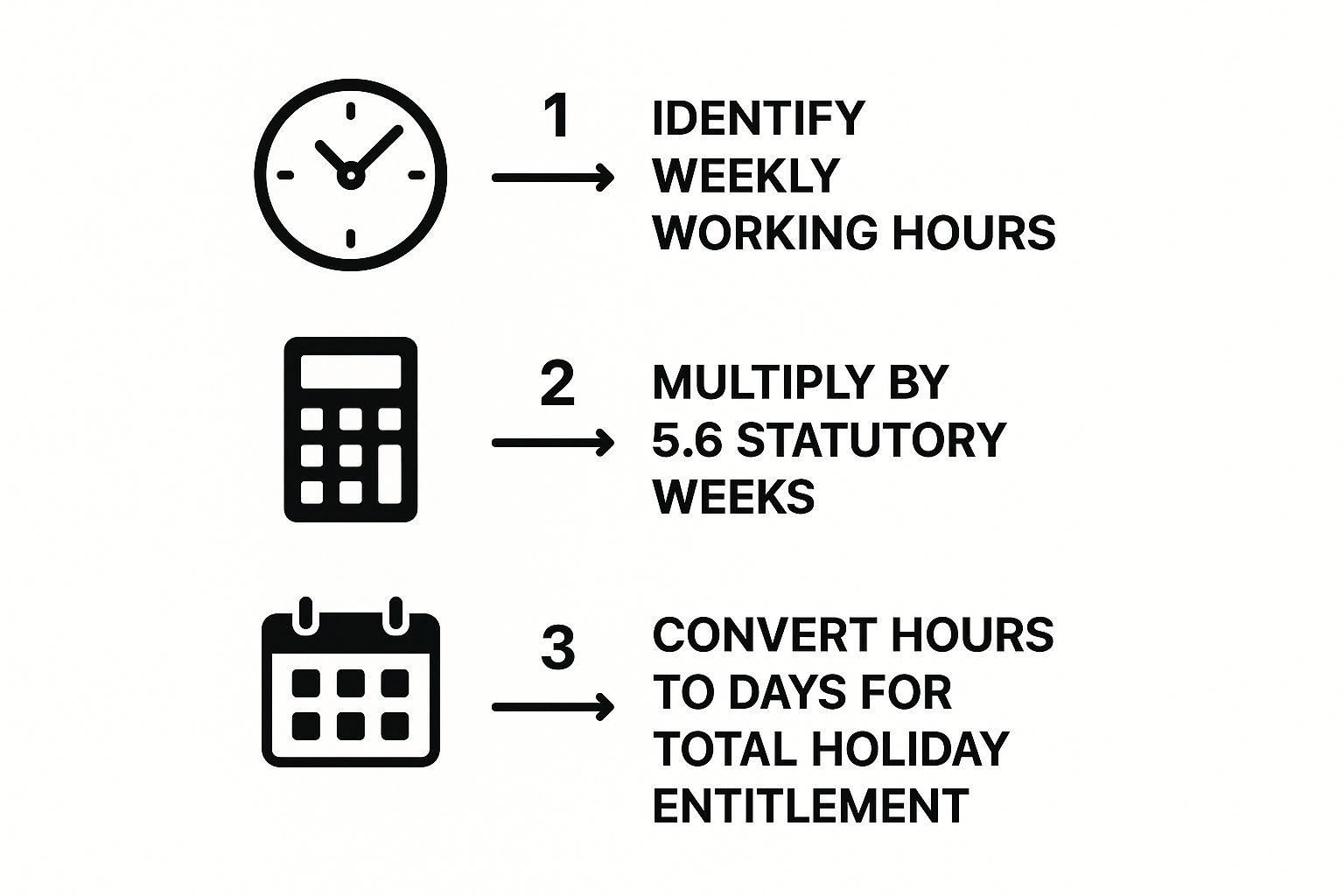
As you can see, the logic flows through three core steps, from identifying the work pattern to getting that final entitlement figure.
Dealing with New Starters and Leavers
Holiday for employees who join or leave part-way through your holiday year is also worked out on a pro-rata basis. Their entitlement is simply proportional to how much of the year they’ve been with the company.
For instance, if your holiday year runs from January to December and a new full-time employee starts on 1st July, they’ve worked for exactly half the year.
- Calculation: 28 days (full entitlement) / 12 months x 6 months worked = 14 days of holiday.
The same logic applies when someone leaves. You calculate the leave they've accrued up to their very last day. If they’ve taken less holiday than they’re owed, you must pay them for the outstanding days in their final payslip. If they’ve taken more, you might be able to deduct the difference, but only if this is clearly written into their employment contract.
These calculations are a crucial part of offboarding. For a closer look at the specific formulas and other scenarios, you might find our guide on how to calculate annual leave useful. It's packed with more examples to help you stay accurate and compliant.
How Bank Holidays Impact Annual Leave

When it comes to managing holiday entitlement UK rules, bank holidays can be a real headache. There's a common myth that employees have an automatic legal right to a paid day off for every bank holiday. That's just not true.
The reality is that an employee’s right to take bank holidays off, or get paid for them, is all down to the wording in their employment contract. This single document is what dictates how you handle these public holidays, and it can lead to very different outcomes for your team.
For industries that never sleep—like hospitality, retail, or the emergency services—asking staff to work on a bank holiday is just business as usual. The crucial part is making sure they still get their full statutory leave allowance of 5.6 weeks at some other point during the leave year.
The Power of Wording in Your Contract
The difference between certain phrases in a contract might look small, but the real-world impact is huge. Nailing this distinction is essential for staying compliant and managing your team's expectations.
Here are two common ways contracts are phrased:
- "28 days of annual leave, inclusive of bank holidays." This phrasing gives you, the employer, flexibility. You can require an employee to work on a bank holiday and let them take a day off in lieu at another time. Their total entitlement is locked in at 28 days.
- "20 days of annual leave, plus bank holidays." This approach is much more rigid. It almost always means the employee gets their 20 days of flexible holiday plus all public bank holidays off as paid leave.
Let's see how this works in practice.
Scenario One: Inclusive Clause
A retail shop needs to stay open on the August bank holiday. An employee with an 'inclusive' contract works that day. They haven't lost a holiday; they just have a day of leave to book some other time, making sure their total for the year is still 28 days.
Scenario Two: "Plus" Clause
A design agency shuts down on all bank holidays. An employee with a 'plus' contract gets that August bank holiday off with pay. This day is one of the 8 standard bank holidays they get on top of their 20 flexible days.
The wording directly shapes both your operational flexibility as a business and the total amount of leave an employee actually receives.
Handling Years with Unusual Bank Holidays
Another tripwire for employers is when the number of bank holidays in a leave year isn't the usual eight. This can happen because of one-off events like a royal jubilee or simply because of how the calendar falls.
No matter what, your primary duty as an employer never wavers: you must always provide the minimum statutory entitlement of 5.6 weeks of paid leave. For a full-timer, that's 28 days.
This is where your contract wording becomes so important.
A contract that states "28 days including bank holidays" is fireproof against these calendar quirks. The total leave is always 28 days, whether there are seven, eight, or nine bank holidays that year.
But a contract specifying "20 days plus bank holidays" can become a compliance minefield. If a leave year happens to have fewer than eight bank holidays, the employee's total entitlement could dip below the legal minimum.
This isn't just a theoretical headache. The leave year running from 1 April 2024 to 31 March 2025, for instance, only has seven bank holidays for England and Wales. An employee on a '20 days plus bank holidays' contract would end up with only 27 days of leave, falling short of the 28-day statutory minimum. You can find out how the 2025 leave year could leave you exposed to make sure you stay compliant.
In these situations, it's up to you, the employer, to top up the employee’s leave to hit that 28-day floor. Being proactive—reviewing contracts and keeping an eye on the calendar—is a vital part of getting UK holiday entitlement right.
Juggling Sickness, Carry Over, and Holiday Pay
Getting a handle on leave management goes way beyond just tracking days off. Some of the trickiest admin headaches pop up when sickness, fluctuating pay, and the end of the leave year all collide. Nailing these details is absolutely vital if you want to run fair, consistent, and legally compliant holiday policies in the UK.
First, we'll tackle the thorny issue of holiday pay for staff whose earnings change month to month. Then, we’ll untangle the surprisingly complex rules around sickness and annual leave, before finishing up with a clear look at your obligations for carrying holiday over.
Calculating Holiday Pay for Variable Pay Staff
For an employee on a fixed salary, holiday pay is a piece of cake—it’s just their normal pay packet. But what about team members who earn commission or regularly work paid overtime? It's crucial that their holiday pay reflects what they actually earn, not just their basic salary.
To get this right, UK law demands you use a 52-week reference period. This means you need to look back over the last 52 weeks where the employee actually got paid. You then work out their average weekly pay across that period to land on the correct rate for their holiday pay.
You can't just include weeks where the employee didn't work or get paid (for instance, if they were on statutory sick pay). Those weeks have to be skipped, and you must go back further until you have 52 full weeks of pay data to build your calculation on. This makes sure the average isn't unfairly watered down.
This rule is in place to stop employees from being out of pocket just for taking the leave they're entitled to. It ensures their holiday pay mirrors what they would have typically earned if they’d been at work.
The Crossover Between Sickness and Annual Leave
How sick leave and annual leave interact is a massive point of confusion for many employers. The golden rule here is that they are two totally separate types of leave, and you can't just swap one for the other without following specific procedures.
An employee’s rights in this situation are pretty clear-cut:
- Sickness during a pre-booked holiday: If an employee falls ill just before or during their holiday, they can cancel the annual leave and take that time as sick leave instead. They just need to follow your company's usual sickness reporting process, like calling in on their first day of illness. The "used" holiday is then added back to their balance to be taken later.
- Accruing holiday while on sick leave: An employee keeps building up their statutory holiday entitlement as normal, even if they're on long-term sick leave.
- Taking holiday while on sick leave: An employee can choose to take paid holiday while they are off sick. They might do this if they want to receive their full holiday pay instead of statutory sick pay, or maybe they don't qualify for sick pay at all.
This whole framework protects an employee's right to a proper rest, recognising that being sick isn't the same as being on holiday.
Understanding Holiday Carry Over Rules
As a general rule, the law says the 5.6 weeks of statutory holiday should be taken within the leave year it's earned. The thinking is 'use it or lose it'. But, like with most things, there are important exceptions where carrying leave over into the next year isn't just allowed—it's legally required.
The main reasons you must allow carry-over are:
- Long-Term Sickness: If an employee can't take their holiday because they're on long-term sick leave, they have to be allowed to carry over up to four weeks (that's 20 days for a full-timer) of their unused leave. This carried-over leave must be used within 18 months from the end of the leave year it was accrued in.
- Family-Related Leave: Staff on statutory leave like maternity, paternity, or adoption leave must be allowed to carry over any holiday they couldn't take into the next leave year.
Outside of these legal must-dos, employers can choose to have their own, more generous carry-over policies. You could, for example, allow everyone to carry over a few days (say, up to 5) as a staff perk. Just make sure this is spelled out clearly in your employment contracts or staff handbook.
It's also worth remembering the temporary rules brought in during the pandemic. You can learn more about how the UK government changed annual leave carry-over rules to help businesses navigate the disruption. While most of these have now ended, they really drove home how important it is to have clear and flexible policies.
Understanding Annual Leave Trends in the UK

Getting your holiday policy legally watertight is one thing. But the real challenge for many small businesses is creating a culture where people feel they can actually take the time off they're owed. It’s easy to offer leave; it’s much harder to make sure it’s used for genuine rest and recuperation.
Unfortunately, the data paints a pretty worrying picture. Despite having a statutory right to paid time off, a growing number of UK workers simply aren't using their full entitlement. This isn’t just some minor admin headache—it points to deeper issues around workplace pressure and well-being that no business leader can afford to sweep under the rug.
The Declining Use of Annual Leave
We're seeing a clear drop in the amount of leave people are taking, which leads to a 'leave liability' nightmare on the company's books and, more importantly, a very real risk of staff burnout. The pressures of a tough economy combined with ever-growing workloads are a major part of the problem.
In fact, the numbers are quite stark. A look at over 3,000 UK companies reveals a clear downward trend.
Decline in Average Annual Leave Taken in the UK (by Year)
This table shows the trend of decreasing annual leave days taken by UK employees over a three-year period, based on industry data.
| Year | Average Days Taken (incl. Bank Holidays) |
|---|---|
| 2020 | 38.0 days |
| 2022 | 36.7 days |
| 2024 | 33.9 days |
The average employee took just 33.9 days of annual leave (including bank holidays) in the year to early 2024. That’s a significant drop from 36.7 days in 2022 and 38 days back in 2020. It's a decrease of nearly 12% in just a few years.
This trend isn't just about numbers on a spreadsheet. It represents a real-world decline in the time people are taking to rest, recharge, and disconnect from work, with serious implications for both mental health and long-term productivity.
Even policies that seem progressive on the surface can backfire. Take the rise of 'unlimited' holiday policies. For some, this creates a weird kind of psychological barrier. Without a specific number of days to aim for, employees get anxious about what’s seen as 'too much' leave and often end up taking less time off than they would have with a traditional allowance.
The Risks of a No-Break Culture
When your team doesn't take their holidays, the risks go way beyond a simple compliance issue. A culture where taking time off is subtly frowned upon—or where workloads make it feel impossible—is a direct route to serious business problems.
- Employee Burnout: Constant work without proper breaks is a fast track to exhaustion and stress. This hammers morale and leads to your best people walking out the door.
- Reduced Productivity: An overtired employee is not an effective employee. They're less focused, their creativity dries up, and they're far more likely to make costly mistakes.
- Increased Sickness Absence: Stress and burnout often show up as physical illness. This means more unplanned absences, which are a lot more disruptive than a planned holiday.
Tackling these annual leave trends means looking at the bigger picture of workplace well-being. Smart companies are now exploring transformative employee wellness program ideas to get ahead of these issues. The message is simple: actively encouraging your team to use their holidays isn't just a 'nice to have'—it's absolutely essential for the long-term health of your business.
Common Questions on Holiday Entitlement
Let's be honest, the finer points of holiday entitlement can get confusing. When you get down to specific situations—like maternity leave or leaving a job—the rules can feel a bit murky.
To help clear things up, we've pulled together the questions that pop up time and time again for both employers and employees. Think of this as your go-to guide for those tricky, real-world scenarios that aren't always covered in the general overview.
Can My Employer Dictate When I Take My Holiday?
Yes, they can. It's perfectly legal for an employer to tell their staff when they have to take their annual leave. This is a common and often necessary practice, especially in industries with clear peak periods or scheduled shutdowns.
A classic example is a factory that closes for two weeks every summer for essential maintenance. In that case, all staff might be required to take their holiday during that shutdown. Likewise, it’s standard for schools to require their staff to take leave outside of term time.
The key here is notice. If an employer is going to enforce leave on specific dates, they have to give you fair warning. The rule is simple: the notice period must be at least twice as long as the holiday they're making you take. So, to enforce a one-week holiday, they need to tell you at least two weeks beforehand. Of course, always check your employment contract, as it might offer more generous terms.
What Happens to My Holiday Entitlement During Maternity Leave?
Your statutory holiday entitlement keeps building up as normal throughout your entire maternity leave. This applies to both Ordinary Maternity Leave (the first 26 weeks) and Additional Maternity Leave (the next 26 weeks).
While you’re at home caring for your new baby, your paid holiday allowance is still ticking up just as if you were at your desk. It's crucial to understand that your employer can't count your maternity leave as your annual leave—they are two completely separate entitlements.
Many new parents choose to tack their accrued holiday onto the beginning or end of their maternity leave, giving them some extra time at home. It’s a great idea to discuss this with your employer and agree on a plan before your leave starts. This helps ensure a smooth return to work and makes sure every day of leave is accounted for.
This principle is a cornerstone of the UK's approach to holiday entitlement UK regulations, ensuring that starting a family doesn't penalise your right to paid time off.
Do I Get Paid for Unused Holiday When I Leave a Job?
Yes, absolutely. When you leave a job, no matter the reason, your employer is legally required to pay you for any statutory holiday you've accrued but haven't taken.
This is calculated on a pro-rata basis, right up to your last day. For example, if you leave a job exactly halfway through your company's holiday year, you will have earned half of your total annual leave. Your final payslip should include a payment for any of those unused, accrued days.
But what if it's the other way around? If you've taken more holiday than you've accrued by the time you leave, your employer might be able to deduct the difference from your final pay. However, they can only do this if a clause allowing for such deductions is clearly written into your employment contract. If it's not in the contract, they can't reclaim that money.
Is Holiday Entitlement Different in Scotland or Northern Ireland?
The fundamental statutory minimum of 5.6 weeks paid holiday is the same across the entire United Kingdom. That means the baseline is consistent whether you're in England, Wales, Scotland, or Northern Ireland.
Where things differ is in the number of public or "bank" holidays each nation observes.
- England and Wales: 8 bank holidays
- Scotland: 9 bank holidays
- Northern Ireland: 10 bank holidays
This is important because of how employment contracts are often worded. A contract in Scotland that offers "20 days plus bank holidays" would add up to 29 days of total leave—one day more than the statutory minimum of 28.
Ultimately, regardless of how many bank holidays there are locally, the employer's legal duty is to make sure every employee's total paid leave hits that 5.6-week mark. For compliance, it's the grand total that counts.