The most popular advice about paternity leave UK statutory rights is also the easiest way to create a payroll error: treat eligibility as a single yes-or-no decision. That approach no longer works for employers in England, Scotland and Wales from 6 April 2026. An employee may have the right to take statutory paternity leave from their first day, while still failing the separate tests for Statutory Paternity Pay.
For a small business, that distinction matters operationally. Your absence process must approve the time off without automatically approving payment, then retain enough evidence to support the payroll decision. A spreadsheet that records only “approved” or “rejected” won't reliably handle new starters, notice dates, expected births, adoption placements, or regional differences.
Table of Contents
- Understanding Statutory Paternity Leave Entitlements
- Navigating the April 2026 Day-One Right Changes
- Separating Leave Eligibility from Statutory Pay
- Managing Notice Periods and Transitional Rules
- Tracking Paternity Leave in Your Absence System
- Encouraging Take-Up and Supporting Returning Fathers
Understanding Statutory Paternity Leave Entitlements
Statutory paternity leave gives eligible employees time away from work after a child's birth or adoption placement. The entitlement can cover a biological father, the mother's husband or partner, including same-sex partners, an adopter, or an intended parent in a qualifying surrogacy arrangement, subject to the relevant statutory conditions. The official UK paternity pay and leave guidance sets out the relationship and parental-status requirements employers should check.
The basic structure is deliberately limited. An employee can take one whole week or two whole weeks, and the leave must be completed within 52 weeks of the child's birth or placement for adoption. It can't be split into individual days, so a request for a Friday and several separate Mondays shouldn't be approved as statutory paternity leave.
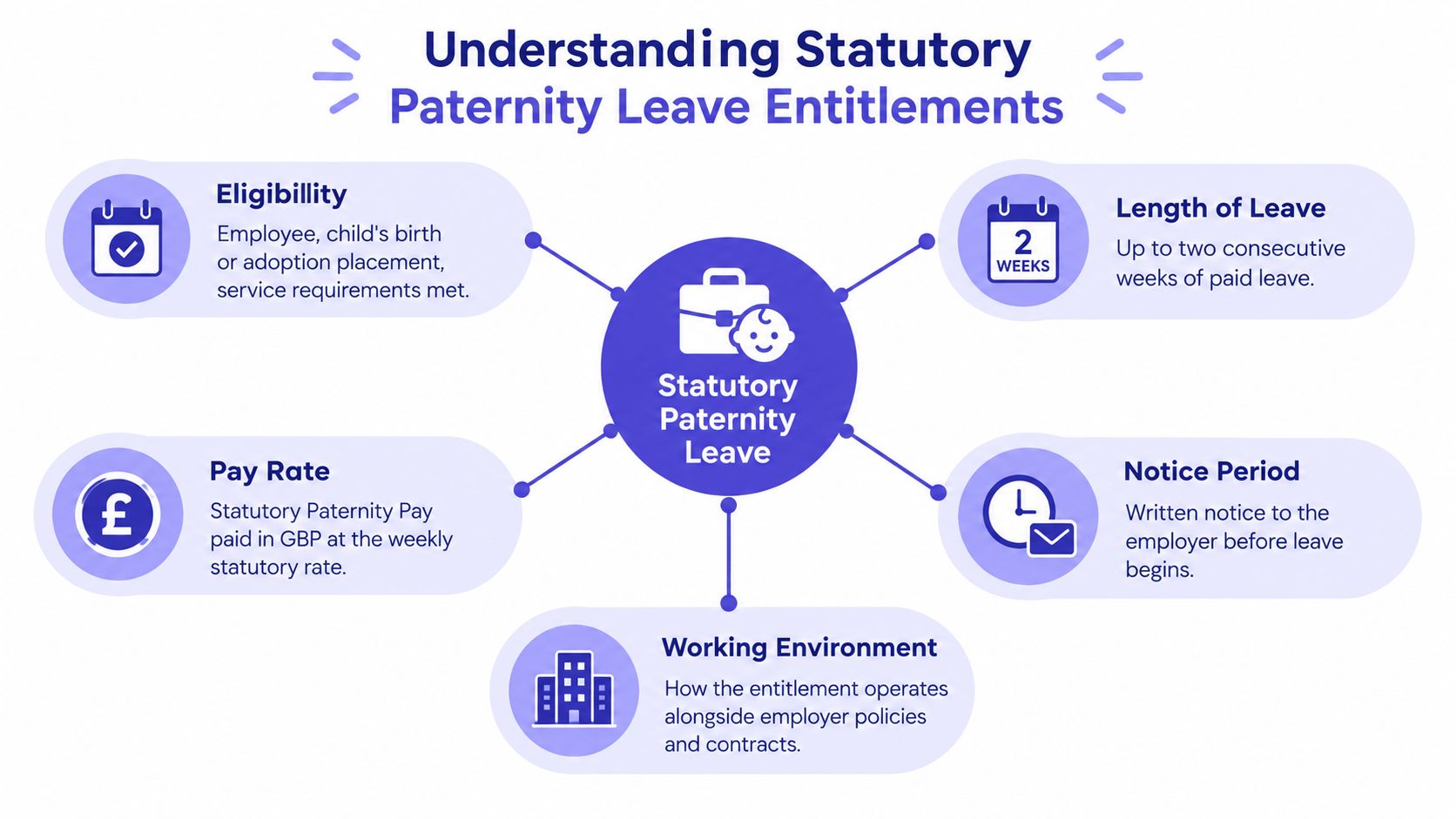
What managers need to validate
The leave may start on the day of birth, on a chosen date after the birth, or after the expected week of childbirth. For adoption, the timing follows the child's placement. That means the system needs more than an absence duration. It needs the event date or expected period, the selected start date, and the requested block length.
Use this check before confirming the request:
- Confirm the relationship or parental status. Check that the employee is within an eligible category and intends to care for the child or support the mother.
- Check the leave shape. Accept one whole week or two consecutive whole weeks, not isolated days.
- Check the completion window. The leave must finish within the permitted 52-week period.
- Record the notice. Keep the date the employee notified the business and the proposed leave dates.
For a practical date check, use the UK paternity leave calculator alongside your normal HR records. A calculator can reduce date-entry mistakes, but it shouldn't replace a documented eligibility decision.
Practical rule: Approve the lawful absence pattern first. Assess statutory pay separately, even where both decisions are made during the same HR conversation.
Navigating the April 2026 Day-One Right Changes
The central change taking effect on 6 April 2026 is that statutory paternity leave becomes a day-one employment right in England, Scotland and Wales. A new employee no longer needs 26 weeks of continuous service before taking the leave itself. The change makes hiring dates less relevant to leave entitlement, but it doesn't remove the separate service and earnings tests for Statutory Paternity Pay. The UK Government notice-period guidance explains the distinction employers need to build into their policies.
Northern Ireland is excluded from these specific changes because family-leave legislation is devolved. A UK-wide handbook that states “all employees have day-one paternity leave” can therefore give the wrong instruction to a Northern Ireland team member.
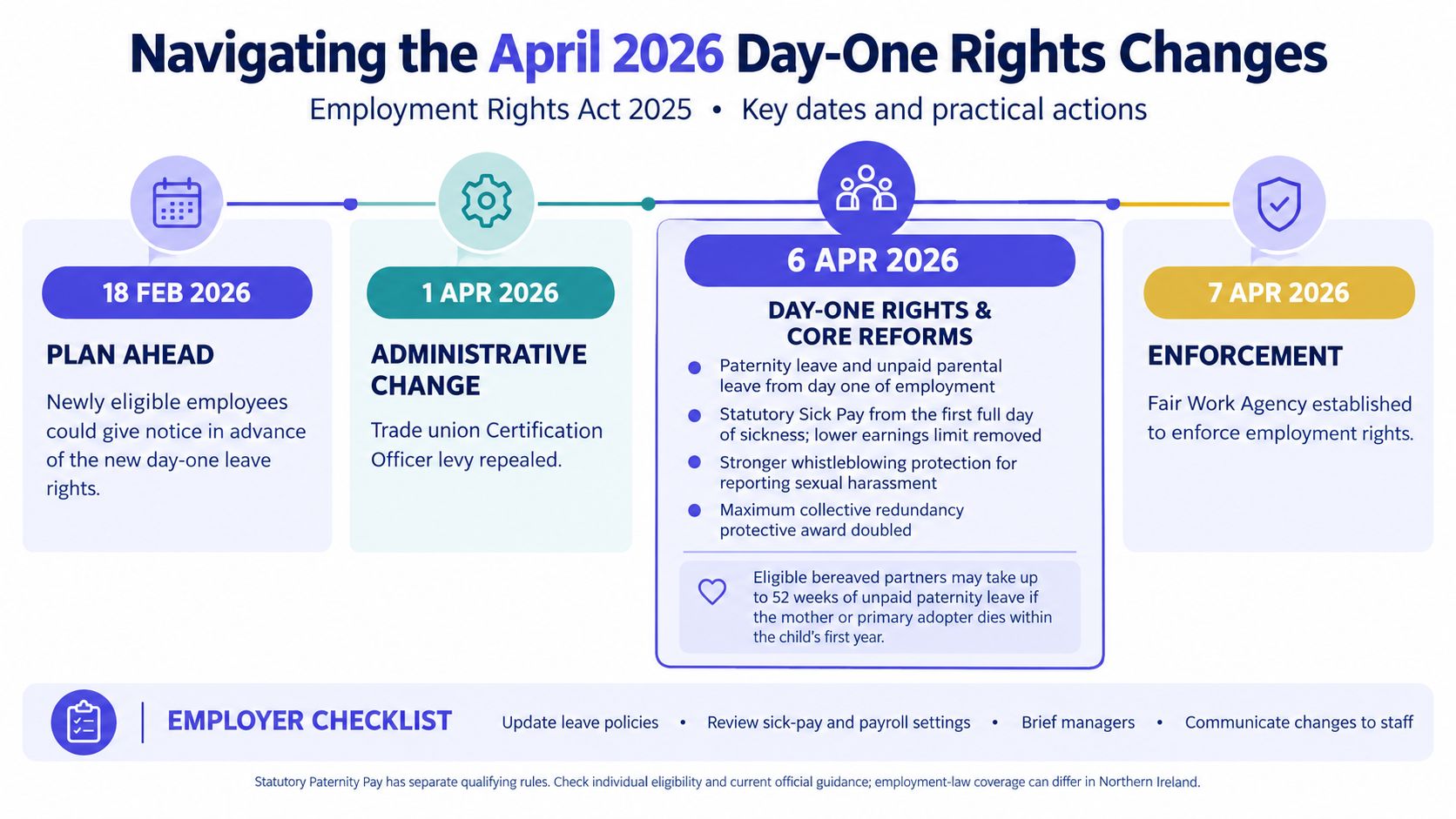
The policy changes to make
Update the employee handbook, absence categories, manager guidance and onboarding materials so they identify the employee's jurisdiction. The policy should say which rules apply in Great Britain and should direct Northern Ireland cases to the applicable local framework rather than applying the Great Britain change automatically.
The reforms also remove restrictions that previously prevented statutory paternity leave or statutory paternity pay after Shared Parental Leave. Your workflow shouldn't contain a blanket rule that rejects every paternity request because Shared Parental Leave has already been used. Instead, it should record the sequence of leave and run the applicable eligibility checks.
For a small employer, the practical decision tree is:
- Jurisdiction: Is the employee in England, Scotland or Wales, or in Northern Ireland?
- Leave entitlement: Does the employee meet the relationship and parental-status conditions?
- Service position: Is the request governed by the post-6 April 2026 day-one rule or an applicable transitional arrangement?
- Pay position: Does the employee satisfy the separate service and earnings tests?
- Previous leave: Has Shared Parental Leave been used, and does the current rule permit the paternity request?
The day-one rights and leave-tracker guidance is useful context for reviewing whether your current system can store those decisions independently.
Separating Leave Eligibility from Statutory Pay
A paternity request can produce two different decisions. First, can the employee take statutory paternity leave? Second, does the employee qualify for Statutory Paternity Pay? Treating those questions as one approval is a common source of payroll errors.
From 6 April 2026, an eligible new starter in England, Scotland or Wales may qualify for statutory leave from the first day of employment, while failing the separate pay test. Statutory Paternity Pay normally requires 26 weeks of continuous employment by the end of the qualifying week, defined as the 15th week before the expected week of childbirth. Average weekly earnings must normally be at least £129 during the relevant period. The employee must also remain employed through the birth and meet the responsibility and caring-purpose conditions. See the official eligibility guidance.
The statutory weekly payment is £184.03 or 90% of average weekly earnings, whichever is lower, under the government paternity pay and leave rules.
Leave vs Pay Eligibility Criteria
| Criteria | Statutory Leave (Time Off) | Statutory Pay (SPP) |
|---|---|---|
| Employment start date | From the first day for eligible employees in England, Scotland and Wales under the rules taking effect on 6 April 2026 | 26 weeks of continuous employment by the end of the qualifying week normally remains necessary |
| Earnings | No separate earnings test for the right to take the leave | Average weekly earnings must normally be at least £129 |
| Leave length | One whole week or two whole weeks | Pay applies to the statutory leave taken, subject to eligibility |
| Payment calculation | The employee may be entitled to time off without statutory pay | £184.03 per week or 90% of average weekly earnings, whichever is lower |
| Service and timing | Check the applicable jurisdiction and statutory leave rules | Check service by the qualifying week, continued employment through birth, and the relevant earnings period |
| Shared Parental Leave | The 2026 reforms remove previous restrictions affecting paternity leave after Shared Parental Leave | Pay eligibility still needs its own statutory assessment |
Configure the absence system to store these outcomes separately. Approving leave should create an absence record and a payroll-review task, not an automatic payment instruction. A payroll team reviewing whether paternity leave is paid should be able to see the leave decision, pay decision, service calculation and earnings assessment in the same record.
A “yes” to leave and a “yes” to pay are separate compliance answers. Record both before payroll is finalised.
Managing Notice Periods and Transitional Rules
Notice handling is where a correct policy often fails in practice. Employees must usually give at least 15 weeks' notice of the expected week of childbirth and their intention to take statutory paternity leave. The employer should record the expected week, the notice date, the proposed leave start date, and the chosen duration rather than relying on an email buried in a manager's inbox.
The transition creates an important exception. For babies due before 26 July 2026, employees with less than 26 weeks' service in the qualifying week don't need to give the usual 15-week notice. They must still give 28 days' notice of the leave start date and duration. This is particularly relevant when a small business hires someone shortly before a birth, adoption placement or qualifying surrogacy arrangement.
A workable notice workflow
- Capture the event. Ask for the expected week of childbirth or the relevant adoption or placement information. Keep the request confidential and limit access to people who need it.
- Calculate the service position. Compare the employment start date with the qualifying week and identify whether the transition rule applies.
- Validate the notice route. Confirm whether the employee has met the ordinary notice requirement or the transitional 28-day requirement.
- Record the intended block. Store the leave start date and whether the employee wants one week or two consecutive weeks.
- Recheck after the event. Births and placements can occur earlier or later than expected. Update the actual event date and confirm that the leave remains within the permitted window.
Don't reject a request just because the expected week changed. Ask the employee to confirm the new facts, then preserve the original notice and the revised record. That audit trail helps explain why the business approved the request and gives payroll the information needed for its separate decision.
Managers should also know that an employee may choose the day of birth, a date after the birth, or a date after the expected week of childbirth, provided the statutory timing rules are met. A good process is flexible about the event, but strict about recording the dates.
Tracking Paternity Leave in Your Absence System
A paternity absence type should behave differently from ordinary annual leave. The system needs to prevent invalid day-by-day bookings, preserve the statutory event dates, and route pay questions to payroll without treating approval as proof of payment eligibility.
Configure the request form to capture:
- Employment start date, so the service position can be calculated.
- Qualifying-week service, including the 15th week before the expected week of childbirth.
- Expected week of childbirth or the relevant adoption placement information.
- Jurisdiction, particularly where employees work across Great Britain and Northern Ireland.
- Relationship or parental status, where needed for eligibility.
- Notice date and intended leave dates.
- Chosen duration, restricted to one whole week or two consecutive whole weeks.
- Average weekly earnings and pay assessment status, held securely for payroll review.
- Shared Parental Leave history, without using it as an automatic exclusion rule.
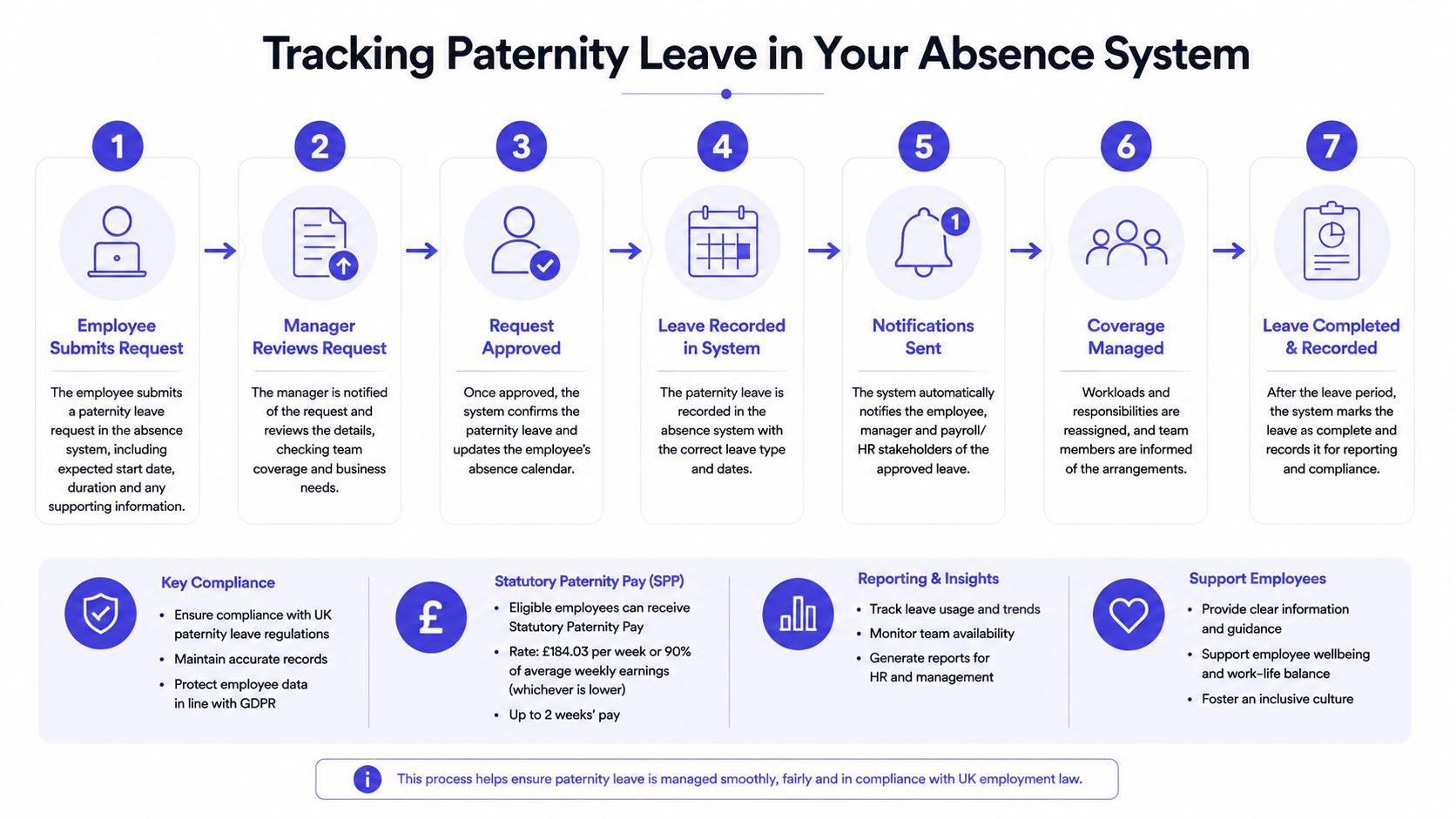
Build separate workflow states
A practical workflow might use these states:
- Request received, with the event and notice details captured.
- Leave eligibility checked, including relationship, jurisdiction and timing.
- Dates validated, with whole-week rules enforced.
- Leave approved, creating the absence and coverage requirement.
- Pay review opened, sending service and earnings checks to payroll.
- Payroll outcome recorded, either eligible, not eligible or awaiting evidence.
- Audit record closed, retaining the decision and any supporting documents.
This design prevents the common spreadsheet failure where one “approved” cell drives both the calendar and payroll. It also gives managers a clear view of staffing while keeping sensitive earnings information away from general team calendars.
LeaveWizard is one option for administering a dedicated Paternity Leave leave type, restricting who can request it, supporting statutory paternity-pay calculations, and comparing the government weekly rate with 90% of average weekly earnings. The wider principle applies to any suitable absence platform: validate the leave pattern automatically, store the evidence, and make the pay decision explicit.
A system should also produce an export or report that payroll can reconcile with the absence record. Keep changes timestamped, especially where the expected week, actual birth date, leave dates or employee status changes. That audit trail is more dependable than asking someone to reconstruct a decision from separate spreadsheets.
Encouraging Take-Up and Supporting Returning Fathers
Low recorded paternity leave does not necessarily indicate low demand. The UK Government's 2025 evidence summary found that 59% of fathers took paternity leave after a birth or adoption, while 21% took time away that was not recorded as a formal parental-leave category. Among fathers who were employees before the birth, recorded take-up rose to 70%, according to the government summary of existing parental-leave evidence.
Affordability, uncertainty about the rules, manager behaviour and concerns about career prospects can all influence whether leave is recorded formally. Annual leave, unpaid time or informal flexibility may then appear as scattered absences, hiding the staffing requirement and making the employee's entitlement harder to assess.
Make the conversation normal
Managers should raise leave options when an employee shares a pregnancy, adoption or surrogacy update. They should ask only for information needed to administer the request. Explain the whole-week structure, the option of two separate one-week periods where applicable, the notice process, and the separate tests for leave and pay.
Track more than approved statutory requests. Compare formal paternity leave with annual leave, unpaid absence and other time away around the same family event. An anonymised dashboard can help identify whether low recorded take-up reflects limited demand or inconsistent conversations between managers.
Shared Parental Leave also remains particularly underused. The evidence cited by the TUC reports take-up of about 1% among employee mothers and 5% among employee fathers, as recorded in the same government evidence summary cited above. A quiet policy does not prove that employees understand or can use it. Provide clear guidance, plan cover predictably and ensure managers do not treat family leave as a lack of commitment.
Returning fathers need a practical re-entry conversation. Confirm the return date, hand over outstanding work, discuss temporary schedule issues and explain where concerns should be raised. A compliant process protects the business. A trusted process makes employees more likely to use the entitlement openly and plan their return properly.
LeaveWizard helps small businesses maintain dedicated paternity leave records, automate leave calculations, streamline approvals and view employee availability. Visit LeaveWizard to replace spreadsheet tracking with an absence workflow that keeps leave approval separate from statutory pay review.