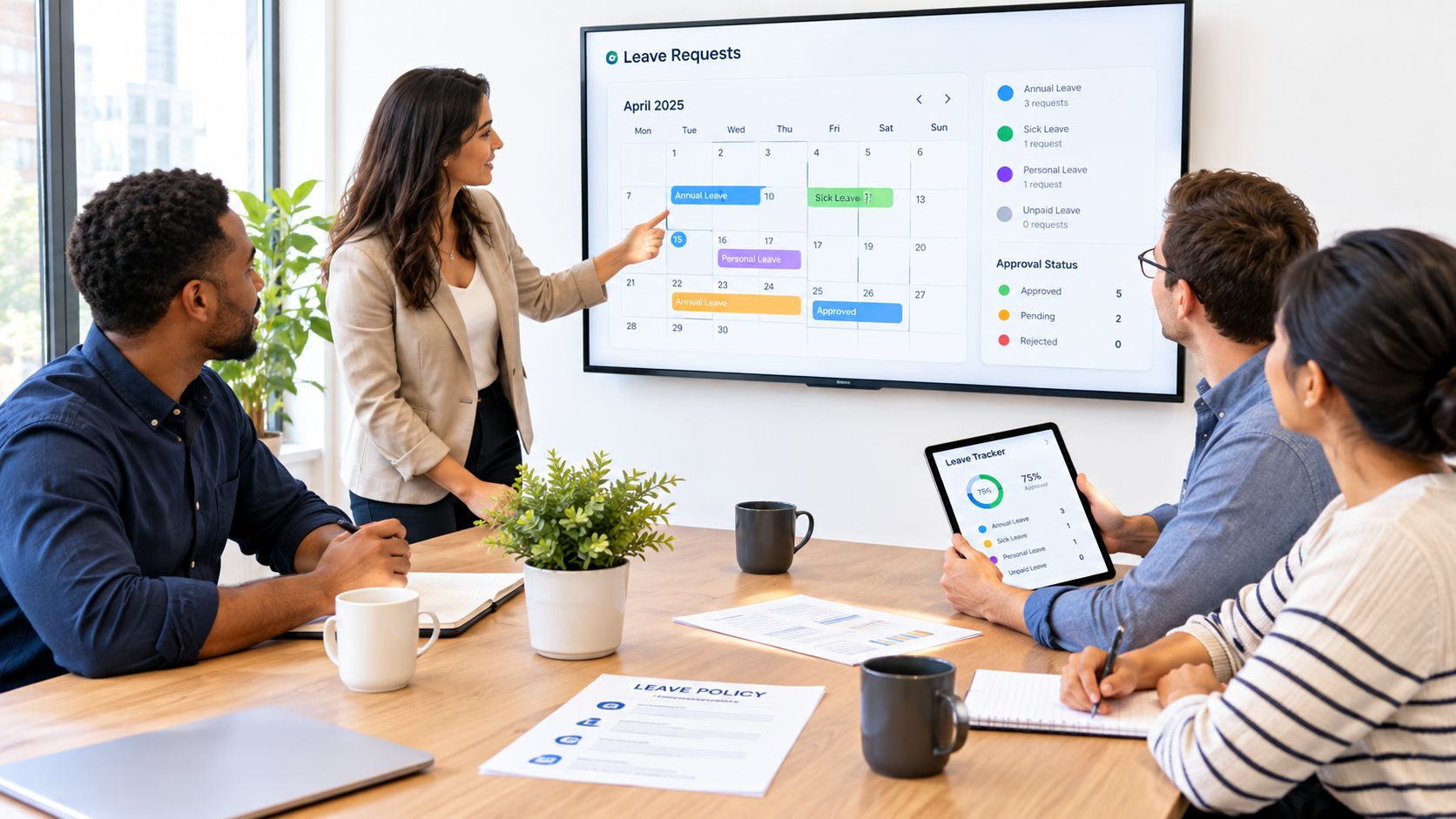
A team member messages at 9:05, “I'm working from home today, but I feel awful.” They're online, answering messages and appearing in the leave calendar as available. By lunchtime, deadlines are slipping, the employee is still unwell, and nobody knows whether to treat the day as sickness absence, remote work or adjusted duties.
That situation is common in small businesses because digital availability makes illness harder to see. Good absence management isn't about pushing people away from work whenever they feel unwell, nor is it about praising employees for working through illness. It means making a clear, safe decision, recording it accurately and protecting both recovery and operational continuity.
Table of Contents
- The Hidden Cost of Working While Unwell
- Immediate Steps When an Employee Falls Ill
- Navigating Notification Rules and Fit Notes
- Recording Absence and Managing Sick Pay
- Planning Coverage and Return to Work
- Building a Proactive Absence Strategy
The Hidden Cost of Working While Unwell
A low sickness absence rate doesn't necessarily mean a healthy, productive team. It may mean employees are taking genuine sick leave, but it may also mean they're working while unwell and hiding the true effect of illness inside reduced concentration, slower work and avoidable mistakes.
UK government evidence makes that distinction clear. In the 2024–2025 Survey of Employees and Self-Employed Workers, 58% of workers said they had worked during the previous 12 months when they did not feel well enough to work, while 49% reported taking sickness absence during the same period. Workers who took sickness absence reported an average of 7.3 days off. These figures are published in the UK government employee survey.
Remote work can make this worse. An employee may join meetings from bed, reply to messages between symptoms and remain visible on collaboration software. Managers then see activity, not capacity. The business records no absence, but the employee may take longer to recover, produce weaker work or become unavailable later.
Use three categories, not one vague label
Managers should distinguish between:
- Full sickness absence: The employee isn't fit to work and should rest without normal work expectations.
- Adjusted duties: The employee is well enough to complete agreed, limited tasks with reduced hours, different responsibilities or fewer meetings.
- Working while unwell: The employee continues normal work despite not being well enough to do so. This should trigger a manager conversation, not automatic approval.
CIPD's 2025 survey found that 36% of organisations with homeworking employees reported lower sickness absence, while 35% said presenteeism increased because of homeworking. The findings appear in CIPD's health and wellbeing at work report. Lower recorded absence can therefore conceal a transfer from visible time off to invisible underperformance.
Practical rule: If an employee wouldn't be safe, effective or capable of completing their normal duties on site, don't assume that working remotely solves the problem.
Set decision rules before someone is ill. Send the employee home, or end their remote workday, when symptoms affect concentration, safety, judgement or reliable communication. Consider adjusted duties only when the employee volunteers that they feel able to work, the duties are genuinely lighter and the arrangement has a defined end point. Never use adjusted duties to avoid recording sickness or to pressure someone into staying available.
Immediate Steps When an Employee Falls Ill
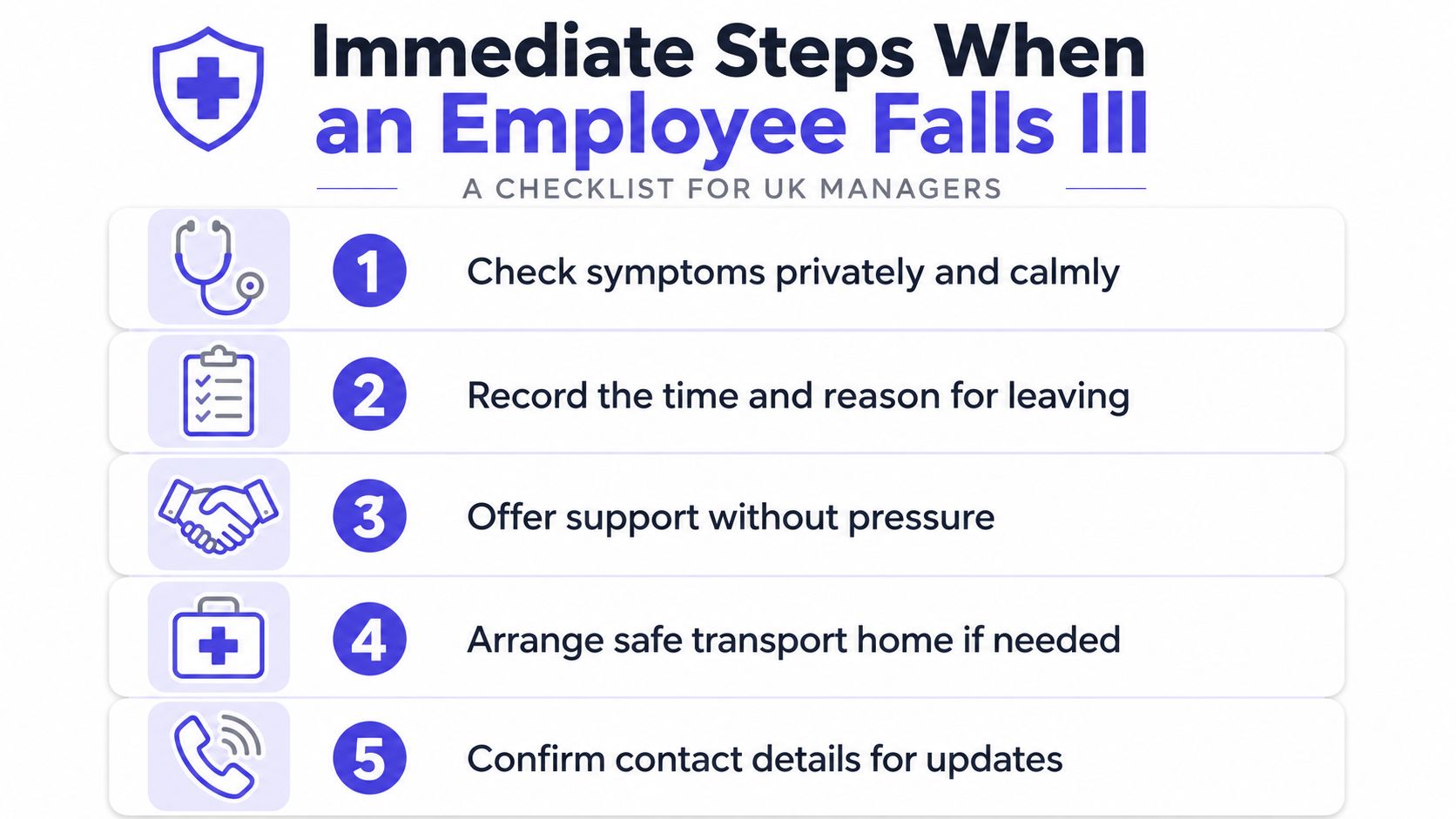
When someone becomes sick during the working day, the first hour should protect the person and stabilise the work. Managers don't need a medical diagnosis. They need a calm process.
- Check in privately. Ask how the employee feels, whether they need urgent help and whether they can travel safely. Don't ask for unnecessary medical detail or discuss their symptoms in front of colleagues.
- Make the work decision. If they aren't fit to continue, confirm that they should stop work. If they can manage limited duties, agree exactly what those duties are and when they'll stop.
- Secure urgent work. Identify deadlines, customer commitments and safety-critical tasks. Reassign only what must be handled immediately, rather than inviting the whole team to investigate the employee's health.
- Arrange a safe departure. An employee who is dizzy, distressed or otherwise unsafe shouldn't be expected to drive. Consider a trusted contact, taxi or another suitable arrangement.
- Record the event. Note the time, whether the employee stopped work, the broad reason given and the agreed contact method. Store health information securely and limit access to people who need it.
For remote employees, use a private call rather than relying on status indicators or a group chat. Confirm whether they're ending work for the day, taking a defined break or moving to adjusted duties. A leave process such as this guide to calling in sick can help employees and managers follow the same steps instead of improvising.
If an illness may involve workplace exposure, seek appropriate professional advice and keep any communication factual and limited. Managers dealing with questions about proving work-related COVID-19 should remember that legal requirements vary by jurisdiction, so an external legal resource isn't a substitute for UK-specific advice.
Navigating Notification Rules and Fit Notes
A sickness policy should answer three practical questions: who must be contacted, by what time and through which reasonable channel. The deadline can be set by the organisation. If no deadline exists, UK Statutory Sick Pay guidance says the employee should normally notify the employer within seven days.
The notification method must remain reasonable. An employer can't insist that notification is made in person or on a special form. A phone call, message or another agreed channel may be appropriate, particularly where the employee is too unwell to travel or speak at length.
Separate notification from medical evidence
A fit note isn't normally required at the start of a short absence. It may be requested only when the employee has been off work for more than seven consecutive days, including weekends and bank holidays. For shorter absences, the employer should use its own self-certification process, explained clearly in the handbook and applied consistently. A practical self-certification sick leave guide can help managers explain what employees need to provide.
Fit notes can be issued by a GP or hospital doctor, but also by a registered nurse, occupational therapist, pharmacist or physiotherapist. They may be digital or printed. The note can state that an employee may be fit for work, which should prompt a discussion about adjustments rather than an automatic return to normal duties.
Don't confuse late paperwork with dishonesty. An employer can't withhold Statutory Sick Pay solely because a fit note was submitted late.
There is a limited distinction around late notification. SSP need not normally be paid for days when the employee was late notifying sickness unless there was a good reason. Apply the policy fairly, ask for an explanation and keep a record of the decision. Avoid turning an administrative error into a disciplinary issue without considering the circumstances.
Recording Absence and Managing Sick Pay
Accurate records should begin when the employee reports sick, not when payroll asks for information. Record the start date, expected duration, actual return date, notification time, broad sickness category and any fit-note information separately. Don't store unnecessary diagnoses in a shared spreadsheet.
Upcoming reforms described in UK government materials on the Employment Rights Act 2025 remove the Lower Earnings Limit and waiting days, making Statutory Sick Pay available from the first full day of sickness. Payment is set at 80% of earnings or the existing flat rate, whichever is lower. The government estimates an additional business cost of about £450 million annually, or roughly £15 per employee, as set out in the Statutory Sick Pay factsheet.
Model the change instead of guessing
A small employer should build an employee-level model using:
- Expected absence patterns: Use historical records by employee, team and absence category, without treating past behaviour as a prediction about an individual.
- Pay interaction: Check how SSP will work alongside contractual company sick pay, enhanced benefits and payroll cut-offs.
- Workflow changes: Update the reporting form, approval route, payroll fields and manager reminders.
- Reconciliation checks: Compare the absence record, fit-note status, payroll calculation and return date before closing the event.
A spreadsheet can work for a very small team if one person owns it and access is controlled. It becomes fragile when managers keep separate versions, dates are entered inconsistently or payroll relies on messages. A dedicated system can centralise sickness events, approvals, fit-note uploads and absence calculations. For example, how to calculate Statutory Sick Pay gives managers a focused reference for the calculation process.
Don't treat the government cost estimate as your own forecast. Build a variable-cost view based on your workforce, pay arrangements and expected absence, then review it when the final implementation details and payroll requirements are confirmed.
Planning Coverage and Return to Work
Absence management becomes operationally useful when records influence decisions about rotas, workload and management practice. The ONS reported 148.9 million working days lost in 2024, an average of 4.4 days per worker, with a sickness absence rate of 2.0%. The total was lower than in 2023 but remained above the pre-coronavirus level. These figures come from the ONS sickness absence analysis for 2023 and 2024.
The useful lesson for a small business isn't to compare itself mechanically with a national rate. It's to look for patterns that affect coverage. Repeated short absences in one department may indicate workload, staffing, management or scheduling problems. Long absences require a different plan from isolated minor illnesses.
Protect the people covering the gap
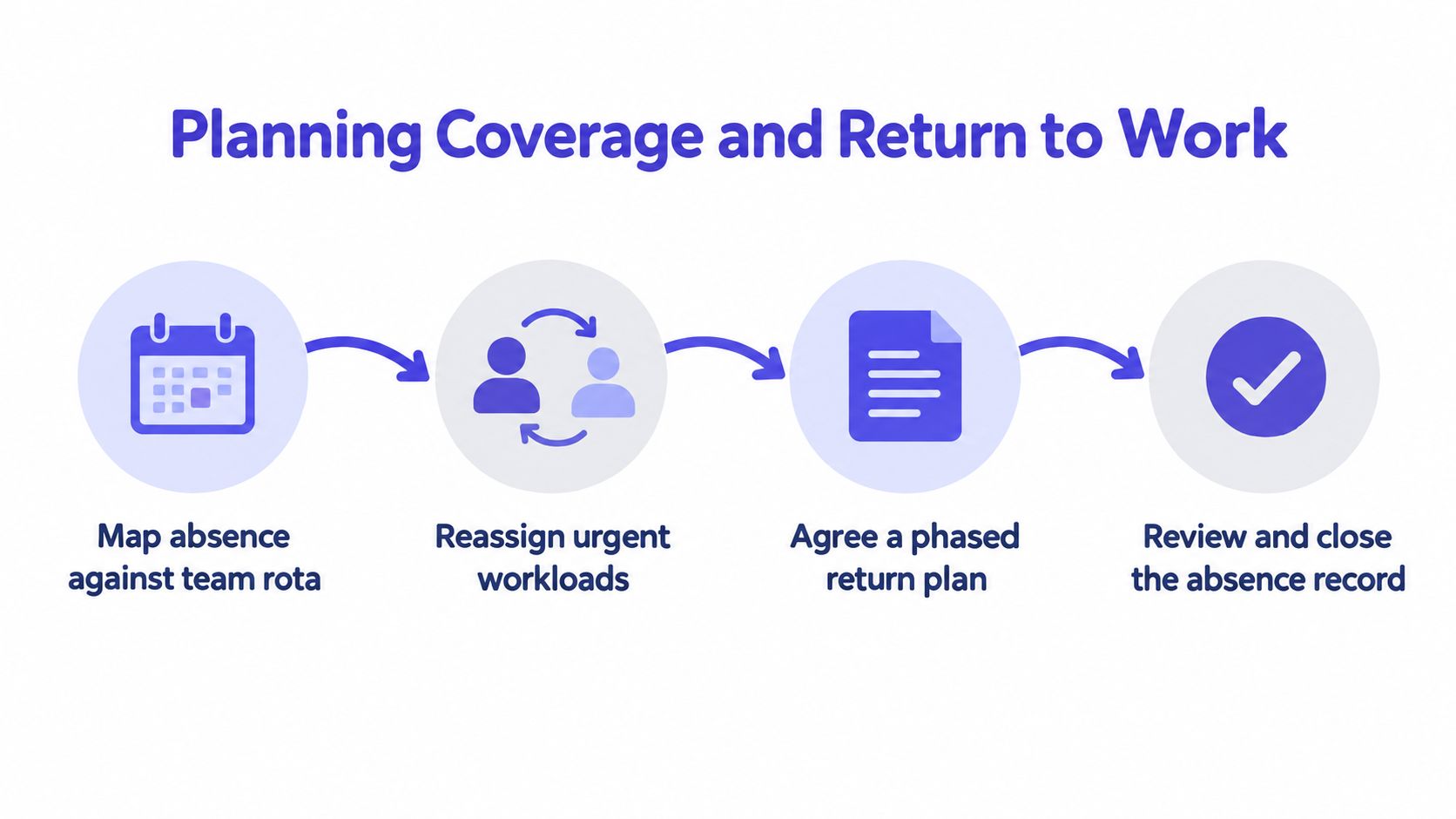
Start with the rota and urgent work, not with a request for the remaining staff to absorb everything. Identify essential tasks, defer work that can wait and assign responsibilities based on competence. Monitor the people covering the absence, because repeated overtime and constant reprioritisation can create another absence problem.
Stress-related absence deserves particular attention. In Great Britain during 2024/25, work-related stress, depression or anxiety affected an estimated 964,000 workers, including 409,000 workers with a new case, and resulted in 22.1 million working days lost, according to the Health and Safety Executive's stress statistics. The figures include new and long-standing cases, so they shouldn't be read as only new illness arising during that year.
A return-to-work meeting should be supportive and specific. Acas says the amount of contact during absence should reflect the employee's circumstances, and employees should have a return-to-work meeting. If a fit note recommends different hours or duties, discuss those adjustments. If agreement can't be reached, the employee must be treated as not fit for work.
Use the meeting to confirm what the employee can safely do, what remains restricted, who will review the arrangement and when the record will be updated. A return date is the start of managed reintegration, not proof that every operational or health issue has ended. Where a role involves monitoring health or recovery, a practical UK guide to patient monitoring may provide useful general context, but managers should follow the employee's fit note and appropriate professional advice.
Building a Proactive Absence Strategy
A proactive approach starts with a simple principle: make the healthy choice easy to report. Employees should be able to notify sickness without negotiating with several people, while managers should see enough information to plan cover without accessing unnecessary health details.
One growing business might begin with a shared spreadsheet, then add a self-service leave process as managers spend more time checking messages than managing work. The employee reports the absence through a defined channel, the manager receives a notification, the event records its start date and category, and payroll can review the relevant information without searching through chat history. That workflow reduces friction, but it doesn't remove the need for judgement.
Combine visibility with discretion
Useful reporting should show:
- Availability: Who is absent, who is returning and which shifts or duties need cover.
- Patterns: Repeated short absences by team, role or working arrangement.
- Compliance points: Notification deadlines, fit-note requirements and unresolved return plans.
- Workforce pressure: Teams carrying repeated extra duties or delayed work.
LeaveWizard is one option for small businesses that need sickness-event recording, category selection, sick-note uploads, self-service reporting and manager visibility through web or smartphone access. Whatever tool you choose, check that it supports controlled access, a clear audit trail and policies that match your employment arrangements.
A supportive culture still matters more than software. Managers should ask whether workload is realistic, avoid rewarding presenteeism and treat sickness reporting as normal workforce administration rather than a sign of poor commitment. For wider thinking about burnout and work-life balance, Refreshing your approach to burnout with Refresh offers relevant wellbeing context.