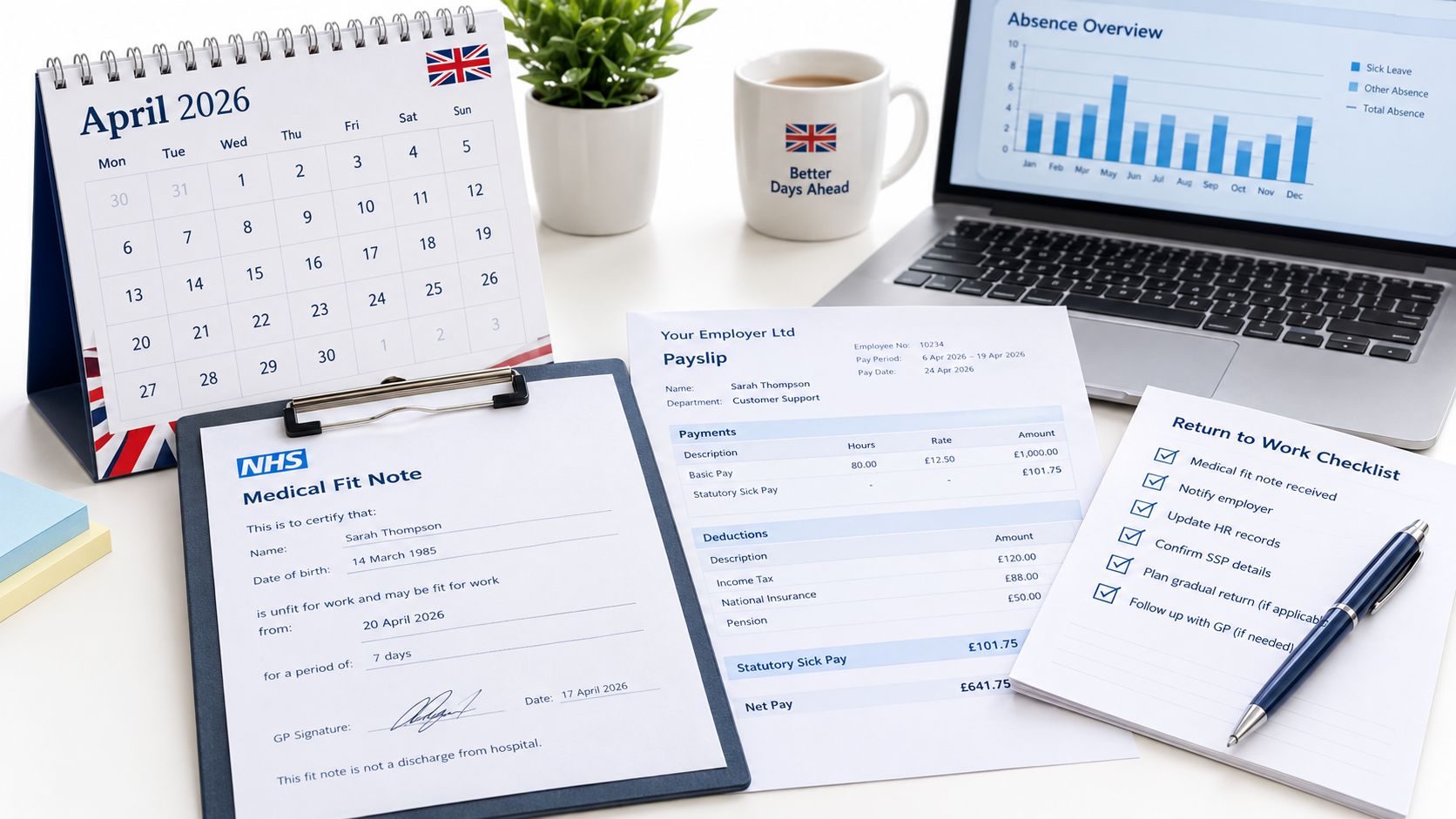
Calculating Statutory Sick Pay, or SSP as it's commonly known, boils down to a few core steps. You need to check if your employee is eligible, figure out their Average Weekly Earnings over a set period, and then apply the weekly statutory rate for up to 28 weeks. Just remember, payments only kick in after three unpaid 'waiting days'.
Understanding Your SSP Obligations

Before you even touch a calculator, it’s essential to get your head around the framework behind SSP and what’s expected of you as a UK employer. It's less about a complicated formula and more about a legal safety net, designed to give some basic financial support to employees who are genuinely too ill to work.
Getting this right isn't just a box-ticking exercise for compliance. It's about building trust with your team and handling employee absence in a fair, consistent way. The whole system is built on a handful of key ideas that every manager or business owner should be familiar with.
Key SSP Concepts Explained
To master the process, you first need to speak the language. Two of the most important terms you’ll come across are the 'Period of Incapacity for Work' (PIW) and 'waiting days'. Let's break them down.
- Period of Incapacity for Work (PIW): This isn't just any random sick day. A PIW is a specific term for a period of sickness that lasts for at least four consecutive days. This includes non-working days like weekends or bank holidays. The PIW is what officially triggers SSP eligibility.
- Waiting Days: SSP isn't paid from day one of an illness. The first three qualifying work days of a PIW are unpaid. These are known as 'waiting days'. Payment only starts from the fourth qualifying day.
At its core, Statutory Sick Pay is a legally mandated benefit. As an employer, you are obligated to pay employees who are off sick for four or more days in a row, as long as they meet the criteria. To qualify, an employee's average weekly earnings must be at or above the Lower Earnings Limit.
You'll find that you only start the actual payment calculations once an employee has been off for a recognised period (the PIW) and has cleared those initial unpaid waiting days. This structure ensures SSP is used for more significant periods of illness, not just a single day off. Grasping this foundation is crucial before we dive into the numbers.
SSP Key Figures at a Glance
To make things a bit easier, here’s a quick-reference table with the key figures you'll need for the current tax year.
| Metric | Value/Rule |
|---|---|
| Weekly SSP Rate | £116.75 |
| Maximum Entitlement | 28 weeks |
| Lower Earnings Limit (LEL) | £123 per week |
| Waiting Days | 3 qualifying days (unpaid) |
| Period of Incapacity (PIW) | Sickness lasting 4+ consecutive days |
Keep these numbers handy as they form the bedrock of any SSP calculation you'll perform.
Confirming Employee Eligibility for SSP
Before you even think about calculating sick pay, the first hurdle is figuring out if your employee is actually eligible for Statutory Sick Pay (SSP). It's a common slip-up to assume every employee who calls in sick automatically qualifies, but that’s just not how it works.
Running through a quick eligibility check upfront can save you a world of compliance headaches and potential disputes down the road.
The whole process kicks off with their basic employment status and earnings. First, they must be legally classed as an 'employee' and have actually done some work under their contract. This might sound obvious, but it’s a crucial distinction that rules out freelancers or self-employed contractors.
Next up is the big one: their average weekly earnings. For an employee to qualify, their earnings must be at or above the government's Lower Earnings Limit (LEL). For the 2024/25 tax year, that threshold is £123 per week. If they earn less than this, they won't be eligible for SSP, no matter how long they're off.
The Sickness and Notification Criteria
Beyond the payslip, the nature of the absence itself is what really matters. For SSP to even come into play, an employee needs to have been sick for at least four consecutive days. This includes weekends and other non-working days, and it's officially known as a ‘Period of Incapacity for Work’ (PIW). A simple one or two-day illness just doesn't meet the criteria.
Your employee also has a part to play by letting you know they're unwell. They need to notify you within the timeframe you’ve set out in your company policy—or within seven days if you haven’t specified one.
Once the sickness hits seven consecutive days, they must provide proof of their illness. This usually comes in the form of a 'fit note' (what we used to call a sick note) from their doctor. If they don't provide this, it could jeopardise their entitlement.
For a deeper dive into all the fundamentals, you can learn more about what is statutory sick pay in our detailed guide.
When an Employee Is Not Eligible
There are a handful of specific situations where an employee won't qualify for SSP, even if they tick the initial boxes. It's vital to know these exclusions so you can handle every case correctly and fairly.
An employee is not eligible for SSP if they:
- Have already received the maximum 28 weeks of SSP.
- Are currently receiving Statutory Maternity Pay or Maternity Allowance.
- Are an agricultural worker who is paid sick pay under a separate, specific agreement.
- Were on strike or in legal custody on the first day of their sickness.
Real-World Scenario: Imagine an employee, Sarah, has just come back to work after receiving Employment and Support Allowance (ESA) for 10 weeks. If she falls ill again within 12 weeks of returning, she wouldn't be eligible for SSP from you. In that situation, your responsibility is to issue her form SSP1.
Getting to grips with these rules means you can assess each situation with confidence, keeping you compliant and maintaining transparency with your team.
Calculating Average Weekly Earnings Correctly
Getting your Statutory Sick Pay (SSP) calculations right all comes down to one number: the employee's Average Weekly Earnings (AWE). This isn't just a ballpark figure; it’s a specific calculation that has to be based on a legally defined timeframe. I’ve seen this trip up countless employers. Get it wrong, and you're looking at incorrect payments and compliance issues, so precision is absolutely vital.
The whole AWE calculation is based on an employee's gross earnings during what's called the ‘relevant period’. Think of it as an eight-week snapshot of their pay that ends right before their sickness absence starts. Nailing down this period is the first, and most important, step.
Defining the Relevant Period
The exact start and end dates for this eight-week period depend on how often the employee gets paid. You need to pinpoint the last normal payday before the first day they were off sick. That date is the end of your relevant period.
From there, you simply count back at least eight weeks to the day after their previous normal payday to find the start date. Every penny of gross earnings paid between those two dates is what you'll use.
- For monthly-paid staff: The relevant period will cover the two pay packets they received right before getting sick.
- For weekly-paid staff: You’ll be looking at the eight weekly wage payments made before their absence began.
This method ensures the AWE is a fair and recent reflection of the employee's usual income, which is especially important for anyone whose pay fluctuates.
This infographic breaks down the main steps in the whole SSP process.
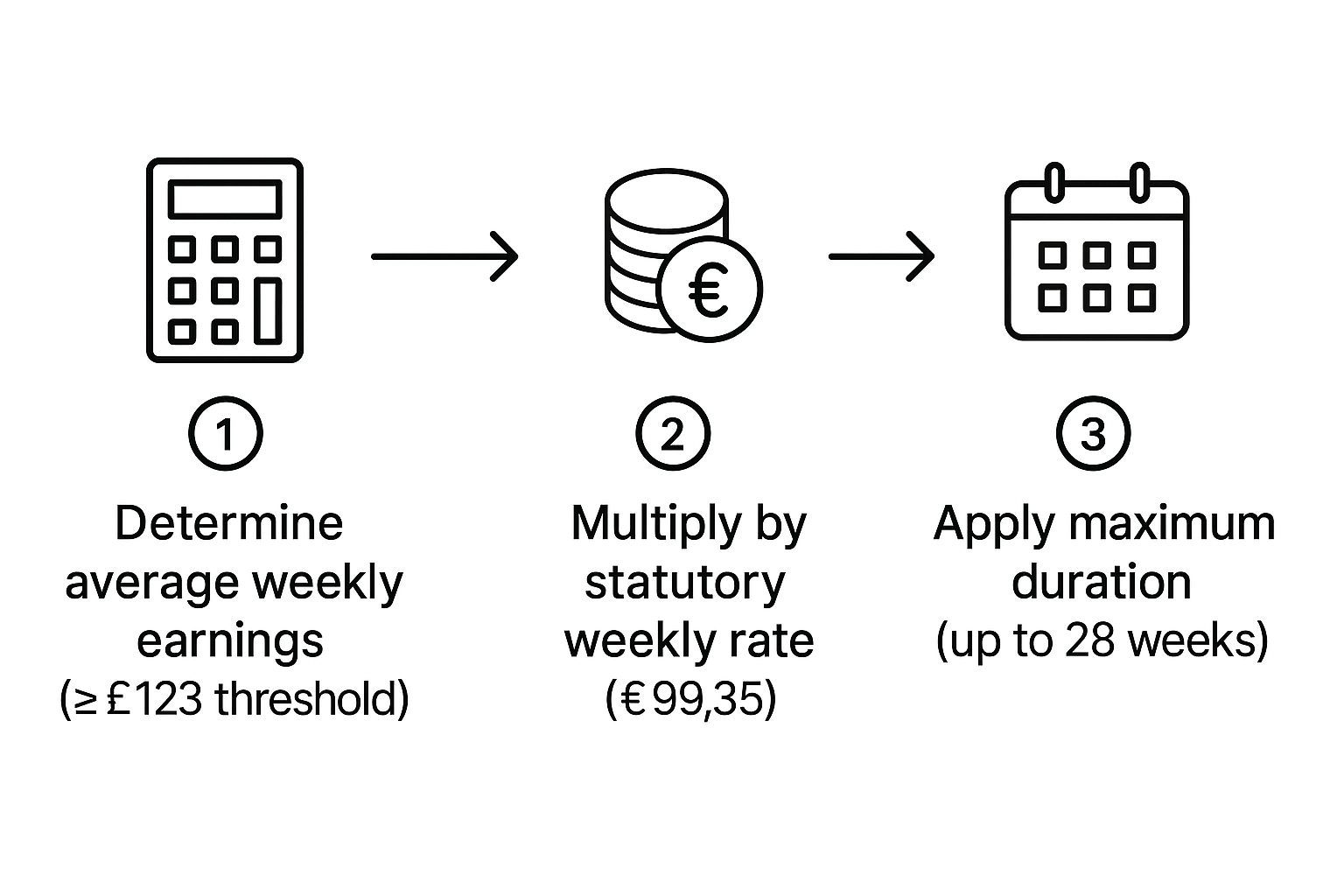
As you can see, working out the average weekly earnings is the foundational step. It's what determines if an employee even qualifies for SSP by meeting that all-important earnings threshold.
What Counts as Earnings
When you're adding up the total gross pay within that relevant period, you need to include more than just their basic salary. The figure has to represent the employee’s total earnings that are subject to National Insurance contributions.
That means you must include things like:
- Commissions
- Bonuses
- Overtime pay
A Common Pitfall: A classic mistake I see is employers leaving out variable payments like bonuses or commission from the AWE calculation. This is wrong. If a payment is part of the employee's gross pay for NI purposes during that relevant period, it has to be included.
A Worked Example for a Monthly Employee
Let's walk through a real-world scenario. Imagine an employee, David, who gets paid on the last Friday of each month. He falls sick on Wednesday, 10th July.
- End of Relevant Period: His last payday before the sickness started was Friday, 28th June.
- Start of Relevant Period: We need to count back at least eight weeks from the 28th June. The start date will be the day after his April payday, which was the 26th of April, so the period starts on the 27th of April.
- Gross Earnings: We look at his total gross pay from his May and June payslips. Let's say he earned £2,200 in May and £2,400 in June (which included a small bonus). That’s a total of £4,600.
- Calculate AWE: To get his AWE, we take the total earnings (£4,600), divide it by the number of months (2), multiply by 12 to get an annual figure, and then divide by 52 for the weekly average. This gives David an AWE of £530.77, putting him comfortably over the £123 threshold.
These rules for calculating earnings apply to everyone, regardless of their contract type. We cover this in more detail in our guide on sick pay entitlement for part-time workers.
Applying the Right SSP Rate and Daily Payments

Alright, you’ve confirmed the employee is eligible and you've worked out their Average Weekly Earnings. Now for the final piece of the puzzle: calculating the actual Statutory Sick Pay (SSP) they’re owed.
This stage is all about translating the standard weekly rate into a daily payment that reflects your employee's specific working pattern.
It’s a common trip-up to simply divide the weekly rate by seven. The correct approach is to base your calculation on the employee's ‘qualifying days’ – the days they normally work. This ensures someone working a three-day week receives a fair, pro-rata amount compared to a colleague working five days.
Don't forget, the first three qualifying days of any sickness period are unpaid. These are known as ‘waiting days’. You only start paying SSP from the fourth qualifying day.
Breaking Down the Weekly Rate
To make life easier, the government provides pre-calculated daily rates based on different work patterns. For an employee working a standard five-day week, the daily rate is £23.75. So, if that employee is off sick for three payable days, the SSP due would be £71.25 (£23.75 x 3).
Manually tracking all this can be a headache, which is why many businesses rely on modern payroll systems to handle the complexities.
Official SSP Daily Rates by Working Pattern
To remove any guesswork, here’s a quick-reference table with the official daily rates. It’s a handy way to ensure you’re applying the correct amount every single time.
| Qualifying Days per Week | Daily SSP Rate |
|---|---|
| 7 | £16.97 |
| 6 | £19.80 |
| 5 | £23.75 |
| 4 | £29.69 |
| 3 | £39.59 |
| 2 | £59.38 |
| 1 | £118.75 |
Using this table simplifies the process and helps you stay compliant, giving you confidence in your calculations.
A Practical SSP Calculation Example
Let's walk through a real-world scenario. Imagine your employee, Maria, works Monday to Friday. She’s off sick for ten consecutive working days, starting on a Monday.
Here’s how you'd work it out:
- Identify Qualifying Days: Maria’s qualifying days are Monday, Tuesday, Wednesday, Thursday, and Friday.
- Apply Waiting Days: The first three days (Monday, Tuesday, Wednesday) are unpaid waiting days.
- Count Payable Days: SSP starts from the fourth day, which is the first Thursday. Maria is off for ten working days, leaving seven payable days (the Thursday and Friday of week one, and all five days of week two).
- Calculate the Total: Maria works a five-day week, so we use the daily rate of £23.75.
The calculation is straightforward: 7 payable days x £23.75 = £166.25.
This is the total SSP you would owe Maria for this period. You'd pay this amount through your usual payroll run, where it will be subject to the normal tax and National Insurance deductions. Following this process keeps your calculations accurate and fully compliant with UK law.
Common SSP Calculation Mistakes to Avoid
Getting your Statutory Sick Pay (SSP) calculations wrong can quickly spiral into payroll headaches, compliance problems, and unhappy employees. Even with the best of intentions, tiny errors can lead to the wrong payments going out. Honestly, the best way to bulletproof your process is to learn from the most common pitfalls we see time and time again.
One of the most frequent mistakes is miscalculating the 'relevant period' used to figure out an employee's Average Weekly Earnings (AWE). This isn't just any eight-week window; it has very specific start and end dates tied to the employee's last payday before their sickness began. Using the wrong dates will skew the AWE, and you could end up wrongly disqualifying an eligible employee or, just as bad, paying someone who isn't.
Another classic slip-up is how qualifying days are handled for staff with variable schedules. For part-timers or shift workers, you can't just guess their working pattern. You need to know their contracted working days to apply the correct daily SSP rate and manage the three waiting days properly.
Misunderstanding Linked Periods of Sickness
One of the trickiest areas is the whole concept of ‘linked periods’ of sickness. It’s a rule that catches a lot of employers out, but getting it right is crucial for managing longer-term or recurring absences.
So, what makes periods of sickness 'linked'? They have to meet two conditions:
- Each absence lasts for four or more consecutive days.
- They are 8 weeks (56 days) or less apart from each other.
When this happens, the absences are treated as one continuous Period of Incapacity for Work (PIW). The big takeaway here is that the employee doesn't have to serve another three waiting days for the second (or third, or fourth…) absence. Forgetting to link them means you might incorrectly hold back payment for the first three days of a later sickness, leading to an underpayment and a rightfully confused employee.
Let's look at a real-world scenario: An employee is off sick for a week in April. They come back to work, but then fall ill again for two weeks in early May. Because the absences are less than eight weeks apart, they are linked. This means the employee is entitled to SSP from the very first qualifying day of their May sickness, as they already served their waiting days back in April.
Inaccurate Record Keeping
Finally, and this one is a biggie, failing to keep meticulous records is a mistake that can have serious repercussions down the line. Your SSP records aren't just for your own convenience; they're a legal requirement. You must be able to show exactly how you calculated every payment and justify your decisions if HMRC ever comes knocking.
That means documenting everything:
- The start and end dates of every sickness period.
- The dates you paid SSP and the precise amount paid each time.
- Copies of all self-certification forms and doctor's 'fit notes'.
- A clear record of which specific dates were treated as waiting days.
Poor records make it nearly impossible to correctly manage linked periods and can leave you completely exposed during a compliance check. Keeping organised, accurate files on all SSP payments protects your business and means you can handle any employee queries with confidence. By steering clear of these common mistakes, you can keep your payroll process accurate, compliant, and fair for everyone.
SSP Record Keeping and Future Changes
So, you’ve paid your employee their Statutory Sick Pay. Job done? Not quite. Your responsibilities as an employer don't end the moment the payment leaves your account.
Keeping accurate, detailed records for every SSP payment isn’t just good housekeeping; it’s a legal must-have. Getting this right protects your business and means you’re always prepared to answer any questions from your employee or HMRC down the line.
Think of your records as a clear audit trail for each sickness absence. You'll need to document the dates the employee was off, keep copies of their self-certification forms and any doctor’s fit notes, and maintain a log of the actual SSP payments you made. It’s also absolutely crucial to note the specific dates you treated as waiting days.
What to Keep in Your SSP File
To stay on the right side of the law, your records for each employee's sickness absence should always include:
- The start and end dates of the Period of Incapacity for Work (PIW).
- All correspondence tied to the sickness, especially any fit notes.
- A clear calculation showing exactly how you worked out the SSP payment.
- The specific dates for which SSP was paid and the total amount.
- A note of any linked periods of sickness.
Having a solid internal process is the key to managing this smoothly. If you need a hand building one, we've got some great advice on developing a comprehensive policy on sickness absence. Remember, you are required to keep these records for at least three years from the end of the tax year they relate to.
Looking Ahead at SSP Reforms
The SSP landscape is about to get a major shake-up. The Government is bringing in reforms, currently planned for April 2025, designed to make sick pay more accessible for more people.
The proposed changes are significant. They’re expected to scrap the Lower Earnings Limit, which would bring more low-income workers into the SSP net. They also aim to get rid of the three-day waiting period, meaning SSP would be payable from day one of sickness. You can read the government’s full report on these statutory sick pay proposals to get the complete picture.
The payment structure itself is also set for a change. Under the new proposals, employees would be paid at 80% of their earnings or the flat statutory rate—whichever is lower.
Keeping a close eye on these legislative shifts is vital. It’s the only way to future-proof your payroll and make sure your business stays compliant when the new rules land.
Got Questions About SSP? We've Got Answers
When you're dealing with Statutory Sick Pay (SSP), it’s easy to run into those fiddly, specific situations that leave you scratching your head. Let's clear up a few of the most common questions we hear from employers trying to get it right.
Do Part-Time Employees Get SSP?
Yes, they absolutely do. A part-timer's right to SSP isn't based on the number of hours they work. The only thing that matters is whether they meet the standard eligibility criteria.
The key test is their average weekly earnings. As long as they earn, on average, at least the Lower Earnings Limit of £123 per week, they are entitled to SSP just like a full-time employee.
What Happens if an Employee Is Sick During Annual Leave?
This one trips a lot of people up. An employee who falls ill while on holiday can choose to end their annual leave and be placed on sick leave instead. If they do this and they qualify for SSP, you're obligated to pay it.
They can then reschedule the annual leave they missed out on for a later date. The most important thing here is to have a clear conversation so everyone knows what's happening.
Key Takeaway: An employee’s entitlement to paid holiday and their right to SSP are two separate things. They can't get both for the same day, but they can switch from holiday pay to sick pay if the situation calls for it.
Can I Pay More Than the Statutory Amount?
Of course. SSP is just the legal minimum you have to provide. Many companies choose to offer a more generous sick pay package, often called contractual or occupational sick pay.
If you have a company scheme like this, the details will be in the employee's contract. Just remember, your own policy can be more generous, but it can never offer less than the statutory amount.