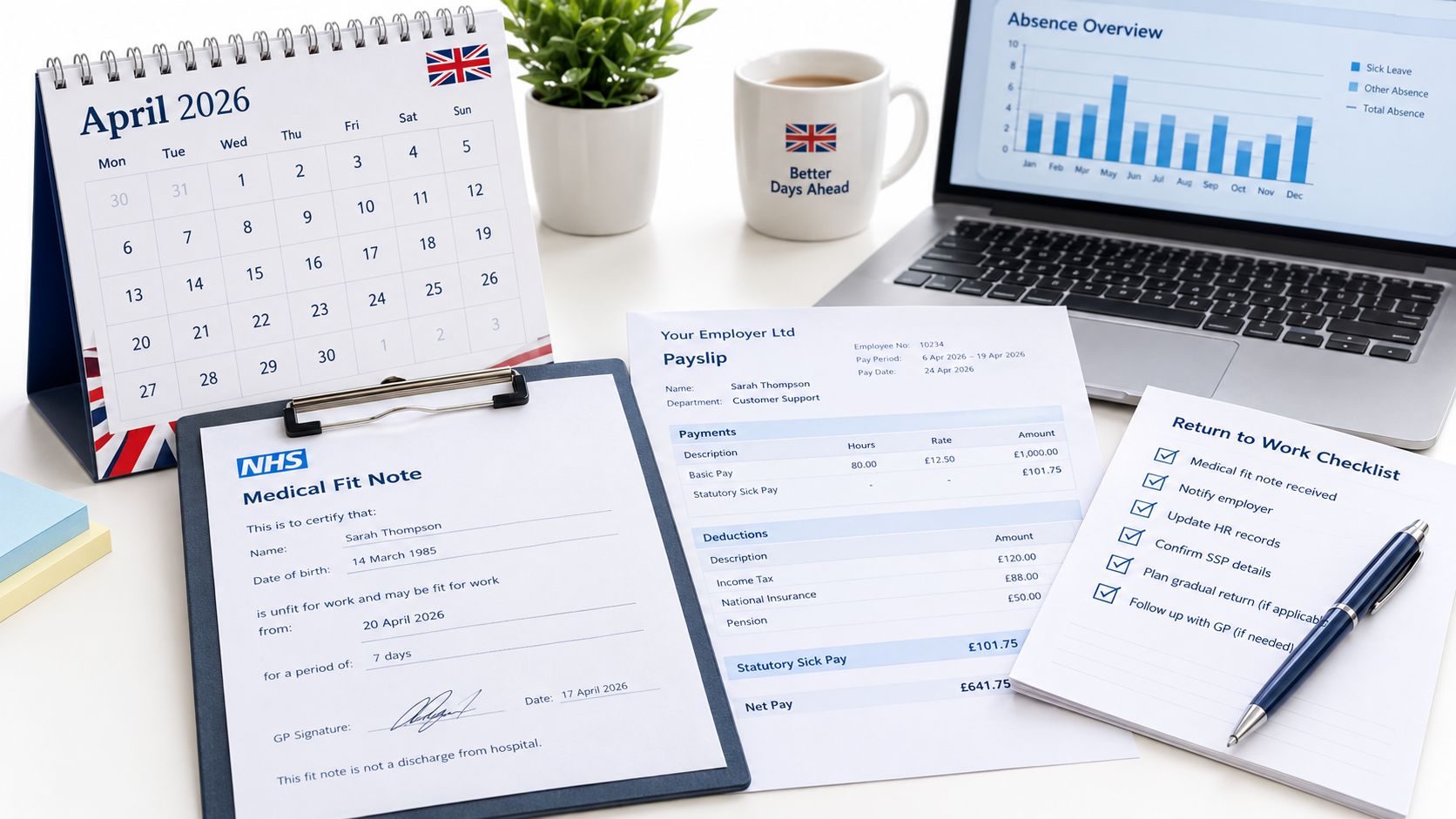
A good sickness absence policy is more than just a document in a dusty folder; it's a foundational guide that clearly lays out the game plan for both employees and managers when someone needs to call in sick. Think of it as a shared agreement that ensures everyone is treated fairly and consistently, protecting both the business and your people from the stress of uncertainty.
Why Your Business Needs a Sickness Absence Policy

It's easy to see a sickness policy as a rigid rulebook designed to catch people out, but it’s much better to view it as a framework built on mutual respect. It’s a pact between you and your team that takes all the guesswork and anxiety out of the equation.
When an employee is genuinely unwell, the last thing they or their manager needs is confusion over what to do next. A well-crafted policy provides a clear, predictable path for everyone to follow, establishing a consistent process for reporting an absence, keeping in touch, and eventually, returning to work.
This consistency is the bedrock of fair management and is absolutely vital for maintaining trust. Without it, you run the risk of different managers handling situations in their own ways, which can quickly spiral into feelings of favouritism or even discrimination.
To give you a clearer picture, let's break down the essential roles of a sickness absence policy.
Core Functions of a Sickness Absence Policy
The table below summarises the primary purposes a sickness absence policy serves, highlighting the advantages for both the company and its staff.
| Function | Benefit for the Business | Benefit for the Employee |
|---|---|---|
| Set Clear Expectations | Ensures consistent management of absences across all departments and reduces operational disruption. | Removes anxiety and confusion by providing a clear process to follow when unwell. |
| Ensure Legal Compliance | Protects against claims of unfair dismissal or discrimination by creating a fair, documented procedure. | Guarantees fair and equitable treatment, protecting their rights under employment law. |
| Promote Fairness | Prevents inconsistent treatment by managers, fostering a culture of trust and transparency. | Knows they will be treated the same as any other colleague in a similar situation. |
| Support Employee Wellbeing | Helps identify underlying health issues early, allowing for supportive intervention and demonstrating care. | Feels valued and supported, knowing there's a structured plan to help them recover and return to work. |
| Manage Costs | Reduces the financial impact of unplanned absences by creating a structured and managed process. | Understands the process for receiving any company or statutory sick pay they are entitled to. |
As you can see, a solid policy acts as a safety net for everyone, creating a more stable and supportive work environment.
Establishing Clarity and Fairness
The main job of a policy on sickness absence is to create a system that’s both transparent and fair. It proactively answers all the crucial questions before they even have a chance to become problems:
- Who exactly does an employee need to contact when they're sick?
- What's the cut-off time for them to get in touch?
- What specific information do they need to provide?
- At what point is a doctor’s fit note required?
By putting all this down in writing, you guarantee that every single absence is handled the same way, every time. This procedural fairness is your best defence against potential legal headaches, like claims of unfair dismissal or discrimination that can pop up from poorly managed absence cases.
A clear policy transforms absence management from a subjective, often stressful task into a structured, fair process. It's about creating a system that supports employees while protecting the operational needs of the business.
This structured approach doesn't just manage risk; it can actively help reduce unplanned absences. When your team understands the process and knows what to expect, it often discourages non-genuine time off. More importantly, it helps you spot patterns or underlying issues that might be causing frequent absences, allowing you to step in with support early on.
Protecting Your Business and Supporting Your Team
The ripple effect of an employee's sickness goes far beyond just one empty desk. Unplanned absences throw workflows into disarray, pile extra work onto the rest of the team, and can seriously dent morale and productivity. While managing absence is a reality for every business, the costs can really add up.
Recent UK data drives this point home. The sickness absence rate, which tracks the percentage of working hours lost, stood at 2.0% in early 2024. While that’s a dip from the 2.6% peak in 2022, it’s still stubbornly higher than the pre-pandemic rate of 1.9%, showing just how crucial effective management continues to be. You can find out more about the latest sickness absence statistics and what they mean for employers.
Ultimately, a strong policy is a powerful statement about your company's commitment to employee wellbeing. It shows you take health seriously and have a supportive plan ready to go. This builds a positive culture where people feel valued and secure—and that’s a massive driver for engagement and loyalty.
Navigating UK Sickness Absence Law
Understanding your legal duties is the absolute cornerstone of a solid policy on sickness absence. It's easy to see UK employment law as a minefield of potential tripwires, but a better way to look at it is as the foundation for building a fair, secure, and supportive workplace.
When you get to grips with these rules, you gain the confidence to manage absence properly, which protects both your business from risk and your employees from unfair treatment. The legal side of things can seem complicated, but it really boils down to a few key areas: paying people correctly, fulfilling your duty of care, and making sure your actions are never discriminatory.
Let's break down the three main legal pillars you need to build your policy on.
The Foundation of Sick Pay
First up, the most fundamental legal requirement: Statutory Sick Pay (SSP). This is the minimum amount the law says you must pay an eligible employee who is off sick for four or more days in a row. Think of SSP as the legal floor – you can't go any lower, but you can certainly go higher.
And many companies do. Offering a more generous company (or contractual) sick pay scheme is a great way to better support your team. If you go this route, your policy must be crystal clear on who qualifies, how much they’ll get, and for how long.
A few key points to keep in your back pocket:
- Eligibility: To get SSP, an employee needs to earn over a specific amount, known as the Lower Earnings Limit.
- Duration: You’re required to pay SSP for up to 28 weeks for one period of sickness.
- Documentation: You can’t ask for a doctor's fit note until an employee has been off for more than seven days. For the first week, they can "self-certify."
Nailing these rules means you've covered your basic obligations and given your team a clear financial safety net.
Your Overarching Duty of Care
Beyond just pay, every UK employer has a legal duty of care towards their employees. This is a broad responsibility to take all reasonable steps to protect their health, safety, and wellbeing at work. Crucially, this duty doesn't just vanish when someone calls in sick.
In fact, you could argue it becomes even more important. Maintaining reasonable and supportive contact with an absent employee is part of this duty. It shows you're concerned for their welfare and are planning for their eventual return, rather than just piling on the pressure.
A proactive duty of care during sickness isn't just about legal box-ticking. It’s about showing your team they are valued members of the organisation, even when they aren't at their desk. This is how you build real loyalty and trust.
This principle is especially vital when you're dealing with long-term absence or issues like work-related stress. If you fail to act reasonably, you could find yourself facing a constructive dismissal claim, where an employee resigns and argues that your actions (or lack thereof) breached their employment contract.
The Equality Act 2010 and Disability
The Equality Act 2010 is a massive piece of legislation that has a direct and significant impact on how you manage sickness absence. The Act protects people from discrimination, and one of the key "protected characteristics" is disability. For a condition to count as a disability, it has to have a 'substantial' and 'long-term' negative effect on a person's ability to carry out normal daily activities.
This is hugely relevant because many long-term health issues can legally be classified as disabilities. Conditions like severe depression, cancer, or multiple sclerosis, for example, all fall under the Act's protection.
When an employee's sickness is linked to a disability, the law places a duty on you to make reasonable adjustments. This isn't a passive role; you must proactively take steps to remove or reduce any disadvantages they face at work.
This could mean things like:
- Adjusting their working hours or shift patterns.
- Providing specialised equipment to help them do their job.
- Reallocating minor parts of their role to a colleague.
Ignoring this duty is a fast track to a costly disability discrimination claim. For this reason, any robust policy on sickness absence must include a firm commitment to considering reasonable adjustments. It’s not just about staying on the right side of the law – it’s about creating an inclusive workplace where every single employee gets the support they need to succeed.
Building Your Sickness Absence Policy Step by Step
Now that we've covered the legal must-haves, it's time to start putting your policy together. Think of it like building a house; you need a solid foundation and a clear blueprint to create something that’s strong, fair, and fit for purpose. A comprehensive policy on sickness absence isn't just one big document—it's a collection of practical parts that work together to guide everyone.
This section is your toolkit. We'll break down each essential element piece by piece, explaining not just what to include, but why it matters. This gives you a clear roadmap to either build a new policy from the ground up or to make your existing one even better.
The Reporting Procedure
The very first step when an employee is unwell is for them to let you know. If this process is fuzzy, it can cause immediate frustration for both the employee and their manager, so your policy needs to be crystal clear.
Don't just say, "let your manager know." Get specific.
- Who to Contact: Be precise. Name a job title, like "your direct line manager," instead of a person who might leave. It's also smart to name a backup contact just in case the manager is unavailable.
- How to Contact: State the exact method. A phone call is often best, as it allows for a quick, direct conversation, which you can't always get from a text or email.
- When to Contact: Set a clear deadline. Something like "at least one hour before your scheduled start time" gives managers enough notice to arrange cover and shuffle workloads without causing major disruption.
Getting this procedure right ensures everyone is treated the same and gives managers the information they need to keep things running smoothly.
Certification and Fit Notes
After the initial call, the next stage is all about certification. For the first seven calendar days of sickness, an employee can "self-certify" that they're unwell. Your policy should explain how you want this done—perhaps with a simple self-certification form to keep things official.
Once an absence goes beyond seven days, the rules change. The employee must provide medical evidence, which usually comes in the form of a Statement of Fitness for Work—what most of us call a "fit note"—from their GP or another healthcare professional.
Your policy needs to spell this out. State that a fit note is required from the eighth day of absence and must be sent promptly to HR or their line manager. This document is more than just proof of sickness; it offers valuable advice on what the employee can do, helping you plan a supportive and managed return to work.
A fit note is more than just a sick note; it's a tool for communication. It can suggest a phased return, altered hours, or amended duties, providing a medical basis for the reasonable adjustments you can make to help your employee get back to work safely.
This formal approach to certification gives you the evidence needed to manage longer-term absences and correctly process Statutory Sick Pay (SSP).
Return-to-Work Interviews
One of the most effective tools for managing absence is the return-to-work interview, but it's amazing how often it gets overlooked. This is just a short, informal chat with an employee on their first day back. Think of it as a supportive check-in, not an interrogation.
The meeting has two main goals. First, it’s a chance to confirm the employee is genuinely feeling better and to catch them up on what they've missed. Second, it's a great opportunity to talk about why they were off and spot any underlying problems. A few colds might just be bad luck, but they could also be a sign of high stress or other issues at work. When drafting your policy, it's a good idea to look at broader health and safety policy examples to see how they weave in employee wellbeing.
By holding these interviews consistently after every single absence, no matter how short, you show that you take employee health seriously and treat everyone fairly. This simple habit reinforces your policy and can be a powerful deterrent for non-genuine absences. For a deeper look at the nuts and bolts of handling absence, our guide on managing sickness absence is packed with more strategies.
By carefully including these core parts—reporting, certification, and return-to-work chats—your policy will become a clear and reliable guide for everyone in your company.
Managing Short-Term and Long-Term Sickness
A solid policy on sickness absence knows that not all absences are created equal. A single day off for a migraine just isn’t the same as a six-week recovery from surgery, and your response needs to reflect that. The trick is to build a flexible management strategy that balances day-to-day operational needs with compassionate, individual support.
Trying to manage both situations with the same broad brushstrokes simply won't cut it. Frequent, short-term absences tend to chip away at workflow and team morale, demanding one approach. Long-term sickness, on the other hand, requires a more focused, case-by-case plan centred on employee wellbeing and a sustainable return to work.
Dealing with Short-Term Absences
Short-term absences are those brief, one-off periods of sickness – think of a common cold or a 24-hour bug. While a single instance is rarely a big deal, a pattern of frequent short days off can be a red flag for bigger issues like low morale, high stress, or a disengaged employee.
Your best defence here is consistency. By holding a return-to-work interview after every absence, you establish a fair and predictable process for everyone. It gives you a natural moment to check in, show you care, and discreetly spot any patterns that might be forming.
Some companies use tools like the Bradford Factor, a formula that places more weight on frequent, short absences than on a single long one. It can be a handy way to highlight trends, but you have to use it with a huge amount of caution.
The Bradford Factor should only ever be a trigger for a conversation, never for automatic disciplinary action. Using it as a blunt instrument can end up punishing employees with genuine chronic health conditions and could easily lead to claims of discrimination.
At the end of the day, managing short-term absence is about being fair, consistent, and paying attention. Spotting a pattern should be the start of a supportive conversation, not the end of one.
The infographic below shows just how powerful a clear policy can be, visualising a 29% reduction in sick days taken per employee.
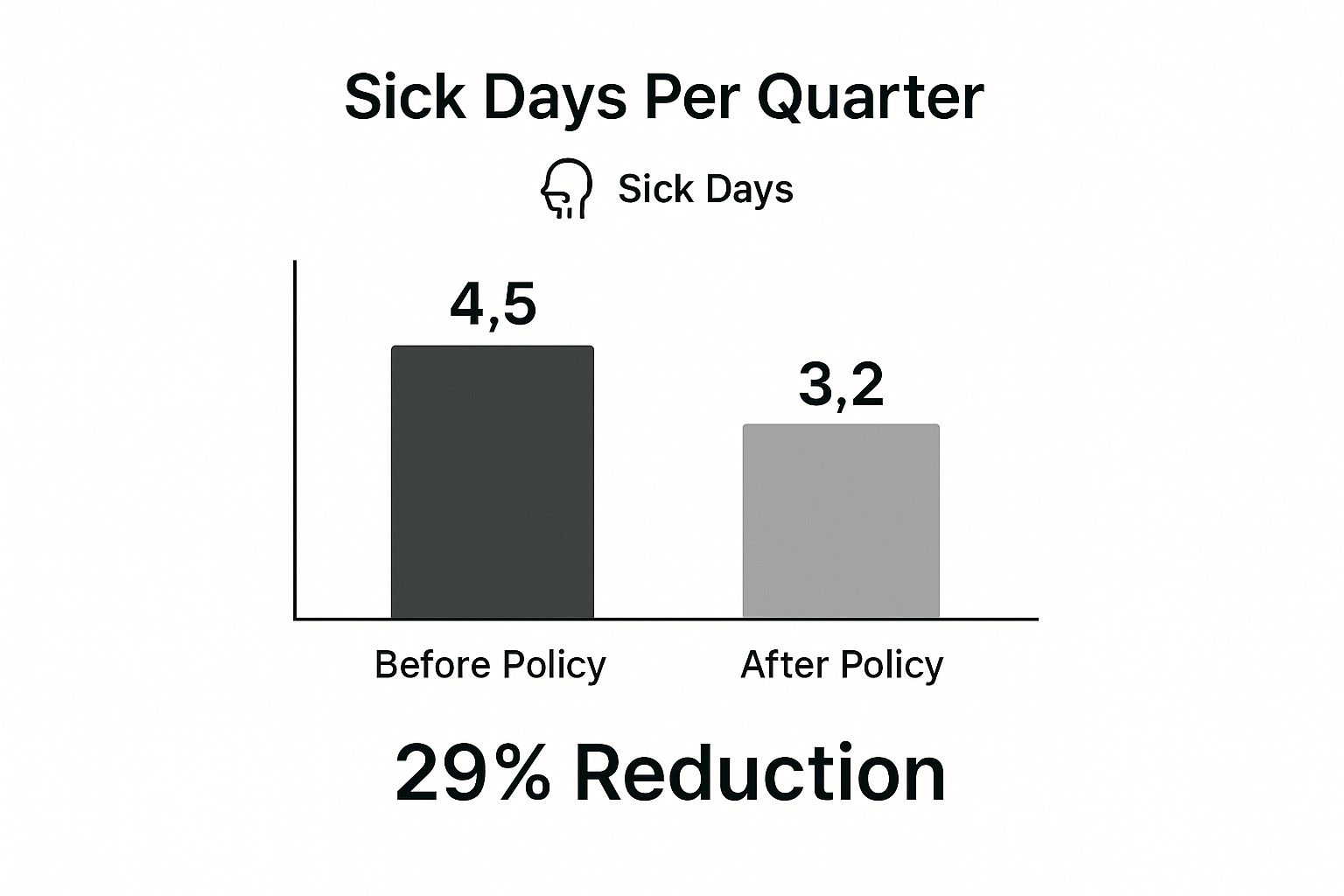
This data really drives home how a structured, well-thought-out approach can bolster both attendance and operational stability.
Supporting Employees Through Long-Term Sickness
When an absence stretches from days into weeks or even months, your focus has to shift entirely. This is no longer about managing patterns; it’s about supportive case management. A long-term illness is often a deeply stressful and difficult time for an employee, and your approach must be human-first. The goal is to help them feel connected to the workplace and pave the way for a successful return when they’re ready.
Maintaining compassionate contact is absolutely vital. Agree on a reasonable schedule for checking in – maybe a brief, friendly email once a week – just to see how they're doing and share any important company updates. This simple act stops them from feeling isolated and makes the thought of coming back much less intimidating. It's all about finding that sweet spot between being supportive and adding pressure. Our comprehensive guide offers more practical tips on managing employee absences of all kinds.
It’s also helpful to understand the wider context of sickness rates. In the UK, a persistent gap exists between the public and private sectors. In 2024, 2.9% of working hours in the public sector were lost to sickness, compared to just 1.8% in the private sector. This ongoing difference shows how sector-specific pressures and cultures can influence absence.
Comparing Approaches to Short-Term and Long-Term Absence
The strategies for handling a few days off versus a few months off are fundamentally different. One is about maintaining consistency and spotting trends, while the other is about personalised support and careful planning. This table breaks down the key distinctions in how you should approach each situation.
| Aspect | Short-Term Absence Management | Long-Term Absence Management |
|---|---|---|
| Primary Goal | Minimise disruption, ensure fairness, and identify patterns. | Support employee recovery and plan a sustainable return to work. |
| Key Tools | Return-to-work interviews, consistent procedures, attendance tracking. | Regular contact, Occupational Health, phased return plans. |
| Focus | Procedural consistency and fairness across the team. | Individualised case management and compassionate support. |
| Warning Signs | Frequent, recurring absences without a clear medical reason. | Lack of communication, deteriorating condition, anxiety about returning. |
Ultimately, a well-rounded policy needs distinct but complementary strategies for both scenarios to be truly effective.
The Role of Occupational Health and Phased Returns
For any prolonged absence, an Occupational Health (OH) assessment can be a game-changer. With the employee's full consent, an OH specialist can provide an impartial, expert medical opinion on their fitness for work and suggest specific adjustments to help them return. This advice is golden because it gives you a clear, professional-led path to follow.
A successful return is very rarely a flick-of-a-switch event. One of the most effective tools in your arsenal is the phased return, which allows an employee to ease back into their role with reduced hours or lighter duties.
Here’s what a simple phased return plan could look like:
- Week 1: Working three days a week, focusing on core, low-pressure tasks.
- Week 2: Working four days, gradually reintroducing more responsibilities.
- Week 3: Returning to full-time hours and duties.
This kind of structured plan, ideally guided by OH advice, helps rebuild an employee’s confidence and stamina. It dramatically increases the chances of a sustainable, successful return to their role, proving you have a policy that values its people just as much as its productivity.
Understanding the True Cost of Employee Absence
When an employee is off sick, it’s easy to focus on the immediate hit to your payroll. You pay them sick pay, and that seems to be the end of the story. But that’s just the tip of the iceberg. The real financial damage is happening beneath the surface, largely out of sight.
To get a true picture of the impact, you have to look past the obvious expenses and start digging into the significant indirect costs. These are the hidden drains on your resources that can be far more harmful to your business's health and operational rhythm.
Once you understand these costs, your policy on sickness absence stops being just another HR document. It becomes a strategic tool for protecting your bottom line.
The Direct Costs of Absence
Direct costs are the most straightforward part of the puzzle. They are the tangible expenses that show up directly on your balance sheet, the ones you can easily track and calculate when an employee is unwell.
- Sick Pay: This covers both the legal minimum, Statutory Sick Pay (SSP), and any enhanced company or contractual sick pay you provide.
- Temporary Cover: Think of the money spent on hiring agency staff to fill the gap or paying overtime to your existing team to cover the absent person's workload.
- Recruitment Costs: If a long-term sickness eventually leads to an employee leaving, you're suddenly faced with the high cost of recruiting and training their replacement.
While these numbers are simple enough to add up, they only tell a small part of the story. The real financial strain often comes from the less obvious, indirect consequences.
Uncovering the Hidden Indirect Costs
Indirect costs are the stealthy expenses that you can't easily put a number on. They disrupt workflow, tank efficiency, and put a huge strain on your team. They won’t appear as a neat line item in your accounts, but their cumulative effect can be massive. Think of them as the ripples spreading out from a single absence.
A recent analysis really put this into perspective, estimating that absenteeism cost UK businesses a staggering £103 billion in 2023 – a sharp rise from previous years. This figure is a mix of direct expenses and these powerful, often overlooked, indirect costs. You can dive into the full breakdown of these findings on the real cost of absenteeism in the UK to see the national picture.
So, what are these hidden costs?
- Lost Productivity: It’s not just that the absent employee isn't getting work done. Colleagues covering for them are often less efficient because they're juggling extra tasks or working in an unfamiliar role.
- Reduced Team Morale: When the same people are constantly picking up the slack, it’s easy for them to feel overworked and resentful. That's a fast track to lower engagement across the board.
- Management Time: Managers get pulled away from their strategic work. Instead, they spend valuable time rearranging schedules, reassigning tasks, and dealing with the admin of the absence itself.
The greatest hidden cost is often the disruption to momentum. A key person's absence can delay projects, affect customer service, and break the rhythm of a high-performing team, with effects that linger long after they return.
Calculating this full picture helps build a powerful business case for investing in proactive wellbeing initiatives and solid management processes. For more ideas on this, our guide on effective absence management strategies offers some really practical steps to get these costs under control.
By appreciating both the direct and indirect costs, you can see why an effective policy isn't just an expense—it's an investment in your company's financial health and operational resilience.
Common Questions on Sickness Absence Policies
Even with a perfectly written policy on sickness absence, tricky situations are bound to pop up. Theory is one thing, but putting it into practice means dealing with real people and their complex, often sensitive issues. This is where managers and HR professionals can feel the most pressure—trying to balance company rules with compassion and legal duties.
Let's tackle some of the most common and challenging questions that arise when managing sickness absence. Our goal is to give you clear, practical answers so you have the confidence to handle these situations fairly, consistently, and with a human touch.
How Should We Adapt Our Policy for Mental Health Absences?
This is one of the most critical questions in modern people management. The golden rule? Treat mental health with the exact same seriousness and respect as physical health. Your policy should state this explicitly to remove any ambiguity right from the start.
While the core reporting process can stay the same (e.g., calling a line manager by a certain time), the way you manage the absence needs a specific focus. Managers should be trained to lead conversations with empathy, focusing on support rather than interrogation. Confidentiality is paramount; employees absolutely must feel they are in a safe space to be open.
The key adaptation really shines at the return-to-work stage. This is where you must actively discuss and consider reasonable adjustments. And no, these aren't just for physical conditions.
An employee returning from a period of anxiety or depression may need adjustments just as much as someone recovering from surgery. The goal is to create an environment where discussing mental health is destigmatised, and asking for help is seen as a sign of strength, not weakness.
Practical adjustments could include things like:
- A temporary shift to more flexible hours.
- A short-term change in duties to reduce high-pressure tasks.
- Ensuring easy access to an Employee Assistance Programme (EAP).
- Planning for a phased return to ease them back into the work environment.
What if We Suspect an Absence Is Not Genuine?
This is a delicate situation that demands an evidence-based approach, not gut feelings or office gossip. Acting on suspicion alone is a fast track to destroying trust and potentially facing a grievance. Your most powerful tool here is your established process.
Use the return-to-work interview as your first port of call. It provides a formal, consistent setting to discuss the absence. Ask supportive but direct questions about their recovery and fitness for work. You'd be surprised how often the simple act of having a structured, professional conversation is enough to discourage non-genuine time off.
If you spot clear patterns, like frequent absences on Mondays or Fridays, you can address the pattern of absence itself without making accusations. You might say, "I've noticed you've been off sick on four of the last five Fridays. Is there an underlying issue I can support you with?" This opens the door for a real conversation.
Only if you have concrete, objective evidence—for instance, a public social media post showing them doing something that contradicts their stated reason for absence—should you even think about formal action. If you do, you must kick off a proper disciplinary investigation, following your company's procedure to the letter to ensure a fair process.
Can We Contact an Employee on Sick Leave?
Yes, you can, and in many cases, you absolutely should. Keeping in reasonable and supportive contact is not only good practice but also a part of your duty of care. An effective policy on sickness absence should outline this to set clear expectations for everyone.
The purpose of this contact is twofold: to check on the employee's wellbeing and to help plan for their eventual return. It should never, ever feel like you're pressuring them to come back before they're ready. The key word is reasonable.
- For short-term absences, a brief call or text to see how they're feeling might be appropriate.
- For long-term leave, it’s a great idea to agree on a communication plan together. A weekly email or a fortnightly call can keep them connected to the workplace without being intrusive. This helps prevent feelings of isolation and can make their return to work a much smoother transition.
Balancing the needs of the business with the employee's need to recover is a tightrope walk. Keep conversations supportive, focus on their welfare, and make sure to document the contact you make.
What Happens When an Employee Exhausts Sick Pay?
When an employee's entitlement to Statutory Sick Pay (SSP) or company sick pay runs out, their employment doesn't automatically end. They are still your employee, and their contract is still active. What you do next is critical and is guided by employment law.
The first step is to keep the lines of communication open. You should schedule a formal meeting to review their situation. To make this discussion productive, it's essential to have an up-to-date medical report, which you can get with the employee’s explicit consent, often through an Occupational Health assessment.
Your legal duty to consider all reasonable adjustments continues. You must explore every viable option that could help them return to work. If their old role is no longer feasible, you have an obligation to search for suitable alternative roles within the business. Dismissal on capability grounds should only ever be a final resort, used after you've exhausted all other avenues and followed a fair and thorough formal process.