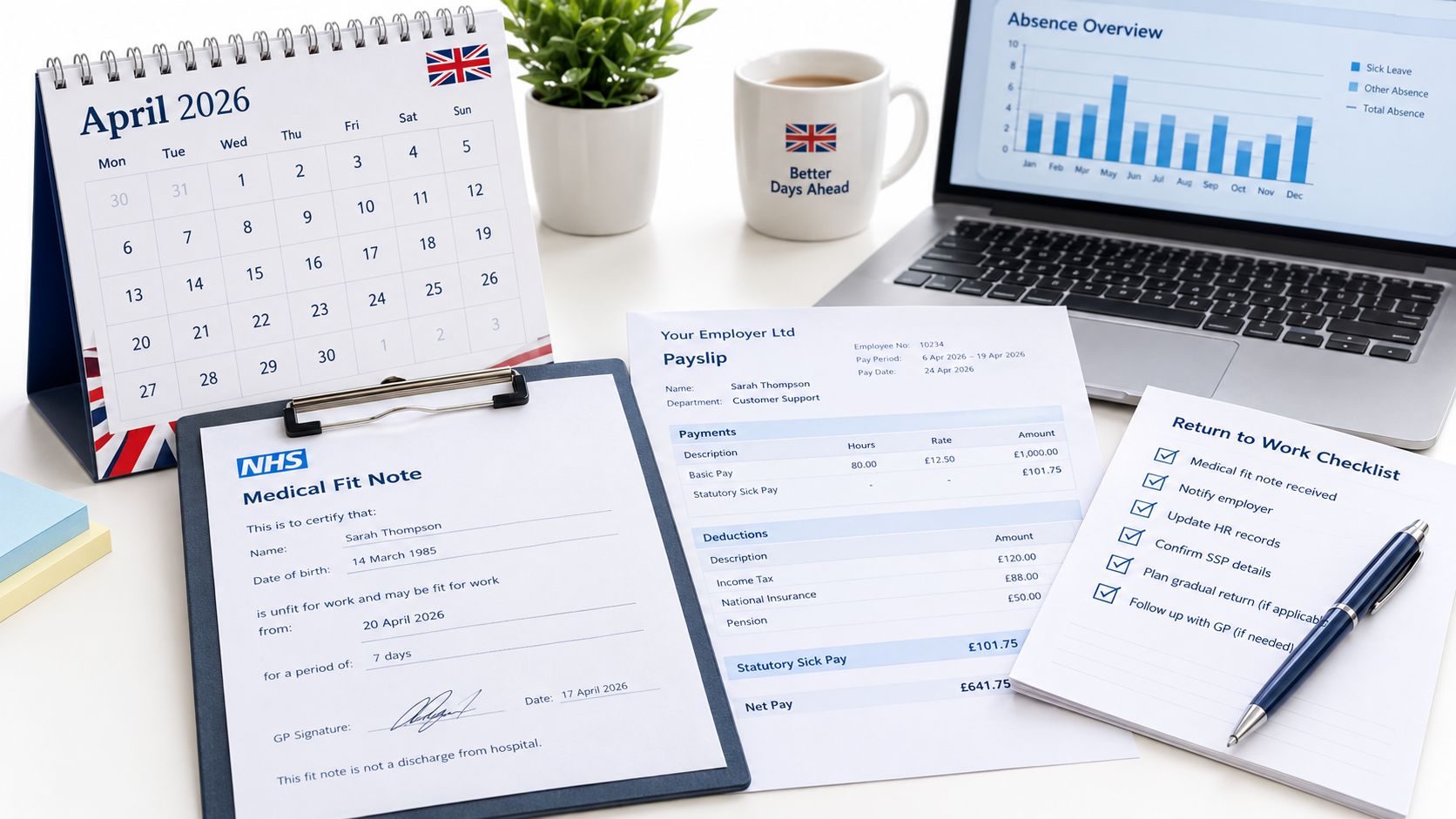
Monday morning, your phone rings before you've had your first coffee. A team member says they're ill, won't be in, and expects you to sort the payroll side later. You've got a choice to make fast, trust the call, ask for proof, or wait until the absence crosses the line where a fit note becomes the next step. Get that wrong, and you end up with messy records, inconsistent pay decisions, and avoidable friction.
Table of Contents
- What Self Certification Sick Leave Actually Means
- The 7 Calendar Day Rule and Why Working Days Trip Managers Up
- Fit Notes Versus Self Certification, Which Route When
- Building a Self Certification Policy That Actually Holds Up
- Spotting and Preventing Sick Leave Abuse Without Becoming a Surveillance State
- Managing Self Certification Sick Leave in LeaveWizard
- LeaveWizard Versus Spreadsheets for Self Certification Tracking
- What the Evidence Says and Your Manager Action Checklist
What Self Certification Sick Leave Actually Means
The Monday-morning call is simple enough. Someone says they're off sick, and you need to decide whether that's enough, whether to record it as absence, and whether proof is needed straight away. In UK workplaces, self-certification sick leave is the standard route for short absences, and it means the employee's own declaration covers the first stretch of sickness.

The point of self-certification is practical. It gives small employers a clean way to log short sickness absences without forcing a doctor's appointment for every cold, migraine, or stomach bug. The rule that matters is straightforward, up to 7 calendar days, then the employer can require a fit note as medical evidence, and Acas also notes that employees who self-certify for up to 7 days should still receive any sick pay they're entitled to, which is why accurate recording matters for payroll and Statutory Sick Pay handling (Acas guidance on fit notes and proof of sickness).
Why the distinction matters in real life
If you treat every call as if it needs immediate proof, you create distrust and unnecessary admin. If you treat every call as automatically credible forever, you lose control of absence records and can mis-handle pay. The right approach is boring but effective, record the absence, count the days properly, and only escalate once the threshold has been crossed.
That's the operational job here. Self-certification solves the awkward gap between a quick phone call and a doctor-backed absence record, and it keeps the process proportionate. It also gives you the basis for a sensible return-to-work conversation later, because you've got dates, duration, and a consistent absence trail rather than a memory-based guess.
Practical rule: trust the initial declaration, then manage the timeline hard. The system should be consistent, not suspicious.
The 7 Calendar Day Rule and Why Working Days Trip Managers Up
A manager gets the call on a Friday. The employee says they are off sick and expects the week to be treated as five working days away from work. That is where small-business teams get caught out. UK sickness absence is counted in calendar days, so the clock keeps running through weekends and bank holidays, whether the person was rostered or not.

Count the whole run, not just shifts
Count every day from the first day of sickness. Do not trim out the days the employee would normally have been off. Guidance aligned with the NHS says self-certification is based on calendar days, not working days, so weekends and bank holidays stay in the total even if the employee does not usually work them (ZoomDoc's NHS-aligned explainer). If you only count shifts, you will undercount absences and delay the point where you should ask for medical evidence.
The classic trap is a Friday-to-next-Friday absence. It looks like one work week, but in calendar terms it can push past the self-certification limit. That is why your process should trigger the move to medical evidence on day 8, not when somebody has missed an arbitrary number of shifts. Government guidance says the expectation changes after the 7-calendar-day threshold, and a fit note is normally required once that point is reached (GOV.UK sick leave guidance). For a plain-English walkthrough of what that document looks like, the fit note from GP guide is worth keeping to hand.
What to do on a Monday morning
Write down the first day of sickness the moment the employee calls. Then count forward day by day, without trying to adjust for rota patterns, rest days, or public holidays. If the absence is still within the first 7 calendar days, self-certification covers it. If it goes beyond that, ask for the fit note straight away.
Do not let managers improvise here. If one supervisor counts working days and another counts calendar days, your records will be a mess and payroll decisions will drift. Keep the rule simple, count the full run, and make the escalation point automatic in your process.
Friday to Friday is not “one week off work”, it is a calendar-period test. Miss that, and your records will be wrong even if your intentions are good.
Fit Notes Versus Self Certification, Which Route When
A manager who waits too long to ask for medical evidence usually creates the problem they were trying to avoid. Use self-certification for the early absence period, then move to a fit note once the 7-calendar-day line is crossed. That keeps the process tied to the evidence you have, not the evidence you wish you had.

Use the route that matches the available evidence
A fit note is the next step once self-certification runs out. Government guidance sets the expectation after the 7-day threshold, so your process should switch on day 8 and ask for medical evidence at that point (GOV.UK sick leave guidance). That is the clean line. It gives managers a rule they can apply without argument.
Self-certification is fast and low-friction, which is exactly why it works for short absences. A fit note serves a different purpose. It gives a healthcare professional view on whether someone is fit for work, fit with adjustments, or not fit at all, which matters when the absence is longer, the return will be phased, or the pattern needs firmer evidence. Use the route that fits the stage of absence, not the route that sounds tougher.
If you want the practical GP side of the process, the fit note from GP guide is a useful reference.
Handle grey areas with judgement, not drama
Short absences that repeat can justify a pattern check, even when each one sits inside the self-certification window. Mental-health-related absences still follow the same calendar rule, but they need a calmer conversation and a return-to-work process that does not sound accusatory. Long absences and phased returns need proportionate evidence requests, applied the same way every time.
Do the simple thing first. If the absence is still within self-certification, accept self-certification. If it has gone beyond that, stop relying on a self-cert form and ask for the fit note. That is the rule, and managers should not freelance around it.
Building a Self Certification Policy That Actually Holds Up
A policy that works has to do more than repeat the legal threshold. It needs a structure that line managers can follow under pressure. Start with scope, then evidence, then consequences. If you get the order wrong, people improvise, and improvisation is where inconsistency creeps in.
Build the policy from the ground up
First, define who the policy covers and when it applies. Keep the eligibility wording simple, because managers need to know whether it applies to full-time, part-time, permanent, and temporary staff without hunting through three documents. Then set out the declaration fields you expect on a self-cert form, reason for absence, dates covered, and the employee's confirmation that the information is accurate.
Next, spell out the escalation rule in plain English. Day 1 to day 7 is self-certification. Day 8 triggers a request for medical evidence. That's the point where your absence record must switch from trust-based reporting to documentary support. Leave the policy no room for “we usually do it this way” nonsense, because that's exactly how managers end up applying the rule differently from one team to another. A template can help here, and a practical starting point is this professional sick leave policy guide.
Policy rule: write the date trigger into the document, not just into manager training. If the rule only lives in someone's head, it won't survive turnover.
Don't skip the unglamorous clauses
Your policy also needs a clear link to sick pay entitlement, confidentiality, and abuse handling. Acas makes it clear that employees who self-certify for up to 7 days should still receive any sick pay they're entitled to, so your policy should tie the reporting process to payroll handling, not leave managers guessing at pay decisions. If someone repeatedly gives false information, the policy should say there may be a misconduct route, but don't write it like a threat.
A decent self-certification policy usually covers:
- Who reports the absence: the employee, ideally on the first day and through the agreed channel.
- What gets recorded: start date, expected return date, reason category, and declaration.
- When evidence is needed: automatic trigger after day 7, not whenever a manager feels like asking.
- How pay is handled: reference to contractual sick pay and SSP rules.
- How data is stored: confidentially, with access limited to the people who need it.
- What happens with abuse: investigation route, not instant assumptions.
A clear policy gives managers confidence and employees consistency. That's the key benefit.
Spotting and Preventing Sick Leave Abuse Without Becoming a Surveillance State
The wrong way to deal with abuse is to start treating everyone like a liar. That kills trust fast and usually doesn't catch the people you're worried about anyway. The better way is honest, proportionate monitoring, with repeat patterns reviewed properly and one-off absences handled like normal sickness.
Focus on patterns, not paranoia
Return-to-work conversations are the simplest control you've got, and they're usually enough. They force a quick check on why someone was absent, whether they're back to full capacity, and whether anything needs follow-up. If absences start clustering on Mondays, Fridays, or around peak periods, pattern review is justified. The key is to review the record, not the rumour.
The Bradford Factor is often used for spotting repetitive absence patterns because it highlights frequent short absences rather than just total days lost. Use it as a trigger for a conversation, not a verdict. Then pair it with line-manager notes and recurring absence reviews so you're looking at the whole picture rather than one metric.
Deal with repeat offenders without making it personal
If someone keeps calling in at awkward times, say what you've seen and keep the tone calm. Don't accuse. Ask for the pattern to be explained, remind them of the policy, and make sure the same standard applies to everyone else. That's how you keep the process defensible.
For managers dealing with burnout-linked absence or stress concerns, this reVIBE Mental Health guide on burnout at work is a sensible read to share internally. It helps keep the conversation on wellbeing instead of immediately jumping to discipline.
Hard truth: if your managers only act when they're frustrated, your absence control is already inconsistent.
A humane process is still a firm process. It just doesn't confuse suspicion with management.
Managing Self Certification Sick Leave in LeaveWizard
A clean workflow matters more than a perfect policy on paper. In a small business, the employee should log the absence once, the manager should see it immediately, and the system should do the counting for them. That removes the mistakes that happen when someone is trying to remember whether day 7 fell on a Sunday or a bank holiday.
Make the system do the counting
The useful workflow is simple. The employee submits the sickness report through the self-service portal. The manager gets the notification. The system records the start date, counts calendar days, and flags the point where self-certification ends and a fit note is needed. That stops the most common error, manual counting that only tracks scheduled shifts.
Once the absence reaches the threshold, the workflow should request medical evidence automatically. That is the part too many small businesses handle badly because someone relies on email memory or a spreadsheet note. A structured tracker keeps the record intact and makes it easier to show why a pay decision was made later. If you need the feature set in one place, the sick leave tracker is the relevant reference.
Tie the record to pay and review
Acas says employees who self-certify for up to 7 days should still receive any sick pay they're entitled to, so the system has to hold the absence record and the pay logic together. If those two things live in separate places, you invite errors. The right workflow links the self-cert note, the calendar count, the fit-note prompt, and the payroll outcome in one chain.
That also helps with reporting. Once the absence is logged properly, managers can see patterns, review repeat absences, and support return-to-work conversations with facts instead of guesswork. If you're running the process manually, you're relying on someone remembering each step. That's not a system, it's a hope.
Operational rule: if the tool can't tell you when day 8 arrives, it's not doing enough.
LeaveWizard Versus Spreadsheets for Self Certification Tracking
Spreadsheets look cheap until the first counting error or missing email. Then they get expensive in lost time, messy records, and inconsistent decisions. A proper tracker wins on consistency, and that matters more than spreadsheet flexibility when you're managing sickness absence.
| Capability | LeaveWizard | Manual Spreadsheet |
|---|---|---|
| Calendar-day accuracy | Automates the count | Relies on manual checking |
| Audit trail | Keeps a consistent record | Easy to overwrite or misfile |
| SSP processing | Links absence data to pay decisions | Needs separate calculations |
| Fit-note escalation | Can trigger the next step | Depends on someone remembering |
| Reporting patterns | Easier to review | Requires extra work |
| Small-team fit | Built for routine admin | Fine only if absence is rare and simple |
The weak spot in spreadsheets is never the formula alone. It's the human workflow around it, missed weekends, lost attachments, inconsistent manager practice, and no obvious prompt when the fit-note point arrives. If your team is tiny and sickness is rare, a spreadsheet might survive for a while. If you want fewer mistakes and less chasing, software is the cleaner option.
What the Evidence Says and Your Manager Action Checklist
The evidence does not support lazy certainty. A Cochrane review found that extending self-certification from one week to two weeks increased mean sickness absence duration in one case, while other extensions had no clear effect, and overall the evidence stayed low to very low certainty (Cochrane review). That leaves you with a straightforward management lesson, the policy has to be clear, and managers have to apply it consistently. There is no magic number on the calendar.

Monday morning checklist
- Confirm calendar-day counting. Stop treating working days as the default, because that is how absences get misclassified.
- Set the fit-note trigger. Make day 8 the automatic escalation point.
- Train line managers. Give them one script and one process, not their own version of the rules.
- Review patterns, not just totals. Repeated short absences need review even when each one is individually legitimate.
- Use return-to-work interviews. They are your best early warning system and your best reset tool. Keep the return-to-work interview template ready so managers do not improvise.
- Explain the why clearly. Staff are more likely to accept a rule they understand than one they think is arbitrary.
- Automate if the admin is getting messy. If counting, chasing, and recording are eating time, fix the process before it becomes a habit.
The hard lesson is that self-certification is not a trust problem. It is a process problem. Get the process right, and most of the noise disappears. Get it wrong, and even honest absences turn into admin headaches.
LeaveWizard gives small businesses a cleaner way to manage absence records, calendar-day counting, and fit-note escalation without living in spreadsheets. If you want a tighter handle on self certification sick leave, visit LeaveWizard and see how it can simplify the process without adding more admin to your week.