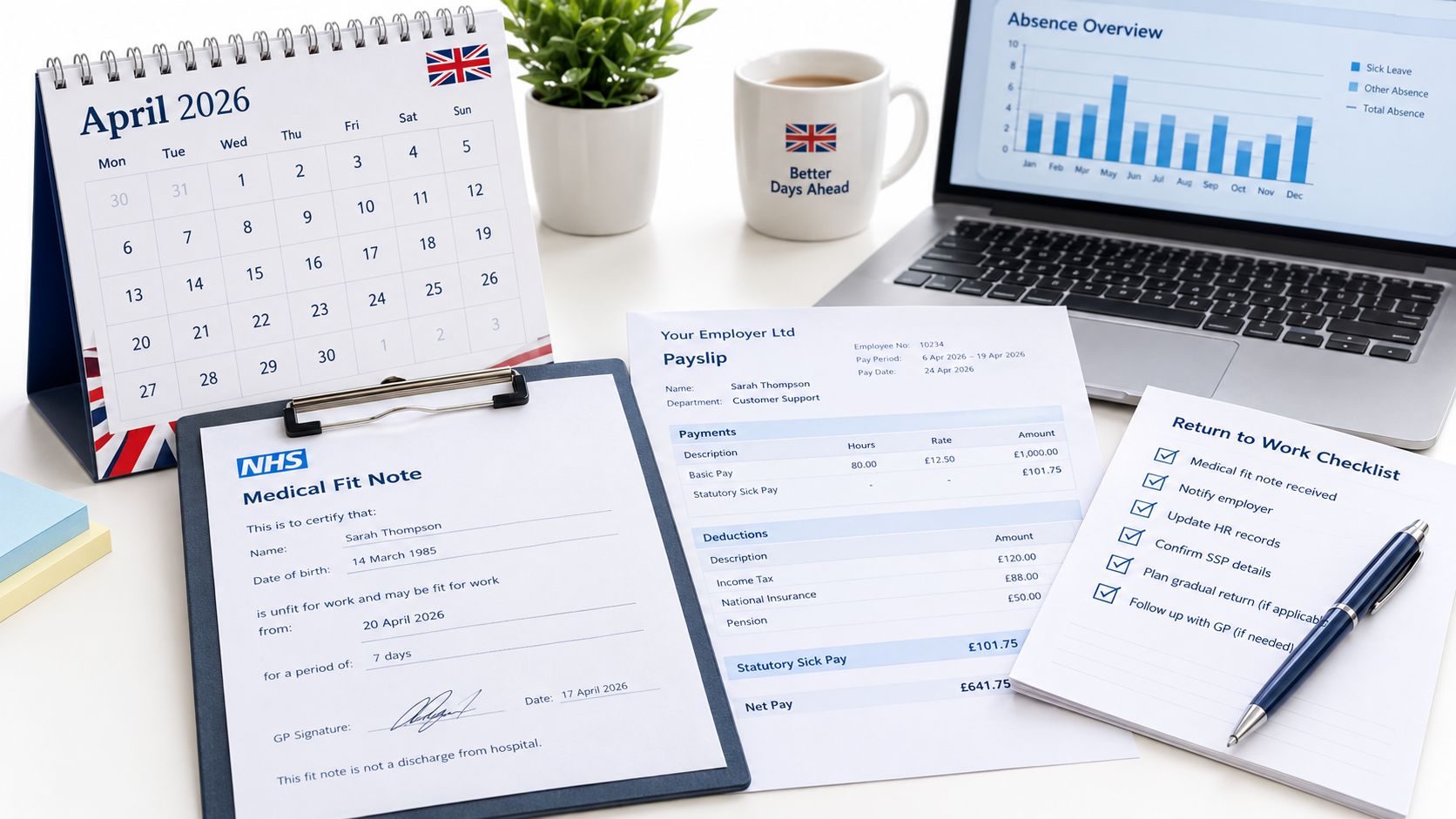
It's 7:12 on a Tuesday morning. A key team member sends a message saying they can't come in. Within minutes, the knock-on effects start. A shift needs covering, customer work may slip, payroll questions follow, and a line manager has to decide what to ask without crossing a line.
That's why calling in sick isn't just an HR moment. It's a business process. Small businesses feel short-notice absence more sharply than larger employers because there's less slack in the system, fewer backup people, and more pressure on managers to make quick judgement calls. If your reporting method is informal, your policy is vague, or your managers all handle absence differently, one sick day can turn into confusion, inconsistency, and avoidable compliance risk.
Table of Contents
- The True Cost of Calling In Sick for Your Business
- Understanding Why Your Employees Call In Sick
- Your UK Legal and Compliance Obligations
- How to Craft a Compliant Sickness Absence Policy
- A Manager's Workflow for Handling Sick Calls
- Tracking Sickness to Prevent Abuse and Support Wellbeing
- Automate Absence Management with LeaveWizard
The True Cost of Calling In Sick for Your Business
Most owners first experience sickness absence as disruption. Someone's off. A rota changes. Another employee stays late. A manager spends the first hour of the day firefighting instead of leading. That's real, but it's only the visible part of the problem.
The bigger issue is that sickness absence is persistent, measurable, and operationally significant across the UK. The Office for National Statistics reported that workers were absent from work due to sickness or injury for 148.9 million working days in 2024, with a sickness absence rate of 2.0% of working hours lost, which means roughly 1 in every 50 working hours was missed for health reasons, according to ONS absence data referenced here.
For a small business, that matters because absence isn't random noise. It affects service delivery, staffing cover, payroll administration, customer commitments, and manager time. If the same business still relies on ad hoc texts, voicemail, or memory, it has no reliable record of what happened, who approved what, or whether similar patterns are emerging elsewhere.
Why reactive handling creates bigger problems
When businesses treat calling in sick as a one-off interruption, they usually create three avoidable issues:
- Inconsistent decisions: One manager asks for details, another doesn't. One allows a text, another insists on a call.
- Weak records: Fit notes, return dates, and reasons end up scattered across inboxes and chat threads.
- Poor planning: Managers can't spot repeat short-notice absences until the problem is already affecting operations.
Practical rule: Treat every sickness report as both a people issue and a process event. You need empathy for the person and a reliable system for the business.
A good absence process doesn't eliminate disruption. It reduces avoidable disruption. That's the difference.
Understanding Why Your Employees Call In Sick
Some absences are straightforward. A bug, a migraine, a fever, a child's illness affecting the employee's ability to work. Others are not. If you manage every case as though it's “off sick today”, you'll miss the underlying cause and probably choose the wrong response.

Short-term illness is only one part of the picture
The obvious category is genuine short-term illness. Colds, infections, stomach upsets, minor injuries, and other brief conditions will always be part of working life. These cases usually need a simple response: record the absence properly, confirm when the employee should update you, and avoid turning a routine illness into an interrogation.
Then there are ongoing health conditions. Employees with recurring symptoms, treatment schedules, or variable health may have intermittent absences that look irregular on the surface but are entirely understandable once you see the pattern. These cases demand consistency, confidentiality, and sometimes adjustments to the role or working arrangement.
A third category is stress, burnout, and mental health strain. In practice, many managers miss this because the employee doesn't always say “I'm burnt out”. They may report headaches, exhaustion, poor sleep, anxiety, or feeling unable to cope. Resources such as Therapy with Ben's guide to burnout at work can help managers understand how burnout presents and why a purely disciplinary lens often makes matters worse.
Different causes need different management responses
Not every absence is driven by health alone. Sometimes repeated calling in sick points to poor scheduling, conflict with a manager, low morale, or a role that has become unsustainable. That doesn't mean the sickness is fake. It means the workplace may be contributing to it.
Such situations call for employer judgment. Use the initial report to gather only what you need. Use the pattern over time to guide the response. If you need a practical employee-facing reference point for legitimate explanations people often give, these common reasons for calling in sick are useful context.
A sensible manager response often looks like this:
- Short-term illness: Keep contact light, confirm reporting expectations, and focus on cover.
- Recurring symptoms: Check whether there's a pattern and whether medical evidence or workplace adjustments may become relevant.
- Stress-related absence: Explore workload, relationships, deadlines, and whether the job itself is part of the issue.
- Concerning patterns: Review the record before drawing conclusions. Frequency matters, but context matters more.
A repeated Friday absence might be misconduct. It might also be a signal that the employee's current working pattern is failing. You won't know unless your records are good and your managers ask better questions.
Trust doesn't come from ignoring patterns. It comes from responding to patterns fairly.
Your UK Legal and Compliance Obligations
When an employee calls in sick, managers often focus on cover first and paperwork later. That's understandable, but it's where small businesses make expensive mistakes. The legal risk usually doesn't come from one absence. It comes from inconsistent handling, poor documentation, and treating health-related cases as conduct issues too early.
What managers need to get right early
Start with a clear distinction between reporting absence and proving entitlement. Your business needs a consistent reporting process, but managers shouldn't improvise evidence requirements on the spot. If you want a plain-English overview of the statutory framework, this guide on what Statutory Sick Pay is is a useful reference point.
Your policy and manager training should cover these basics:
How absence must be reported
Set out who the employee contacts, by when, and through which channel. If the process changes depending on shift patterns or site location, document that clearly.What information you need
Usually that means the employee is unfit for work, the likely duration if known, and whether urgent work needs handing over. You do not need a manager fishing for unnecessary medical detail.When self-certification applies and when further evidence may be needed
Many businesses cause friction by asking for evidence too early or too casually. Your policy should define the process so managers don't invent their own rules.How sick pay is handled
Be specific about statutory entitlement, any company sick pay, and what payroll needs from the employee and manager.
Where small employers get into trouble
The next issue is disability and discrimination risk. If an employee's sickness absence is linked to a condition that may amount to a disability, your obligations change. At that point, repeated absence is not just an attendance problem. It may require a discussion about reasonable adjustments, altered duties, temporary flexibility, or occupational health input.
That's where many employers go wrong. They focus on triggers and forget context. A trigger can be useful administratively, but it can't replace judgement.
Common mistakes include:
- Applying the same trigger to everyone without review
- Treating mental health absence less seriously than physical illness
- Demanding detail managers don't need
- Penalising disability-related absence without legal advice
- Failing to document support offered, not just concerns raised
Compliance point: A defensible process is one you can explain later. Why was evidence requested? Why was contact made? Why was an adjustment considered or refused? Write that down at the time.
Fit notes also need practical handling, not box-ticking. If a fit note indicates the employee may be fit for work with adjustments, the manager's task is to assess whether those adjustments are possible in the actual role. If they aren't, record why. If they are, implement them consistently and review them.
For small businesses, the safest approach is rarely the harshest one. It's the clearest one. You need a written policy, trained managers, a consistent record of each absence, and enough discipline not to make legal decisions by instinct on a busy morning.
How to Craft a Compliant Sickness Absence Policy
A workable sickness policy removes guesswork. Employees know how to report. Managers know what to ask. Payroll knows what to process. HR has a record it can rely on later if patterns need review or a decision is challenged.
The case for clarity is strong. CIPD's 2025 Health and Wellbeing at Work survey found the average sickness absence rate rose to 7.8 days per employee per year in 2024, as noted in this reference to the CIPD finding. When absence is part of normal business reality, policy quality matters.

Write the reporting rules so nobody has to guess
A strong policy answers the operational questions first.
- Who to notify: Name the role or team, not “management”.
- When to notify: Give a clear deadline for day-one reporting.
- How to notify: State the approved method. If you accept digital reporting, say so.
- What must be included: Keep it limited to essential information.
- How ongoing updates work: Avoid daily improvisation by setting expectations.
If you want a drafting starting point, this sick leave policy template guide is useful because it helps structure the process in a way managers can easily follow.
Build consistency into manager decisions
The policy also needs to cover what happens after the initial report. That's where fairness often breaks down, especially in owner-managed businesses where one supervisor is more flexible than another.
Include these clauses:
- Evidence rules: Spell out self-certification, fit note handling, and when additional information may be requested.
- Return-to-work meetings: Make them routine, brief, and supportive. Don't reserve them only for “problem employees”.
- Trigger reviews: If you use absence thresholds, explain that they prompt review rather than automatic discipline.
- Adjustment considerations: State that health-related absence may require a discussion about support or changes to work.
For more complex cases, it can help managers understand how a fitness for work assessment in The Lagom Clinic's occupational health guide fits into decision-making, especially when an employee may be able to work with modifications rather than stay off entirely.
Policy quality shows up in manager behaviour. If your managers still have to guess what “reasonable” means, the document isn't finished.
A good policy should read like an operating manual, not a warning notice.
A Manager's Workflow for Handling Sick Calls
The quality of absence management often depends on what happens in the first five minutes. A poor response creates defensiveness, patchy records, and avoidable disputes. A good response gets the facts, protects dignity, and lets the business plan quickly.
What poor handling looks like
An employee calls in sick. The manager sounds irritated, asks probing medical questions, and ends with “I'll need proof”. Then the manager forgets to log the absence until later, tells payroll separately, and messages the team with partial information.
That approach fails on every level. It unsettles the employee, gives the business no clean audit trail, and leaves room for inconsistent follow-up.
For wider reading on the operational side of handling employee unexpected absences, there's useful value in looking at how organisations separate immediate cover decisions from the employee conversation itself. Those are different tasks and should be handled as such.
A better workflow for real businesses
Industry guidance from Personio notes that forcing an unwell employee to phone in is outdated, while HRIS-based reporting captures all required data in one transaction, notifies stakeholders, and creates a time-stamped audit trail for compliance, as described in Personio's guidance on calling in sick protocols.
That matters because the goal isn't the phone call. The goal is the record.
A practical manager workflow looks like this:
Acknowledge the report calmly
“Thanks for letting me know. I'm sorry you're unwell.”Confirm the essentials
Ask whether they're unfit for work, whether they expect to be off beyond today if known, and whether there's anything urgent that needs handing over.Explain the next step
Tell them how the absence will be recorded and when you need an update.Log it immediately
Record the absence in your system while the details are current.Arrange cover separately
Don't turn the employee into the cover planner unless your policy specifically requires a handover note and they're well enough to provide one.Follow up appropriately
Keep contact proportionate. Supportive, not intrusive.
| Do | Don't |
|---|---|
| Use a consistent script so every employee gets the same basic treatment | Interrogate the employee about private symptoms |
| Record the absence straight away with dates and notes | Rely on memory or scattered messages |
| Separate welfare from suspicion until you've reviewed a pattern | Assume misuse from one absence |
| Tell the employee when to update you | Leave contact expectations vague |
| Prepare for return-to-work discussion before they come back | Treat the return as administratively complete once they reappear |
“Thanks for telling me. Focus on getting better. I'll log this now, and we'll check in according to the policy.”
That kind of response is professional, human, and easy to defend later.
Tracking Sickness to Prevent Abuse and Support Wellbeing
If you only record absence to count days lost, you're underusing the data. Tracking should help you see patterns early enough to act. That might mean extra support, workload changes, a return-to-work conversation, or a more formal review. It should not mean building a culture where every absence is treated as suspicious.

The scale matters. The UK Office for National Statistics reported 185.6 million working days lost to sickness in 2022, which means even small improvements in pattern detection can have material operational value for workforce planning, as discussed in this UK absence analysis.
Track patterns, not just days lost
Useful absence tracking goes beyond a total count. Look at:
- Frequency: Is the employee calling in sick often, even if each absence is short?
- Timing: Are absences clustering around particular shifts, deadlines, or periods of pressure?
- Team-level trends: Is one department seeing more short-notice absence than others?
- Return-to-work quality: Are managers documenting what they learned when employees came back?
Tools like the Bradford Factor often enter the conversation. Used carefully, it can highlight frequent short-term absence. Used badly, it becomes a blunt punishment device that ignores disability, stress, or poor management.
Use triggers to start conversations, not punish people
A sensible employer uses data as an invitation to review, not a shortcut to discipline.
For example:
- A cluster of short absences may point to a recurring health issue.
- Repeated Monday absences may suggest burnout after unsustainable weekend cover.
- A spike in one team may reflect poor supervision or impossible workloads.
- A pattern across winter months may need staffing contingencies rather than individual blame.
Good absence analytics ask, “What might this pattern mean?” before asking, “What sanction applies?”
That shift matters. It protects the business from overreaction and gives employees a fairer process. It also improves planning, because the same records that support a wellbeing conversation also help forecast staffing pressure.
Automate Absence Management with LeaveWizard
A lot of sickness absence friction comes from weak process design. The employee doesn't know how to report. The manager logs it late. HR has incomplete notes. Payroll asks follow-up questions. Nobody has a single view of who's off and for how long.

Why system design matters
The strongest operational improvement is often simple. Replace fragmented reporting with one structured workflow that captures the absence event, stores notes and supporting documents, and alerts the right people at the same time. That gives managers real-time visibility and leaves a reliable record for later review.
For small businesses, that means fewer re-entry errors, fewer missing details, and less dependence on individual managers remembering what happened. It also means the business can analyse absence by employee, team, and absence type without reconstructing events from texts and inboxes.
What automated reporting changes day to day
In practice, an automated absence system should help you do four things well:
- Report consistently: Employees follow the same process every time.
- See impact immediately: Managers can spot coverage issues as soon as absence is logged.
- Keep auditable records: Notes, dates, and documents sit in one place.
- Review trends over time: HR can identify recurring issues without manual spreadsheets.
One example is LeaveWizard, which provides self-service absence reporting, central records, calendars, and reporting tools that help small businesses manage sickness absence in a more consistent and compliant way.
A short product walkthrough helps show what that looks like in practice:
Automation won't remove the need for manager judgement. It does remove a lot of the preventable mess around that judgement. And that's its primary value. Calling in sick becomes a structured process the business can handle calmly, fairly, and with evidence.