
Let's cut straight to it: when you're running a business in the UK, the number of working days in a year isn't a simple, fixed figure. It generally lands somewhere between 251 and 254 days, but the exact count changes every single year. Getting your head around this fluctuation is one of the keys to smart business planning.
How Many Working Days Are in a Year

It seems like a basic question, but many business owners are surprised to find the answer is a bit of a moving target. The truth is, the total count hinges on several variables that shift from year to year. Nailing this number isn't just a box-ticking exercise; it’s the bedrock of accurate payroll, fair leave management, and realistic project timelines.
Think of it as the fundamental metric that defines your team's total capacity for the year ahead. To get it right, you have to account for weekends, public holidays, and even the occasional leap year.
Key Factors That Change The Total
The main things that influence your final count are:
- Weekends: A standard year has 52 weeks, which means you can immediately subtract 104 weekend days (Saturdays and Sundays) from the 365 total days.
- Bank Holidays: The UK's bank holiday schedule isn't one-size-fits-all. It varies between England, Scotland, Wales, and Northern Ireland, and extra holidays can even be granted for special events.
- Leap Years: That extra day in February every four years adds one potential working day to the calendar, a small but important detail that can't be overlooked.
Let's take a look at a real-world example. 2023 was a normal year with 365 days, but England observed an extra bank holiday for the King's coronation, bringing the total to nine. Once you remove the 104 weekend days and those 9 holidays, you're left with 251 working days. In contrast, 2024 is a leap year, which pushes the total closer to 254.
You can dive deeper into how these numbers are calculated in our complete guide for modern business planning.
To give you a clearer picture, here's a quick breakdown of how a typical year stacks up.
Working Days Breakdown At a Glance
| Day Type | Approximate Number (Non-Leap Year) | Approximate Number (Leap Year) |
|---|---|---|
| Working Days | ~252 | ~253 |
| Weekend Days | 104 | 104 |
| UK Bank Holidays | ~9 | ~9 |
Remember, this table is an approximation, as the exact number of bank holidays can vary. It’s always best to check the official schedule for your specific country within the UK.
Mastering this calculation is a fundamental business skill. An incorrect count can lead to payroll errors, unfair pro-rata leave for part-time staff, and misaligned project deadlines, impacting both your finances and employee morale.
By getting to grips with these components, you can move from a rough guess to a precise figure. That accuracy sets your business up for a year of smooth, organised, and efficient operations.
Why Does This Calculation Matter So Much?
So, you've figured out the number of working days in a year. You might be tempted to file it away and forget about it, but getting this calculation right is genuinely critical for your business. Think of your annual working day count not just as a number, but as the operational heartbeat of your company. If it's even slightly off, you can create knock-on effects that touch every department, from finance to team morale.
A solid grasp of your working days in a year is the foundation for managing your business with precision. It has a direct line to your financial health, your operational efficiency, and even your legal standing.
The Bedrock of Financial Planning
Accurate payroll is probably the most obvious benefit. For salaried employees, it ensures their monthly pay is correct. But for your hourly or pro-rata staff, it's absolutely vital. Every single day counts, and a miscalculation can easily lead to overpayments or underpayments, creating financial headaches and chipping away at employee trust.
This number also dictates how you budget for projects. Imagine you plan a three-month project based on a vague idea of "around 65 working days." You could easily be off by a few days. That might seem small, but it's enough to throw deadlines off track, bloat costs, and strain client relationships.
Enhancing Operational and Team Management
Beyond the money, knowing your true working day count is a cornerstone of smart resource planning. It allows you to set realistic, achievable deadlines for long-term projects and accurately forecast what your team can handle. Without it, you're essentially planning in the dark, which is a recipe for overworked staff and missed targets.
An accurate working day count fosters a fair and transparent workplace. It ensures that annual leave entitlements are calculated correctly for everyone, from full-time staff to part-time team members, which is fundamental for maintaining positive employee relations.
Understanding your total working days is the first step toward optimising productivity; it gives you the essential framework for developing robust effective time management strategies for your business. Suddenly, an abstract number becomes a tool for creating real business outcomes.
Ultimately, this calculation is about more than just staying compliant. It empowers you to:
- Improve Project Accuracy: Set timelines that truly reflect your team's availability.
- Strengthen Financial Control: Make sure payroll is precise and project budgets are realistic.
- Boost Employee Morale: Guarantee fair leave calculations for all staff.
- Ensure Legal Compliance: Meet your obligations for statutory leave entitlements without any guesswork.
Getting this foundational metric right connects directly to your company's stability and growth. It's a small calculation with a massive impact on your success.
A Step-by-Step Guide to Manual Calculation

Even though software can handle the heavy lifting, knowing how to manually calculate the working days in a year is a genuinely invaluable skill. It gives you the power to double-check the numbers, understand the logic behind your team's schedule, and plan your business operations with real confidence.
Think of it like carving a sculpture. You begin with a big block of stone and carefully chip away the pieces you don’t need until the final shape is revealed. The calculation is a simple process of subtraction, starting with the total days in the year and taking away all the non-working ones.
Here’s a straightforward method to work it out yourself.
Step 1: Start with Total Calendar Days
Your starting point is always the total number of days in the calendar year. This will be one of two numbers:
- 365 days for a standard year.
- 366 days for a leap year, which pops up every four years.
This is your 'block of marble' – the total potential days you have to work with before you start refining the number. Getting this first step right is absolutely crucial for an accurate final count.
Step 2: Subtract All the Weekends
Next, it's time to chisel away the days that most businesses treat as non-working: Saturdays and Sundays. A typical year has 52 full weeks.
Calculation: 52 weeks x 2 weekend days per week = 104 weekend days
You can pretty much rely on this number for most years. So, the formula so far is simple:
(365 or 366 days) – 104 weekend days
This single subtraction already gives you a much clearer idea of your available working days, but we're not done yet. The next bit involves the most variable part of the equation: public holidays. If you want to get deeper into the formulas, you might find our UK annual leave calculation guide useful.
Step 3: Identify and Subtract Bank Holidays
The final step is to subtract the bank holidays. This is where you need to be precise, as the number of holidays changes each year and varies depending on which country in the UK you're in.
- Confirm Your Location: Are you calculating for England, Wales, Scotland, or Northern Ireland? Each has a slightly different list of public holidays.
- Find the Official List: Always use the official government website (GOV.UK) to get the correct list of bank holidays for the exact year and country you're planning for.
- Subtract the Total: Count up the number of bank holidays that fall on a weekday and subtract this total from your running count.
Let’s say you’re calculating for England in a standard year that has 9 bank holidays. Your final formula would look like this:
365 (Total Days) – 104 (Weekends) – 9 (Bank Holidays) = 252 Working Days
By following these three simple steps, you can accurately figure out the number of working days in a year for any situation. This gives you a rock-solid foundation for all your business planning.
Navigating UK Bank Holidays and Regional Differences
One of the biggest trip-ups when calculating the working days in a year is assuming UK public holidays are a single, neat list. This is a classic mistake, especially for businesses with remote staff dotted around the country. The reality is that the holiday calendar isn't one-size-fits-all; it's more like a patchwork quilt, with different patterns for England, Wales, Scotland, and Northern Ireland.
This regional flavour means that just grabbing a generic list of UK bank holidays can throw your scheduling and payroll way off course. For instance, while England and Wales share the same eight standard bank holidays, Scotland has nine, and Northern Ireland has ten. These small differences add up and have a direct impact on your final working day count.
A business operating across the UK has to get these regional holidays right to ensure everything is fair and legally sound. Overlooking the nuances between, say, Scotland's Summer Bank Holiday and Northern Ireland's St. Patrick's Day can easily disrupt operations and breed confusion among your team.
Getting these distinctions right isn't just about crunching numbers accurately. It's about respecting the local culture of your team members and making sure everyone gets a fair deal, no matter where they're based.
This infographic shows just how much working days can vary from one country to another, really driving home why you need to get specific with your calculations.
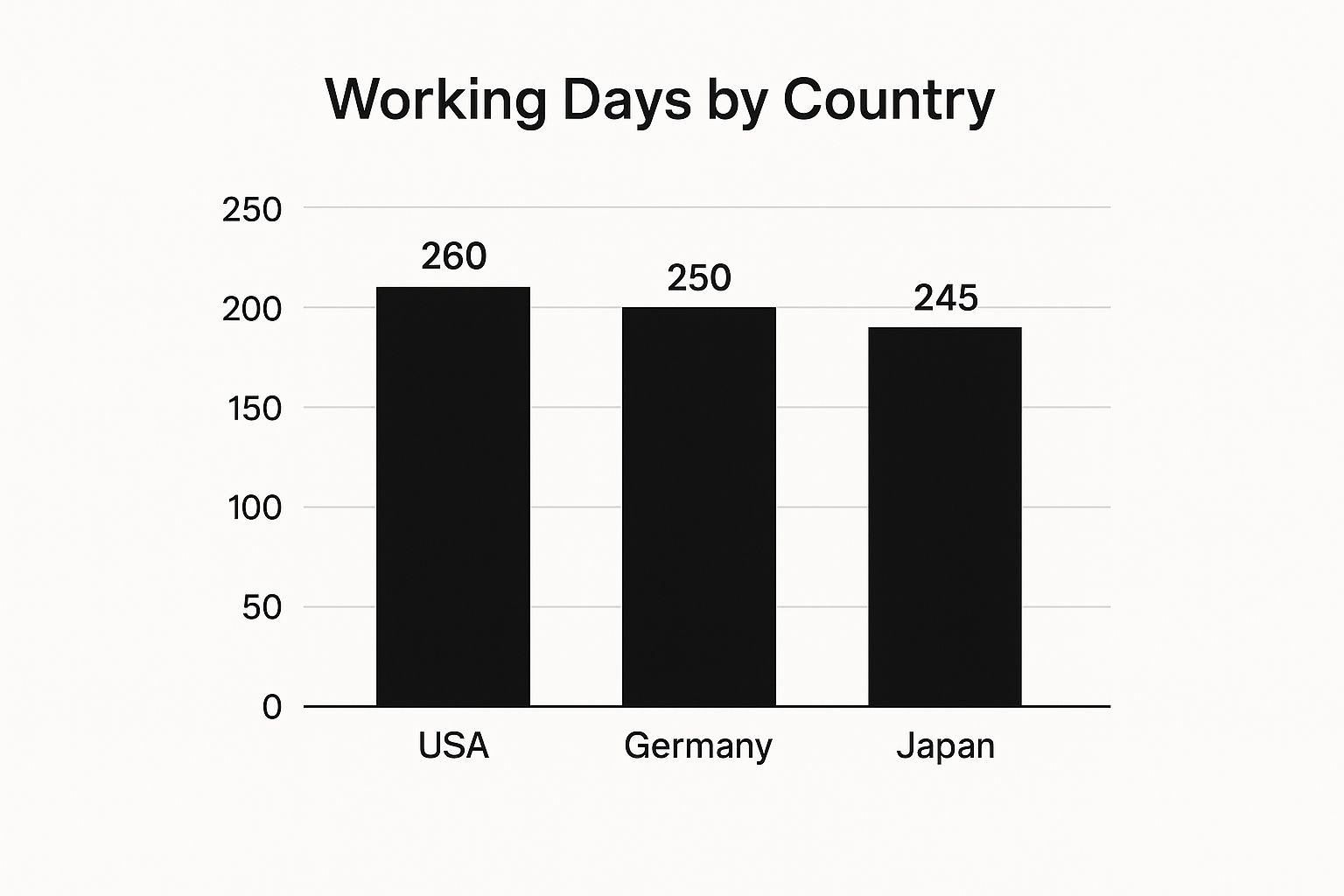
The data speaks for itself—there's no universal standard for annual working days. This just reinforces the need for precise, local calculations.
Comparing Bank Holidays Across the UK
To steer clear of any confusion, it’s vital to know which holidays apply where. While many are shared across the board, like Christmas Day and New Year's Day, several are unique to specific nations. This becomes particularly important when you're managing staff across these internal borders.
For example, Scotland gets a day off for St. Andrew's Day, while Northern Ireland celebrates both St. Patrick's Day and the Battle of the Boyne (Orangemen's Day). If you have employees in those regions, you absolutely must factor these unique dates into your planning.
To give you a clearer picture, here’s a quick comparison that highlights the main differences.
UK Bank Holiday Comparison by Country
This table breaks down the standard bank holidays across the UK, showing how they differ by country. It’s a handy reference for seeing at a glance where the calendars diverge.
| Holiday Name | England & Wales | Scotland | Northern Ireland |
|---|---|---|---|
| St. Patrick's Day | No | No | Yes |
| Battle of the Boyne | No | No | Yes |
| Early May Bank Holiday | Yes | Yes | Yes |
| Spring Bank Holiday | Yes | Yes | Yes |
| Summer Bank Holiday | Yes (August) | Yes (Early August) | Yes (August) |
| St. Andrew's Day | No | Yes | No |
As you can see, what’s a day off in one part of the UK might be a regular working day just across the border. Getting this wrong can lead to some very awkward conversations with your team!
The Role of Substitute Bank Holidays
Just when you think you have it all figured out, there’s another layer of complexity: the 'substitute' day. What happens when a fixed-date holiday like Christmas Day lands on a weekend? Well, the law makes sure you don’t lose out on your day off.
If a bank holiday falls on a Saturday or Sunday, a substitute weekday—almost always the following Monday—becomes the new public holiday. This handy rule stops the number of non-working days from shrinking in any given year.
Forgetting to account for these substitute days is a frequent source of error when calculating the total working days in a year, leading to wonky payroll and incorrect leave balances. The golden rule? Always check the official calendar to see which days have been officially designated as substitutes.
Understanding Your Legal Obligations for Working Time
When we talk about working days in a year, it's more than just a simple count on a calendar. The concept is deeply tied to a legal framework built to protect your employees. For any UK business, the key piece of legislation to get your head around is the Working Time Regulations 1998. Knowing its core rules isn't just good practice—it's a legal must-have that dictates how you schedule your team and calculate their leave.
Think of these regulations as the essential guardrails for your business. They’re there to ensure that while your team is getting the job done, their well-being isn’t being pushed to the side. Getting this wrong can lead to serious compliance headaches, employee disputes, and a sour workplace atmosphere.
The Core Rules Every UK Employer Must Know
At its heart, the legislation draws clear lines around working hours and guarantees proper rest. These rules aren't up for debate; they are the foundation of any compliant work schedule. They cover everything from the maximum average working week and minimum daily rest periods to the statutory right for paid time off.
These aren't just light suggestions; they have a direct impact on how your business can operate. The regulations ensure that within the 251 to 254 working days in a year, your employees get legally protected rest and holidays. For example, the Working Time Regulations 1998 set up a maximum 48-hour working week (though staff can choose to opt out), mandated at least 28 days of paid annual leave, and require a 20-minute break for shifts longer than six hours. You can find more detail on these UK labour standards on Wikipedia.
Statutory Annual Leave Entitlement
One of the most important rules to lock down is the statutory minimum for paid holiday. Every full-time employee in the UK is entitled to 5.6 weeks of paid annual leave, which works out to 28 days.
This is a critical number for all your holiday calculations. As an employer, you can decide to include bank holidays within this 28-day total, but the overall entitlement can never drop below this legal minimum.
This legal floor is a baseline that guarantees every employee gets a decent amount of paid time away from their desk. It’s also vital to remember how policies can shift in unusual situations, like we all saw with the government’s approach to holiday carry-over rules during the pandemic. Staying on the right side of the law means building a work environment that respects these regulations, which in turn helps boost both productivity and employee happiness.
Translating Working Days into Annual Hours

While figuring out the number of working days in a year is a huge step forward, many businesses need to get even more specific. For things like accurate project costing, managing your team's capacity, and smart budgeting, you often need to think in hours, not just days.
Converting your annual working day count into total working hours gives you a much sharper, more powerful view of your workforce's true capacity.
Think of it like swapping a blurry, old map for a high-resolution satellite image. Suddenly, you can see the terrain with incredible clarity. That kind of detail is exactly what you need to understand what your team can realistically achieve throughout the year.
The trick is to connect your calculated working days to your team's standard contracted hours.
Building Your Hourly Calculation
First things first, you need a clear baseline for a typical work week. Even though individual contracts can vary, using UK averages gives you a solid starting point for planning across your whole workforce. It helps you get a real sense of the general productive capacity you have on hand.
In recent years, full-time workers in the UK have averaged around 36.5 hours per week. This figure is a reliable benchmark for turning your day count into a total annual hourly workload. You can dig into more data on UK working hours from Statista.
With this weekly average, we can put together a simple but very effective formula. Assuming a standard five-day work week, the average workday comes out to roughly 7.3 hours (36.5 hours / 5 days). This daily number is the crucial link you need.
Example Calculation:
Let's say you've calculated 252 working days for the year.252 Working Days x 7.3 Hours Per Day = 1,839.6 Total Annual Working Hours
This simple bit of multiplication instantly transforms how you plan. Now, instead of vaguely assigning a project "20 working days," you can budget for approximately 146 hours of work. That leads to far more accurate forecasts and resource allocation. Honestly, getting this granular is one of the secrets to effective, proactive business management.
Right then, once you’ve done the maths and figured out your baseline for the working days in a year, a few real-world questions always seem to come up. These are the practical, day-to-day scenarios that go beyond the basic calculation. Getting these details right is absolutely vital for keeping your leave policies fair, compliant, and consistent for everyone.
Let’s dive into the most common questions we hear, giving you clear answers so you can manage your team with confidence.
Do Part-Time Employees Get Bank Holidays Off?
Yes, they certainly do. It’s a legal requirement for part-time workers to get a pro-rata equivalent of paid bank holidays. There’s a common myth that they only get the day off if the bank holiday happens to fall on one of their normal working days, but that’s not the case.
For instance, an employee who works three days a week is entitled to 3/5ths of the total bank holiday allowance. If a bank holiday lands on a day they wouldn't normally work, you still have to make sure they get that time back to take on another day. Nailing this calculation is crucial for being fair and staying on the right side of the law.
How Do You Handle Staff Who Start or Leave Mid-Year?
When someone joins or leaves your team part-way through the year, their entire holiday entitlement—bank holidays included—has to be calculated on a pro-rata basis. It’s a simple principle: you figure out what they’d get for a full year and then work out the fraction they’ve earned based on how long they were with the company.
This makes sure everyone gets a fair amount of leave that accurately matches their time of service. Doing this by hand can get fiddly, which is why most modern HR software handles it automatically to sidestep any costly mistakes.
Key Insight: Whether you're dealing with a part-timer or a new starter, the rule is the same: pro-rata calculations are the foundation of fair leave entitlement. Getting this right prevents arguments and shows you're committed to treating every single employee equitably.
Can I Require Employees to Work on a Bank Holiday?
You can, yes. There’s no automatic legal right for an employee to have bank holidays off. The crucial thing is that this requirement must be spelled out clearly in their employment contract.
The standard approach, and best practice, is to give them a day of leave "in lieu," which they can take at another time. This method ensures they still get their full statutory holiday entitlement for the year while giving your business the operational flexibility it needs to keep things running.


