Monday morning, a key person phones in sick, the rota is already tight, payroll wants to know whether SSP applies, and somebody has to decide whether the absence is one day, seven days, or a linked spell from last month. That's the natural shape of UK sick leave entitlement in an SME, not a neat annual number on a policy page. If you need a practical benchmark for building a healthier absence process, The Healthy Workplace is a useful companion read.
Table of Contents
- What Happens When an Employee Calls in Sick Today
- Statutory Sick Leave and Statutory Sick Pay Explained
- How the 6 April 2026 SSP Rule Change Reshapes Entitlement
- Calculating SSP for Full-Time, Part-Time and Variable Schedules
- Self-Certification, Fit Notes and Return-to-Work Adjustments
- What UK Absence Data Tells Managers About Real Exposure
- Notification Deadlines, Linked Absences and Employer Obligations
- Best-Practice Implementation for SMEs and a 2026 Checklist
What Happens When an Employee Calls in Sick Today
At 9:05 on Monday, an employee phones to say they cannot work. By 4:00, they send a text with more detail. Your record must capture both events, not just mark the day as “sick”.
Managers need to answer three separate questions: may the employee remain off work, does Statutory Sick Pay apply, and what evidence belongs in the absence record? The result depends on the sickness start date, the employee's working pattern, and the information provided. A spell beginning before 6 April 2026 may follow different SSP rules from one beginning on or after that date, so a spreadsheet date can change the payroll result.
A practical Monday-morning check
Ask whether the employee is too unwell to work, whether they were scheduled to work that day, and whether they reported the absence within your deadline. Record the report time as its own field. A verbal report at 9:05 and a text at 16:00 are different evidence events for the same sick day.
Practical rule: keep the right to be absent separate from the right to be paid. Combining them can misclassify the absence and produce the wrong pay outcome.
Store the start date, working pattern, notification time, evidence, and payment status separately. The record should also show whether the absence continues, because later information can change the assessment. A single yes-or-no absence field cannot represent those decisions reliably.
The Healthy Workplace is less useful here than a clear process that ties each payroll decision to its date and supporting record.
Statutory Sick Leave and Statutory Sick Pay Explained
An employee can be entitled to time away from work without being entitled to pay for every day missed. Statutory sick leave describes the absence. Statutory Sick Pay is the statutory payment attached to that absence when the relevant rules are met. Treating them as one field is a reliable way to create payroll errors.
Who qualifies and why the fields matter
Before 6 April 2026, SSP generally depended on the person being an employee or worker who had started work for the employer, being incapable of working for at least four consecutive days including non-working days, meeting the applicable average-earnings threshold, and reporting the absence by the employer's deadline. If no deadline existed, notification generally had to be made within seven days, as described in the government's report on employer sickness-absence practice.
Your absence record should therefore hold separate fields for worker status, employment start date, sickness start date, notification time, working pattern, and whether the absence remains continuous. A single “sick” label cannot show which rule was applied or explain why payment was approved, refused, or changed later.
The 2026 reset changes the shape of entitlement
From 6 April 2026, the old lower-earnings threshold is removed and eligible employees can receive SSP from the first day of sickness absence, provided that day would normally be a working day (ACAS guidance). The date of the absence becomes a rule-selection field, not just an administrative detail.
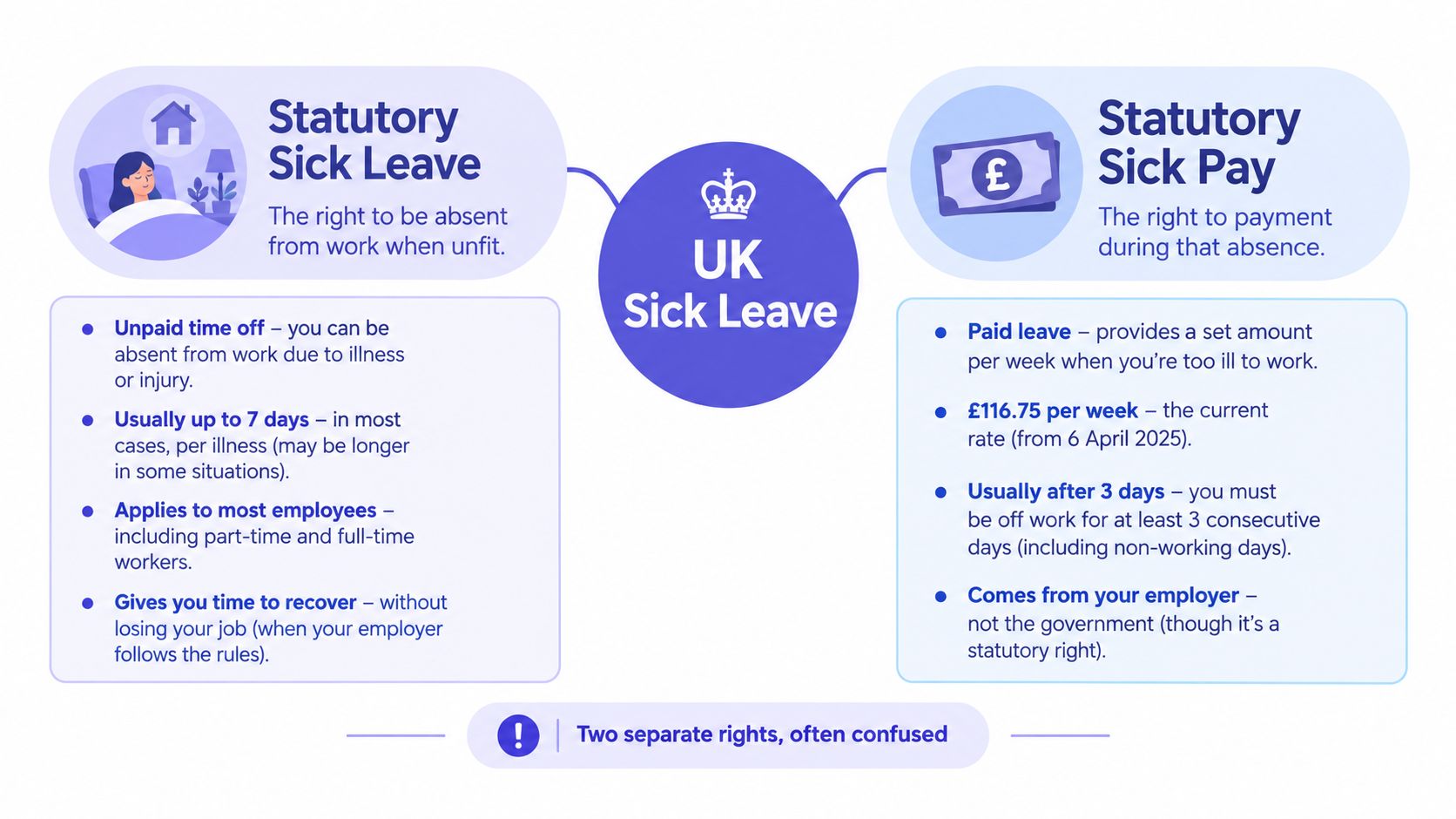
For managers, keep the decisions separate: whether the employee may remain off work, whether SSP is due, and what evidence supports the record. That separation matters for limited-hours workers and for any absence crossing the 6 April rule change.
How the 6 April 2026 SSP Rule Change Reshapes Entitlement
A sick leave record that starts on 5 April 2026 can produce a different SSP result from one that starts on 7 April 2026, even if the employee, rota, and weekly pay are identical. For SME teams still running absence through spreadsheets, that is where errors start. The date is now a rules field, not just a timestamp.
Before and after the switch
The practical change is the cut-over itself. Before 6 April 2026, SSP still followed the older framework. From 6 April 2026, the government says the previous lower-earnings threshold is removed and payment starts from the first day of absence for eligible employees (business.gov.uk).
Use a simple payroll check to see the effect. If an employee earns £400 a week and their first sick day is 7 April 2026, that day now falls into the new regime. If the same person's first sick day had been 5 April 2026, you would have been applying the old rules instead. The employee has not changed. The calendar date has, and payroll has to respond accordingly.
That is why one static SSP formula fails. Teams need absence records that can separate pre-change and post-change cases, especially where a period of sickness sits close to the cut-over date or later links to another absence.
What should change before April
Three setup changes usually prevent most of the avoidable mistakes.
- Rule versioning: store whether the sickness started before 6 April 2026 or on and after it.
- Eligibility logic: remove old threshold checks where the new regime applies.
- First-day payment logic: capture the first qualifying sick day accurately, based on the employee's actual working pattern.
A useful external explainer on the business impact is 2026 statutory sick pay changes.
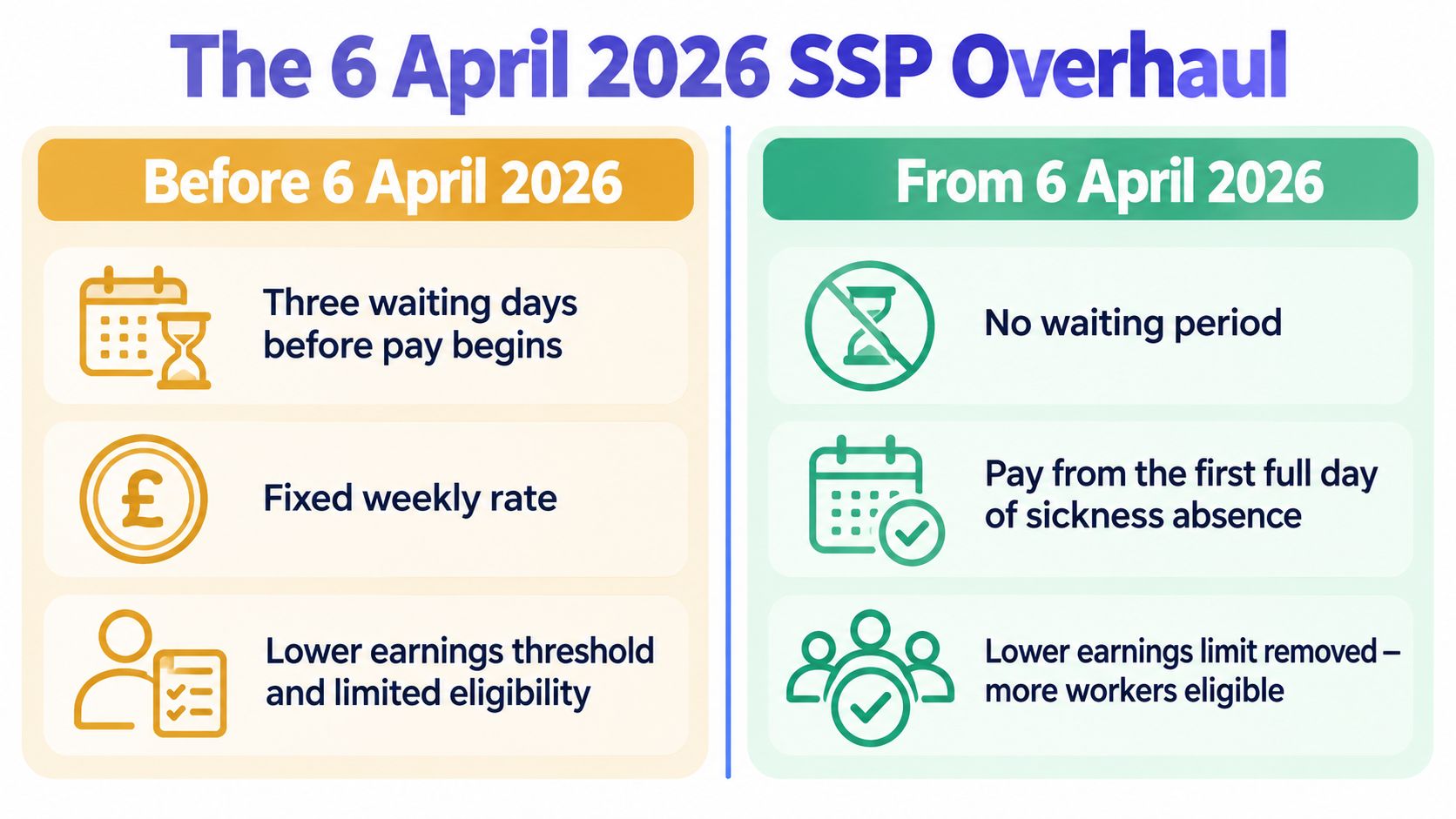
This matters most where HR and payroll still share one workbook. A hard-coded waiting-period tab will miss the cut-over, then the fit-note boundary at day 7 and the 56-day linking rule add another layer of risk. The fix is straightforward. Track start date, qualifying days, linked absences, and the rule set used for each decision.
Calculating SSP for Full-Time, Part-Time and Variable Schedules
The weekly SSP figure for the 2026 to 2027 tax year is the lower of £123.25 or 80% of the employee's average weekly earnings, and the amount paid for a qualifying day depends on both earnings and the number of qualifying days the person normally works each week (rates and thresholds). That means the same weekly cap can produce different daily amounts depending on the rota.
Full-time and part-time logic
For a full-time employee on a five-day week, the weekly SSP ceiling is still the weekly ceiling. The daily figure comes from the qualifying-day count, not from dividing by calendar days in the week. For a three-day part-time employee, the same weekly cap is spread over fewer qualifying days, so the daily amount is higher.
| Working Pattern | Qualifying Days | Weekly SSP | Daily SSP |
|---|---|---|---|
| Five-day week | Five | Lower of £123.25 or 80% of average weekly earnings | Weekly SSP divided by five qualifying days |
| Three-day week | Three | Lower of £123.25 or 80% of average weekly earnings | Weekly SSP divided by three qualifying days |
| Variable schedule | Changes by week | Lower of £123.25 or 80% of average weekly earnings | Based on that week's qualifying days |
Why irregular schedules cause the most errors
Compressed hours, rotating shifts, and distributed teams create the biggest payroll risk. The mistake is to copy one colleague's daily SSP figure into another person's file because they both “work part-time”. That ignores qualifying days, and qualifying days are the whole point.
A practical way to sanity-check pay is to compare your payroll output with a manual calculation method such as LeaveWizard's SSP calculation guide. Use it to test edge cases, not just straightforward five-day patterns.
Operational rule: never calculate SSP from the contract alone. You need the employee's working pattern for the actual sickness period, not just their job title or hours contract.
Self-Certification, Fit Notes and Return-to-Work Adjustments
For the first seven calendar days, including weekends and bank holidays, employees can self-certify. An employer can normally request a fit note only when the absence goes beyond seven days in a row, and the note may say the person is not fit for work or may be fit for work, while describing functional effects rather than naming a diagnosis (government guidance).
Where managers get stuck
The tricky part isn't the note itself. It's what happens when the note says may be fit for work. That wording invites a conversation about adjustments, not a binary yes or no. If the worker can come back on amended duties, reduced hours, or another sensible change, the manager has to record what was offered, what was agreed, and what the review point is.
The same handling discipline applies to evidence from other registered professionals where the employer accepts it. A fit note is not a diagnosis file. It's a working document for return-to-work decisions.
What to record every time
A line manager should capture:
- Evidence type: self-certification, fit note, or agreed return-to-work plan.
- Date received: so the seven-day boundary is clear.
- Proposed adjustments: for example altered duties or phased return.
- Employer response: accepted, declined, or pending review.
- Review date: so the conversation doesn't disappear into an inbox.
If you want a straightforward employee-facing explanation, LeaveWizard's self-certification guide is a useful reference point for internal policy wording.
Spreadsheets tend to fail here because they store the absence and the evidence as one line item. That's too crude. Medical evidence has its own lifecycle, and managers need to see it separately from payroll status.
What UK Absence Data Tells Managers About Real Exposure
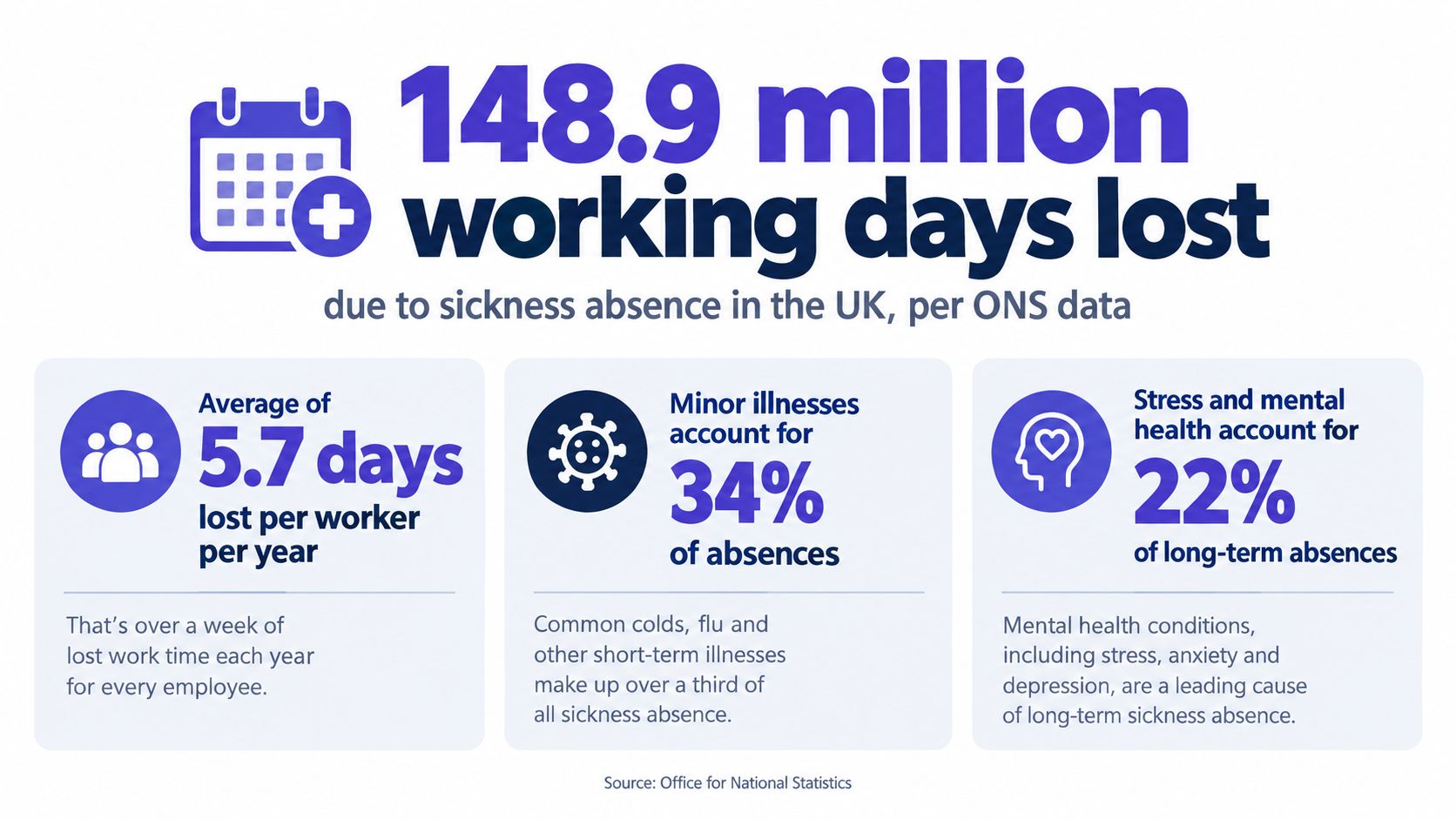
For a small team, two or three overlapping absences can disrupt service quickly. The national figures show why absence belongs in workforce planning, not just payroll administration. The Office for National Statistics recorded 148.9 million working days lost to sickness or injury in 2024, an average of 4.4 days per worker. Sickness absence accounted for 2.0% of working hours, compared with 2.3% in 2023 (ONS).
Why the national average matters to a small business
Sector context helps managers avoid treating one benchmark as a forecast. In 2024, the sickness absence rate was 2.9% in the public sector and 1.8% in the private sector. Your own pattern may differ because of staffing levels, job demands, and scheduling.
The operational risk often comes from repeated short absences rather than one extended case. A rota can appear adequately staffed until several people are unavailable on the same day. Record absence by date, employee, and working pattern, then compare the result with LeaveWizard's overview of average sick days per year in the UK as a planning benchmark.
National figures provide context. Your dated absence record determines tomorrow's cover.
Notification Deadlines, Linked Absences and Employer Obligations
Notification timing is one of the easiest places to get into trouble. Employees must tell their employer about sickness within the firm's own deadline, or within seven days if no deadline exists, and late notification doesn't automatically wipe out the whole SSP claim. It affects the late days, not every day in the absence chain.
The 56-day rule is the one spreadsheets miss
Separate periods of incapacity for work that are no more than 56 days apart must generally be linked and treated as one period, and eligibility is assessed from the first day of the first period rather than restarting with each later absence (government guidance). That makes the gap between absences a real data field, not a note for the margin.
If someone is off in early May and again in late June, payroll must check whether those periods link. If they do, the earlier date controls the SSP assessment. That's the kind of rule that manual trackers often miss because they only log the episode, not the spacing between episodes.
What employers still need to do
Don't withhold SSP just because a fit note came in late. Government guidance says late evidence alone isn't a valid reason to withhold SSP, although notification rules still matter for payment timing. Managers should also treat partial fitness seriously and keep the discussion about adjustments visible in the record.
Recordkeeping matters: if the data can't show the gap between absences, it can't show whether the absences link.
Best-Practice Implementation for SMEs and a 2026 Checklist
A workable sick-leave policy sets out how employees report absence, what evidence they provide, when a fit note is required, how return-to-work conversations are handled, and whether contractual sick pay supplements SSP. Clear instructions prevent managers from creating inconsistent processes.
The data fields your record needs
A reliable absence record needs more than a start date and reason. At minimum, record:
- Sickness start date
- Qualifying days
- Eligibility status under the relevant rule version
- Notification date
- Evidence type
- Review date
- Adjustment notes
Keep the gap between linked absences visible as well. The 56-day linking window can change which absence date controls the SSP assessment, so a tracker that stores episodes without the intervals between them is incomplete.
The April 2026 cut-over also requires payroll and absence records to identify which rule version applies. Finance, payroll, and line managers should work from the same fields and dates.
A simple 2026 checklist
- Confirm the rule change: check that the 6 April 2026 SSP logic is built into payroll.
- Review top-ups: decide whether contractual sick pay sits above SSP and how it interacts with the new rate.
- Set a fit-note path: agree who receives evidence, who reviews it, and what happens when a note says may be fit for work.
- Use self-service tracking: give employees a way to request, evidence, and review leave without email chains.
One option for SMEs replacing spreadsheets is LeaveWizard, which provides self-service tracking, approvals, and reporting for employee leave and absences.
Treat UK sick leave as a date-sensitive data model, not a single entitlement line. If your process records start dates, qualifying days, evidence, notification timing, and the gaps between absences, payroll can apply the 2026 rules without guesswork.
If your team is still tracking sickness in spreadsheets, now's the time to tighten the process. Visit LeaveWizard to see how structured absence tracking can help you handle SSP, fit notes, and linked absences with less admin and fewer payroll mistakes.