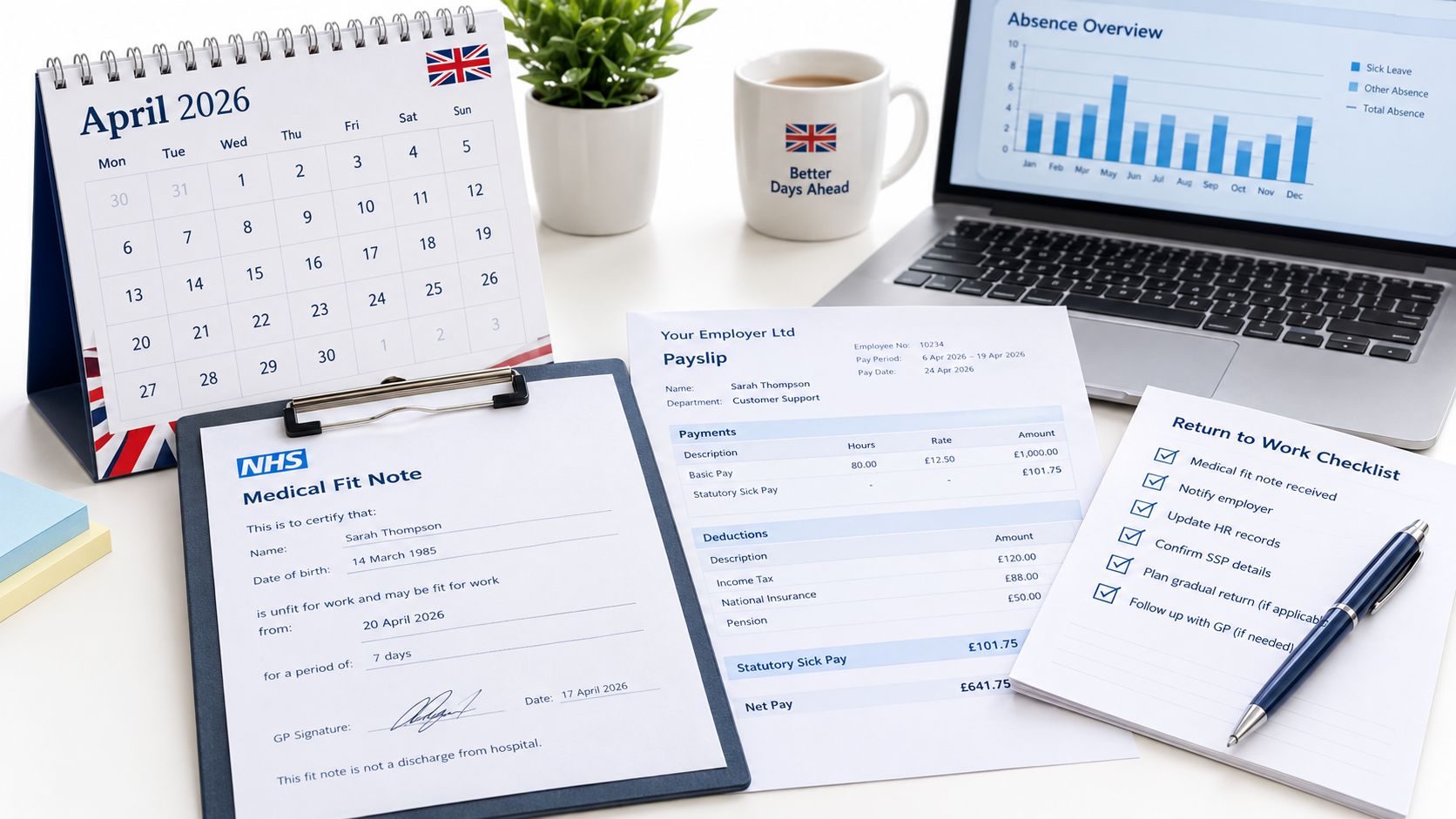
The headline figure sounds simple. The UK average employee takes 4.4 sick days per year according to GI Group’s summary of WHO and ONS data. For a small business owner, that number can be dangerously reassuring.
A national average is useful for context, but it’s a poor operating target for a lean team. If you run a business with a handful of employees, one unplanned absence can delay work, force overtime, create customer service gaps, and put pressure on payroll and compliance processes. That’s why average sick days per year uk is not really a question about one number. It’s a question about how you interpret that number, what records you keep, and whether your policy matches the reality of your business.
The bigger risk isn’t always high absence. It’s bad decision-making based on the wrong benchmark. I’ve seen small employers treat the national figure as a cap, a trigger, or proof that their own absence levels are “fine” without checking patterns, job roles, seasonality, or whether managers are applying the rules consistently. That creates problems fast. Some are operational. Some are legal. Some only surface when an employee challenges how they were treated.
A better approach is straightforward. Use the UK-wide data as a reference point, build your own internal benchmark, make sure your statutory sick pay process is correct, and run an absence policy that is both fair and practical. Done well, absence management protects the business and supports the employee at the same time.
Table of Contents
- Introduction Navigating Sickness Absence in Your Business
- The National Picture UK Sickness Absence Rates in 2026
- Why National Averages Can Mislead Small Businesses
- Your Legal Obligations for Managing Sickness Absence
- How to Benchmark Absence Rates for Your Small Business
- Proactive Strategies to Manage Absence and Support Employees
- Simplifying Compliance and Strategy with LeaveWizard
- Conclusion From Data to Actionable Insight
Introduction Navigating Sickness Absence in Your Business
Most employers ask about average sick days per year uk because they want a benchmark. That’s reasonable. The trouble starts when the benchmark becomes the policy.
In a large organisation, averages smooth out a lot of variation. In a small business, they hide it. One warehouse operative off sick affects output differently from one administrator. A Monday absence in hospitality has a different effect from a Tuesday absence in a back-office role. A single long-term case can distort your annual figures, but that doesn’t mean someone has done anything wrong or that your business has a culture problem.
That’s why absence management has to do two jobs at once. It has to keep you compliant, and it has to help you make sensible staffing decisions. If either side is weak, the process breaks down. Employers either overreact and create legal risk, or underreact and lose control of costs, cover, and consistency.
What good absence management looks like
A workable approach usually includes four elements:
- A clear reporting process: Staff know who to contact, when to report sickness, and what information they need to give.
- Accurate pay handling: Payroll knows when SSP applies, when waiting days matter, and what records must be kept.
- Manager follow-through: Return-to-work conversations happen promptly and consistently.
- Useful data: You can see trends by team, role, frequency, and duration instead of relying on gut feel.
Practical rule: If your only sickness record is a payroll note and a few emails, you don’t have an absence management system. You have fragments.
Small firms don’t need bloated procedures. They do need disciplined ones. The businesses that handle absence well are rarely the ones with the toughest wording. They’re the ones that document properly, train managers to respond consistently, and review patterns before they become disputes.
The National Picture UK Sickness Absence Rates in 2026
Across the UK workforce, the average employee takes 4.4 sick days per year, with 148.9 million sick days recorded in 2024. That gives business owners useful context, but only if they read it carefully.

Those national figures show scale, not what absence will look like inside your business. A small employer can look “close to average” on paper and still have a serious operational problem if absences hit the wrong roles, the wrong days, or are recorded inconsistently. I see this mistake often. Owners use a national benchmark as if it were a safe internal threshold, then find out too late that payroll, records, and manager decisions are not aligned.
That is where compliance risk starts.
The headline figure is useful for board-level context and budget conversations. It is less useful for frontline decisions. It will not tell you whether a pattern needs a welfare conversation, whether sick pay has been handled correctly, or whether your managers are applying the same standard across the business.
What the headline figure does and does not tell you
The 4.4-day average gives you a broad labour market baseline. It does not answer the questions that affect staffing, cost control, and fair treatment in a small firm.
Questions that matter more in practice include:
- Which absences are short-term and repeated?
- Which roles create the highest cover cost when someone is off?
- Are some managers logging sickness properly while others rely on informal messages?
- Are absence reasons recorded clearly enough to support consistent decisions?
- Is payroll applying SSP at £118.75 per week for up to 28 weeks with the right supporting records?
If those basics are weak, a national average can create false reassurance. The number may look ordinary while your process is exposed.
National patterns are useful, but only with care
Earlier data cited in this article also highlighted a familiar pattern. In the private sector, Mondays and Fridays tend to see more sickness absence than midweek days. That should prompt better recording and closer review, not snap judgments.
A repeated day-of-week pattern may point to workload pressure, poor scheduling, an underlying health issue, or conduct concerns. Those are very different management responses. Treating them as the same problem creates risk. Small businesses feel that risk quickly because one poor decision can lead to inconsistent treatment, a grievance, or a preventable dispute.
A few national indicators are still worth keeping in view:
| National indicator | What it means for employers |
|---|---|
| 4.4 average sick days | Broad context only. It is not a trigger point for action on its own |
| 148.9 million sick days in 2024 | Absence remains a material workforce cost across the UK |
| Higher absence on Mondays and Fridays in the private sector | Reporting rules and manager follow-up need to be consistent |
| SSP is £118.75 per week for up to 28 weeks | Payroll records and absence records must match |
Use national data as background, not as a shortcut. The businesses that stay compliant are usually the ones that separate market context from internal decision-making, then build policies around their own roles, risks, and reporting discipline.
Why National Averages Can Mislead Small Businesses
The sharpest mistake I see is this. A small company compares itself with the national average, decides its numbers are “about right”, and stops there. That’s not benchmarking. That’s outsourcing judgment to a statistic that wasn’t designed for your business.
Data from 1,775 SMBs showed an average of 128 sick days per business in 2023, with a 6% rise year-on-year and a 55% increase since 2019, while the ONS national measure sits at 4.4 days per worker and a 2% sickness absence rate, as summarised by Croner’s explanation of sickness absence benchmarking for employers.

Those figures don’t conflict. They answer different questions. The ONS figure spreads sickness absence across the whole workforce. The SMB figure reflects what absence feels like inside smaller organisations with tighter staffing margins.
A small team feels absence differently
If one person is absent in a team of six, the effect is immediate. Someone else covers. Work gets delayed. Customer response times slip. Managers spend time rearranging rotas instead of doing their own job. That operational strain won’t show up in a national average.
This is why small employers should be wary of copying policies from large corporates. Bigger organisations can absorb short-notice disruption more easily. They may have float capacity, specialist HR support, and separate payroll teams. Most small businesses don’t.
A useful way to think about it is this:
- National average: Good for context
- Sector pattern: Good for planning
- Your own internal data: Best for management decisions
That last one matters most. If your business is seasonal, shift-based, customer-facing, or dependent on a few specialist staff, your absence tolerance will differ from the UK average and from other small firms too.
Benchmark your business against itself first
The strongest benchmark for an SMB is a rolling internal one. Compare this quarter with the same quarter last year. Compare roles with similar working patterns. Compare short-term frequency separately from long-term cases. Don’t lump everything together and hope the average tells the story.
Use a simple review lens:
| Question | Why it matters |
|---|---|
| Are absences concentrated in one team or spread across the business? | This points to either local management issues or wider trends |
| Are you seeing frequent short-term episodes or isolated long-term cases? | The response should be different |
| Do certain days repeatedly cause cover problems? | Staffing and reporting processes may need adjustment |
| Are managers applying the policy consistently? | Inconsistency is where legal risk often starts |
Owner’s test: If a number doesn’t help you decide what to do next, it’s not yet a useful absence metric.
The compliance angle is important here too. Misreading averages often leads employers to set arbitrary trigger points, rush capability discussions, or challenge employees in ways they can’t justify later. Data should support fair process, not replace it.
Your Legal Obligations for Managing Sickness Absence
Sickness absence becomes risky when employers improvise. If your rules aren’t clear, your records are incomplete, or your managers handle similar cases differently, problems build and usually surface at the worst moment.

The basic legal framework is not optional. Employees may be entitled to Statutory Sick Pay. You need a lawful process for receiving sickness reports, keeping records, and responding to medical evidence. You also need managers who understand that sickness absence is not just a conduct issue. In some cases, it may involve underlying health conditions and the need for adjustments.
Get statutory sick pay right from the start
The verified SSP figure available here is £118.75 per week for up to 28 weeks, with the first three days normally excluded unless recent SSP rules affect the position, as noted in the earlier national data source. That’s the figure many small employers know. The harder part is applying it consistently.
Common errors include:
- Late reporting capture: A manager hears about an absence informally but payroll never receives the correct start date.
- Waiting day confusion: The business pays or withholds SSP incorrectly because nobody checked linked periods of absence.
- Poor evidence handling: Self-certification and fit notes are requested inconsistently.
- No audit trail: There’s no clean record showing when the employee reported sick, what was said, and what pay decision followed.
For a plain-English breakdown of how SSP works in practice, including common employer questions, this Stewart Accounting Services guide to SSP is a useful companion resource.
The legal risk is rarely the number of absences on its own. It’s the mismatch between your policy, your payroll process, and what managers actually do.
Fit notes records and fair process
If someone is off long enough to provide medical evidence, don’t treat the fit note as a formality. Read it properly. If it says the employee may be fit for work with support, consider what changes are realistic in your business. That might include amended duties, different hours, a temporary phased return, or altered workplace arrangements.
You also need clean records. If you want a practical checklist for what UK employers should keep, this guide on sickness absence records for UK employers is worth reviewing.
Your records should show:
- Notification details: When the employee reported sick and to whom
- Reason given: Record what was reported, not assumptions
- Evidence received: Self-certification, fit note, or other documentation
- Pay decisions: SSP start point and any contractual sick pay applied
- Follow-up actions: Welfare contact, return-to-work meeting, support discussed
That record protects everyone. It helps the employee feel heard, helps payroll stay accurate, and gives the business evidence if a decision is later challenged.
A short refresher on handling absence fairly can help managers avoid avoidable mistakes:
Consistency matters more than toughness
Return-to-work interviews are one of the most effective parts of absence management, and one of the most neglected. They don’t need to be adversarial. They do need to happen.
A good return-to-work conversation should confirm fitness to return, check whether any support is needed, verify the recorded reason for absence, and note any pattern that needs follow-up. Keep the tone professional and calm. If you only hold these meetings with employees you suspect, you create inconsistency and resentment.
Fairness matters because sickness cases can move into sensitive territory quickly. Long-term conditions, mental health issues, pregnancy-related illness, and age-related health needs all require careful handling. Small businesses don’t need a legal department to manage this well. They need a policy, records, and managers who stick to both.
How to Benchmark Absence Rates for Your Small Business
If you want a meaningful answer to average sick days per year uk for your own company, calculate your own baseline and review it over time. That’s far more useful than comparing yourself loosely with a national figure.
Start simple. Measure what you can use. If a metric creates noise without helping a manager act, drop it.
Track the measures that help you act
For most small businesses, four internal measures are enough to start:
Days lost
Count the working days lost to sickness in a set period. This gives you the clearest view of operational impact.
Number of absence episodes
This shows frequency. Ten one-day absences tell a different story from one ten-day absence.
Average duration per absence
Useful for spotting whether your issue is frequent short-term sickness or longer recovery periods.
Department or role pattern
If one area repeatedly carries the problem, you need to know whether the cause is workload, management, environment, or chance.
Build these measures monthly, then review them quarterly. Annual totals are useful for reporting, but they’re slow. A small business needs earlier warning signs.
A practical internal dashboard might look like this:
| Measure | What it helps you decide |
|---|---|
| Days lost by month | Whether absence pressure is rising or seasonal |
| Episodes by employee | Whether a pattern needs review |
| Average duration | Whether support or cover planning is the bigger issue |
| Team comparison | Whether one manager or work area needs attention |
Use the Bradford Factor carefully
The Bradford Factor can help with one specific issue. It highlights frequent short-term absence by weighting repeated spells more heavily than single longer absences. Used carefully, it can prompt useful manager conversations.
Used badly, it creates nonsense. It can penalise genuine health issues, ignore context, and push managers into mechanical decisions. It should never be the only basis for warnings or formal action.
If you want a practical explanation of how it works and where employers go wrong, this Bradford Factor score calculator guide is a solid starting point.
A sensible way to use it is:
- As a prompt, not a verdict: It tells you to review a case, not how to judge it.
- Alongside manager notes: Numbers without context are weak evidence.
- With clear policy wording: Employees should understand what is monitored.
- Never in isolation: Medical evidence, working conditions, and consistency still matter.
Good benchmarking doesn’t ask, “Who’s the problem?” It asks, “What pattern do we need to understand?”
That shift in mindset matters. Small businesses often overfocus on the individual and underfocus on the system. Better measurement helps you do both properly.
Proactive Strategies to Manage Absence and Support Employees
Reactive absence management usually costs more. It creates admin, conflict, and repeat problems. Proactive management is harder at the start because it requires thought, but it’s almost always the steadier option.
The strongest evidence for that comes from long-term absence patterns. In the UK Civil Service, long-term sickness accounted for 4.9 days per staff year lost, and mental ill-health was the cause of 47.1% of those long-term absences. The same report shows sickness absence rising with age, with employees over 60 losing 10.9 days on average compared with 6.9 days for ages 16 to 29, according to the Civil Service sickness absence 2025 report.

Those figures come from the Civil Service, not every SMB. But the management lesson carries across clearly. Long-term absence often has deeper causes, and employers who rely only on policing don’t solve them.
Focus on causes you can actually influence
Most small businesses can’t eliminate illness. They can improve how work interacts with health. That usually means tightening the basics rather than launching expensive wellbeing schemes.
Practical steps that often help include:
- A clear sickness policy: Staff should know reporting rules, evidence requirements, contact expectations during absence, and return-to-work procedures.
- Manager training: Supervisors need to know how to respond to mental health issues, ongoing conditions, and repeated short-term absences without freelancing.
- Workload review: Persistent pressure, poor rotas, and unclear expectations often sit behind repeated absence.
- Reasonable support options: Temporary flexibility, altered duties, or phased returns can make the difference between recovery and repeat absence.
Support isn’t the soft option. It’s often the most operationally sensible option.
Mental health needs careful handling in particular. Managers shouldn’t act as therapists, but they should know how to respond constructively, signpost support, and avoid dismissive language. If an employee needs outside help, even a simple signpost can be useful. For example, where someone is struggling and wants to explore support independently, they may choose to find therapeutic support for depression.
Short term absence and long term absence need different responses
Many SMB policies go wrong. They use one process for everything.
Short-term absence usually needs pattern review, return-to-work interviews, and consistency. Long-term absence needs welfare contact, medical evidence review, practical support discussions, and careful decision-making around return or capability.
Here’s a straightforward comparison:
| Type of absence | Better response |
|---|---|
| Repeated short-term absences | Review frequency, timing, reasons, and reporting behaviour |
| A single long-term absence | Focus on contact, evidence, support, and return planning |
| Mixed pattern over time | Check for an underlying health issue before treating it as conduct |
The tone matters too. Employees are more likely to be candid when they trust the process. If your policy reads like a disciplinary letter, people conceal problems until they become harder to manage.
That doesn’t mean lowering standards. It means setting clear rules and applying them in a way that employees can understand as fair.
Simplifying Compliance and Strategy with LeaveWizard
Manual absence management fails in predictable ways. Someone forgets to log a phone call. A manager keeps notes in email. Payroll uses one date, HR uses another, and nobody notices until an employee queries pay or a pattern needs reviewing.
That’s why many small businesses move away from spreadsheets once absence starts affecting more than one manager or location. The issue isn’t only convenience. It’s control.
Where manual processes usually fail
The weak points tend to be the same:
- Fragmented records: Sickness notifications, fit notes, and return-to-work notes sit in different places.
- Inconsistent approvals: Managers follow different habits because the process lives in their heads.
- Poor visibility: Owners can’t see who is off, what cover is needed, or whether a pattern is developing.
- Compliance drift: SSP handling and record-keeping become dependent on memory rather than process.
For a small business, each of those failures carries a cost. Some are direct admin costs. Others appear as payroll corrections, rushed staffing decisions, or disputes that could have been avoided.
What a dedicated system changes
A dedicated leave and absence system gives you one place to record absences, store relevant documentation, track return dates, and review patterns. It also makes it easier to standardise manager behaviour because the workflow itself guides what happens next.
One option small employers use is LeaveWizard for small business absence and leave management. In practical terms, systems like this help by centralising absence records, giving managers real-time visibility of who is off, and reducing the manual steps that create payroll and compliance mistakes.
The strategic benefit is just as important as the admin benefit. Once your data is reliable, you can tell the difference between a temporary spike and a recurring pattern. You can review departments consistently. You can spot when support is needed earlier. That’s difficult to do when the data sits across diaries, inboxes, and spreadsheets.
A system won’t make difficult absence decisions for you. It will make sure those decisions are based on complete records instead of guesswork.
For SMBs, that’s usually the ultimate win. Better data, cleaner process, and fewer avoidable errors.
Conclusion From Data to Actionable Insight
The search for average sick days per year uk often starts with curiosity and ends with policy. That’s where employers need to be careful.
The national figure is useful, but it isn’t a decision-making tool on its own. Small businesses need a more grounded approach. Build your own benchmark. Separate short-term patterns from long-term cases. Make sure SSP, records, fit notes, and return-to-work processes are handled consistently. Train managers to follow process instead of relying on instinct.
The businesses that manage sickness absence well aren’t always the strictest. They’re the clearest. Employees know how to report absence. Managers know what to record. Payroll knows what to pay. Owners can see patterns early enough to act.
That’s the fundamental shift. Stop treating absence as a headline number and start treating it as an operational and compliance process. When you do that, the data becomes useful, the risks become manageable, and the workplace becomes easier to run.