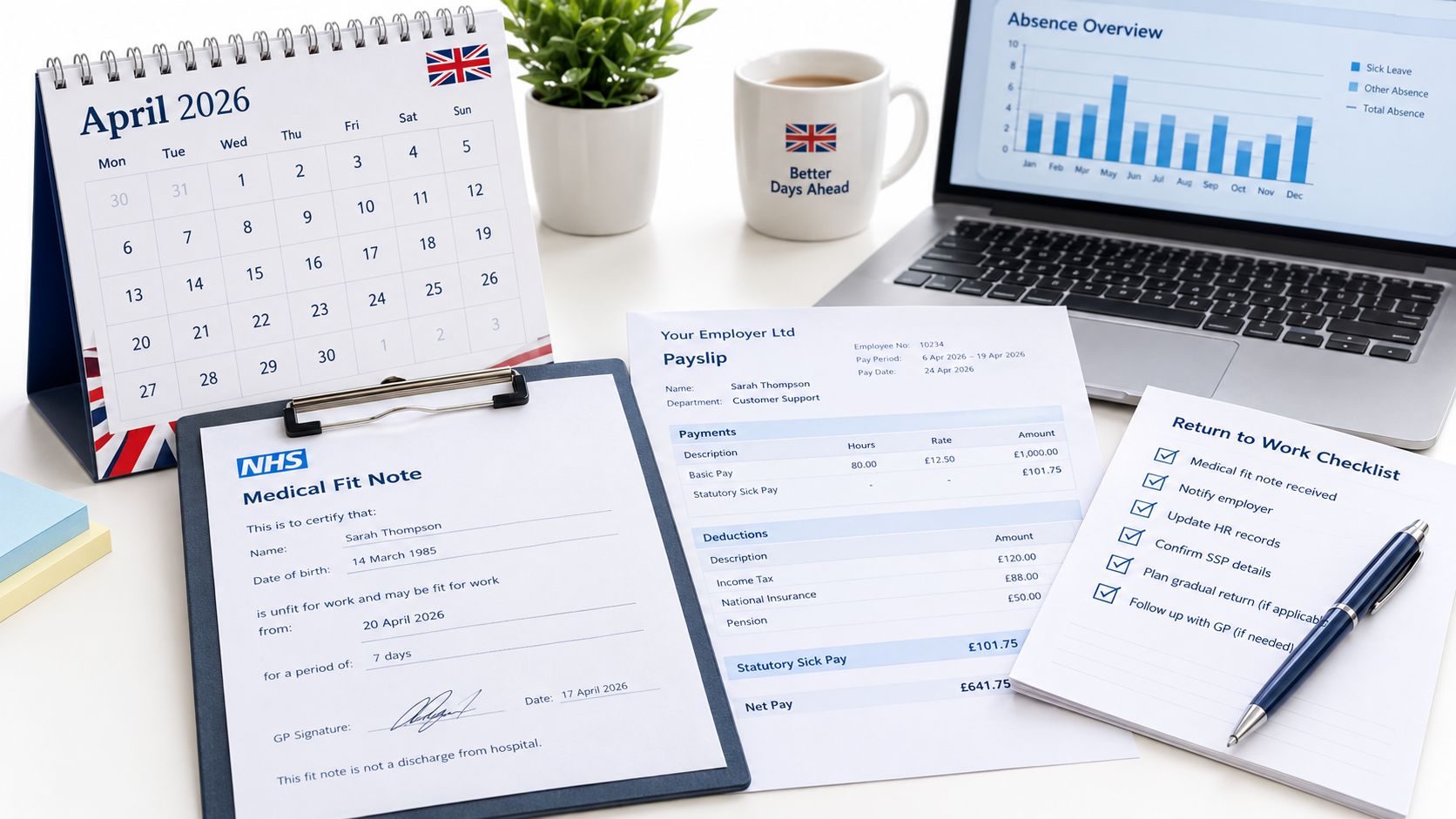
Juggling employee sickness absence can feel like walking a tightrope. One wrong move and you could find yourself dealing with a messy tribunal claim. For any UK employer, keeping solid sickness absence records isn’t just good admin—it's a legal must-have that protects your business and, just as importantly, helps you support your people.
The Foundations of Sickness Absence Records
Getting your documentation right when an employee is off sick is a critical compliance task that safeguards your business. Think of these records as the bedrock of how you manage your team and your legal obligations. Without them, you’re not just disorganised; you're leaving your business wide open to serious legal and financial trouble.
Good record-keeping isn’t about playing detective. It’s about being fair, consistent, and demonstrably compliant with UK law. The visual below neatly breaks down the three main pillars of managing sickness records, showing how each one helps secure your business.

As you can see, everything comes back to having great records. They’re central to staying compliant, handling statutory pay correctly, and giving your employees the support they need. A single, well-kept system really can tick all these boxes at once, providing a clear and defensible audit trail.
Why Compliance Is Your Top Priority
First and foremost, you have a legal duty as an employer to follow the law. Accurate and consistent records are your proof that you’re doing just that, acting as a crucial shield for your business. They’re absolutely vital for:
- Calculating Statutory Sick Pay (SSP): You must keep records to show you're paying the right amount of SSP to eligible staff. This protects you from HMRC penalties and ensures you meet your legal payroll duties.
- Defending Tribunal Claims: Should an employee ever claim unfair dismissal or discrimination tied to their absence, your detailed, objective records will be your first and best line of defence.
- Adhering to GDPR: Employee health information is 'special category data'. Handling it correctly is a legal requirement, and doing so helps you avoid the significant fines and reputational damage that come with a data breach.
To help you get this right, here’s a quick summary of the core legal requirements and how meeting them benefits you.
UK Sickness Absence Compliance At a Glance
| Requirement | Key Action for Employers |
|---|---|
| Statutory Sick Pay (SSP) | Maintain records of SSP payments and qualifying days for 3 years after the end of the tax year they relate to. This is essential for passing any potential HMRC audits. |
| Fit Notes | Keep a copy of the employee's fit note (or 'statement of fitness for work') as evidence of medical advice. This justifies payment decisions and management actions. |
| Data Protection (GDPR) | Store health-related data securely, limit access, and have a clear policy on why you collect it and how long you keep it. This is non-negotiable for avoiding ICO fines. |
| Equality Act 2010 | Ensure your absence policies and records are applied fairly to avoid discrimination claims, especially for disabled employees. Consistency is your legal shield. |
This table covers the essentials, but keeping these records organised is what truly makes the difference between compliance chaos and peace of mind.
Getting statutory payments right is a common headache for many UK businesses. For an in-depth look at your obligations, this comprehensive Statutory Sick Pay guide is an excellent resource. It can help you navigate the rules and ensure you’re always on the right side of the law.
What Every UK Employer Must Record For Sickness Absence
When an employee calls in sick, your immediate thoughts are probably about cover and workflow. But what you do next—specifically, what you write down—is just as important for legal compliance. Think of your sickness absence records as your business's official logbook. It’s the proof that you’ve followed procedures, calculated pay correctly, and treated your people fairly.
Getting this right isn’t about creating pointless paperwork. It’s about building a solid framework that protects you from potential tribunal claims and makes sure you’re meeting all your legal duties as a UK employer. A consistent, thorough approach to record-keeping is your first and best line of defence.

To help you stay compliant every time, here’s a checklist of the data points you absolutely need to be logging. Some are mandatory for legal compliance, while others are best practice for fair and effective management.
Essential Sickness Absence Record Checklist
| Data Point | Why It's Essential for Compliance | Example |
|---|---|---|
| Employee's Full Name & Department | Basic identification for all HR records and reporting. | John Smith, Sales Team |
| Date & Time Absence Reported | Establishes compliance with your reporting procedure. | 15th October, 8:45 AM |
| Person Notified of Absence | Confirms the correct line of communication was used, supporting your internal policy. | Reported to Jane Doe (Line Manager) |
| First & Last Day of Sickness | Critical for calculating SSP entitlement and total duration, ensuring accurate and lawful pay. | First day: 15/10/24, Return to work: 18/10/24 |
| Total Absence Duration | Determines whether a fit note is required (over 7 days), a key step in compliance. | 3 working days |
| Reason for Absence | Initial reason provided by the employee for their sickness. | "Stomach bug" or "Migraine" |
| Fit Note Received (if >7 days) | Legal requirement for SSP and a key piece of evidence for long-term absence management. | Fit note received on 22/10/24, copy filed. |
| Agreed Actions/Adjustments | Evidence of compliance with the Equality Act 2010, demonstrating you’ve met your duty of care. | Phased return agreed: 4-hour days for 1 week. |
This checklist forms the backbone of a legally sound absence record. Having this information on hand makes everything from payroll to performance reviews much more straightforward and defensible.
"A meticulously kept absence record is more than just an administrative task—it's your primary evidence in demonstrating compliance with SSP regulations and defending against potential discrimination claims under the Equality Act 2010."
Differentiating Self-Certification and Fit Notes
A key part of your responsibility is knowing what kind of documentation to ask for. The rules change depending on how long someone is off sick, and getting this wrong can cause payroll headaches and compliance issues.
For any absence that lasts seven calendar days or less (this includes weekends and non-working days), an employee can self-certify. This just means they can tell you why they’re off without needing a doctor’s note. You can, and should, have them fill out a simple company form for this to maintain a consistent record.
However, the moment an absence goes beyond seven calendar days, the employee must give you a 'fit note' (its official name is a 'Statement of Fitness for Work'). This comes from a registered healthcare professional and is a legal must-have if you're going to pay Statutory Sick Pay (SSP) beyond that first week. Always keep a secure copy of the fit note; it’s a critical piece of your sickness absence record and justifies your payment decisions.
Documenting Fit Note Recommendations
Fit notes are more than just a sick note; they often contain valuable advice. A doctor might state an employee "may be fit for work" if certain adjustments are made. As an employer, you have a legal duty to give these recommendations serious thought to comply with the Equality Act.
Common suggestions you might see include:
- A phased return to work: Gradually building up hours and duties over a week or two.
- Altered duties: Temporarily swapping out tasks that are physically demanding or particularly stressful.
- Amended working hours: Shifting start and finish times to help an employee avoid a stressful commute.
You must document that you’ve considered these recommendations. If you can make the adjustments, write down what they are and when they’ll be reviewed. If you genuinely can't accommodate the request, you need to record the clear business reasons why. This simple step creates a defensible paper trail, showing you’ve met your legal duties under the Equality Act 2010 and acted reasonably.
Handling Health Data and Staying GDPR Compliant
Whenever you're managing sickness absence, you’re handling highly sensitive personal information. Under the UK General Data Protection Regulation (GDPR), an employee's health data is ‘special category data’. This puts it in the highest tier of protection, meaning you have a serious legal duty to treat it with the utmost care to avoid severe penalties.
Think of it like this: you've been handed the keys to a bank vault. You can’t just look around whenever you want. You need a specific, legitimate reason (a 'lawful basis') and must follow a strict set of rules. Getting this wrong doesn't just erode trust – it can land you in hot water with the Information Commissioner's Office (ICO), facing some pretty hefty fines.

Establishing a Lawful Basis for Processing
Before you even think about recording an employee’s health details, you must have a clear and lawful reason to do so. For sickness absence, your main lawful basis will be to fulfil your legal duties as an employer.
These duties typically include:
- Calculating and paying Statutory Sick Pay (SSP) correctly.
- Assessing an employee's fitness for work and making reasonable adjustments as required by the Equality Act 2010.
- Meeting your health and safety obligations in the workplace.
It's crucial that you document these lawful bases in your company's privacy policy. This policy needs to be easy for all your employees to find and understand, demonstrating transparency and helping you meet your GDPR obligations. To really get this right, it pays to learn more about how to make your systems secure by design.
The Principle of Data Minimisation
One of the core ideas in GDPR is ‘data minimisation’. In simple terms, this means you should only collect and keep the information that is absolutely necessary for your specific, lawful purpose. It’s a common mistake to collect more data than you need, but doing so just increases your risk and potential liability.
For instance, when an employee calls in sick for a short period, you need to know their start date of absence and the general reason. You don’t need, and absolutely should not ask for, a full clinical diagnosis.
Sticking to data minimisation isn't just about ticking a compliance box; it's a smart way to reduce risk. The less sensitive data you hold, the lower your liability if a data breach ever happens.
Secure Storage and Access Control
Once you've collected the necessary information, these sickness records have to be stored securely to comply with GDPR. If you're using paper, this means keeping them in locked filing cabinets where only authorised people, like HR managers or direct line managers, can access them.
For digital records, this means strong passwords, encryption, and strict access controls. It is absolutely vital that sensitive health data is kept separate from general employee files. Only people with a genuine 'need to know' should ever be able to see an employee’s sickness history. Confidentiality here is non-negotiable; a breach can shatter employee morale and create serious legal headaches for your business.
How Long to Keep Sickness Absence Records in the UK
Knowing how long to hold onto employee sickness records is a classic GDPR tightrope walk for any UK employer. Disposing of them too quickly could leave you undefended against a legal claim. But keeping them for too long is a direct violation of UK GDPR principles, which can lead to regulatory action.
You need a clear, defensible data retention policy. The entire point is to hold records only for as long as you have a legitimate, legally-backed need, and then to dispose of them securely and permanently. This structured approach is essential for compliance.
Legal Minimums for Retention
The most straightforward rule comes from HMRC, and it’s about Statutory Sick Pay (SSP). You are required to keep all records of SSP payments for at least three years after the end of the tax year they relate to. This is a hard-and-fast minimum for compliance, as HMRC might need them for an inspection.
However, sticking to just the three-year SSP rule often isn't enough to protect you from other legal risks. The time limits (statute of limitations) for different types of legal claims are a huge factor you must consider.
For instance, the clock is different for various claims:
- Breach of Contract: An ex-employee generally has six years to bring a claim.
- Personal Injury: A claim for a workplace injury usually has a three-year time limit.
- Discrimination: Claims under the Equality Act 2010 typically have a much shorter window of three months from the alleged act.
Creating a Compliant Retention Schedule
With these different timeframes, just following one rule isn't safe. This is why many experienced employers adopt a standard retention period of six years plus the current year (often called "6 years + 1") after an employee leaves the company. This wider net gives you a solid defence against the majority of potential legal actions, especially breach of contract claims, while remaining a justifiable retention period under GDPR.
The "retention clock" for an employee’s sickness records should only start ticking once their employment has ended. While they are still working for you, their absence history is a live and relevant record for ongoing management and legal compliance.
Once that retention period is finally up, you have a legal duty to get rid of the data securely. For paper files, this means cross-cut shredding. For digital records, it means permanent deletion from all systems, including backups. Simply moving a file to the 'Recycle Bin' is not compliant disposal.
Having a proper system for secure document storage and management is fundamental to closing these compliance gaps and ensuring you're not holding onto data unlawfully.
Using Absence Data to Support Your Employees
Keeping compliant **sickness absence records** is only half the story for any UK employer. The real value comes when you use that data proactively. Instead of just logging days off, you can turn your records into a powerful tool for spotting patterns, offering support, and genuinely improving your team’s well-being, all while reinforcing a fair and legally compliant management process.
This isn't about looking for reasons to punish someone; it's about being supportive. Great absence management uses data to start helpful conversations, not disciplinary ones. When you see an unusual pattern, it’s an opportunity to check in with your employee and see if there’s an underlying issue you can help with—a move that demonstrates responsible employer conduct.
Spotting Patterns with Absence Triggers
A key part of a fair and proactive approach is to set up absence triggers. These are predefined thresholds that prompt a manager to have a friendly, informal chat with an employee. Their purpose isn't to start a formal process, but to simply ask, "Is everything okay?" in a timely manner.
One popular tool is the Bradford Factor, a formula that gives more weight to frequent, short absences. When an employee’s score hits a trigger point, it’s a clear, objective signal for their manager to initiate a supportive conversation.
Using data-driven triggers like these creates a consistent and fair way to manage absence across the entire company. It removes guesswork and potential for unconscious bias, ensuring every employee is treated equitably. That consistency is crucial for building trust and defending your management actions if they are ever challenged.
"A fair and consistent process for managing absence is your best defence against claims of discrimination. Using objective data triggers ensures you're treating all employees equitably, which is a cornerstone of good employment practice and legal compliance."
The Power of the Return-to-Work Interview
One of the most effective tools for demonstrating good practice is the return-to-work interview. This is a brief, informal chat held with every employee on their first day back after any sickness absence, no matter how short.
The purpose is threefold:
- Welcome the employee back: It’s a small gesture that shows you care.
- Ensure they are fit to return: It’s a chance to confirm they are well enough to resume their duties safely, fulfilling part of your health and safety duty.
- Discuss any underlying issues: It provides a confidential space to talk about any ongoing problems that might be impacting their health and attendance.
By conducting these interviews consistently, you create a formal record that you are actively managing absence and supporting employee well-being, which is invaluable from a compliance perspective.
Making Reasonable Adjustments
If a return-to-work interview or a fit note flags an ongoing health condition, especially one that could be classed as a disability under the Equality Act 2010, you have a legal duty to consider ‘reasonable adjustments’.
These are simply changes to the workplace or an employee’s role to help them manage their condition and carry out their job effectively. Some common examples include:
- Providing specialist equipment: An ergonomic chair or adaptive keyboard.
- Altering working hours: Allowing flexible start and finish times.
- Modifying duties: Temporarily or permanently reassigning tasks that are difficult due to their condition.
Making sure you document that you have considered and implemented reasonable adjustments is vital. It serves as tangible proof that you’ve met your legal obligations and acted as a supportive employer, which is your strongest defence against potential disability discrimination claims.
Streamline Compliance with Absence Management Software
Still wrestling with spreadsheets to track employee sickness? If so, you're not just creating extra work; you're actively increasing your risk of non-compliance. Spreadsheets are slow, notoriously prone to human error, and make keeping secure sickness absence records a constant battle for any UK employer.
Modern software transforms this responsibility from a manual chore into an automated, compliant process. Instead of digging through old files and email chains, imagine a system that handles the most time-consuming and legally sensitive tasks for you, ensuring you meet your obligations every time.

From Manual Errors to Automated Assurance
The real benefit of this kind of software is how it directly solves core compliance problems, turning legal requirements into automated functions. It’s not just a digital filing cabinet; it becomes an active partner in helping you stay compliant.
Consider how its key features address your legal duties:
- Secure Data Storage: Employee health information is kept in a centralised, GDPR-compliant system. You can set strict access controls to ensure only authorised managers can view sensitive data, fulfilling your data protection duties automatically.
- Automatic SSP Calculations: The system automatically tracks qualifying days and calculates Statutory Sick Pay. This takes the risk of payroll errors off the table and helps you meet HMRC requirements without breaking a sweat.
- Centralised Fit Note Management: Employees can upload fit notes directly. This creates an instant, secure record and can even trigger reminders for managers when a note is about to expire, preventing compliance gaps.
This level of reporting and automation doesn't just save hours of admin time; it significantly reduces your legal risk. If you feel like you're constantly playing catch-up, exploring dedicated employee absence management software is a sensible next step.
Of course, when an employee returns after a period of sickness, especially a long-term one, you might need more detailed information. For these situations, a guide on Fitness to Work Assessments for Employers can offer valuable insight into your responsibilities.
By automating triggers and reporting, you gain strategic insights into absence trends. This allows you to move from simply recording sickness to actively managing workforce health and productivity, turning a compliance burden into a genuine business advantage.
Frequently Asked Questions About Sickness Records
Navigating the rules around sickness absence can throw up some tricky questions. To help you stay on the right side of the law and make confident, compliant decisions, here are some clear answers to the queries we hear most often from UK employers.
What Is the Difference Between Self-Certification and a Fit Note?
This is a matter of timing and evidence. For any sickness that lasts for seven calendar days or less, your employee can self-certify. This means they inform you of their absence and the reason for it, without needing a doctor. A self-certification form creates the basic record you need for short-term absence.
Once an absence stretches beyond seven days, the rules change. Your employee is then legally required to provide a fit note ('Statement of Fitness for Work') from a healthcare professional. This is a crucial piece of evidence for your sickness records, necessary for managing Statutory Sick Pay (SSP) correctly and justifying any long-term absence management steps.
Can I Contact an Employee’s Doctor About Their Sickness?
The short answer is no, not directly. Calling an employee's GP would be a serious breach of their data privacy under UK GDPR, as their health information is special category data.
The compliant route, should you genuinely need more medical detail, is to first get the employee's explicit, written consent to request a report from their doctor. Alternatively, you can refer them to an Occupational Health specialist for an independent assessment. This allows you to gather necessary information lawfully, respecting employee privacy and meeting your legal obligations.
What Are Reasonable Adjustments When an Employee Returns?
Reasonable adjustments are changes you make to an employee's job or work environment to remove barriers they face due to a disability or long-term health condition. This isn't just good practice; it's a legal duty under the Equality Act 2010. Failing to make them can lead to discrimination claims.
In practice, this could include:
- Phased Returns: Allowing them to gradually build up their hours.
- Altered Duties: Temporarily moving them off physically demanding tasks.
- Specialist Equipment: Providing an ergonomic chair or other adaptive tools.
Documenting that you've considered and implemented these adjustments is your key evidence that you have complied with the Act.
Must I Pay Sick Pay Without a Fit Note?
This depends on the length of the absence. For the first seven calendar days, when an employee can self-certify, you must pay SSP if they meet the other eligibility criteria.
After seven days, you are within your rights to withhold company sick pay (if you offer it) and potentially SSP if the employee fails to provide a valid fit note. The fit note is the required evidence for longer absences, and not providing one can break the conditions for payment, giving you a clear, compliant reason for your action.