Pro rata holiday entitlement is the proportional scaling of the statutory 5.6 weeks of annual leave, based on a worker's contracted days or actual hours worked. A five-day worker receives 28 days, while a regular three-day worker receives 16.8 days, so part-time staff receive equal treatment to full-time employees.
You're probably dealing with this because a new starter, a term-time employee or someone with changing shifts has asked how much leave they can book, and the answer isn't obvious from a spreadsheet. The calculation becomes harder when bank holidays are included, working patterns change, or the leave year falls on different sides of the April 2024 rule change. A reliable process starts by identifying the contract type, the leave year and the way the business records leave.
Table of Contents
- Understanding Pro Rata Holiday Entitlement Basics
- Navigating UK Legal Requirements and Recent Changes
- Calculating Leave for Part-Time and Irregular Hours
- Managing Bank Holidays and Part-Year Employment
- Automating Calculations with Leave Management Software
- Building a Transparent Absence Management Policy
- Frequently Asked Questions About Pro Rata Leave
Understanding Pro Rata Holiday Entitlement Basics
A line manager receives a holiday request from someone who works three days a week. The employee has been told that full-time colleagues receive 28 days, but the manager isn't sure whether to copy that figure, divide it by the number of days, or calculate the allowance in hours. That uncertainty is common, especially in a growing SME where HR, payroll and line management responsibilities overlap.
Pro rata means “in proportion”. For annual leave, it means adjusting the full-time entitlement so it reflects the employee's working pattern, without reducing the rate of holiday they receive. The starting point is the UK statutory minimum of 5.6 weeks of paid holiday per leave year. For someone working a five-day week, that equals 28 days, and a part-time worker receives a proportional entitlement, such as 16.8 days for a three-day worker. The UK government's holiday entitlement guidance sets out this statutory baseline and confirms that part-time workers receive leave on a pro rata basis.
The purpose isn't to give part-time employees fewer benefits because they work fewer days. It's to preserve the same amount of holiday measured against the time they work.
Practical rule: Calculate the worker's entitlement from the full-time standard used by your organisation, then scale it to their contracted days or hours.
Start with the leave year
Before doing any maths, establish the leave year. It might follow the calendar year, the tax year or another period specified by the employer. The leave year determines which entitlement rules apply and whether you're calculating a full-year allowance, a mid-year starter's balance or a leaver's accrued leave.
Record these details first:
- Contract type: Is the employee on regular hours, irregular hours or a part-year arrangement?
- Working pattern: How many days or hours are they contracted to work?
- Leave year: What are the start and end dates?
- Contractual allowance: Does the employer offer more than the statutory minimum?
- Bank holiday wording: Are bank holidays included in the overall allowance?
For a regular part-time worker, the basic formula is straightforward:
Full-time statutory days ÷ full-time working days × employee working days
Using the statutory baseline, a two-day week produces 11.2 days, a three-day week produces 16.8 days, and a four-day week produces 22.4 days, as confirmed by ACAS guidance on checking holiday entitlement. If your organisation tracks leave in hours, use the equivalent hours-based approach so a day represents the employee's actual working time.
For a practical explanation of the wider entitlement calculation, see this guide to annual leave entitlement. It's particularly useful when you're converting between days, weeks and hours.
Navigating UK Legal Requirements and Recent Changes
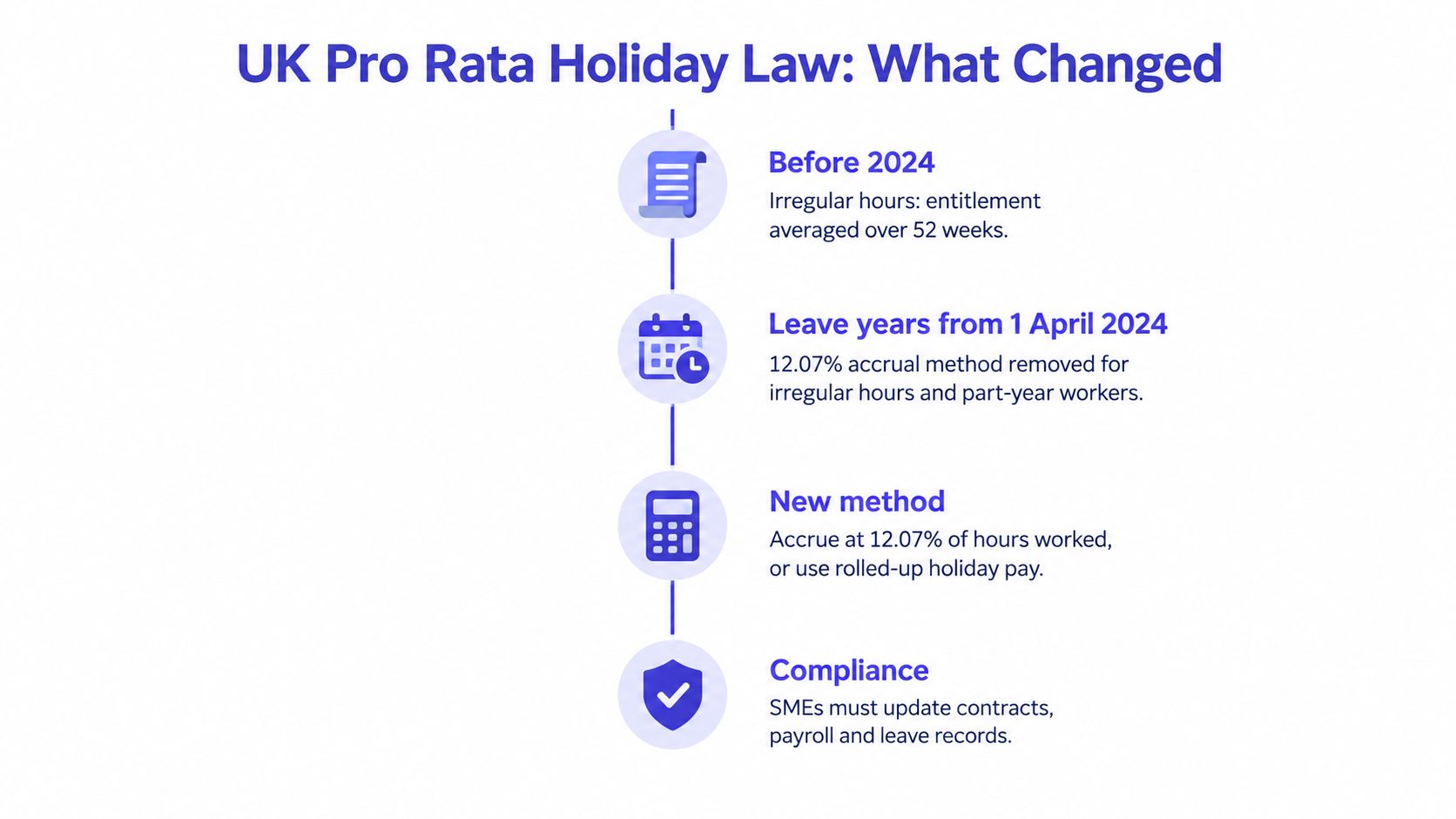
The most important operational distinction is whether the leave year began before or from 1 April 2024. The rules for irregular-hours and part-year workers changed for leave years beginning on or after that date, so an SME handling multiple leave years may need to apply different methods to different records.
For the newer leave years, employers must use an accrual method based on actual hours worked. The statutory accrual rate is 12.07% of hours worked, and total entitlement remains capped at 5.6 weeks per year. The government's explanation of the holiday pay and entitlement reforms explains the change and its relationship to the treatment of part-year workers on permanent contracts.
Why the calculation changed
Older approaches could treat a permanent part-year worker as though their annual leave should be reduced because they worked fewer weeks. A Supreme Court ruling in July 2022 confirmed that part-year workers on permanent contracts shouldn't have their entitlement reduced in that way. The revised framework introduced a more direct relationship between hours worked and holiday accrued for irregular-hours and part-year workers.
The difference matters in payroll. A calendar split may overstate leave for some part-year arrangements or under-accrue it for casual workers whose hours vary. A business can therefore create risk in either direction, by allowing more leave than the contract supports or by denying leave that has legally accrued.
Separate current and legacy records
Don't overwrite historical records when updating the system. First identify the leave year attached to each employee record.
| Leave year position | Operational approach |
|---|---|
| Beginning on or before 31 March 2024 | Check the rules that applied to that legacy leave year rather than automatically applying the new accrual method. |
| Beginning on or after 1 April 2024 | Apply the hours-worked accrual approach for eligible irregular-hours and part-year workers. |
| Regular-hours contracts | Use the contracted working pattern and the proportional method, subject to the contract and leave-year dates. |
An audit should compare contracts, payroll settings and the employee-facing balance. Check whether the system recognises a permanent part-year contract, records actual hours accurately and applies the cap correctly. Also confirm whether rolled-up holiday pay is being used lawfully and consistently where relevant.
The safest operational response isn't to memorise one formula. It's to make the employee's contract type and leave-year start date visible before payroll calculates entitlement. More detail on the legal baseline is available in this guide to UK legal holiday entitlement.
Calculating Leave for Part-Time and Irregular Hours
A part-time employee joins on 1 October and works three days each week. Their annual allowance is not the same as a full-time colleague's, and they have not been employed for the whole leave year. Calculate the full-year entitlement first, then apply the employment period. This two-stage approach prevents the common error of using the employee's current pattern without accounting for when they started.
Regular part-time workers
Start with the full-time statutory allowance used by the organisation. For a five-day week, this is 28 days, or 5.6 weeks. Multiply the employee's contracted working days by 5.6, as shown below.
| Contracted Days Per Week | Calculation Method | Total Statutory Days |
|---|---|---|
| 2 | 2 × 5.6 | 11.2 |
| 3 | 3 × 5.6 | 16.8 |
| 4 | 4 × 5.6 | 22.4 |
| 5 | 5 × 5.6 | 28 |
These figures preserve the same number of weeks' holiday while converting the allowance into bookable days that match the employee's normal working week. A result such as 11.2 days should remain visible in the calculation. The organisation's policy and rounding approach should determine how that balance is presented and booked.
For the employee who works three days each week and starts on 1 October, the calculation is:
3 × 5.6 = 16.8 days for a full year
If six months remain in the leave year:
16.8 × 6 ÷ 12 = 8.4 days
Use the actual start date where the organisation's method requires more precise treatment, and apply the same documented rounding practice across comparable employees.
Compressed hours require a separate check. An employee may work full-time weekly hours across fewer, longer days. Recording leave in days could then use fewer booking days for a full week away, while recording it in hours should reflect the longer daily shift. Confirm whether the system measures absence in days or hours before changing the underlying weeks of entitlement.
Mid-year starters and leavers
For a regular-hours worker who joins or leaves during the leave year, calculate each employment period separately. A common method is:
Full annual entitlement × months employed ÷ 12
A worker whose contracted hours change part-way through the year also needs a weighted calculation. Work out the entitlement for the period before the change, calculate the entitlement for the period after it, and add both results. Applying the final working pattern to the entire year can overstate or understate the balance.
Irregular-hours workers
For eligible irregular-hours and part-year workers in leave years beginning on or after 1 April 2024, accrue holiday from actual hours worked:
Hours worked in the pay period × 12.07% = holiday hours accrued
If payroll records 100 hours in a pay period, the calculation produces 12.07 hours of accrued holiday. The annual entitlement must remain within the statutory cap of 5.6 weeks. For legacy leave years beginning on or before 31 March 2024, do not automatically apply this approach. ACAS guidance for irregular-hours and part-year workers explains that the hours-worked method was not mandatory for those earlier leave years.
Government rounding rules also affect payroll outputs. Where the result contains part of an hour, round down to the nearest hour if the fraction is less than 30 minutes, and round up when it is 30 minutes or more. Keep the unrounded figure as an audit value, then show the rounded balance used for booking and payroll.
For a practical comparison of day-based and hour-based calculations, see this guide to calculating holidays for part-time workers. Manual spreadsheets can handle one pattern, but changes in hours, start dates and accrual methods quickly create administrative friction. For a growing SME, automation is the scalable way to apply the right calculation consistently and retain a clear audit trail.
Managing Bank Holidays and Part-Year Employment
Bank holidays create disputes when managers treat them as a separate automatic benefit. The statutory entitlement is an overall holiday allowance, and the employment contract determines whether bank holidays sit inside that allowance or are provided in addition. The employee's working-day pattern then determines how the allowance can be used fairly.
A worker who doesn't normally work Mondays doesn't automatically lose their share of bank holiday entitlement. Equally, a part-time employee doesn't automatically receive every bank holiday as an extra day off. The business must examine the wording of the contract, the employee's normal working days and the leave-year rules.
Separate the three records
Keep these items visible rather than hiding them in one unexplained balance:
- Overall annual leave entitlement, calculated from the contract and applicable statutory rules.
- Bank holiday allocation, showing how relevant public holidays are treated.
- Working-day pattern, identifying whether a bank holiday falls on a day the employee normally works.
A policy that says annual leave is “inclusive of bank holidays” requires the relevant bank holidays to be deducted from the total when the employee takes them. A policy that provides annual leave plus bank holidays treats them separately. The contract, not a generic calculator, decides which arrangement applies.
Part-year contracts need careful handling
“Works fewer weeks” doesn't automatically mean “receives less holiday overall” for a permanent part-year worker. Recent UK guidance confirms that a part-year worker on a permanent contract should receive 5.6 weeks of annual leave, and the entitlement shouldn't be reduced purely because the worker is active for fewer weeks in the year. The correct result depends on the contract and the leave-year rules.
That distinction matters for term-time and seasonal arrangements. Before reducing a balance, establish whether the worker remains employed throughout the year, whether the contract describes a part-year pattern and whether the relevant leave year began before or from April 2024. For a broader local explanation of annual leave, pro rata treatment and bank holidays, review the contract wording alongside the official rules.
Managers who handle payroll-linked benefits may also need to understand how absence affects wider employment arrangements. For example, guidance on obiettivi e bonus in maternità can be a useful resource when reviewing how leave and maternity-related processes interact with performance administration.
A bank holiday isn't a shortcut around the calculation. Treat it as an allocation question governed by the contract and the employee's pattern.
Automating Calculations with Leave Management Software
A spreadsheet can handle a simple five-day pattern. It becomes fragile when several employees have different leave-year dates, changing hours, bank holiday arrangements and historical balances. One person edits a formula, another copies an old tab, and payroll inherits a result that nobody can easily explain.
Manual tracking creates several operational weaknesses:
- Formula risk: A copied formula may use the wrong working pattern or leave year.
- Visibility gaps: Managers may approve leave without seeing the team's current availability.
- Audit difficulty: HR may struggle to explain how a balance was produced.
- Payroll rework: Corrections arrive after payroll has already been prepared.
- Employee frustration: Staff can't easily check what they have accrued or used.
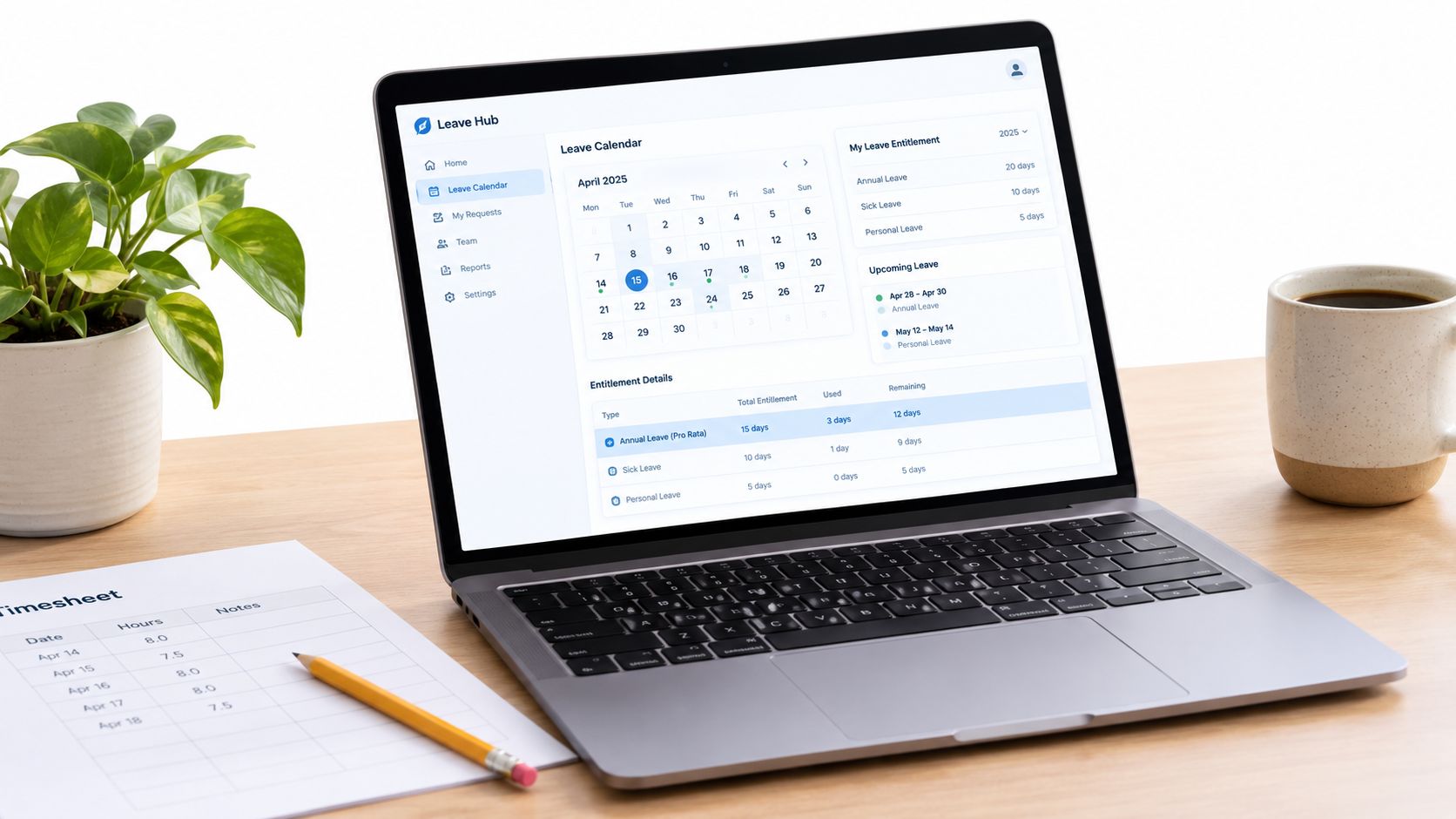
Software doesn't remove the need for sound policy. It gives the policy a consistent operating layer. A suitable system should let administrators define the employee's allowance, contract type, working pattern and leave year, then apply the relevant calculation rather than forcing HR to rebuild the formula manually.
What to automate first
Start with the records that cause the most friction:
- Entitlement setup: Store annual allowances and contractual variations in one place.
- Accrual tracking: Update balances from approved hours or the employee's defined schedule.
- Bank holiday handling: Show whether a public holiday is included, excluded or deducted.
- Approval workflow: Route requests to the right manager and retain the decision record.
- Reporting: Give finance and HR a current view of used, remaining and accrued leave.
LeaveWizard is one option for small businesses. It provides tools for defining holiday allowances, calculating employee entitlement, managing approvals and showing availability through web and smartphone access. The important test is whether the system makes the calculation visible and reviewable, not whether it only produces a number.
The platform should also support a self-service experience. When employees can see their balance and submit requests without sending messages to HR, managers spend less time answering routine questions and more time coordinating cover.
This video provides another way to think about digital leave administration. Watch it after reviewing your current process, so you can compare the workflow with the tasks your team still performs manually.
Automation becomes scalable when it preserves the reasoning behind the result. Keep the contract, leave-year date and calculation history alongside the balance. That gives HR a defensible record when an employee asks why their entitlement changed.
Building a Transparent Absence Management Policy
Accurate maths won't prevent confusion if employees can't understand how the balance works. Your absence policy should explain the entitlement basis, the leave year, the treatment of bank holidays and the process for requesting time away.
Use plain language and give employees a practical route to answers:
- State the baseline: Explain whether the allowance is statutory only or includes contractual leave.
- Define the pattern: Say how the business treats regular part-time, compressed-hours and irregular-hours work.
- Explain bank holidays: Make clear whether they're included in the total or offered separately.
- Set the request process: Identify who approves leave and how much notice employees should normally give.
- Record absence consistently: Use the same unit, days or hours, for comparable working patterns.
- Publish escalation steps: Tell employees who to contact if they believe a balance is wrong.
Managers should also address presenteeism. Employees need to know that working while unwell isn't a substitute for reporting sickness, and that planned annual leave supports recovery rather than creating suspicion. A transparent policy helps full-time and part-time colleagues see that different balances reflect different working patterns, not different treatment.
Review the policy whenever contracts, payroll settings or holiday legislation changes. Then test it with real scenarios, such as a three-day regular worker, a mid-year starter and an irregular-hours employee. If a line manager can't explain the result without opening a hidden spreadsheet, the process still needs simplifying.
Frequently Asked Questions About Pro Rata Leave
Does a compressed four-day week reduce entitlement?
Not automatically. Decide whether the business records leave in days or hours. A compressed worker may need fewer days to take a week away, while an hours-based system records the longer daily hours.
How do zero-hour workers accrue leave?
For eligible irregular-hours workers in a leave year beginning on or after 1 April 2024, use 12.07% of hours worked in the relevant pay period, subject to the 5.6-week cap. Check the rules for any legacy leave year before applying that method.
What happens when someone leaves mid-year?
Calculate the proportion of the annual entitlement attributable to the period worked, then compare it with leave taken. Record the calculation and resolve any resulting balance through the employer's payroll and contract processes.
How should awkward fractions be rounded?
For an entitlement containing part of an hour, round down when the fraction is less than 30 minutes and up when it is 30 minutes or more. Apply the rule consistently and retain the original calculation.