Working out holiday pay for your part-time staff doesn't have to be a headache. The rule of thumb in the UK is simple: they get the exact same holiday rights as your full-time employees, just calculated on a pro-rata basis. In short, their holiday allowance is directly proportional to the hours or days they work.
The Essentials of Part Time Holiday Entitlement

Getting to grips with the basics of part-time holiday entitlement is the first step to keeping your leave management fair and legally sound. The core principle is that every single worker, no matter their contract type, is entitled to a statutory minimum of 5.6 weeks of paid annual leave.
For a standard full-time employee working five days a week, this works out neatly to 28 days (5 days × 5.6 weeks).
When it comes to your part-time staff, this same 5.6-week entitlement is just scaled down to match their working pattern. The goal is to ensure everyone is treated equally. So, if someone works three days a week, they’ll get 60% of the full-time allowance, which perfectly mirrors their working hours.
Two Core Calculation Methods
When you sit down to do the maths, there are two main ways to calculate holidays for part-time workers, and the best one depends on how they work:
- By days worked: This is the go-to method for employees who have a fixed number of days each week, even if their hours on those days vary a bit.
- By hours worked: This approach offers more precision for staff who work a set number of hours spread across a variable number of days each week.
The trick is to pick the method that lines up best with the employee’s contract and gives you the clearest answer. We'll dive into the specific formulas for each approach in a bit, but just knowing this distinction is a crucial starting point.
Pro-Rata Entitlement in Practice
In the UK, the law is clear: holiday entitlement for part-time workers must be calculated on a pro-rata basis compared to their full-time colleagues.
Let's take a real-world example. An employee working three days a week is legally entitled to 16.8 days of paid holiday per year (3 days × 5.6 weeks). This system guarantees fairness and proportionality—a principle that's been reinforced by recent legal updates clarifying rules around holiday accrual during sick leave and for those with irregular hours.
Key Takeaway: The pro-rata principle isn’t just a nice-to-have; it's a legal requirement. It ensures that a part-time worker who puts in 60% of full-time hours receives exactly 60% of the full-time holiday allowance. Simple as that.
Part Time Holiday Entitlement at a Glance
To give you a clearer picture, here’s a quick reference table showing the statutory minimum holiday days for common part-time schedules.
| Days Worked Per Week | Calculation (Days x 5.6 Weeks) | Total Annual Holiday Days |
|---|---|---|
| 1 | 1 x 5.6 | 5.6 |
| 2 | 2 x 5.6 | 11.2 |
| 3 | 3 x 5.6 | 16.8 |
| 4 | 4 x 5.6 | 22.4 |
| 5 (Full-Time) | 5 x 5.6 | 28.0 |
While these figures provide a solid baseline for common scenarios, every business is different. For total peace of mind, especially with more complex work patterns, you can always use a dedicated tool to calculate holiday entitlement for any work pattern and ensure you’re getting it spot on every time.
Putting the Pro-Rata Holiday Formulas into Practice
Knowing the theory is one thing, but actually applying it is where you really build confidence. It’s all well and good to understand the rules, but putting them into practice for real people with different schedules is what truly matters. Let's get the numbers working for the scenarios you'll see time and time again.
We'll walk through the two most common part-time setups: employees working a set number of days each week, and those who work a fixed number of hours on a more flexible basis. Get these two down, and you’ll be ready for pretty much anything that lands on your desk.
This quick overview breaks down the pro-rata calculation process, showing the steps from figuring out the work pattern to landing on the final entitlement.
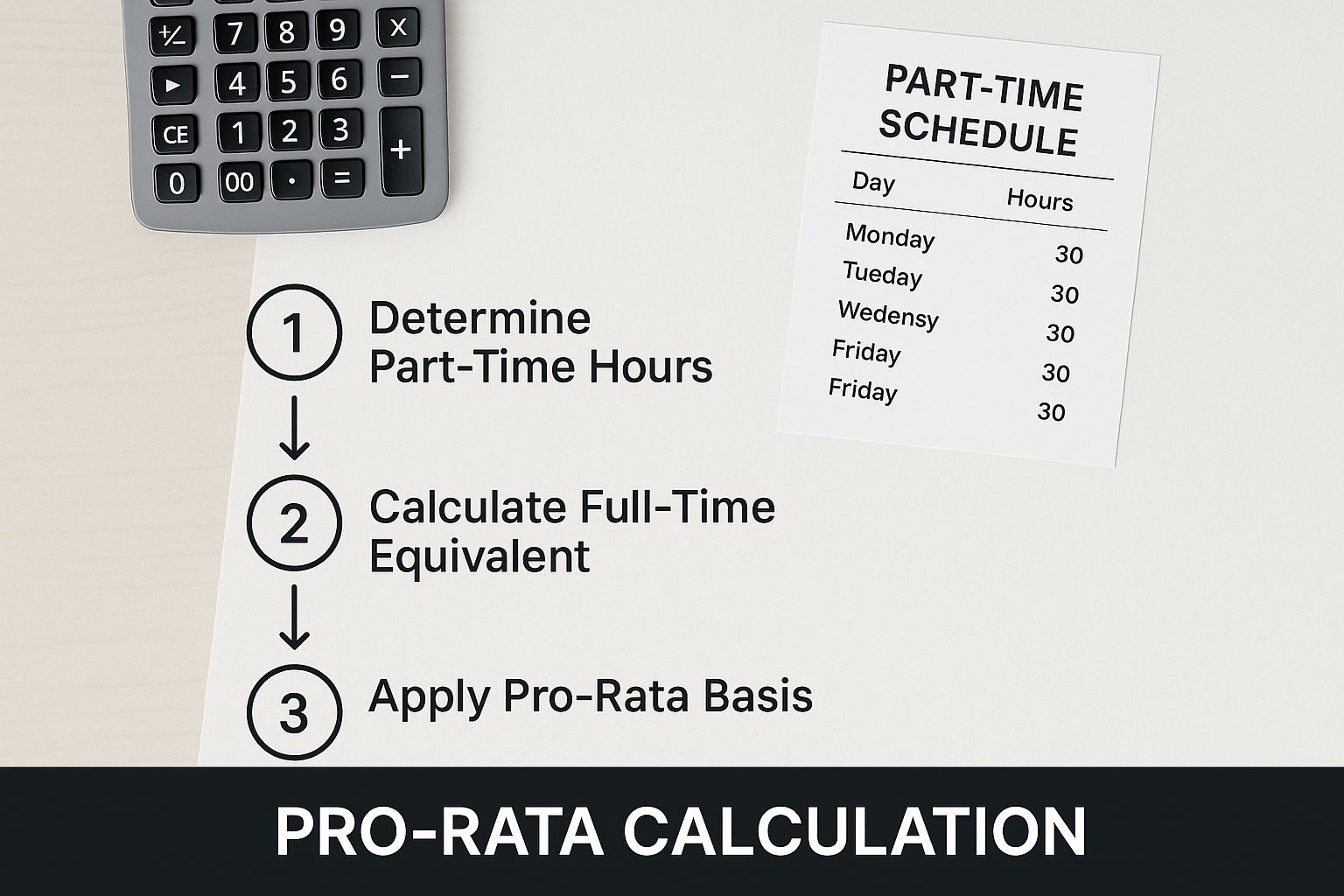
As you can see, the trick is to match the right formula to the person's working arrangement. That’s how you guarantee fairness and stay compliant.
Calculating for Employees with Fixed Days
This is the most straightforward calculation you'll come across, and it covers a huge chunk of the part-time workforce. If your employee works the same days week in, week out, you can calculate their holiday allowance in days. Simple.
The formula couldn't be easier:
Number of days worked per week × 5.6 weeks = Total holiday entitlement in days
Let’s see it in action.
Scenario One: Sarah the Graphic Designer
Sarah has a fixed schedule, working three days a week – every Tuesday, Wednesday, and Thursday. Your full-time staff work five days and get the statutory minimum of 28 days' leave.
To work out Sarah's holiday, you just pop her numbers into the formula:
- 3 days (Sarah's work week) × 5.6 (statutory weeks) = 16.8 days
Just like that, Sarah is entitled to 16.8 days of paid holiday for the year. When she books a Tuesday off, that's one day used from her total.
A question I get all the time is about rounding. Legally, you don't have to round up, but it's definitely best practice. Bumping 16.8 days up to 17 days (or at least to the nearest half-day) makes tracking simpler and builds a lot of goodwill. The one thing you must never, ever do is round down. That would mean you’re providing less than their statutory entitlement.
Calculating for Employees with Fixed Hours
But what about team members who have a set number of weekly hours, but their actual workdays chop and change? This is pretty standard in retail, hospitality, or any role with shift work. For these employees, calculating their leave in hours is the only way to be accurate and fair.
The starting point is to figure out the full-time equivalent (FTE) in hours and then apply the same 5.6-week standard to the part-timer's hours.
The formula is just as simple:
Number of hours worked per week × 5.6 weeks = Total holiday entitlement in hours
Let’s look at another common situation.
Scenario Two: Tom the Customer Support Agent
Tom is on a contract for 20 hours per week. His shifts vary – one week he might work four 5-hour shifts, the next it could be two 10-hour shifts. Because his workdays aren't fixed, a day-based calculation just wouldn't work fairly.
Here’s how to calculate Tom’s holiday entitlement in hours:
- 20 hours (Tom's work week) × 5.6 (statutory weeks) = 112 hours
Tom’s total annual holiday allowance is 112 hours. If he wants to take a day off where he was down for a 5-hour shift, he uses 5 hours from his 112-hour pot. This is the fairest approach because it deducts the exact time he was actually scheduled to work.
Key Considerations for Both Methods
Whichever way you calculate holiday for your part-time workers, consistency and communication are absolutely vital.
- Communicate Clearly: Make sure your part-time employees know their total entitlement in either days or hours right at the start of the holiday year.
- Document Everything: Their employment contract should clearly outline their working pattern and how their holiday pay is calculated. No grey areas.
- Use the Right Tool: You can do these calculations by hand, but it's easy to make a mistake. An automated system like LeaveWizard takes all the guesswork out of it. It applies the correct pro-rata formula automatically, saving you time and preventing some very costly errors.
By using these practical formulas, you can manage part-time leave with confidence and ensure every single team member gets the holiday they are legally entitled to. Getting this foundational accuracy right is crucial before you start tackling more complex things like bank holidays.
How to Handle Bank Holidays Fairly for Part Timers

Bank holidays. They’re a welcome break for most, but for managers handling part-time staff, they can be a real headache. A common mistake is to just give someone the day off if a bank holiday falls on their normal working day. This might seem simple, but it’s a recipe for unfairness.
Think about it: most bank holidays in the UK fall on a Monday. An employee who always works Mondays gets a bunch of extra paid days off over the year. What about their colleague who works Tuesday to Friday? They get nothing. That isn't just unfair; it's not legally compliant.
The only fair and correct way to approach this is to treat bank holidays as part of the total annual leave entitlement. You need to calculate a pro-rata allowance for bank holidays and add it to each employee's total holiday pot.
The Proportional Bank Holiday Calculation
To get this right, you must give every part-time employee a proportional share of bank holidays, no matter which days they actually work. Once you’ve done that, you simply deduct a day from their total allowance whenever a bank holiday happens to land on one of their scheduled workdays.
Here’s the simple formula you’ll need:
(Days worked per week ÷ 5) × Number of bank holidays in the year = Pro-rata bank holiday entitlement
Let's say there are 8 bank holidays in the year. A full-time employee working 5 days a week naturally gets all 8. But what about a part-timer who works 3 days a week?
- (3 ÷ 5) × 8 = 4.8 bank holiday days
You then add these 4.8 days to their standard pro-rata holiday entitlement. It’s the only way to make sure everyone gets their fair slice of the pie.
Seeing Fairness in Action A Tale of Two Workers
Let’s walk through a real-world scenario to see why this proportional method is so important. Imagine you have two part-timers, David and Chloe. Both work three days a week.
- David’s Schedule: Monday, Tuesday, and Wednesday.
- Chloe’s Schedule: Wednesday, Thursday, and Friday.
Both are entitled to a standard holiday allowance of 16.8 days (3 days × 5.6 weeks). To this, we add their pro-rata bank holiday entitlement of 4.8 days. This gives them each a total leave pot of 21.6 days for the year.
Key Insight: Giving both David and Chloe a total leave pot of 21.6 days is the crucial first step. From here, you simply deduct leave based on their individual circumstances, which guarantees a fair outcome for both.
How the Calculation Plays Out
As the year progresses, let's say five of the eight bank holidays land on a Monday, with another on Good Friday.
-
For David: The five Monday bank holidays all fall on his normal working days. The office is closed, so he has to take them off. For each of these five Mondays, you deduct a day from his 21.6-day total. This leaves him with 16.6 days to book off whenever he chooses.
-
For Chloe: She doesn't work Mondays, so those five bank holidays don't affect her schedule at all. Only one bank holiday (Good Friday) falls on her normal workday. You deduct that one day from her 21.6-day pot, leaving her with 20.6 days to book off as she pleases.
The result is perfectly fair. They both started with the exact same total leave entitlement. David had to use more of his for bank holidays because of his schedule, giving Chloe more flexibility with hers. The system works because it respects individual work patterns while ensuring the total amount of leave is identical. This isn't just good practice; it's essential for fair management.
This proportional approach is also vital for other types of non-standard contracts. For a deeper dive into more complex schedules, have a look at our guide on holiday entitlement on zero-hours contracts, which builds on these same principles.
Pro-rata calculations based on fixed days or hours are great for predictable schedules, but what about when an employee's hours change every single week? That's the reality for casual staff, seasonal workers, and anyone on a zero-hour contract.
For these team members, trying to pin down a fixed holiday allowance upfront is impossible. You need a more flexible approach.
Calculating Holiday for Irregular and Zero-Hour Workers
This is where the 'percentage of hours worked' method comes in. It’s a fair, legally sound way to handle holidays for part-time workers whose schedules are all over the place. Instead of getting a fixed pot of leave at the start of the year, they accrue holiday entitlement as they work. Simple.
Understanding the 12.07% Method
The government has endorsed a specific figure for this calculation: 12.07%. This number isn't just plucked out of thin air; it’s directly derived from the statutory 5.6 weeks of holiday entitlement.
Here’s how the maths breaks down:
- A standard working year is 52 weeks.
- Subtract the 5.6 weeks of statutory leave, and you're left with 46.4 working weeks (52 – 5.6 = 46.4).
- The percentage is then calculated as: (5.6 ÷ 46.4) × 100 = 12.07%.
This means that for every single hour an employee on a variable schedule works, they earn holiday time at a rate of 12.07%. It’s a brilliant tool for ensuring fairness for your most flexible staff.
Expert Tip: While 12.07% is the established standard, it’s crucial to apply it correctly. This method is specifically for genuinely irregular or zero-hour contracts. If you try to use it for regular part-time staff, you could end up with incorrect calculations and potential compliance headaches.
Putting the Percentage Method into Practice
Applying this is pretty straightforward. At the end of each pay period—whether that’s weekly or monthly—you just need to do a quick calculation. Take the total hours the employee worked during that time and multiply it by 12.07%.
The formula looks like this:
Total hours worked in pay period × 0.1207 = Holiday hours accrued
This gives you the holiday entitlement, in hours, that the employee has earned for that period. This amount gets added to their running total, creating a 'holiday pot' they can draw from when they want to take paid time off.
For more detailed guidance on different scenarios, check out our complete guide to calculating holidays for part time workers.
Let's walk through a real-world example to see how this works month by month.
Case Study: A Seasonal Retail Worker
Meet Liam. He’s a seasonal worker hired to help during the hectic autumn and winter retail rush. As you’d expect, his hours fluctuate significantly based on how busy the store is.
Let's track his holiday accrual over three months:
-
October: Liam works a total of 60 hours.
- Calculation: 60 hours × 0.1207 = 7.24 hours accrued.
-
November: The Black Friday sales period is chaos, and Liam puts in 110 hours.
- Calculation: 110 hours × 0.1207 = 13.28 hours accrued.
-
December: In the final push to Christmas, he works his busiest month yet at 130 hours.
- Calculation: 130 hours × 0.1207 = 15.69 hours accrued.
After just three months, Liam has built up a holiday pot of 36.21 hours (7.24 + 13.28 + 15.69). He can now use these hours to take paid leave. If he books a day off where he would have normally worked a 6-hour shift, 6 hours would simply be deducted from his 36.21-hour total.
This accrual-based system makes sure Liam’s holiday entitlement is always directly proportional to the work he's actually done. It's really the only fair way to manage leave for workers whose hours are never guaranteed.
Managing Holiday Calculations for New and Departing Staff
Holiday entitlement isn't just an annual set-it-and-forget-it task. Things get particularly tricky during employee transitions—when someone joins your team or decides to move on part-way through the leave year.
Getting these figures wrong can easily lead to payroll errors, legal headaches, and a poor final impression. These transitional periods require a precise pro-rata calculation based on the employee's time with the company. It's a key part of both a warm welcome and a professional offboarding process, ensuring fairness and full legal compliance from day one to the last.
Calculating Entitlement for New Part-Time Starters
When a new part-time employee joins, their holiday for the rest of the leave year needs to be calculated proportionally from their start date. You can't just hand them the full year's allowance; it has to be adjusted fairly.
First, work out what their full annual entitlement would be if they were with you for the entire year. Let’s take a new team member, Ben, who starts on 1st April. He works three days per week, and your company's holiday year runs from January to December.
His full annual entitlement would be calculated like this:
3 days × 5.6 weeks = 16.8 days
But since Ben is only working for nine of the 12 months in your leave year (from April to December), you need to figure out his pro-rata share for that specific period.
- Calculation: (16.8 days ÷ 12 months) × 9 months = 12.6 days
So, Ben is entitled to 12.6 days of paid leave for the rest of the year. Making this crystal clear during his onboarding will head off any confusion later on.
A Practical Tip: Many businesses choose to round this figure up to the nearest half or full day, making it 13 days in Ben's case. It's a small gesture that simplifies tracking for everyone and shows a bit of goodwill right from the start.
Handling Leave for Departing Employees
When a part-time employee leaves, you must calculate the holiday they've accrued right up to their final day. This is to make sure they're compensated for any leave they've earned but haven't had a chance to take. The process is very similar to a new starter's calculation, but it focuses on the portion of the year they have worked.
Let's imagine another employee, Chloe. She also works three days a week (giving her a full entitlement of 16.8 days) and is leaving on 30th June. Her last day falls exactly halfway through the holiday year.
Her accrued holiday entitlement is straightforward:
16.8 days ÷ 2 = 8.4 days
The next step is to check how much holiday Chloe has actually taken. This is where you figure out if any money is owed—either to her or, in some cases, to the company.
Settling the Final Holiday Balance
Once you have the accrued leave total for a departing employee, you just need to compare it against the leave they've already used. This will lead to one of two outcomes.
- Untaken Holiday: If Chloe has only used 5 days of her 8.4-day accrued entitlement, you owe her for the remaining 3.4 days. This is typically added to her final salary as a 'payment in lieu of holiday'.
- Excess Holiday Taken: What if Chloe has already taken 10 days off? In that case, she has used 1.6 days more than she had actually earned. You may be able to deduct the value of this excess leave from her final pay.
Crucial Compliance Check: You can only deduct pay for excess holiday if there's a specific clause in the employee's contract of employment that allows for it. Without this contractual right, attempting to reclaim the money is unlawful. Always double-check your contracts before processing a leaver's final pay.
Your Questions on Part-Time Holiday Answered
Even when you’ve got the formulas down, real-world situations have a knack for throwing a spanner in the works. Calculating holiday for part-time workers isn't always a straight line from A to B, leaving even seasoned managers searching for quick, clear answers.
This section tackles the most common questions we hear, clearing up the grey areas and giving you practical solutions for those tricky, everyday challenges.
What Happens If a Part-Time Worker Changes Their Hours Mid-Year?
This is a classic scenario, especially in growing businesses where roles are constantly evolving. If an employee's hours change, their holiday entitlement needs a rethink to keep things fair and, crucially, legal. You can't just stick with the original figure, nor can you just switch to the new one.
The standard and fairest way to handle this is with two separate calculations. First, you work out the leave they earned on their old contract, and then you do a second calculation for the period on their new contract.
- First, calculate the holiday accrued on the old working pattern.
- Then, calculate the entitlement for the rest of the year based on the new pattern.
Let's imagine an employee worked three days a week for the first six months of your leave year (January to June) and then switched to four days a week for the final six months (July to December).
Here’s how that breaks down:
- First 6 months: (16.8 days full-year entitlement ÷ 12) × 6 = 8.4 days
- Second 6 months: (22.4 days full-year entitlement ÷ 12) × 6 = 11.2 days
Add them together, and their total entitlement for the year is 19.6 days. The key here is to document this change clearly and let the employee know their new total. It saves a world of confusion later on.
Do We Have to Round Up Holiday Entitlement?
The maths rarely gives you a nice, clean whole number. You'll often end up with figures like 16.8 or 11.2 days. While there's no strict legal obligation in the UK to round up holiday entitlement, it is overwhelmingly seen as best practice.
Why? Well, rounding a figure like 16.8 up to 17 days (or at least to the nearest half-day) makes life easier for everyone. It simplifies admin for your HR and payroll teams and, just as importantly, builds goodwill with your employees. It's a small gesture that goes a long way.
The one absolute rule you must always follow is to never round down. Shaving off part of a day means you’re providing less than their statutory minimum entitlement. That’s against the law and could easily land you in front of a tribunal. Your best bet is to have a consistent, clearly stated policy on rounding in your employee handbook.
How Is Holiday Pay Calculated for a Part-Time Worker?
This question isn't about time off, it's about the money. Holiday pay has to reflect a worker's normal rate of pay. For a part-timer on fixed hours and a set salary, this is straightforward—they get paid the same whether they're working or on leave.
But what about team members with variable hours? Or those whose pay includes regular overtime, commission, or bonuses? That's when things get more involved. For these employees, you have to calculate their average pay over the previous 52-week reference period.
Critically, you only count the weeks where the employee actually got paid. If there are any weeks where they earned nothing, you skip them and go back further until you have 52 weeks of earnings. This is a legal requirement designed to make sure their holiday pay is a true reflection of their typical earnings, not just their basic contractual rate.
Can I Make a Part-Time Employee Take Holiday on a Bank Holiday?
Yes, you can require employees to take annual leave on specific days, including bank holidays, but you have to manage it correctly.
If a bank holiday falls on a day your part-time employee would normally be working, you can require them to use a day of their pro-rata holiday allowance to cover it. The key is to be fair, consistent, and crystal clear in your communication.
Crucially, this must be written into their contract of employment. You can’t, however, make them use a day's leave for a bank holiday that falls on one of their non-working days. A clear policy, applied fairly to all staff, is the only way to handle this without causing problems.