Let's cut through the confusion around paid leave, shall we? When it comes to UK holiday entitlement, the magic number everyone talks about is 28 days. Legally, every full-time employee is entitled to 5.6 weeks of paid holiday per year, and for someone working a standard five-day week, that translates to 28 days.
This is the absolute baseline that every employer must provide. It’s non-negotiable.
Your Essential UK Holiday Entitlement Explained

Getting your head around that statutory minimum is the first step. But the real devil is in the detail, especially when it comes to bank holidays. The law gives employers a bit of wiggle room here, and how they handle it makes all the difference.
It's perfectly legal—and very common—for an employer to include the standard 8 UK bank holidays as part of that 28-day total. This is where your employment contract becomes your best friend.
Contract Wording Makes All the Difference
The way your holiday allowance is worded in your contract isn't just semantics; it has a real impact on your flexible time off. I’ve seen two main ways companies phrase this, and you need to know which one applies to you:
- "28 days including bank holidays": This is the most common approach. It means your total paid leave for the year is exactly 28 days. On a year with 8 bank holidays, that leaves you with 20 days to book as you please.
- "20 days plus bank holidays": This phrasing is a bit more generous. It gives you 20 days of flexible annual leave in addition to the bank holidays. In a typical year, that adds up to 28 days off in total, but you get the full 20 days to choose for yourself.
Of course, some companies offer more than the statutory minimum, perhaps giving 30 days or more including bank holidays. The crucial thing is that the total can never dip below that 5.6-week legal requirement.
Key Takeaway: Always, always check your contract's wording. The difference between "including bank holidays" and "plus bank holidays" defines your true flexible leave and is a critical detail that many people miss.
How Entitlement Stacks Up for Part-Time Staff
Statutory entitlement is based on a standard 5-day working week. But what if you work fewer days? To keep things fair, your allowance is simply calculated on a pro-rata basis.
This system ensures that every employee, no matter their work pattern, gets the same proportional amount of paid time off.
For instance, a part-time team member working 3 days a week would be legally entitled to 16.8 days of holiday each year. This is just 3/5ths of the full-time 28 days. It’s all designed to provide fair rest periods for everyone, with leave starting to accrue from your very first day on the job. If you're keen to dive deeper, it's worth reading up on the latest holiday pay reforms explained by Armstrong Watson.
Statutory Minimum Holiday Entitlement at a Glance
To make things even clearer, here’s a quick reference table showing the legal minimum entitlement based on how many days you work per week.
| Days Worked Per Week | Statutory Annual Leave (Days) |
|---|---|
| 5 Days | 28.0 |
| 4 Days | 22.4 |
| 3 Days | 16.8 |
| 2 Days | 11.2 |
| 1 Day | 5.6 |
As you can see, the calculation is a straightforward multiplication: 5.6 weeks x (the number of days you work per week). This ensures fairness and consistency across the board.
Calculating Leave for Part-Time Employees

When it comes to holiday entitlement for your part-time staff, fairness is the name of the game. Everything hinges on a ‘pro-rata’ system, which is just a straightforward way of saying their leave is proportional to what a full-time colleague gets. This approach ensures everyone receives the right amount of time off relative to the hours they put in.
You don't need a complex spreadsheet to get this right. For part-timers who work a consistent number of days each week, the calculation is refreshingly simple.
The formula you'll keep coming back to is: (Number of days they work per week) x 5.6 weeks = Total annual leave days.
The Calculation in Action
Let's ground this in a real-world scenario. Imagine you have an employee, Sarah, who works a fixed schedule every Tuesday, Wednesday, and Thursday. To figure out her holiday entitlement, you just plug her days into the formula.
- Sarah’s Calculation: 3 days per week x 5.6 weeks = 16.8 days of paid holiday per year.
It really is that easy. This figure already includes her pro-rata share of bank holidays. So, if a bank holiday falls on a Monday, it doesn't impact her leave allowance because she wouldn't normally work that day. But if it falls on a Tuesday, she would use one of her 16.8 days of leave.
Important Tip: While you can round up part-day entitlements like 16.8 days to 17 as a gesture of goodwill, you are legally not allowed to round it down. Your employee must receive their full, exact entitlement.
What About Part-Time Hours?
The method shifts slightly for employees who work a set number of hours spread flexibly across the week, rather than on specific days. In these situations, calculating their entitlement in hours makes a lot more sense.
A typical full-time week is often around 37.5 hours. The statutory 28 days of leave for a full-timer would translate to 210 hours of holiday (28 days x 7.5 hours per day).
Now, let's consider another employee, David, who is contracted for 20 hours per week. Here’s how you’d work out his leave:
- Step 1: Find the Pro-Rata Percentage. Divide David's weekly hours by the full-time hours. So, that's 20 ÷ 37.5 = 0.5333 (or 53.33%).
- Step 2: Calculate Holiday Hours. Multiply this percentage by the full-time holiday allowance in hours. That gives you 0.5333 x 210 hours = 112 hours of holiday.
This approach ensures David gets the exact same proportion of leave as his full-time colleagues, just measured in a way that fits his work pattern.
Getting these simple formulas right is the key to managing your part-time staff fairly and steering clear of the common payroll errors that cause confusion and frustration. If you want to dive deeper into the nuances, you can learn more about how to calculate annual leave and explore a variety of other scenarios.
Handling Irregular Hours and Zero-Hour Contracts
This is where many businesses get tripped up. Calculating holiday entitlement for staff with unpredictable schedules or those on zero-hour contracts can feel like guesswork. But it's entirely manageable once you have the right method. You don't need a crystal ball, just a clear process.
The secret is to stop thinking about leave in terms of days and start calculating it in hours, based on the time your people have actually worked. This keeps things fair and compliant, no matter how much their weekly hours fluctuate.
The 12.07% Method Explained
For years, the go-to approach has been the 12.07% method. This figure isn’t just pulled out of thin air; it’s derived directly from the statutory holiday entitlement.
Here’s the logic behind it:
- A standard working year has 52 weeks.
- The statutory holiday entitlement is 5.6 weeks.
- This means employees are actually working for 46.4 weeks of the year (52 weeks – 5.6 weeks).
To figure out the percentage of holiday they accrue while working, you simply divide the holiday weeks by the working weeks: 5.6 ÷ 46.4 = 0.12068. This is then rounded up to 12.07%.
In practice, this means for every hour an employee works, they accrue holiday pay and leave equivalent to 12.07% of that hour. If they work 100 hours in a pay period, they earn 12.07 hours of paid holiday.
This method gives you a simple, consistent way to calculate holiday based on actual hours worked, which is essential for being fair to casual and zero-hour staff. If you need a really deep dive, our detailed guide offers more insights on zero-hour contract holiday calculations.
A New Option: Rolled-Up Holiday Pay
Things got a bit easier recently. For leave years starting on or after 1st April 2024, the government has officially brought back 'rolled-up holiday pay' as a compliant option, specifically for irregular-hour and part-year workers.
Instead of tracking accrued leave in a separate pot, you can 'roll up' the holiday pay and include it directly in the worker’s regular pay packet. It’s a much more straightforward system.
There are a couple of rules, though. It must be:
- Calculated at 12.07% of their total pay for that period.
- Clearly itemised as 'holiday pay' on their payslip.
This approach is a real game-changer for workers with unpredictable schedules. They get their holiday pay as they earn it, which gets rid of the headache of calculating and paying out accrued leave when they decide to take time off.
A Practical Example
Let’s see how this actually works. Meet Tom, a student who works shifts at a local café on a zero-hour contract. His hours vary every week based on how busy they are.
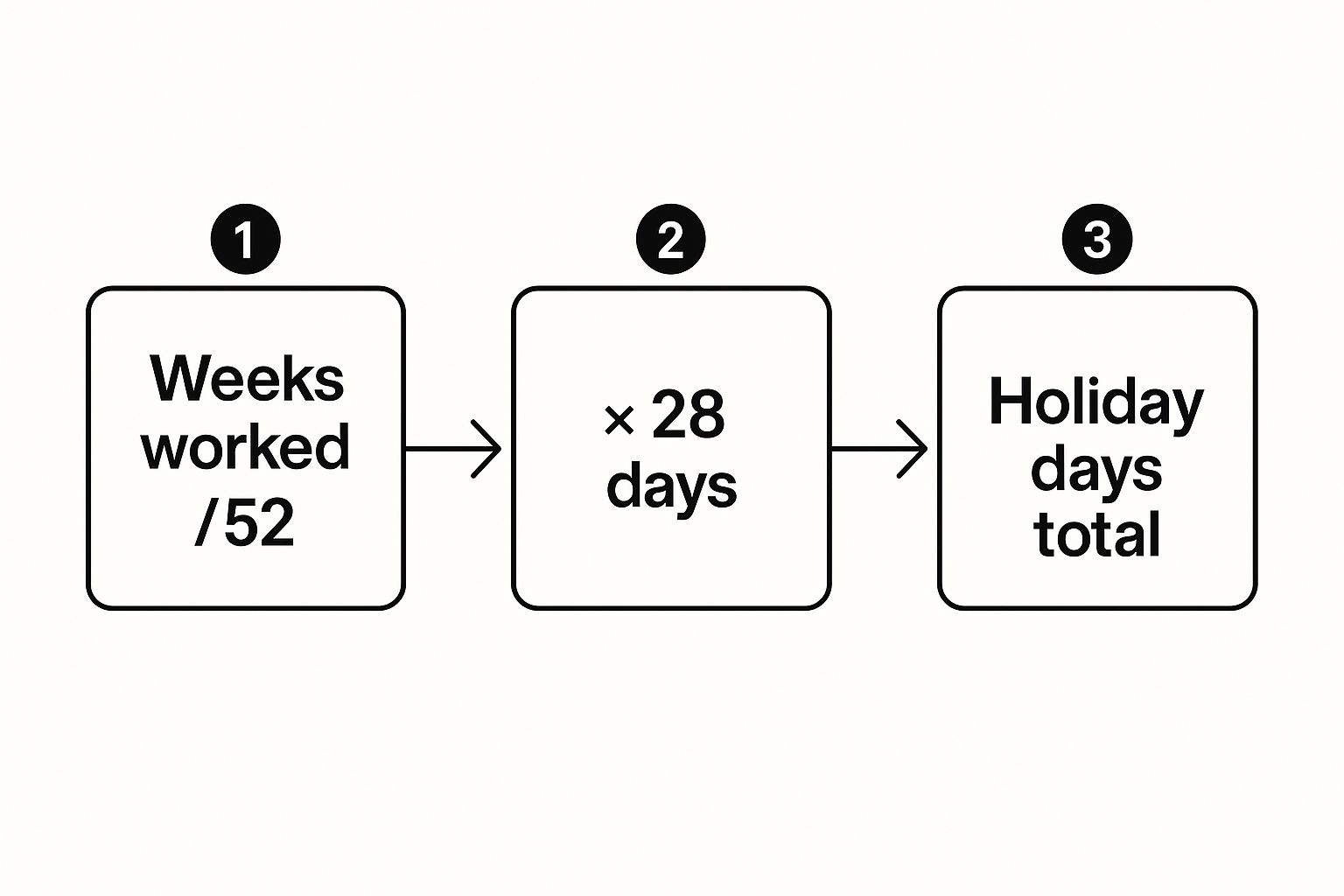
In May, Tom works a total of 60 hours. To calculate his holiday accrual for the month, his employer uses the 12.07% method.
- Holiday Hours Earned: 60 hours x 12.07% = 7.24 hours
His employer now has two choices. They can either add these 7.24 hours to Tom's accrued holiday balance for him to take later, or, if they're using rolled-up pay, add the monetary equivalent directly to his May wages, making sure it’s clearly marked on his payslip.
Managing Holiday for New Starters And Leavers

Employee churn is inevitable, but handling holiday properly shouldn’t be a guessing game. When someone joins or leaves halfway through your holiday year, you need to calculate entitlement precisely on a pro-rata basis.
Holiday entitlement kicks in from day one and builds up evenly. A new starter won’t have their full allowance until they’ve actually worked for it, so splitting the year month by month is the fairest approach.
Take a full-timer with 28 days’ annual leave. They earn roughly 2.33 days per month (28 ÷ 12). If they arrive mid-year, they only get what they’ve accrued in the remaining months—not the full 28 days.
Calculating For New Starters
Bringing someone on board in June or July? You don’t want a fresh recruit booking two weeks off immediately. Instead, work out how many months remain in your leave year and multiply by the monthly accrual.
- Months to Work: July to December = 6 months
- Monthly Accrual: 2.33 days per month
- Total Accrued: 6 × 2.33 = 13.98 days
In practice, round up to the nearest half or full day. That way, you’d grant 14 days for their first half-year—and everyone knows where they stand from day one.
Handling Departing Employees
When someone leaves, accuracy matters for their final pay. First, calculate how much holiday they’ve earned up to their last day. Then compare it to what they’ve actually taken.
Imagine a colleague entitled to 28 days who departs after eight months. Their accrual looks like this:
| Months Worked | Monthly Rate | Total Accrued |
|---|---|---|
| 8 | 28 ÷ 12 | 18.67 days |
From there, two scenarios emerge:
- Unused Leave: If they’ve taken only 15 days, you owe 3.67 days of holiday pay. This ‘payment in lieu of holiday’ must appear on their final payslip.
- Overtaken Leave: If they’ve already taken 20 days, they’ve used 1.33 days more than they accrued. Your contract should allow you to deduct that overpayment from their final salary.
A well-drafted employment contract is your safety net. It should clearly explain how starters and leavers accrue holiday and outline deductions if someone takes more than they’ve earned. This level of transparency avoids awkward disputes at the finish line.
Avoiding Common Pitfalls and Contractual Traps
Getting the numbers right is just one piece of the puzzle when you're working out holiday entitlement. Believe me, the exact wording you use in your employment contracts is just as critical. I've seen minor oversights spiral into some pretty significant and entirely avoidable disputes.
A clear, unambiguous contract is your best line of defence. It protects both you and your staff by setting out clear expectations from day one, leaving no grey areas when it comes to paid time off.
The Bank Holiday Calendar Quirks
One of the most common traps I see managers fall into is assuming there are always eight bank holidays every year. This isn't a given. Calendar quirks happen, and if your contracts aren't worded to handle it, you could find yourself accidentally short-changing employees on their statutory minimum leave.
For instance, the leave year from 1 April 2024 to 31 March 2025 is a perfect example. Because of how Easter falls, there are only seven bank holidays within this specific period in England and Wales. Anyone with a contract stating '20 days plus bank holidays' would suddenly only have 27 days of leave, which is below the legal minimum of 28. It’s a stark reminder of just how crucial precise wording is.
The safest approach? State the total entitlement clearly. Something like, "28 days of paid annual leave, inclusive of all bank holidays." This simple phrasing protects you from these calendar anomalies and keeps you compliant, no matter how many bank holidays fall in a given leave year.
Managing Carried-Over Leave and Sickness
Another area ripe for confusion is what to do with unused leave. Your policy on carrying over holiday days into the next leave year needs to be explicitly stated in your company handbook or contract.
While the first four weeks of statutory leave generally can't be carried over (unless an employee couldn't take it due to sickness), you have more flexibility with the additional 1.6 weeks and any extra contractual leave you offer. Spell it out so everyone knows where they stand.
Similarly, remember that holiday entitlement continues to build up as normal during periods of long-term sickness. An employee on sick leave is still accruing their paid time off. It's vital to have a clear process for how this accrued leave can be taken once they return to work.
Calculating Holiday Pay Correctly
Holiday pay isn't always as simple as just paying an employee's basic salary. For the first four weeks of statutory leave, the pay must reflect what an employee would have normally earned.
This means you must include regular payments like:
- Compulsory and voluntary overtime that is worked with enough regularity.
- Commission payments that are intrinsically linked to performing the job.
- Performance-related bonuses that are a normal part of their pay.
Getting this wrong can easily lead to underpayments and potential legal claims. Honestly, calculating pay that includes all these variables can be a huge administrative headache.
For businesses navigating these complexities and wanting to sidestep legal or contractual issues, using professional payroll services can be invaluable. It also helps to get familiar with the details yourself, which you can do by checking out our guide on how to calculate holiday pay with simple methods that work.
Answering Your Trickiest Holiday Entitlement Questions
Even when you've got the basic numbers sorted, real-life situations can throw a spanner in the works. What happens during maternity leave? Does holiday pay need to include that regular overtime? These are the nuanced scenarios that often trip people up.
Let's dive into some of the most common questions I hear. With the right information, you can handle these situations with complete confidence.
What Happens to Holiday During Maternity Leave?
This is a big one, but the rule is simple: an employee’s full statutory and contractual holiday entitlement continues to build up throughout their entire maternity leave. This is a non-negotiable right, and their allowance accrues just as if they were in the office every day.
Because they can't take annual leave while on maternity leave, it's best to have a chat and arrange for them to use this accrued holiday either before they go, or immediately after they return. Remember, you can't just pay them in lieu of this time unless their employment with you is coming to an end.
Should Holiday Pay Include My Regular Overtime and Commission?
Yes, absolutely. For the first four weeks of statutory leave, holiday pay must reflect what an employee would 'normally' earn. This isn't just their basic salary; it has to include payments that are intrinsically linked to their job.
That means you must factor in things like:
- Regular overtime, whether it's compulsory or voluntary.
- Commission payments that form a regular part of their income.
- Certain performance-related bonuses.
While the remaining 1.6 weeks of statutory leave can legally be paid at a basic rate, many employers find it much simpler—and fairer—to just pay the full 5.6 weeks at the higher 'normal' rate. It keeps payroll straightforward and is a great way to show you value your team's contributions.
Key Insight: Getting 'normal pay' right is crucial. Forgetting to include regular overtime or commission when calculating holiday pay for those first four weeks can easily lead to underpayment claims. The guiding principle is to pay for leave based on what an employee would have genuinely earned if they were working.
Can My Employer Tell Me When I Have to Take My Holiday?
In short, yes. Employers do have the right to manage when their staff take annual leave. This is a common and perfectly reasonable practice used to handle business needs, like planning for a company-wide shutdown over Christmas or making sure the team isn't short-staffed during a project launch.
An employer can also turn down a holiday request. However, they need to give proper notice. The rule of thumb is that the notice period must be at least as long as the holiday requested. So, if you need to decline a two-week holiday request, you must give the employee at least two weeks' notice.
It's vital that these rules are clearly spelled out in the employment contract or the company handbook. Transparency is your best friend here—it prevents misunderstandings and ensures everyone is on the same page about booking time off.