Navigating UK employment law can sometimes feel like trying to solve a puzzle, but the rules around holiday entitlement are actually quite straightforward once you get the hang of them. The absolute cornerstone is the legal minimum of 5.6 weeks of paid annual leave that nearly all workers are entitled to.
For someone working a typical five-day week, this works out to be 28 days of paid time off each year. This isn't just a nice-to-have; it's a legal requirement designed to protect your team's well-being and make sure everyone gets enough rest.
Understanding Your Core Holiday Obligations
Think of the statutory 5.6 weeks as the non-negotiable "annual leave allowance" that you, as an employer, must provide to your team. This is the absolute minimum, and falling short can lead to serious compliance headaches and even employment tribunals.
This core principle is the foundation for everything else related to holiday pay and policies in your business. Whether you're managing full-time staff, part-time team members, or those on zero-hours contracts, it all starts from this legal baseline.
What Does the 5.6 Weeks Actually Mean?
The right to paid holiday was established by the Working Time Regulations 1998, which originally set the entitlement at four weeks. This was later increased to 4.8 weeks in 2007 and then finally to the current 5.6 weeks in April 2009 to account for bank holidays.
So, how do bank holidays fit into this? This is a common point of confusion for many business owners. Here's the key thing to remember:
You can include bank holidays as part of the statutory 28-day entitlement, but you are not legally required to. The decision ultimately comes down to what's written in the employee's contract.
For example, you could offer 28 days of leave including the 8 bank holidays. In this case, a standard Monday-to-Friday worker would have 20 days to book whenever they like. Alternatively, you could offer a more generous package of 28 days plus bank holidays. The choice is yours, as long as it's clearly stated.
To make it easier to see how this breaks down, here's a quick reference table.
Statutory Minimum Holiday Entitlement At a Glance
This table shows the minimum holiday entitlement in days, based on how many days a week an employee works.
| Days Worked Per Week | Weeks Entitlement | Total Days of Holiday Per Year |
|---|---|---|
| 5 days | 5.6 weeks | 28 days |
| 4 days | 5.6 weeks | 22.4 days |
| 3 days | 5.6 weeks | 16.8 days |
| 2 days | 5.6 weeks | 11.2 days |
| 1 day | 5.6 weeks | 5.6 days |
Remember, the 5.6 weeks is the constant factor. You just multiply it by the number of days the employee works each week to get their total annual entitlement.
Why Getting the Basics Right Matters
Getting this right isn't just about ticking a legal box. It has a direct impact on both your legal standing and your company culture. Ensuring every employee receives their correct allowance is a fundamental part of complying with employment laws.
Beyond the legalities, a clear and fair holiday policy is a huge contributor to team morale and helps prevent burnout. When your people know their time off is protected and valued, it creates a much healthier and more productive work environment.
Nailing this foundational understanding is crucial before we dive into more complex situations, like pro-rata calculations or the rules for carrying leave over. Building your policies on this solid legal ground ensures you're being fair and consistent with everyone on your team.
Calculating Holiday for Part-Time and Atypical Workers
Once you’ve got the hang of the rules for your full-time staff, the next step is tackling holiday calculations for part-time and atypical workers. This is an area where a lot of businesses trip up, but getting it right is vital for fairness and staying on the right side of UK legal holiday entitlement regulations.
The core principle here is pro-rata. It’s a simple concept: employees get holiday in direct proportion to the time they actually work. The good news is that the maths isn't as scary as it might sound.
The Standard Method for Consistent Part-Time Hours
Let’s start with the easy one. For an employee who works a set number of days each week, the calculation is just simple multiplication. You take the statutory 5.6 weeks and multiply it by the number of days they work per week. This keeps their holiday allowance perfectly proportional to a full-timer.
Imagine you have a marketing assistant who works three days a week. Here’s how you’d figure out their entitlement:
- Calculation: 5.6 (weeks) x 3 (days worked per week) = 16.8 days of paid holiday per year.
It’s crucial to be precise with these numbers. While you can always round up to be generous, you must never round down. So, in this case, the employee is entitled to exactly 16.8 days. You could let them take 16 full days and account for the final 0.8 of a day, or just round it up to 17 days to keep things simple.
This decision tree shows how that first step guides your entire process.
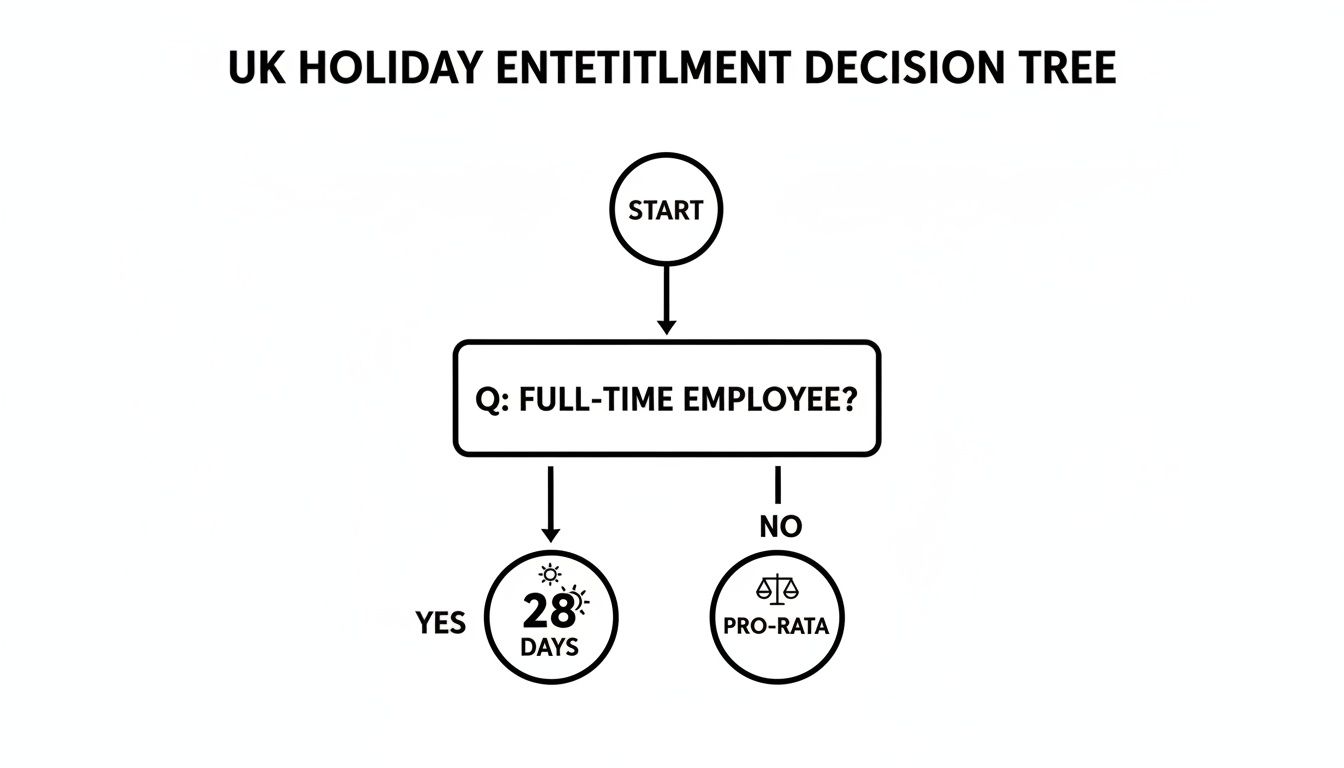
As you can see, the first question is always whether an employee is full-time or not. That simple distinction determines whether you use the standard 28-day figure or a pro-rata calculation.
The Percentage Method for Irregular Hours
But what about workers whose hours are all over the place, like casual staff or people on zero-hours contracts? A fixed-day calculation just won’t work. For them, we use a percentage-based method where holiday time is accrued as they work.
The magic number is 12.07%. This figure represents the 5.6 weeks of statutory holiday as a percentage of the total working weeks in a year.
The calculation for this percentage is: (5.6 weeks of holiday / 46.4 weeks of work) x 100 = 12.07%. The 46.4 weeks represents the 52 weeks in a year minus the 5.6 weeks of statutory leave.
This percentage acts as a constant accrual rate. For every hour someone works, they earn a little slice of paid holiday time.
Let's say a member of your weekend team worked 60 hours last month. To find out how much holiday they’ve earned:
- Calculation: 60 hours x 12.07% = 7.24 hours of paid holiday earned.
This approach ensures absolute fairness, as their holiday entitlement rises and falls in direct step with the hours they put in. You just apply this percentage to their total hours for each pay period.
Practical Steps for Accurate Calculations
Applying these methods consistently is the key to preventing headaches and disputes. Getting holiday calculations wrong can easily lead to underpayments and unhappy staff, which is a fast track to potential legal trouble. For a more detailed walkthrough, our holiday calculation guide for part-time workers provides extra examples and advice.
To keep your calculations spot-on, just follow these steps:
- Identify the Worker Type: Is the employee on fixed part-time hours or irregular hours? This is the first question and dictates which method you'll use.
- Calculate the Entitlement: Use the 5.6 weeks multiplier for fixed-hour staff or the 12.07% accrual rate for variable-hour staff.
- Track Accrual and Usage: Keep meticulous records. For irregular staff, this means tracking hours worked. For everyone, it means logging holiday time accrued and taken. This is non-negotiable for payroll and compliance.
- Communicate Clearly: Make sure your employees know exactly how their holiday is calculated. Putting this information clearly in their contract or employee handbook avoids confusion down the line.
By sorting your team into these categories and applying the right formula, you can manage your UK legal holiday entitlement obligations with confidence. A systematic approach doesn't just keep you compliant; it builds trust by showing every team member, whatever their working pattern, that you have a fair and transparent process.
Defining What Counts as Holiday Pay
One of the most common tripwires in managing UK legal holiday entitlement is figuring out what holiday pay should actually include. It's not as simple as paying an employee's basic salary while they're off. A series of landmark legal cases have hammered home a key principle: holiday pay must reflect an employee's 'normal remuneration'.
The whole point is to make sure your team isn't financially penalised for taking the time off they're entitled to. If someone regularly earns more than their base pay, those extra earnings need to be factored in. Think of it this way: an employee on leave should earn what they would typically earn if they were at work. Getting this wrong can lead to underpayments, disputes, and some very costly legal headaches.
Beyond the Basic Salary
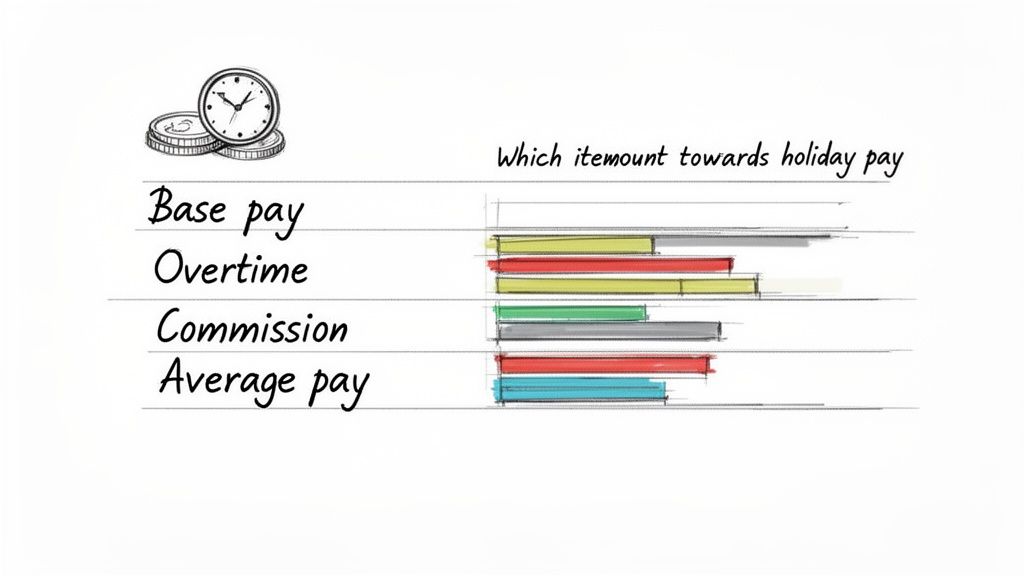
So, what exactly is 'normal remuneration'? The definition has been shaped and clarified by employment tribunals and court rulings over the years. It generally covers any payments that are intrinsically linked to the job and are paid on a regular basis.
If an employee consistently relies on these extra earnings as part of their regular income, then it stands to reason they should be part of their holiday pay calculation.
Key components that you absolutely must include are:
- Compulsory Overtime: This is a given. It includes any overtime the employer is obliged to offer and the employee is required to work.
- Regular Voluntary Overtime: This one catches people out. Even if overtime is optional, if an employee works it consistently enough that it becomes part of their normal pay packet, it has to be included.
- Commission Payments: If commission is directly linked to the work the employee does, it must be factored into their holiday pay.
- Performance-Related Bonuses: Bonuses that are tied to performance and paid regularly should also be part of the calculation.
Getting these sums right is fundamental. Once you know what to include, implementing it properly means setting up a payroll system that can handle the complexity.
The Two-Tier System of Holiday Leave
Here’s a crucial detail that often gets missed: the statutory 5.6 weeks of leave is actually split into two distinct pots. Each has slightly different rules for pay, a distinction that comes from a mix of European and UK law.
The First 4 Weeks: This portion comes from the EU's Working Time Directive. For these four weeks, you must include all elements of 'normal remuneration'—that means overtime, commission, and any relevant bonuses—when you calculate holiday pay.
The Remaining 1.6 Weeks: This extra bit is a UK-specific entitlement. For these days, the law is less strict. You are generally only required to pay an employee their basic salary, unless their contract says otherwise.
This two-tier system can feel a bit fiddly, but it’s a non-negotiable part of being compliant. To keep things simple and avoid errors, many employers just apply the full 'normal remuneration' calculation to the entire 5.6 weeks.
For a deeper dive into the specifics, you can learn more about how to https://www.leavewizard.com/calculate-holiday-pay/.
Calculating the Average Pay
To work out the correct holiday pay rate, you need to calculate an employee's average weekly pay over a specific reference period. The standard reference period is now 52 weeks.
When an employee takes a holiday, you look back at the previous 52 weeks where they actually earned money. This is important. If there were any weeks they didn't work (perhaps due to unpaid leave), you must discount those weeks and go back further until you have 52 weeks of pay data. This stops the average from being unfairly dragged down.
Following this process ensures the holiday pay they receive is a true reflection of what they normally earn, protecting both your employee's income and your business's legal standing.
Managing the Overlap of Sickness and Annual Leave
It’s a scenario every manager has faced: an employee is all set for a well-deserved holiday, only to call in sick right before they’re due to jet off. This situation can feel a bit confusing, but the rules around UK legal holiday entitlement are actually quite clear. They're built on the idea that rest is fundamentally different from recovery.
When someone falls ill just before or during their pre-booked annual leave, they have the right to treat that time as sick leave instead. This means they can reclaim their holiday days to use later on, once they've recovered. Of course, they still need to follow your company's usual sickness reporting procedures, like calling in on the first day of their absence.
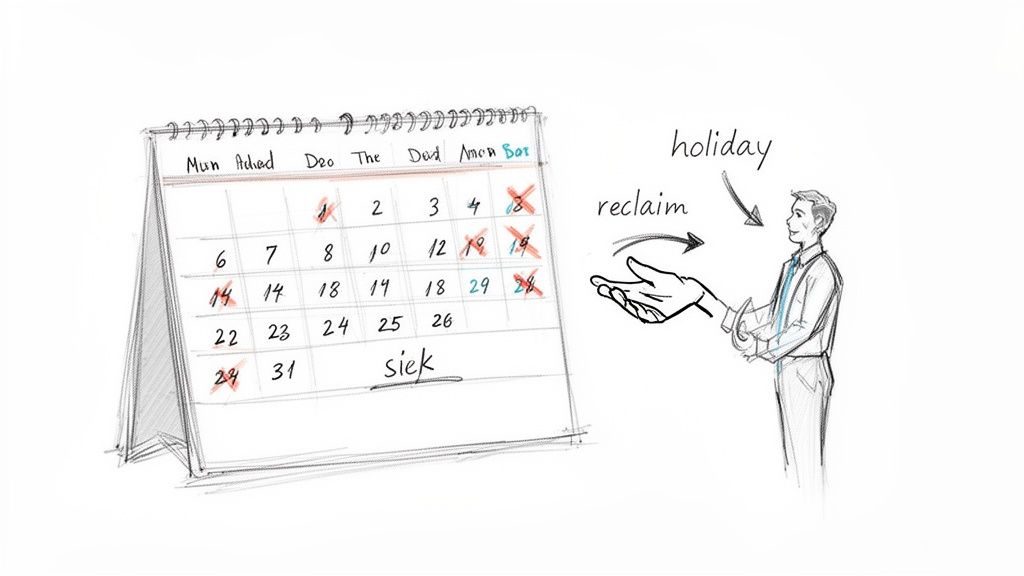
This protection ensures that a holiday—which is meant for rest and relaxation—isn't wiped out by a bout of flu. During this time, the employee would receive Statutory Sick Pay (SSP) or any contractual sick pay you offer, not their holiday pay.
Holiday Accrual During Long-Term Sickness
A question that often comes up is whether employees continue to build up holiday entitlement while on long-term sick leave. The answer is a simple and resounding yes. Employees continue to accrue their statutory 5.6 weeks of annual leave throughout any period of sickness, no matter how long it lasts.
This right is firmly baked into UK law. It’s based on the principle that the need for a break from work doesn't just vanish because someone is unwell. Trying to stop this accrual would be a direct breach of the Working Time Regulations.
Rules on Carrying Over Sickness-Related Leave
This brings us to the next logical point: what happens if someone on long-term sick leave can't possibly use their holiday before the leave year ends? In this specific situation, the usual carry-over rules become more flexible.
An employee must be allowed to carry over any of the four weeks of leave derived from EU law into the next holiday year if they were unable to take it due to sickness. This carried-over leave must then be used within 18 months from the end of the leave year in which it was accrued.
This provision is a crucial safety net. It prevents employees from losing their fundamental right to paid time off simply because of a prolonged illness, and it's a key part of managing your team with compassion and legal diligence.
The evolution of UK holiday entitlement has been quite a journey. It all started with the Holidays with Pay Act in 1938, eventually leading to the 2009 increase to 28 days for full-time workers—that’s a 40% real-terms jump from the 20 days offered back in 1998. Understanding this history gives context to the importance of proactive planning, especially with today's changing work patterns. You can find more insights into how the UK compares internationally on Personnel Today.
Developing a Clear Sickness and Holiday Policy
To handle these situations smoothly and sidestep any potential disputes, your company policy needs to be airtight. Your employee handbook or absence policy should spell everything out clearly:
- Reporting Sickness During Leave: Detail the exact steps an employee must take if they get sick while on holiday. Who do they call? What evidence, like a doctor's note, might they need to provide?
- Reclaiming Holiday: Explain the process for an employee to reclaim the days they were sick and re-book them for a later date.
- Carry-Over Rules: Outline the company's approach to carrying over leave due to long-term sickness, making sure it aligns perfectly with the legal requirements.
Getting these rules down in writing provides a consistent, fair framework for everyone. It protects both the employee and the business from confusion and conflict.
Setting Clear Rules for Carrying Over Unused Leave
What happens when an employee gets to the end of the year with a stash of unused holiday days? It's a common puzzle for employers, but the rules around UK legal holiday entitlement are actually quite clear, if a little strict. The general principle is often summed up as "use it or lose it."
However, it's not quite that simple. The law makes a crucial distinction within the statutory 5.6 weeks. The first four weeks, which stem from EU law, are there to ensure employees get proper rest within the year they're earned. As a rule, these can't be carried over.
The remaining 1.6 weeks are a UK-specific top-up, and here you have more flexibility. You can let your team carry this portion over into the next leave year, but only if you have a written agreement in place, like a clause in their employment contract or a clear company-wide policy.
Understanding the Legal Exceptions
While the "use it or lose it" rule is the baseline, there are critical exceptions where carrying leave over becomes a legal requirement. These are specifically designed to protect employees who were physically unable to take their holiday.
The biggest exception is for anyone on long-term sick leave. If an illness stops an employee from taking their statutory holiday, you must allow them to carry over the untaken part of their initial four weeks. The same goes for employees on family-related leave, like maternity or adoption leave.
It's your legal duty to let employees carry over up to four weeks of statutory leave if they couldn't take it due to long-term sickness or family leave. This carried-over leave usually needs to be used within 18 months.
Getting this wrong isn't just a simple mistake; it's a direct breach of the Working Time Regulations. That could land your business in hot water with an employment tribunal claim.
The Business Risks of Excessive Accrued Leave
Letting too much untaken leave pile up is a recipe for trouble. For starters, it’s a financial liability sitting on your balance sheet. If an employee with a huge bank of accrued holiday leaves, you're legally on the hook to pay them for all of it in their final payslip.
It also creates massive operational headaches. Imagine a last-minute stampede of employees trying to burn through their remaining holiday before the year ends. You could be left seriously short-staffed when you can least afford it. More importantly, employees who don't take regular breaks are prime candidates for burnout, which hits productivity, morale, and overall well-being.
On a positive note, it seems workplace culture is shifting for the better. Recent data shows a dramatic 71% drop in unused annual leave per employee since 2019, falling from a hefty 18.5 days to just 5.3 days in 2024. You can find more insights on this evolving annual leave trend on timetastic.co.uk.
Creating a Clear and Fair Carry-Over Policy
A well-defined policy is your best friend here, preventing confusion and protecting your business. It needs to be communicated clearly to everyone and should live in your employee handbook.
Here’s what it absolutely must cover:
- The General Rule: State plainly that holiday should be taken in the leave year it's earned.
- Your Carry-Over Allowance: Be specific. How many days (if any) from the additional 1.6 weeks can be carried over? A cap of five days is a common and sensible limit.
- A Firm Deadline: Set a cut-off date for using carried-over leave in the new year (for example, by 31st March). This stops it from snowballing.
- The Exceptions: Clearly outline the legal exceptions for sickness and family leave. This ensures everyone understands their rights and your obligations.
To get a grip on the complexities of carry-over rules and stay compliant, looking into different recurring task apps for managing leave can be a game-changer. These tools can help track entitlements and send out reminders, encouraging a healthier work-life balance and protecting your business from unnecessary risk.
A Few Common Questions About Holiday Entitlement
Once you get past the basic calculations, the day-to-day reality of managing holiday leave throws up some practical questions. Getting these right is crucial for keeping your team happy, treating everyone fairly, and staying compliant. Let's walk through some of the most common queries we see from employers.
What Happens to Holiday When an Employee Leaves?
When someone's time with your company comes to an end, you need to sort out their final holiday pay. The first step is a pro-rata calculation to figure out exactly how much leave they’ve built up during their final year, right up to their last day.
If they have leftover statutory holiday, you are legally required to pay them for it. This is called a payment in lieu of holiday, and it’s one of the only situations where this is allowed. On the flip side, if they’ve taken more holiday than they’ve actually accrued, you can usually deduct the value of the extra days from their final pay. Just make sure you have a clear clause in their employment contract that gives you permission to do this.
Can We Tell Employees When to Take Their Holiday?
In short, yes. As the employer, you can absolutely tell your staff when they need to take their annual leave. This is a common and practical approach for businesses that have a company-wide shutdown, maybe over the Christmas period or for summer maintenance.
The key is to give them enough notice. The rule is simple: you must give notice that is at least double the length of the holiday you're asking them to take. So, for a one-week shutdown, you’ll need to give everyone at least two weeks' notice. If you’re closing for two weeks, that notice period goes up to a minimum of four weeks.
This rule cuts both ways. If you ever need to cancel an employee's pre-approved holiday, you have to give them notice that is at least as long as the leave they had booked.
Are Bank Holidays an Automatic Right Off?
This is probably one of the biggest misconceptions out there. There's no automatic legal right for an employee to have bank holidays off work. Whether they get the day off, and whether it's paid, comes down to one thing: what's written in their contract of employment.
Many employers include the eight UK bank holidays as part of the statutory 5.6 weeks (28 days) of leave. If you need people to work on those days—common in retail, hospitality, and healthcare—your contract must say so. It should also be clear about what they get in return, like a different day off in lieu or an enhanced rate of pay.
How Can We Manage Holiday Requests Fairly?
A clear, consistent holiday request policy is your best friend here. It helps you manage expectations, keep things running smoothly, and avoid any arguments about favouritism. The trick is to establish a few ground rules and apply them to everyone without exception.
A few popular and effective approaches include:
- First-Come, First-Served: Simple and hard to argue with. Requests are approved in the order they come in.
- Set Clear Limits: Decide how many people from a single team can be off at the same time. This ensures you always have enough cover to operate.
- Blackout Periods: If your business goes through predictable peak seasons (like Christmas for a retailer), communicate these "blackout periods" well in advance so everyone knows when leave is off the table.