Getting UK holiday pay right comes down to one core idea: calculating an employee's average 'week's pay' and then multiplying it by their statutory leave entitlement.
For your salaried staff, this is usually just their normal weekly wage. But for team members with irregular hours, you'll need to use a 52-week reference period to find a fair average. Nailing this calculation isn't just good practice; it's a legal must.
Understanding UK Holiday Pay Essentials

While the rules around UK holiday pay can seem a bit tangled at first, they're all built on the principle of fairness. The law is designed to make sure employees get paid for their time off at a rate that truly reflects what they’d have earned if they were working. This stops people from being penalised financially just for taking a well-earned break.
The starting point is the legal entitlement itself. In the UK, almost all workers are entitled to 5.6 weeks of paid annual leave. For someone working a standard five-day week, that works out to 28 days. This often includes bank holidays, although there's no automatic legal right for them to be paid unless it's specified in their employment contract.
Fixed vs Variable Hours
The biggest fork in the road for holiday pay calculations is how your employee works.
- Fixed Salary/Hours: For staff on a set salary or who work the same hours week in, week out, the calculation is refreshingly simple. 'A week's pay' is exactly what it sounds like – what they get paid in a normal week.
- Irregular or Zero Hours: This is where it gets more involved. For employees whose hours and pay change from one week to the next, you have to look back over a reference period to calculate an average weekly pay. This ensures they get a fair amount that reflects their typical earnings.
The golden rule is this: holiday pay should not leave an employee out of pocket for taking time off. It has to reflect their usual earnings, and that includes things like regular overtime and commission.
Understanding this difference is the first and most critical step. The regulations have evolved specifically to protect workers with variable pay, so it's vital for employers to stay on top of the latest guidance. We've actually covered some of the most important changes to calculating holiday pay in another article. Getting this right from the beginning will save you a world of compliance headaches down the line.
Calculating Pay for Salaried and Fixed-Hour Staff
When it comes to calculating holiday pay, staff on a fixed salary or those who work consistent hours each week are usually the most straightforward. Thankfully, this is the most common scenario for many businesses, and getting this right is the foundation for everything else.
The main idea is to figure out their standard 'week's pay'. For someone on a full-time salary, you just divide their annual salary by 52. If they’re part-time but work the same hours every week, it’s simply their normal weekly wage.
A Practical Example: Salaried Full-Time
Let's take a real-world example. Imagine you have a full-time employee, Sarah, who earns an annual salary of £31,200.
- First, we need her weekly pay: £31,200 / 52 = £600. This is her 'week's pay' for holiday calculations.
- If Sarah books a one-week holiday, she gets paid £600.
- For her two-week summer getaway, her holiday pay comes to £1,200 (£600 x 2).
But what about a single day off? Assuming she works a standard five-day week, her daily rate is £600 / 5 = £120. That's exactly what she'll receive for one day of annual leave.
Part-Time Fixed Hours Scenario
Now, let's look at David. He works a set 20 hours every week and is paid £15 per hour. His situation is just as simple to work out.
David's regular weekly pay is 20 hours x £15/hour = £300. When David takes a full week of holiday, his pay for that week is £300. The calculation doesn't change because his hours never fluctuate. This method ensures part-time staff are paid their holiday entitlement accurately and fairly.
Remember, consistency is key. For any employee with fixed hours, their holiday pay must match their normal weekly earnings. This ensures they aren't at a financial disadvantage just for taking their statutory leave.
While this article is all about UK holiday pay, it can be interesting to see how other employee benefits are handled elsewhere. For instance, using tools like an end-of-service benefits calculator for different regions shows a variety of calculation methods. The core principles of fairness and accuracy, however, are universal, even if the specific rules differ.
Mastering Holiday Pay for Irregular and Zero-Hour Workers
Calculating holiday pay for workers without fixed hours—like your zero-hours contract staff, casual workers, or seasonal team—can feel a bit like guesswork. But it's far more logical than it seems, and getting it right is crucial for staying compliant.
The guiding principle here is to look back at what a team member has actually earned to figure out a fair average. The UK has specific rules for this, moving away from a short-term snapshot to a more representative picture of their earnings. To get this right, you need to use a 52-week reference period. This approach ensures their holiday pay truly reflects their typical earning pattern, which is especially important for anyone whose hours fluctuate throughout the year.
The 52-Week Reference Period Explained
So, how does this work in practice? You need to look back at the last 52 weeks where the employee actually got paid. The key here is to only count the weeks they earned money. If there are weeks they didn't work and, therefore, didn't get paid, you skip right over them and keep going back until you have a full set of 52 paid weeks.
Here’s a simple breakdown of the process:
- Gather the data: First, pull up the payroll records for the employee.
- Filter out unpaid weeks: Ignore any weeks where no work was done and no pay was received.
- Go back further if needed: If you can't find 52 paid weeks straight away, you can look back up to a maximum of 104 weeks to find them.
Once you have the total earnings from those 52 weeks, you just divide that number by 52. The result is their average weekly pay, and that’s the figure you'll use to calculate their holiday pay. If someone has been with you for less than 52 weeks, no problem—just use the total number of full weeks they have worked.
This visual helps to simplify the core steps: grabbing the right pay data, working out the average, and then calculating the final holiday pay.
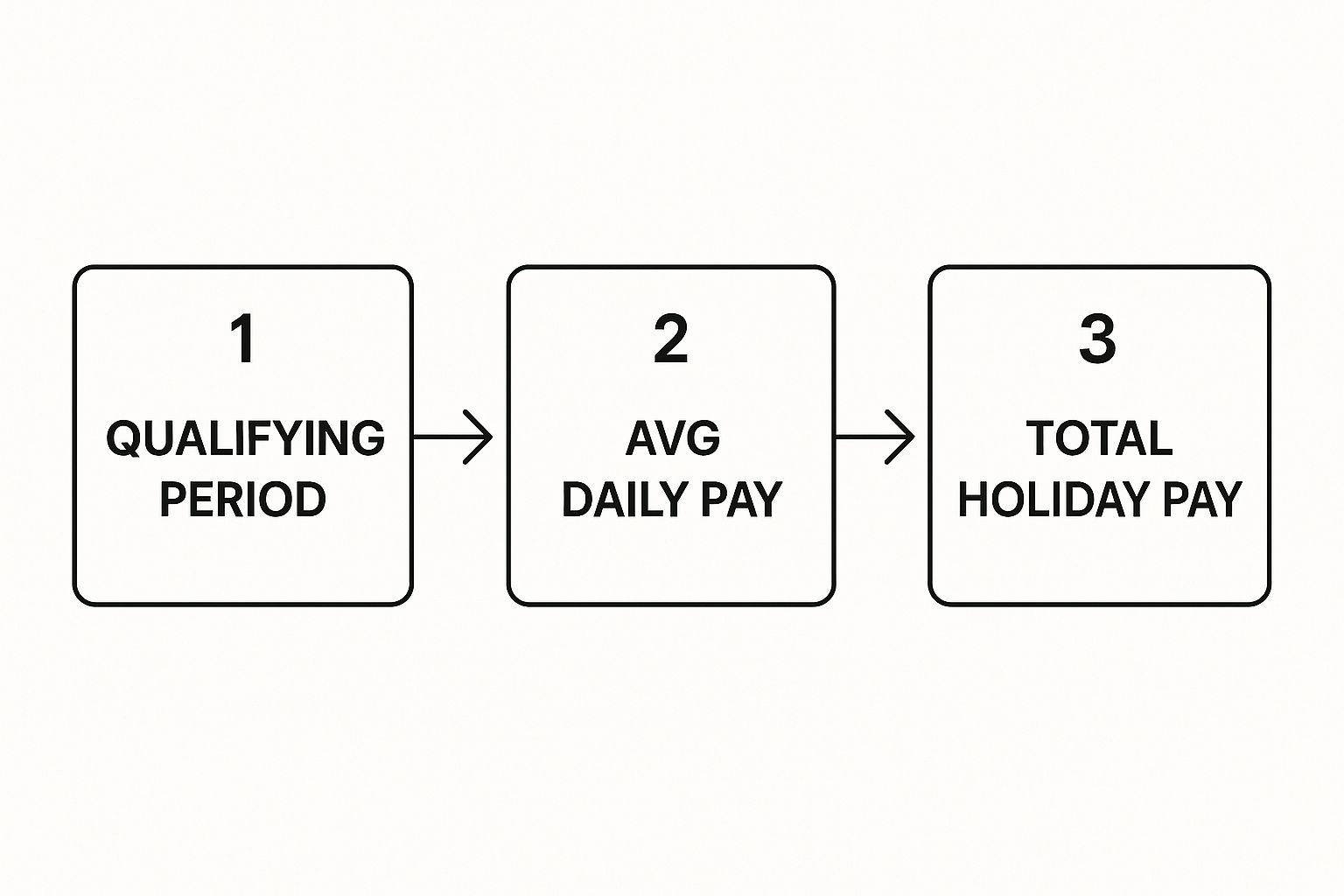
This method makes sure a worker's holiday pay is a fair reflection of what they typically earn over a meaningful period.
A common pitfall is including unpaid weeks in your calculation. Doing so will unfairly drag down the average weekly pay and short-change your employee. Always double-check you’re only counting weeks where they actually received remuneration.
This process provides a much more equitable way to handle pay for workers on variable schedules. To get a deeper understanding of the rules for these specific employment types, check out our complete guide to zero-hour contract holiday entitlement. Getting this right isn’t just good practice; it's a cornerstone of fair employment and legal compliance.
Defining What Counts as Normal Pay

One of the most common pitfalls when you calculate holiday pay is getting tripped up on what actually counts as "normal pay". It’s not just about an employee’s basic salary, and getting this wrong is a surefire way to end up with underpayments and even legal challenges.
The law is clear: an employee's holiday pay must reflect their normal remuneration. Essentially, it should mirror what they would have earned if they’d been at work. This means you have to include certain additional payments in your calculations for at least the first four weeks of their statutory leave.
Payments You Must Include
When you’re working out an employee's average pay, several types of earnings are considered intrinsically linked to their role. Forgetting these is where many businesses slip up.
- Commission Payments: If your employee’s earnings regularly include commission, this has to be part of their holiday pay. It’s a direct result of the work they do, so it counts.
- Non-Guaranteed Overtime: This is overtime you don't have to offer, but which the employee must work if you do. If it's a regular part of their work pattern, it needs to be included in the calculation.
- Certain Bonuses: Bonuses tied directly to performance that are paid with enough regularity should be factored in. Purely discretionary bonuses, however, are typically excluded.
Recent UK holiday pay reforms have tried to bring more clarity here. While the core holiday pay rates haven't changed, the rules now provide a more consistent definition of 'normal remuneration' for statutory leave, which used to be a bit of a grey area. It’s all about ensuring fairness. You can read more about these recent holiday pay reforms to keep up to speed.
The key question to ask yourself is this: Is this payment intrinsically linked to the performance of the tasks required under the contract of employment? If the answer is yes, it very likely needs to be included.
By correctly identifying all the relevant bits of an employee's earnings, you can be confident your calculations are not just accurate but fully compliant. It’s about protecting your business and doing right by your team.
Building a Compliant Holiday Pay Policy
Knowing how to calculate holiday pay is one thing, but it’s only half the battle. A clear, comprehensive, and well-communicated holiday pay policy is your best defence against disputes and confusion. It ensures everyone, from management right down to your newest starter, is on the same page.
Think of it as the single source of truth for all things leave-related in your company. A solid policy leaves no room for guesswork and clearly defines all the key operational details, so there are no nasty surprises for your team. It’s essentially the user manual for taking time off.
Key Elements to Include
When you’re drafting your policy, there are a few non-negotiables you need to cover. These elements really form the backbone of a compliant and effective document:
- The Holiday Year: Be explicit about when your company's holiday year runs. Is it from 1st January to 31st December, or does it align with the financial year?
- Leave Request Process: Outline the exact procedure for booking time off. You need to specify how much notice is required and which system or person employees should use to submit a request.
- Carry-Over Rules: Detail how much untaken leave, if any, can be carried over into the next holiday year. Don't forget to include any deadlines for using it up.
A well-defined policy protects both the business and the employee. It ensures operational continuity by managing leave requests effectively, while also guaranteeing staff can access their rightful entitlements without hassle.
To get a handle on managing all this and ensure your policy is being followed correctly, exploring various accounting automation tools can seriously streamline the calculation and payroll side of things.
Communicating Your Policy Effectively
Once your policy is written down, its real success hinges on how you communicate it. Don't just file it away on a dusty server somewhere; make it a living, breathing, accessible resource.
A great start is including it in your employee handbook. You should also make a point to discuss it during onboarding and send out friendly reminders before key periods, like the run-up to the end of the holiday year.
Transparency is absolutely crucial here. When every team member understands their entitlements and the procedures they need to follow, you build trust and create a workplace where leave is managed fairly and efficiently. For a deeper dive into the specifics of entitlements, you can also explore our complete guide to UK holiday entitlement.
Common Holiday Pay Questions Answered
Even once you've got the basics down, real-world situations can throw a spanner in the works. Handling these tricky scenarios correctly isn't just about compliance—it's crucial for keeping your team happy and avoiding unnecessary friction.
So, let's dive into some of the most frequent questions we hear from employers trying to get holiday pay right. I'll give you clear, practical answers to help you navigate these moments with total confidence.
What Happens When an Employee Leaves?
When someone's contract ends, you're legally required to pay them for any statutory holiday they've earned but haven't used during that leave year. This is often called 'payment in lieu of holiday'.
The calculation is usually straightforward. It's based on how much of the holiday year they've worked through. For instance, if your leave year is January to December and an employee leaves at the end of June, they’ve accrued half of their annual entitlement. You simply pay out any unused days from that accrued amount.
An important note on leavers: This payment should always be included in their final pay packet. Delays can easily lead to disputes, so it’s essential to have a payroll process that can handle this smoothly.
Holiday Entitlement During Long-Term Leave
What about team members on extended leave, like maternity, paternity, adoption, or long-term sick leave? This is a common point of confusion, but the legal position is crystal clear.
- Holiday still accrues: Your employees continue to build up their statutory holiday entitlement throughout their entire period of leave. They don't miss out.
- Leave can be carried over: If an employee can't take their holiday because they're on sick leave, they must be allowed to carry it over into the next leave year.
This ensures that nobody is penalised for taking statutory family leave or for being genuinely unwell.
Are Bank Holidays Included in the 5.6 Weeks?
This is one of the most common questions, and the answer often surprises people. There is no automatic legal right for an employee to have bank holidays off, whether paid or unpaid.
As an employer, you can choose to include bank holidays as part of the statutory 5.6 weeks of annual leave. In fact, many businesses do this for simplicity, but it must be clearly stated in the employment contract. If your contract doesn't mention it, bank holidays are just treated as normal working days.