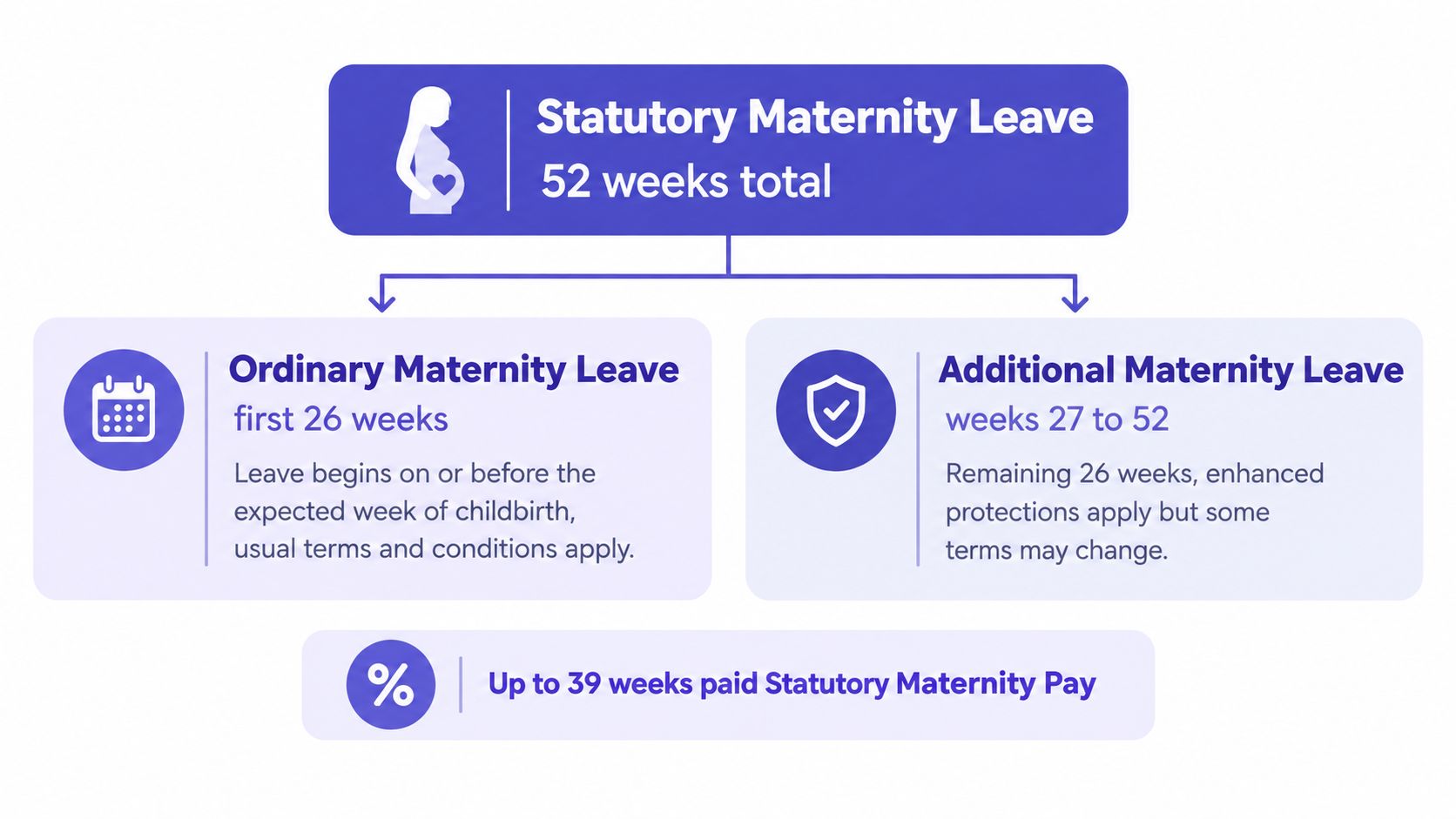
Eligible UK employees can take up to 52 weeks of Statutory Maternity Leave, split into 26 weeks of Ordinary Maternity Leave and 26 weeks of Additional Maternity Leave, regardless of length of service or salary. The entitlement to leave is separate from eligibility for Statutory Maternity Pay.
You're an HR manager in a small business, and an employee has just told you she's pregnant. She wants to know when her leave can start, how long she can take, and whether she'll be paid throughout it. Your director wants the absence dates, payroll wants the eligibility details, and your spreadsheet has one column labelled “maternity leave”.
That single column is where many avoidable errors begin. Leave duration, pay eligibility, start-date triggers and Shared Parental Leave are related, but they aren't the same administrative question.
Table of Contents
- Understanding the 52-Week Statutory Entitlement
- Ordinary and Additional Maternity Leave Periods
- Leave Eligibility Versus Pay Eligibility
- Notice Requirements and Start Date Triggers
- Interaction With Shared Parental Leave
- Common Tracking Mistakes for Small Businesses
- Next Steps for Accurate Leave Administration
Understanding the 52-Week Statutory Entitlement
An employee tells you she is pregnant, and the first mistake is to open payroll before you pin down the legal leave period. Start with entitlement. Statutory Maternity Leave can last up to 52 weeks, made up of 26 weeks of Ordinary Maternity Leave followed immediately by 26 weeks of Additional Maternity Leave, as set out in the UK Government's statutory maternity leave guidance.
That answer sounds simple, but the admin risk sits in the gap between leave and pay. If your records treat maternity absence as one payroll question, you can end up giving the right leave dates with the wrong pay assumption, or the right pay calculation with the wrong return date.
The employee does not have to take the full year. She must still take at least 2 weeks after the birth, or 4 weeks if she works in a factory. Leave can usually start as early as 11 weeks before the expected week of childbirth. It can also start automatically the day after the birth if the baby arrives early, or when the employee is off work for a pregnancy-related reason during the 4 weeks before the expected week of childbirth.
For small employers, this is the baseline record to get right first. The right to leave does not depend on length of service, hours worked or salary, as long as the person is an employee rather than a worker and gives the required notice. That distinction catches out newer managers and owner-led businesses, especially when someone has only recently joined and payroll assumes short service means no maternity rights.
It may mean no entitlement to Statutory Maternity Pay, but it does not remove the leave entitlement.
That is why Statutory Maternity Leave and Statutory Maternity Pay should sit on separate lines in your system. An employee may qualify for statutory pay for up to 39 weeks, while the legal leave entitlement still runs to 52 weeks. Record the leave start date, the expected leave end date, and the pay position separately.
The same disciplined approach helps with other absence rules, including Christmas leave for household staff. Identify the legal entitlement first, then apply the payment rules that sit alongside it.
Ordinary and Additional Maternity Leave Periods
The statutory year has two legal periods, even though employees and managers often refer to it as “maternity leave”.
Ordinary Maternity Leave covers the first 26 weeks. It starts on the employee's agreed maternity leave date or through one of the automatic triggers described above. Additional Maternity Leave covers the following 26 weeks, taking the total potential absence to 52 weeks.
This distinction matters when you build absence records and plan contact with the employee. Your system should show the first 26-week period, the second 26-week period and the overall expected end date, rather than treating the absence as an unstructured block.
Why the split matters in practice
The employee can return before the end of the full entitlement, subject to the statutory rules and the required notice arrangements. She isn't required to take all 52 weeks, but the compulsory minimum after birth still applies. That means the expected return date is a planning assumption until the employee confirms a different arrangement.
The full leave period also continues beyond the point at which Statutory Maternity Pay may stop. An employer that records only the paid period can accidentally mark the employee as absent without authorisation once pay ends. That's incorrect. The end of pay isn't the end of statutory leave.
The safest absence calendar includes:
- Leave phase: Ordinary Maternity Leave or Additional Maternity Leave.
- Pay phase: Statutory Maternity Pay, another payment arrangement or no statutory pay.
- Expected return: The recorded end date, subject to an earlier return or a later transition into another statutory arrangement.
Leave Eligibility Versus Pay Eligibility
The most important distinction for payroll and HR is simple: the right to leave is broader than the right to Statutory Maternity Pay. An employee qualifies for Statutory Maternity Leave from the first day of employment if she's an employee, not merely a worker, and provides the correct notice. There's no minimum employment period, minimum number of weekly hours or minimum salary for the leave entitlement, as confirmed in the UK Government's maternity pay and leave guidance.
Statutory Maternity Pay has additional conditions. The employee generally needs at least 26 weeks of continuous service into the qualifying week, which is the 15th week before the expected week of childbirth, and must meet the applicable average-earnings threshold.
| Criteria | Statutory Maternity Leave | Statutory Maternity Pay |
|---|---|---|
| Core question | Can the employee take statutory maternity leave? | Must the employer pay Statutory Maternity Pay? |
| Employment status | The person must be an employee rather than a worker | The applicable pay rules and conditions must be assessed |
| Service requirement | No minimum employment period for the leave entitlement | Generally, at least 26 weeks of continuous service into the qualifying week |
| Earnings requirement | No minimum salary for the leave entitlement | The applicable average-earnings threshold must be met |
| Potential duration | Up to 52 weeks | Up to 39 weeks |
| If the test isn't met | Leave may still be available | The employee may instead qualify for Maternity Allowance |
Keep the two decisions separate
An employee who doesn't qualify for Statutory Maternity Pay may still take the full statutory leave period and may instead qualify for Maternity Allowance. Don't tell an employee that she can't take maternity leave because payroll has determined that Statutory Maternity Pay isn't due.
For a practical explanation of the payment side, keep a separate reference such as what Statutory Maternity Pay means. You should also avoid assuming that part-time status answers the question. Broader guidance on part time benefits in 2026 can help when reviewing wider benefits, but it doesn't replace the specific statutory maternity eligibility checks.
The framework also protects entitlement in unusual circumstances. Statutory leave and pay can remain available where a baby is born early, where a stillbirth occurs after the start of the 24th week of pregnancy, or where the baby dies after birth. These cases require careful, humane communication as well as accurate payroll and absence records.
Notice Requirements and Start Date Triggers
Maternity leave doesn't always begin on the date an employee first expects. The start date can change because of the birth or because pregnancy-related absence triggers an automatic commencement.
Start by recording the expected week of childbirth and the date the employee wants leave to begin. Leave can normally start as early as 11 weeks before the expected week of childbirth, so your calendar should calculate the earliest possible date rather than relying on a handwritten estimate.

Watch for automatic changes
Three operational triggers deserve particular attention:
- Early birth: If the baby arrives early, maternity leave starts automatically the day after the birth.
- Pregnancy-related absence: If the employee is absent for a pregnancy-related reason during the 4 weeks before the expected week of childbirth, leave can start automatically.
- Compulsory post-birth leave: The employee must take at least 2 weeks after the birth, or 4 weeks when working in a factory.
When a trigger occurs, update the absence record immediately and confirm the revised dates in writing. Don't leave the original planned start date in the system and add an informal note elsewhere. That creates conflicting records for managers, payroll and the employee.
The practical mechanics of timing are also set out in guidance on when to go on maternity leave. Treat the notice received, the expected week of childbirth, the planned start date and any triggering event as separate fields. That approach makes an unexpected early birth manageable rather than a retrospective spreadsheet correction.
Interaction With Shared Parental Leave
Shared Parental Leave can change the shape of a maternity absence. The birth parent or primary adopter must first end maternity leave early or return to work before the remaining leave can be converted into Shared Parental Leave.
That means a record originally created as one uninterrupted maternity absence may later need to show several distinct blocks. The employer must know when maternity leave ends, when Shared Parental Leave begins, which periods have been booked and which notices have been received.
Record the notices as separate events
Parents must generally provide a notice of entitlement at least 8 weeks before Shared Parental Leave starts, and each booked period of Shared Parental Leave also requires 8 weeks' notice, according to the UK Government's employer technical guide to Shared Parental Leave and Pay.
A reliable record should therefore capture:
- the date the employee gives notice of entitlement;
- the date maternity leave ends;
- each booked Shared Parental Leave period;
- the dates supplied for each notice;
- the relevant pay arrangements for each leave type.
The birth parent's maternity leave and pay arrangements remain based on the statutory maternity framework. Eligible parents can share the remaining leave and pay entitlement under Shared Parental Leave rules, but the conversion does not occur just because someone asks to split the absence.
A maternity record should be flexible enough to hold several leave blocks, not just one start date and one return date.
For employers that need a separate explanation of the interaction, Shared Parental Leave in the UK is a useful reference point. The practical principle is to preserve the original maternity history while adding each later leave event, rather than overwriting the record.
Common Tracking Mistakes for Small Businesses
A small business may begin with a spreadsheet because the first maternity absence looks easy to manage. One row contains the employee's name, one date marks the planned start and another marks the expected return. The problem appears when payroll asks why pay ends before the employee's recorded leave, or when an early birth changes the start date.
The most common mistake is treating pay as a proxy for leave. A payroll manager sees that Statutory Maternity Pay is no longer due and assumes the employee's statutory absence has ended. That can lead to incorrect instructions to the employee and an inaccurate return-to-work date.
Where manual records fail
The wrong eligibility question: A manager asks whether the employee qualifies for pay and uses the answer to decide whether she qualifies for leave. The business then gives legally incorrect advice because it hasn't separated employment status and leave entitlement from the pay assessment.
The missed trigger: An employee is absent for a pregnancy-related reason in the relevant pre-birth period, but the planned maternity start date remains in the spreadsheet. Payroll and line management then work from different dates.
The overwritten history: The employee moves from maternity leave into Shared Parental Leave, and someone edits the original maternity row instead of recording a new leave block. The business loses the notice trail and can't easily explain how the dates were calculated.
The informal return date: A manager agrees an early return in a conversation but doesn't update the central record or send written confirmation. Cover planning, payroll and the employee's own expectations then diverge.
These failures aren't caused by a lack of goodwill. They usually arise because a basic absence tracker has no separate fields for leave type, pay status, statutory trigger, notice date and expected return. A proper process prevents the compliance gap by making each decision visible to the person responsible for it.
Next Steps for Accurate Leave Administration
A typical small business error starts with good intentions. Someone checks whether the employee qualifies for Statutory Maternity Pay, then uses that answer to decide the leave record. That is where administration goes wrong. Leave entitlement, pay eligibility and date triggers need separate entries, or you risk giving the wrong return date, the wrong paperwork, or both.
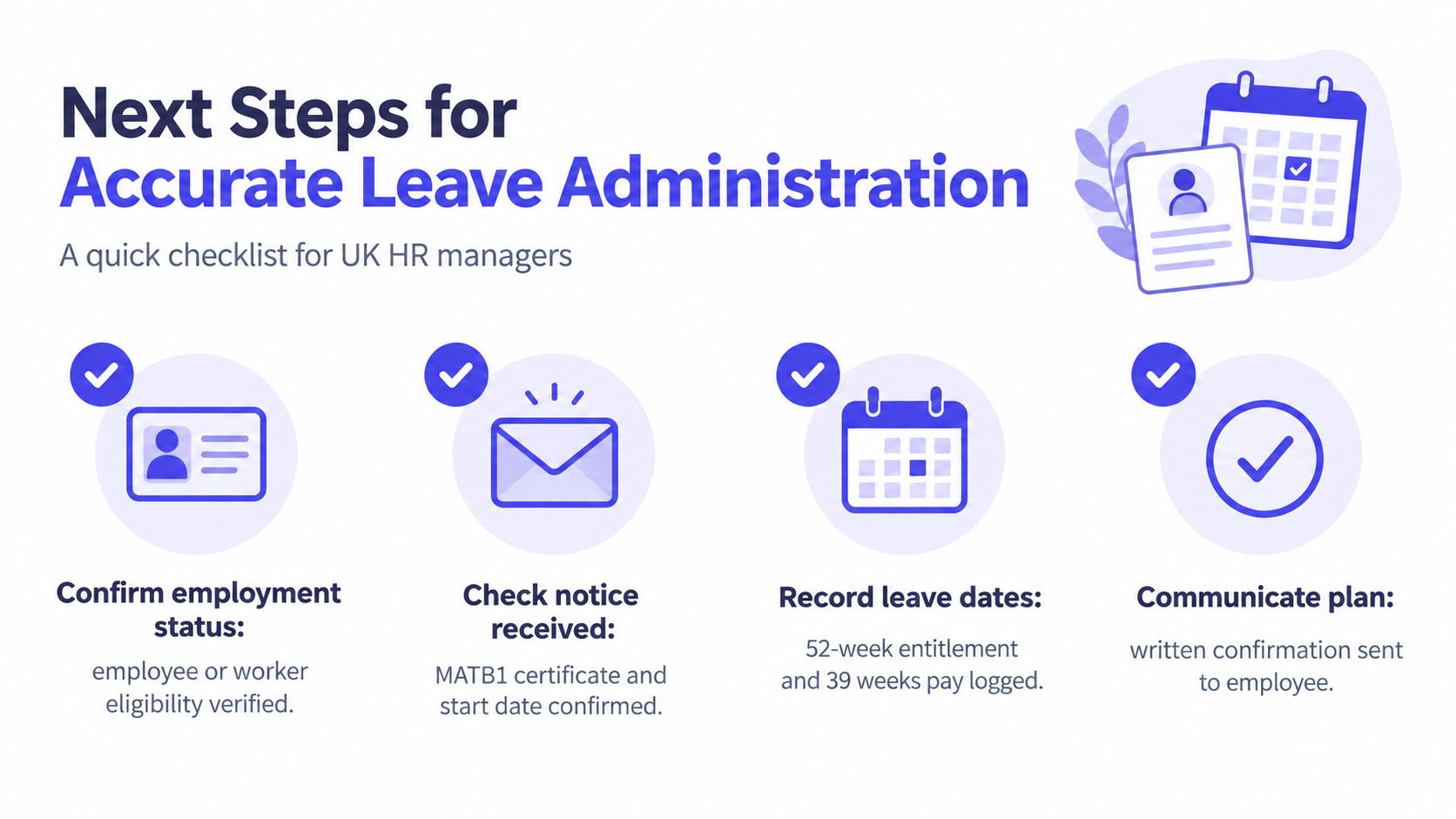
Keep the record simple, but make each decision visible. Start with employment status, then log the notice received, the expected week of childbirth, the intended start date and any later trigger that changes it. The aim is not more process. It is a record that shows why the leave dates were set and why payroll reached its own decision.
Use a practical administration checklist
- Confirm employment status: Verify whether the person is an employee and record the basis for leave entitlement.
- Check the notice: Capture the requested start date, expected week of childbirth and supporting information supplied by the employee.
- Calculate the leave dates: Record the 52-week entitlement as 26 weeks of Ordinary Maternity Leave followed by 26 weeks of Additional Maternity Leave, as noted earlier in the article.
- Assess pay separately: Keep the Statutory Maternity Pay decision in the payroll record, including whether the employee may need to explore Maternity Allowance.
- Monitor triggers: Update the start date if the baby arrives early or a pregnancy-related absence means maternity leave starts automatically.
- Prepare for change: Leave fields for maternity leave ending, Shared Parental Leave notices and any booked leave blocks.
- Communicate in writing: Send the employee a clear confirmation of the recorded dates, pay position and contact arrangements.
A system such as Lathire can help when you are reviewing wider workforce administration, but the software does not remove the need for the right fields. Whether you use a spreadsheet, an HR platform or a specialist absence tool, check that it distinguishes leave from pay and preserves amendments instead of overwriting the original record.
LeaveWizard helps small businesses calculate and record statutory leave dates, manage approvals and maintain a clear absence calendar for maternity and other leave types. Visit LeaveWizard to see how a structured record can reduce date errors, support Shared Parental Leave changes and give managers a reliable view of employee availability.