An employee tells you they're expecting a baby and asks whether they can split their leave with their partner. You're pleased for them, but your next thought is practical: what forms do you need, which dates can you approve, and how will payroll calculate the payment?
That's a familiar challenge for a small business. Shared Parental Leave (SPL) is a statutory right, yet it isn't usually an everyday process. The government introduced SPL in the UK in 2015, and eligible parents can share up to 50 weeks of leave and 37 weeks of pay between them under the government's guidance. Because requests are infrequent, managers may not have a well-practised routine. Because the rules involve two parents, linked notices, leave balances and pay limits, a single request can still create a high-complexity compliance task.
This guide is for small-business owners, managers, payroll teams and HR administrators who need a clear way to handle shared parental leave in the UK. It explains how the shared entitlement works, who qualifies, how pay differs from leave, what notices employees must provide, and how to organise the records without relying on disconnected spreadsheets.
The government has also begun an 18-month parental leave and pay review, launched in July 2025, which includes SPL and possible simplification of the system as recorded in Parliament. The rules you apply today still matter, but a sensible employer should also keep policies, payroll settings and employee communications ready for change.
Table of Contents
- Introduction to Shared Parental Leave for Busy Small Businesses
- What Shared Parental Leave Means and How It Works
- Who Can Take Shared Parental Leave and What Employers Must Check
- Pay Rights and Leave Rights Compared With Maternity and Paternity
- Notice Periods Booking Rules and Employer Duties Step by Step
- Practical Examples Calculations and Managing SPL in LeaveWizard
- Next Steps for Compliant and Confident Shared Parental Leave Management
Introduction to Shared Parental Leave for Busy Small Businesses
A request can arrive after months of no SPL activity. A manager then has to check eligibility, match two parents' leave arrangements, calculate pay and organise cover, often without a dedicated HR team. Shared Parental Leave (SPL) is a statutory right, so low usage does not reduce the need for an accurate response.
The government's evaluation found that only 1% of employee mothers and 5% of employee fathers reported taking SPL, making it a relatively uncommon leave pattern according to the UK government's evaluation information. For a small business, that combination of low volume and high complexity creates a compliance risk. The work is less like approving ordinary holiday and more like coordinating several linked records.
The employee may work for you while their partner works for another employer, which means the two workplaces may approve different patterns. The mother or adopter may also need to curtail maternity or adoption leave before shared leave can be used. Payroll must then separate paid and unpaid weeks, while managers plan cover around dates that may change.
A request can be manageable without a large HR team
Begin with three checks:
- Is there a valid shared entitlement? Confirm the maternity or adoption leave and pay already used.
- Does each parent meet the relevant tests? One employee's record cannot establish the other parent's eligibility.
- Are the notices complete and timely? A discussion helps with planning, but formal written notice is still required.
The government evidence review found that 73% of managers were aware of SPL, rising to 94% in workplaces with 250 or more employees and falling to 71% in workplaces with fewer than 50 employees in the published summary of existing evidence. Small employers should therefore avoid assuming that employees or managers already understand the process.
Practical rule: Treat an SPL request as a coordinated case, not an ordinary holiday booking.
A consistent workflow, such as recording entitlement, notices, bookings and payroll actions together in LeaveWizard, gives everyone one version of the dates. It also supports auditable decisions and helps the business adjust its policy and payroll settings as the parental leave and pay review develops. You do not need a large HR function. You need clear ownership, accurate records and a repeatable checklist.
What Shared Parental Leave Means and How It Works
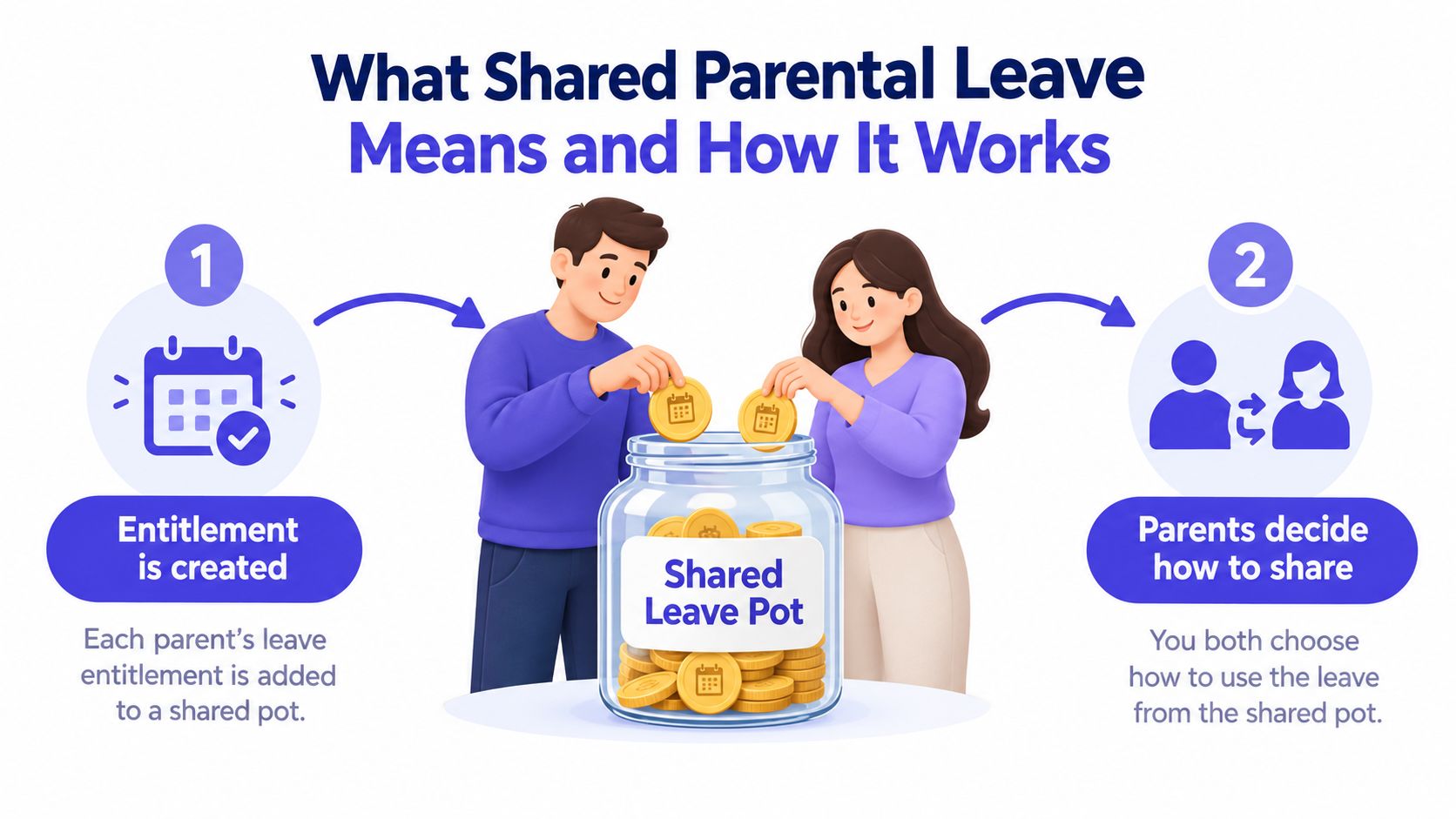
The simplest explanation is that SPL creates a shared leave pot. It isn't an additional block of leave on top of maternity or adoption leave. The parents create the pot by ending, or planning to end, the mother's or adopter's maternity or adoption leave early. The remaining entitlement can then be divided between eligible parents.
Build the shared pot
Think of the entitlement as two linked balances:
- Leave balance: up to 50 weeks can be shared.
- Pay balance: up to 37 weeks can be paid through Statutory Shared Parental Pay, subject to the statutory calculation.
The underlying leave is calculated as 52 weeks minus any maternity or adoption leave already taken. The pay entitlement is calculated as 39 weeks minus maternity or adoption pay, or maternity allowance, already used under the government's employer technical guide.
For example, if a mother has already used maternity leave, the couple doesn't receive a fresh 50-week entitlement. The unused portion becomes the available shared leave. The same principle applies to pay. Any maternity pay or maternity allowance already used reduces the remaining paid weeks.
Decide how to use the balance
The parents can decide how to divide the available weeks. One parent might take the first period of leave and the other might take a later period. They may also request separate blocks, provided the arrangement follows the statutory rules and each employer receives the required notices.
The important distinction is between time available and money available. A family may have shared leave remaining after the paid portion has been exhausted. The final 13 weeks of the 50-week leave entitlement are unpaid, unless an employer offers enhanced pay or another contractual arrangement as set out in published guidance on SPL pay.
That difference affects conversations with employees. Ask them to consider the leave dates and the pay position separately. A request for several weeks away from work doesn't automatically mean that all those weeks will attract Statutory Shared Parental Pay.
Who Can Take Shared Parental Leave and What Employers Must Check
Eligibility has two parts. The employee requesting SPL must meet the employment test, while the other parent must meet separate work and earnings conditions. The parents can work for different organisations, so a small employer may need information held by another business.
Check the employee's employment position
The employee taking SPL usually needs 26 weeks of continuous employment with the same employer by the end of the 15th week before the baby's due date under the government's eligibility guidance. Adoption cases use corresponding rules connected with the placement.
The employee must provide enough formal information to establish the entitlement. This normally covers the child, the other parent, the maternity or adoption leave position, and the amount of leave being curtailed.
Treat the initial check like assembling a timeline. Record:
- Employment dates: confirm the continuous service date.
- Expected placement or due information: check the date used for the statutory test.
- Leave already used: record maternity or adoption leave and pay already taken.
- Other parent details: note the other parent's employer and information relevant to the work and earnings test.
For a practical overview of the entitlement and employer checks, use this UK parental leave entitlement guide. Keeping these details together also helps LeaveWizard users build a reliable record before approving dates.
Check the other parent's work and earnings test
For birth parents, the mother must have worked for at least 26 weeks in the 66 weeks before the due week. Those weeks do not need to be consecutive, as explained in the eligibility guidance. The other parent must also meet the applicable work and earnings conditions.
A job change or gap in employment does not automatically mean the test has failed. Check the qualifying period carefully, then retain the evidence and calculations with the employee's request. This is a low-volume process for many small businesses, but one missed date can affect eligibility, pay and the leave record at the same time.
Confirm curtailment before approving the pattern
SPL relies on the mother or adopter ending maternity or adoption leave, or giving binding notice that it will end. The employee cannot add SPL while keeping the full original leave balance untouched.
Check the declarations, dates and supporting information before confirming a pattern. Do not make assumptions based on family structure, job title or whether both parents work. If information is missing, explain what needs clarification and record the decision. A structured LeaveWizard workflow can keep eligibility evidence, balances and notices together, while leaving room to review any statutory changes planned for 2026.
Pay Rights and Leave Rights Compared With Maternity and Paternity
An employee may have a right to leave without having the same right to pay. Maternity and adoption leave belong to the relevant parent. Shared Parental Leave, or SPL, comes from unused maternity or adoption leave and can be shared only when both parents satisfy the conditions.
Statutory Shared Parental Pay is available for up to 37 weeks. It is paid at the lower of £172.48 per week or 90% of the worker's average weekly earnings, subject to the relevant earnings rules in the government's 2023 evaluation report. Payroll therefore needs two checks: how much leave remains and which pay test applies. For the separate maternity-pay calculation, use this guide to statutory maternity pay.
A comparison for employee conversations
| Leave Type | Total Leave Available | Pay Basis | Flexibility |
|---|---|---|---|
| Maternity leave | Individual maternity entitlement, subject to the statutory framework | Statutory maternity pay or relevant contractual enhancement, where applicable | Usually starts with the birth parent, with potential transfer into SPL |
| Adoption leave | Individual adoption entitlement, subject to the statutory framework | Statutory adoption pay or relevant contractual enhancement, where applicable | Can form the basis of SPL after curtailment |
| Paternity leave | Individual paternity entitlement, subject to eligibility and current rules | Statutory paternity pay or contractual enhancement, where applicable | Generally shorter and linked to the birth or placement |
| Shared Parental Leave | Up to 50 weeks, less maternity or adoption leave already used | Up to 37 weeks of Statutory Shared Parental Pay, paid at the lower of £172.48 or 90% of average weekly earnings | Parents can share eligible remaining leave and request planned blocks |
The table helps explain the choices, but it does not replace checking the employee's circumstances and the current rules. Leave entitlement works like a pool: maternity or adoption leave already taken reduces what can later be shared, while pay must be assessed separately.
Why families may choose SPL
SPL can let both parents spend time caring for the child. It can also support a phased return to work, with parents arranging eligible leave in planned blocks. The practical trade-off is that statutory pay may be below normal salary, and unpaid leave can put pressure on household finances.
Small businesses should explain the pay basis, confirm the approved dates and avoid describing SPL as automatically better or worse than maternity or paternity leave. A clear record helps payroll and managers work from the same information, especially when a request combines eligibility evidence, leave balances and pay calculations.
Fairness can raise further questions. An employer that offers enhanced maternity pay but no equivalent SPL arrangement may need to explain how its policy applies across different family choices and salary bands. Record the policy position before approving dates, and review it if statutory arrangements planned for 2026 affect the process.
Notice Periods Booking Rules and Employer Duties Step by Step
A small business may receive only occasional SPL requests, yet each one can combine eligibility checks, leave balances, pay treatment and several deadlines. Handle the process as a timeline. The parent confirms entitlement first, then requests specific dates. The employer checks the information, responds through the required process and records the outcome for payroll and staffing.
Start with the entitlement notice
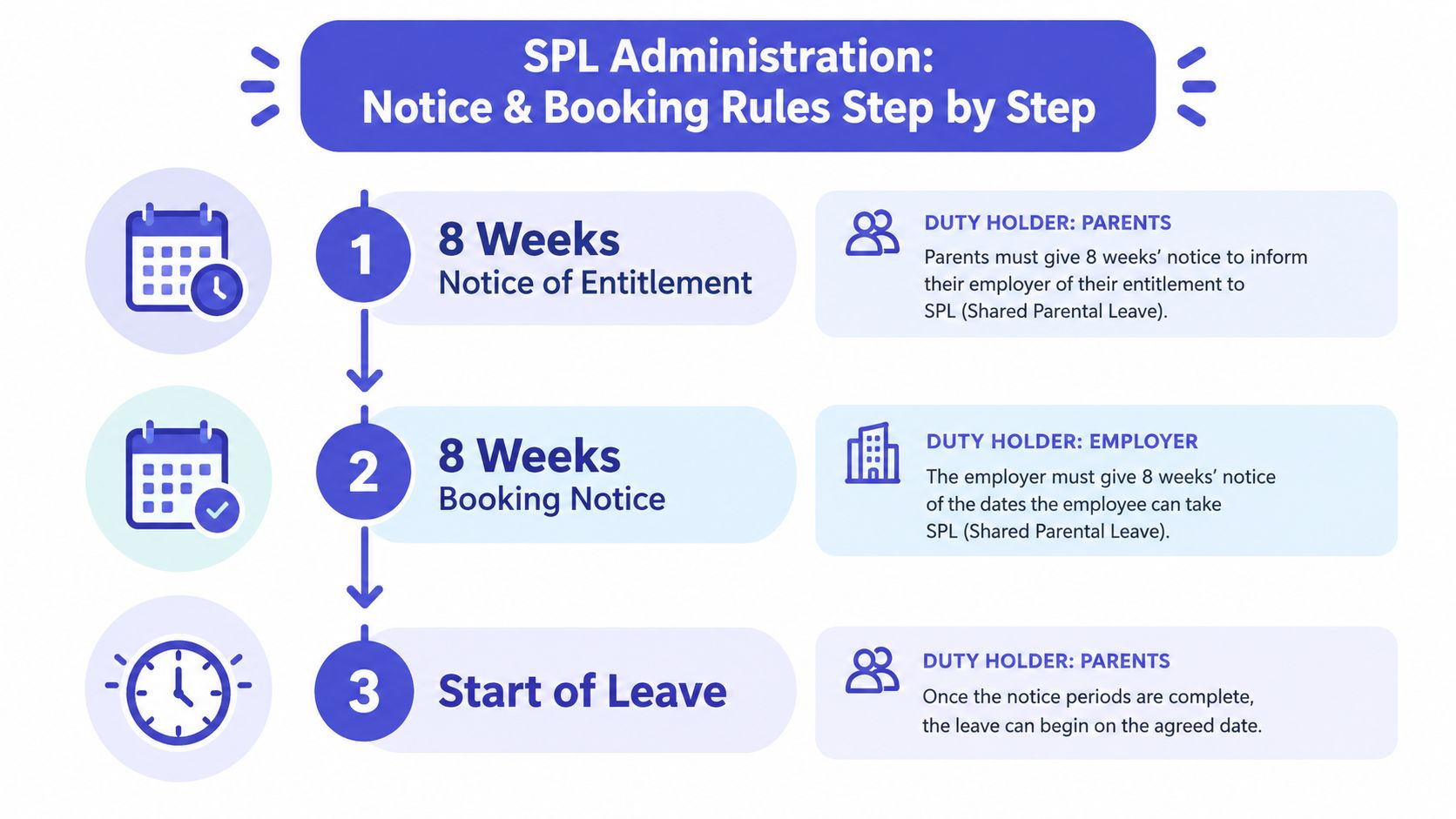
The parent must give an 8-week notice of entitlement before SPL begins, according to in Acas's guidance on taking SPL. This notice tells the employer that the parent plans to use SPL and provides the declarations and information needed to assess the proposed arrangement.
Entitlement notice and booking notice serve different purposes. An employee might mention intended leave in a meeting or message, but that conversation does not necessarily provide the formal details needed for administration. Give employees a clear explanation of the two stages and the information required for each.
Book the actual leave
The parent must give 8 weeks' notice to book leave, including the requested start and end dates. Leave is taken in whole-week blocks, although a block may begin on any day.
A booking notice should state:
- Start date: The first day of the requested block.
- End date: The final day of that block.
- Requested pattern: Whether the employee wants a continuous or discontinuous arrangement.
- Pay treatment: Whether the relevant weeks are expected to be paid or unpaid.
Parents can make up to three booking notifications. Keep every notice with the employer's response. A later request may change staff cover, payroll instructions or the remaining leave balance, so a dated record prevents small misunderstandings from becoming compliance problems.
Record the response and return arrangements
Confirm the decision in writing and update the employee's leave record. Employees are protected from detriment for exercising the statutory right. Return-to-work arrangements also need care. Keep-in-touch days can help someone stay connected, but agree them with the employee rather than presenting them as compulsory.
A practical workflow in LeaveWizard can keep notices, approved dates, leave balances and payroll instructions together, giving a small team one reliable record. It also helps managers plan cover without treating an informal conversation as approval.
Childcare planning may involve nursery fees hours and SEND support. The employer's role is to administer the right fairly, explain the confirmed dates and pay position, and leave enough time for the employee to arrange care. Review the workflow if statutory arrangements planned for 2026 change the required information or timing.
Practical Examples Calculations and Managing SPL in LeaveWizard
A small business receives a request that looks simple: the mother curtails maternity leave, and the father asks to use the remaining shared weeks. The calculation starts with the shared balance, not the weekly pay rate. Subtract maternity leave and maternity pay already used, then record the leave and pay balances separately.
For pay, compare the employee's average weekly earnings with the statutory rate. If 90% of average weekly earnings is below £172.48, the lower figure applies. If 90% is higher, the statutory cap of £172.48 applies instead, as noted earlier. Leave can remain available after the paid weeks have ended, so payroll should mark later weeks as unpaid unless a contractual enhancement applies.
Two patterns need different planning
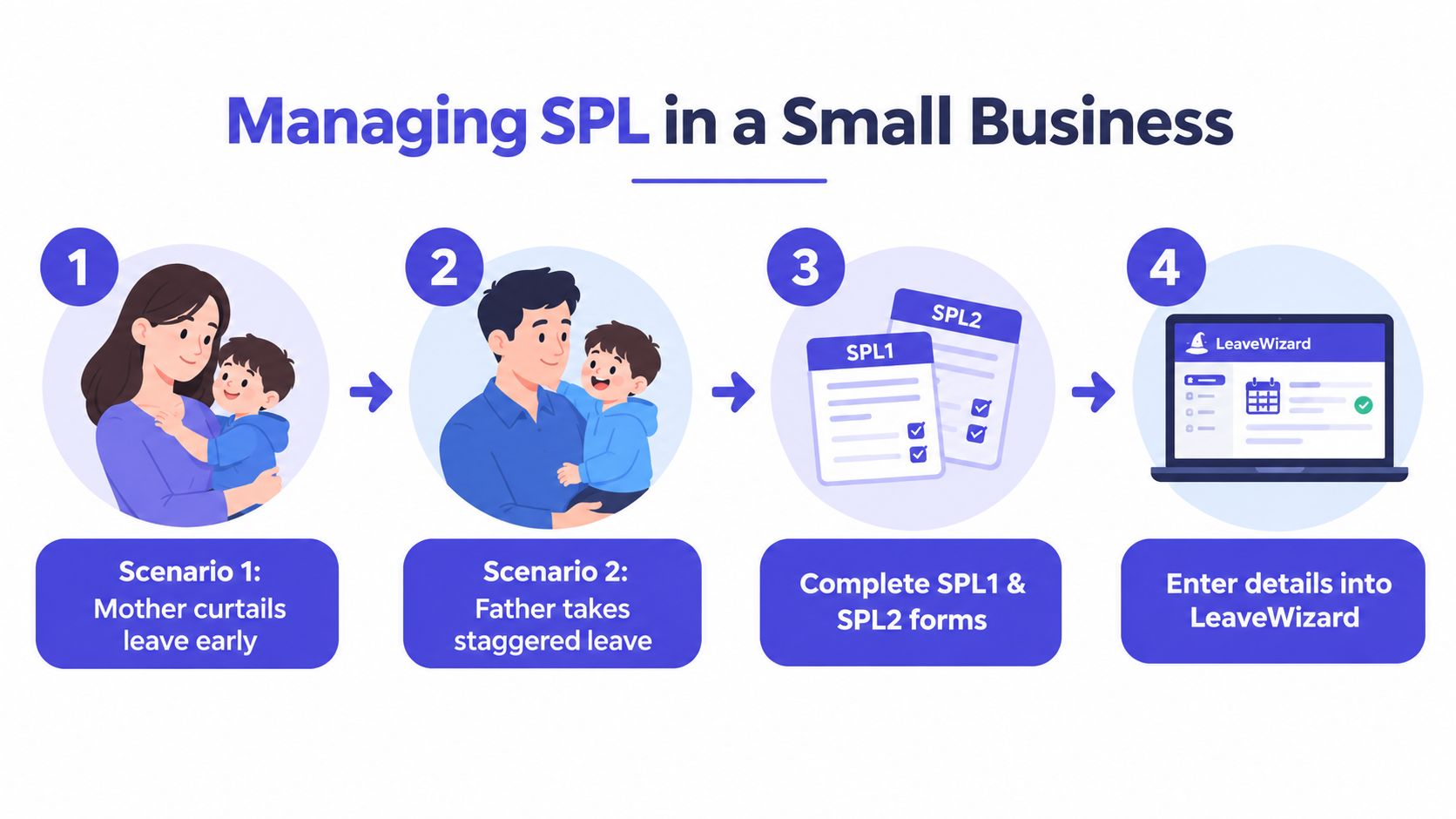
Suppose the mother ends maternity leave early and the father takes one continuous block. The handover may be straightforward, but payroll still needs the correct curtailment date and the remaining pay balance. A wrong date can affect both the balance and the instructions sent to payroll.
A staggered arrangement creates a different administrative task. The father may request several whole-week blocks with gaps between them. Each gap affects cover planning, and each booking must be checked against the same shared balance. Treating every request as a new entitlement is likely to produce an incorrect total.
A practical LeaveWizard workflow
LeaveWizard's Shared Parental Leave Calculator helps calculate shared leave and Statutory Shared Parental Pay entitlement. It can show remaining leave, remaining pay and whether proposed dates fit the available balance.
Use a consistent case record:
- Collect notices and declarations. Save the documents with the employee's record.
- Confirm the balances. Enter leave taken, pay used and the proposed curtailment information.
- Check the dates. Compare every requested block with the remaining leave and pay.
- Record the approved absence. Keep the calendar, payroll instructions and cover plan aligned.
- Review exceptions. Flag unpaid weeks, changed dates, disputed eligibility or missing evidence for manual review.
The published SPL evaluation indicates that take-up is low. For a small business, that means managers may rarely build practical familiarity before a request arrives. The risk is therefore low-volume but high-complexity: one case can combine eligibility checks, two balances, pay calculations, notice dates and cover decisions. A central record helps prevent an unpaid period being missed or leave being deducted twice.
Reform planning adds another layer. The government's July 2025 review is examining whether SPL should change, while evidence discussed in Parliament describes uneven access, including 60% of claims coming from the top 20% of earners and London having more claims than Scotland, Wales, Northern Ireland, the North West and the North East combined as reported in the parliamentary debate. Keep templates and payroll assumptions easy to update, and review the workflow if reforms alter pay, eligibility or notice requirements in 2026.
Next Steps for Compliant and Confident Shared Parental Leave Management
A small business can handle SPL confidently by treating it as a controlled compliance workflow. The essentials are straightforward:
- Shared pot: Calculate what remains after maternity or adoption leave and pay already used.
- Dual eligibility: Check the employee's service and the other parent's work and earnings conditions.
- Separate balances: Track leave and pay independently.
- Notice discipline: Require the entitlement notice and booking notice within the relevant 8-week windows.
- Operational planning: Confirm whole-week blocks, cover arrangements and return details.
- Audit trail: Keep notices, calculations, approvals and payroll decisions together.
Review your family leave policy before the next request arrives. Make sure managers know who receives the notice, payroll knows how to test the statutory rate against average earnings, and employees can find the forms without having to explain their situation repeatedly.
The low historical take-up shouldn't lead to casual administration. It should lead to preparation for a process that may be rare, but carries several linked decisions when it does occur. The UK review may also change expectations around pay, simplicity and fairness, so schedule a policy check whenever official guidance changes.
Use a consistent conversation with every employee. Explain the available choices, avoid assumptions about which parent should take leave, and give both the employee and the business enough time to plan. That approach supports wellbeing while protecting the business from avoidable payroll and record-keeping errors.