Deciding when to start maternity leave is a massive, deeply personal choice. There's no single 'right' answer, but if you're looking for a common benchmark, most women in the UK tend to begin their leave somewhere between two to four weeks before their due date. This popular timeframe seems to hit a sweet spot, offering a decent balance between wrapping things up at work and getting some essential rest before the baby arrives.
Deciding When to Start Your Maternity Leave
Choosing that perfect moment to step away from your desk and officially begin maternity leave is one of the first big decisions you'll make on your journey to parenthood. It’s a real balancing act, isn't it? You're weighing up the desire to maximise every precious moment with your newborn against the very real need to rest and prepare beforehand.
Honestly, there's no magic formula here. Your ideal start date will boil down to your unique circumstances.
This decision really rests on three core pillars: your legal rights, your financial situation, and most importantly, your personal health and wellbeing. Getting a firm grip on these elements gives you a solid framework for planning.
- Legal and Company Policies: First thing's first—get to know your statutory rights and any enhanced benefits your employer might offer. This is your starting block.
- Financial Stability: Let's be practical. Your income during leave, especially Statutory Maternity Pay (SMP), will heavily influence how early you can realistically afford to stop working.
- Health and Wellbeing: This is the big one. The physical and mental demands of your job, combined with the realities of pregnancy, are paramount. Listening to your body isn't just a suggestion; it's non-negotiable.
Understanding Your Entitlements
In the UK, the law is on your side, giving eligible employees the right to take up to 52 weeks of Statutory Maternity Leave. It’s a generous allowance that provides significant flexibility.
The pay structure is also a key piece of the puzzle. For the first six weeks, you're entitled to 90% of your average weekly earnings, which is a crucial detail for your financial planning.
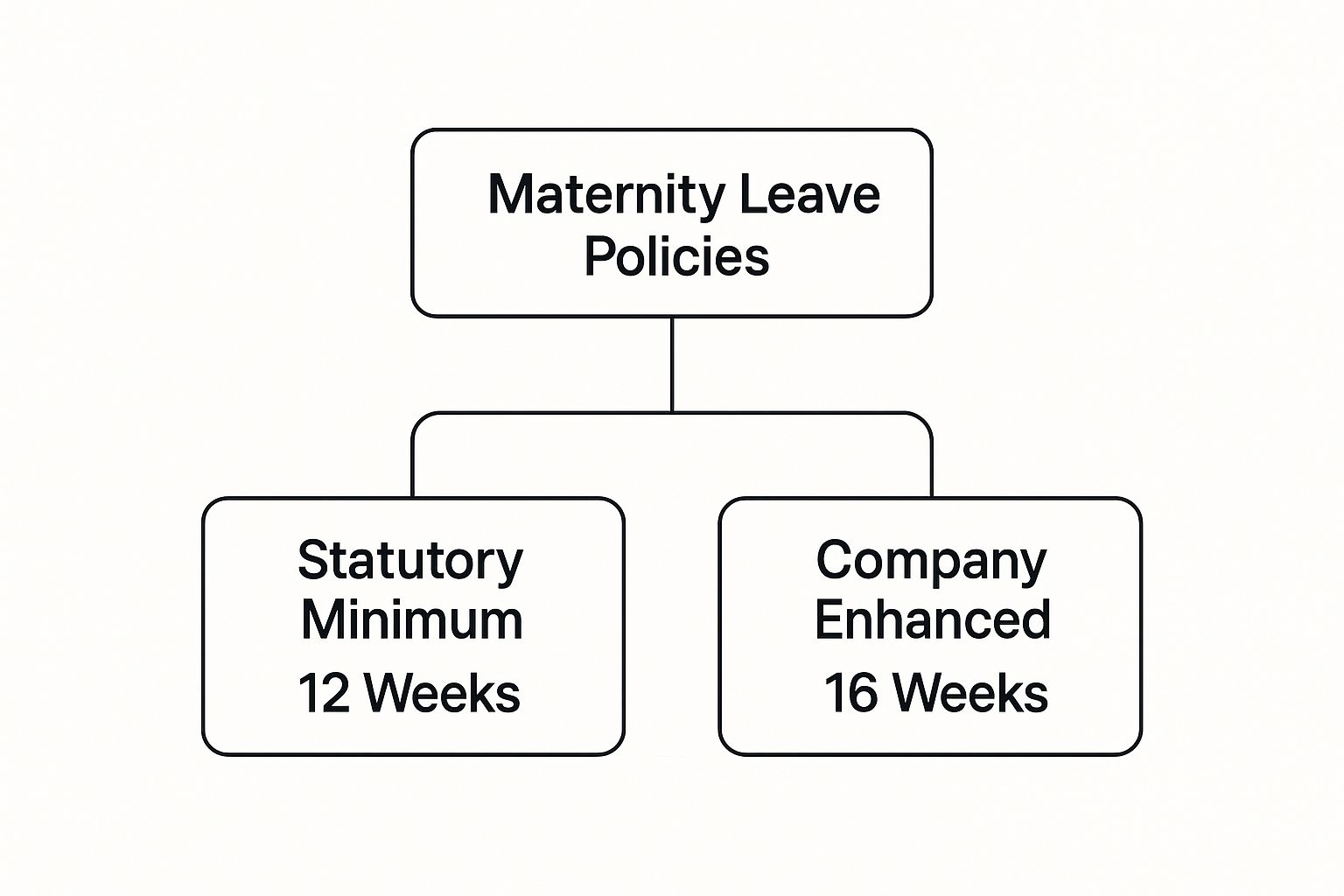
This image really helps to visualise the difference between the legal minimums and what a more generous company policy might look like. It's a reminder to always check your own employer's handbook, as you might be entitled to more than you think.
To help you weigh everything up, here's a quick table summarising the main things you'll want to think about.
Key Factors for Deciding Your Maternity Leave Start Date
| Factor | Consideration for Starting Earlier | Consideration for Starting Later |
|---|---|---|
| Health & Wellbeing | Your job is physically demanding, or you're experiencing pregnancy-related discomfort and need more rest. | You're feeling great, have plenty of energy, and your job is not physically strenuous. |
| Financial Situation | You have enough savings or an enhanced company policy that makes starting early financially viable. | You want to maximise your income before the baby arrives and receive your full salary for longer. |
| Personal Preference | You want dedicated time before the birth to prepare, nest, and mentally switch off from work. | You prefer staying busy and want to save as much of your 52-week leave entitlement for after the baby is born. |
| Work Commitments | You're ready to hand over your projects and feel confident your team is prepared for your absence. | There are critical projects you want to see through or a handover that requires more time to complete properly. |
Ultimately, looking at these factors side-by-side can help bring some clarity to what often feels like an overwhelming decision.
The goal is to create a transition that feels supportive, not stressful. By considering each of these factors, you can approach your decision with clarity and confidence, ensuring you feel prepared and empowered as you head into this exciting new chapter.
For a comprehensive collection of information covering various aspects of this journey, you might find some helpful articles and additional pregnancy and maternity resources here. We’ll be diving deeper into each of these pillars throughout the rest of this guide.
Understanding Your Maternity Leave Rights
Trying to get your head around the legal side of maternity leave can feel a bit like wading through treacle. But getting a firm grasp on your rights is the first, most important step in planning with confidence. When you know where you stand, you can decide on the best time to start your leave without second-guessing yourself.
Let’s break down the UK laws in plain English.
In the UK, if you’re eligible, you’re entitled to a total of 52 weeks of Statutory Maternity Leave. It’s a full year, designed to give you proper time to recover from birth and bond with your new baby. A simple way to think about it is to split it into two halves.
-
Ordinary Maternity Leave (OML): These are the first 26 weeks. During OML, all your employment rights stay exactly as they are, and you’re guaranteed the right to return to your precise job role. No ifs, no buts.
-
Additional Maternity Leave (AML): This covers the second 26 weeks. Your rights are still protected here, but there's a slight difference. If, for a genuine business reason, it’s not practical for you to go back to your old job, your employer can offer you a similar role with the same pay and conditions.
This two-part structure gives you security when you need it most and a bit of flexibility for the longer term. It’s a core part of what makes maternity leave so valuable. To dig into this a bit more, check out our guide on understanding the benefits of maternity leave.

When Can You Legally Start Your Leave?
The law is pretty clear on when you can kick off your maternity leave. The absolute earliest you can start is 11 weeks before your baby’s expected due date.
This gives you a huge amount of wiggle room. You can pick any date you like, from that 11-week mark right up to the day you go into labour. The choice is yours, and it allows you to balance your health, your job’s demands, and your finances.
There is, however, one rule that’s set in stone.
By law, every new mother must take a minimum of two weeks of leave straight after the baby is born. This is called 'compulsory maternity leave' (and it’s four weeks if you work in a factory). This rule is there purely to make sure you have a baseline period for physical recovery.
This compulsory period is a non-negotiable legal protection for your health. It’s the one bit of the timeline that you can’t change, and for very good reason.
Notifying Your Employer: A Crucial Timeline
To lock in your rights to leave and pay, you have to follow a specific process for telling your employer. Think of it as putting in a formal request, but with a bit more legal oomph behind it.
You need to let your employer know about your pregnancy and that you plan to take maternity leave by the end of the 15th week before your due date. This cut-off point is often called the 'qualifying week'.
When you tell them, you’ll need to provide three things:
- Proof that you’re pregnant: This is usually your MAT B1 certificate, which you’ll get from your midwife or GP at around 20 weeks.
- Your baby’s due date: This will be on your MAT B1 form.
- The date you want your leave to start: Don’t worry if you’re not 100% sure. You can change this later, but you have to give your employer at least 28 days' notice of the new date.
Hitting this deadline is vital. It gets the ball rolling officially and gives your employer plenty of time to arrange cover, which makes for a much smoother handover for everyone. It also protects your entitlement to Statutory Maternity Pay (SMP). This legal framework is your roadmap, laying out the key milestones for a seamless transition into parenthood.
How Statutory Maternity Pay (SMP) Works
Let’s talk about money. Financial planning is a massive piece of the puzzle when you’re figuring out when to start maternity leave. You need to know what your income will look like, and for most people in the UK, that means getting your head around Statutory Maternity Pay (SMP).
Think of SMP as the government-backed safety net, the standard financial support system designed to help you while you’re off. Understanding how it works is the key to forecasting your income. It gives you the clarity to decide if starting your leave a bit earlier is realistic, or if working closer to your due date makes more sense for your family's budget.

Are You Eligible For SMP?
Before you start crunching the numbers, you need to check if you actually qualify for SMP. The rules are quite specific, but they’re pretty straightforward once you break them down. It’s not just about being pregnant; it’s tied to your recent work history with your current employer.
To be eligible, you need to tick two main boxes. First, you must have been on your employer’s payroll continuously for at least 26 weeks leading up to the 'qualifying week'. This qualifying week is the 15th week before your baby is due. Second, your average weekly earnings in the run-up to this period (usually the eight weeks before) must be at least £123.
These financial realities, alongside your health and the demands of your job, heavily influence when you start your leave. It’s why many UK mothers aim to start their leave around two to four weeks before their due date, though this really does change from person to person.
How SMP Is Calculated
Okay, so you've confirmed you're eligible. What now? The next step is understanding how much you'll actually get. SMP is paid for up to 39 weeks, and it’s split into two distinct phases. This is important—your income will drop partway through your leave, so you need to plan for it.
Here’s how the payment structure works:
- The First Six Weeks: For this initial period, you’ll receive 90% of your average pre-tax weekly earnings. There’s no upper cap on this, which gives you a decent financial cushion right after the baby arrives.
- The Remaining 33 Weeks: After those first six weeks, your pay drops. You’ll get either a standard weekly rate set by the government or 90% of your average weekly earnings, whichever is lower. That standard rate is reviewed every April.
This two-stage payment is the baseline that most eligible mothers in the UK receive. If you want to dive deeper into the nitty-gritty, we’ve got a complete overview in our detailed guide on what is Statutory Maternity Pay.
Checking For Enhanced Company Pay
While SMP is the legal minimum, don't just assume that's all you'll get. Many companies offer much more generous packages to support their employees, often called 'contractual' or 'enhanced' maternity pay.
Your employment contract or company handbook is the first place you should look for details on an enhanced maternity pay scheme. Some companies might offer full pay for a longer period, or they may top up the standard SMP rate for several months.
Seriously, don’t skip this step. A better package can completely change your financial picture and might be the single biggest factor in when you decide to clock off for your leave.
For instance, a company might offer something like:
- 12 weeks of full pay, followed by the standard SMP rate.
- 6 months at 50% of your salary, which includes your SMP entitlement.
- A return-to-work bonus after you come back from leave.
Finding out you have access to an enhanced scheme can provide some much-needed breathing room. It could mean you can afford to start your leave a few weeks earlier to rest up without stressing about the financial hit. This is why a thorough check of your company’s policy is an absolutely essential part of your planning.
Prioritising Your Health and Wellbeing
Beyond the legal timelines and financial spreadsheets, the most important factor in this whole decision is, quite simply, you. Your physical and mental health during that final trimester isn't just a minor consideration; it’s the bedrock of your entire plan. Listening to your body is non-negotiable—it gives you the clearest signals for when it’s time to step back from work.
The demands of pregnancy are completely unique to each person and, crucially, to each job role. What feels perfectly fine for one mum-to-be might be utterly exhausting for another. This is where an honest self-assessment becomes so important for your own wellbeing.

Assessing the Physical Demands of Your Job
Your day-to-day work routine plays a massive part in how you'll feel as your due date gets closer. Let's be honest, a one-size-fits-all approach just doesn't work when jobs are so different.
For instance, if your job has you on your feet all day—maybe in retail, nursing, or hospitality—you’ll likely find the physical strain becomes a real issue much earlier. The third trimester often brings swelling, back pain, and a deep-seated fatigue, all made worse by standing for hours on end.
On the flip side, a desk-based job comes with its own set of challenges. Sitting for long stretches can lead to discomfort, poor circulation, and that nagging backache. And let's not forget the mental drain of a demanding office role, which, when combined with pregnancy brain fog, can make concentration a serious struggle and send stress levels soaring.
Think of your energy as a phone battery. In those final weeks of pregnancy, that battery drains much faster and takes longer to recharge. Your job is a major app running in the background; you need to decide when to close it down to conserve power for the main event.
The Importance of Mental Preparation and Rest
Deciding when to start your maternity leave isn't just about escaping physical discomfort. It's about creating the mental space you need to prepare for what’s ahead. The shift to becoming a mother is a profound psychological one, and giving yourself time to process it without work deadlines breathing down your neck is invaluable.
This pre-baby period is your chance to properly decompress. It's an opportunity to switch off from "work mode" and embrace a slower pace, focusing on self-care, nesting, and just mentally preparing for the huge life change on the horizon. This buffer can help dial down stress and anxiety, letting you go into labour feeling rested and emotionally ready, rather than frazzled from a last-minute handover.
Think about what you need to feel truly prepared:
- Rest and Recuperation: Just having time to nap, put your feet up, and recover from the sheer physical effort of the third trimester.
- Practical Preparations: Getting the nursery finished, packing your hospital bag, and sorting the house without a frantic rush.
- Emotional Connection: Spending quality time with your partner, family, or friends before your focus shifts entirely to your newborn.
As you plan for maternity leave and motherhood, it's also a good time to think about long-term financial protection. It might be worth looking into options like life insurance specifically for mums to make sure your family's future is secure.
Consulting Your Midwife or GP
Your healthcare provider is your most trusted advisor through all of this. Your regular check-ups with your midwife or GP aren't just for monitoring the baby; they're for keeping an eye on you, too. Be completely open with them about how you're feeling, both physically and mentally.
They can offer personalised advice based on your specific health picture. If you're dealing with complications like high blood pressure, gestational diabetes, or severe fatigue, they may strongly recommend you start your leave earlier. It’s vital to follow this medical advice. Your health and your baby's health are the absolute priorities, and a medical professional provides the objective view you need to make the safest choice.
Starting your leave a little earlier than planned on medical advice isn't a failure. It’s a sensible, proactive step to ensure a healthy and safe arrival for you both.
Planning a Smooth Handover at Work
Deciding when to start maternity leave isn't just about your health or finances; it's also about leaving things in great shape at work. A well-thought-out handover is a gift—to your colleagues, to the person covering for you, and especially to your future self. It paves the way for a seamless transition, letting you properly switch off and focus on your baby without nagging work worries.
Think of your handover document as a user manual for your job. The aim is to create something so clear and comprehensive that someone can step into your shoes with real confidence. This isn't just about listing daily to-dos; it’s about sharing the context, key contacts, and little bits of know-how that make you so good at what you do. A thorough plan minimises disruption and shows your professionalism, setting the stage for a much smoother return later on.
Crafting Your Handover Document
Your handover document is the absolute cornerstone of your departure plan. My best advice? Start it early. Add to it bit by bit, rather than trying to cram everything into a frantic last week at your desk.
To make sure nothing gets missed, break your role down into its key components:
- Daily and Weekly Tasks: Map out all the regular, recurring responsibilities of your job. Be sure to include deadlines, describe key processes, and add links to any software or important documents.
- Ongoing Projects: For every major project, give a clear update on its current status, its main objectives, any upcoming milestones, and the roles of other team members involved.
- Key Contacts: List the essential people, both inside the company (like colleagues in other departments) and outside (clients, suppliers, partners). Briefly explain your relationship with each and why they’re important.
- Logins and Access: Put together a secure list of necessary passwords and system access details. Always make sure you're following your company's IT security policies when you share this kind of sensitive information.
A well-organised document is like a safety net. It ensures business keeps moving and drastically cuts down on the "just a quick question" emails you might get while on leave.
Below is a simple checklist you can adapt to help organise your thoughts and track your progress.
Sample Handover Plan Checklist
This table provides a practical framework to help you organise your work responsibilities and ensure a seamless transition before you start your maternity leave.
| Task Category | Action Item | Status (To Do, In Progress, Complete) |
|---|---|---|
| Core Responsibilities | Document all daily and weekly recurring tasks. | To Do |
| Detail the month-end reporting process. | To Do | |
| Projects | Update the status of Project Alpha. | In Progress |
| Outline next steps for the Q4 campaign. | To Do | |
| Contacts & Relationships | List key client contacts and their history. | To Do |
| Introduce my cover to the main supplier via email. | To Do | |
| Systems & Access | Compile a secure list of essential software logins. | In Progress |
| Request temporary system access for my cover. | Complete | |
| Final Touches | Schedule a final handover meeting with my manager. | To Do |
| Set up an out-of-office email auto-responder. | To Do |
Using a simple structure like this can take the pressure off, allowing you to methodically work through everything without feeling overwhelmed.
Timing Your Leave Strategically
Beyond your own personal readiness, take a look at the rhythm of your workplace when picking a leave date. Aligning your departure with your company's business cycle can make a huge difference to how smoothly everything goes.
For instance, if your job revolves around distinct project cycles, aiming to wrap up a major project before you leave provides a natural, clean break. This prevents your replacement from having to jump into complex work halfway through. On the flip side, try to avoid starting your leave right before a critical business period, like the end of the financial year or a major product launch, if you can help it.
Leaving work with a sense of completion is crucial for your peace of mind. By timing your exit thoughtfully, you're not just helping your team; you're setting yourself up to disconnect fully, knowing you've left everything in the best possible state.
This kind of proactive thinking helps manage expectations with your manager and colleagues, demonstrating that you’re committed to a responsible and professional transition.
Communicating Your Plan Effectively
Clear and open communication is absolutely vital during this time. Once you’ve told your manager your intended leave date, work together to create a handover timeline. Schedule a few regular, brief check-ins to chat about progress and sort out any potential gaps.
Keep your team in the loop, too. Let them know who will be covering your work and where they can find your brilliant handover document. Setting up an email auto-responder during your final couple of days is another practical step. It can point queries to the right person and manage expectations about when people can hear back.
Thinking ahead about your handover now will pay dividends when you're preparing to come back. The processes you document will not only help your cover but will also be a fantastic refresher for you. This foresight is also a huge help when preparing for your eventual return, a process you can learn more about in our guide to running a successful return-to-work interview. Ultimately, a smooth departure paves the way for a confident return.
How to Notify Your Employer
Right, you’ve done the hard work of weighing up your health, finances, and work commitments. Now it’s time to make it all official. This final step is where your careful planning turns into a real, concrete plan of action.
Properly notifying your employer does more than just formalise your maternity leave. It’s what protects your legal rights to leave and pay, and it sets the stage for a positive, supportive experience as you prepare to step away for a while.
Think of this as firing the official starting pistol for your maternity leave journey. Of course, it’s a professional courtesy that gives your team plenty of time to prepare. But more importantly, it's a legal requirement. You must inform your employer in writing of your plan to take maternity leave no later than the end of the 15th week before your baby’s expected due date.
What to Include in Your Written Notice
Your notification doesn't need to be a long, formal essay. It just needs to be clear and contain three key bits of information. Whether you send a formal letter or a straightforward email often comes down to your workplace culture. Whatever you do, always keep a copy for your own records.
Here's exactly what you need to tell them:
- That you are pregnant. A simple, clear statement is all you need for your initial notice.
- Your expected week of childbirth. You'll provide your MAT B1 form later on (your midwife usually gives you this around 20 weeks) as the official proof.
- The date you intend to start your leave. This is your planned start date, but don't panic if it's not set in stone just yet.
It’s important to remember that you can change your start date later on. The law allows for flexibility, but you must give your employer at least 28 days’ notice of the new date. This ensures they have a fair amount of time to adjust their plans.
Getting this formal communication sorted gets the ball rolling. It allows your manager and the HR department to start preparing for your absence and get your Statutory Maternity Pay processed.
A Step-by-Step Notification Guide
Communicating your plans clearly and professionally is the key to a smooth transition for everyone. This isn't just about ticking a box by sending an email; it's about starting a constructive conversation about your handover and who will be covering your role.
Here’s a simple process you can follow:
- Step 1: Have an Informal Chat: Before you send anything in writing, it’s often a great idea to have a quick, in-person chat with your line manager. It helps maintain a good relationship and gives them a personal heads-up.
- Step 2: Draft Your Formal Notice: Write your email or letter, making sure to include the three essential points we mentioned above. Keep the tone professional but positive.
- Step 3: Send Your Notice on Time: Make absolutely sure you send your notification before the 15th-week deadline. This is crucial for protecting your rights.
- Step 4: Provide Your MAT B1 Form: As soon as you get this certificate from your midwife, give a copy to your employer. It’s the official confirmation they need for their records and to process your SMP.
Following these steps ensures you've met all your legal obligations while keeping things cooperative and positive with your employer. It’s the final piece of the puzzle, letting you step away from work feeling organised, confident, and ready for your next chapter.
Frequently Asked Questions
Figuring out the ins and outs of maternity leave can feel like you're trying to solve a puzzle. To help you plan with a bit more confidence, we've answered some of the questions that pop up most often.
Can My Employer Tell Me When to Start My Maternity Leave?
In a word, no. Your employer can't dictate when your maternity leave begins. The decision is entirely yours, as long as it's sometime from 11 weeks before your due date. You just need to give them proper notice.
There is one exception, though. If you're off work with a pregnancy-related illness in the four weeks leading up to your due date, your employer can start your leave automatically.
What Happens if My Baby Arrives Early?
If your little one makes an early debut before your leave has officially started, things will adjust automatically. Your maternity leave will kick in the day after the birth.
You’ll need to let your employer know about the birth as soon as you reasonably can. Don't worry about the leave you had planned before the birth; it simply converts into maternity leave, and your Statutory Maternity Pay (SMP) will start from this new date.
Think of your plan as a guide, not a rigid set of rules. Life happens, and early arrivals or health issues can shift your timeline. UK law is built with this flexibility in mind, protecting you so your leave and pay start right when you need them.
Can I Change My Maternity Leave Start Date?
Yes, you can absolutely change your mind. If you need to adjust your start date, you just have to give your employer at least 28 days' notice before the new date or your original date, whichever is sooner.
It's always a good idea to put this change in writing to keep everything clear. As you're mapping out your leave, it's also smart to think about the time after birth. Brushing up on essential postpartum recovery tips can make for a much smoother and healthier transition.