
When it comes to calculating holiday pay, everything starts with a legal foundation known as statutory entitlement. On top of that, many companies add their own layer, which is called contractual leave.
For any full-time employee in the UK, the starting point is a legal minimum of 5.6 weeks of paid holiday per year. Anything a company offers beyond that is extra. Getting your head around these two core components is the first step to mastering leave management.
Understanding UK Holiday Entitlement
Staring at leave spreadsheets can feel like you’re trying to crack a code, but the whole system is built on two simple, distinct layers. Think of it like building a house: you have the legal foundation that everyone must have, and then you have the optional, custom additions that make it your own.
Getting this right isn’t just about keeping tidy records. It’s a legal requirement and a cornerstone of employee morale. When you calculate leave accurately, you ensure fairness, prevent disputes, and show your team you genuinely value their well-being.
The Foundation: Statutory Leave
Every single employee in the UK is legally entitled to a minimum amount of paid holiday. This is the non-negotiable floor set by the government to make sure all workers get the rest they need.
In the UK, this translates to a legal minimum of 5.6 weeks of paid holiday annually. For someone working a typical five-day week, that works out to 28 days. The 5.6-week figure is deliberately used to scale proportionally for part-time workers. For instance, an employee working three days a week gets 16.8 days (5.6 weeks × 3 days). Simple, right? You can discover more insights about minimum holiday entitlement in the UK on our blog.
Key Takeaway: Statutory leave is the legal minimum. It's calculated in weeks (5.6) to ensure part-timers receive a fair, proportional amount of time off compared to their full-time colleagues.
Adding Value with Contractual Leave
Contractual leave is any paid holiday an employer offers above and beyond the statutory minimum. This is a powerful tool for attracting and keeping great people, as a more generous holiday allowance can be a huge perk.
This extra leave is written into the employee's contract of employment, making it a binding part of their terms and conditions.
For example, a company might offer 33 days of annual leave, inclusive of bank holidays. Here’s how that breaks down:
- 28 days of statutory leave
- 5 additional days of contractual leave
This extra allowance is entirely at the employer’s discretion, but once it's in the contract, it must be honoured. The total figure—statutory plus contractual—becomes the employee’s full holiday entitlement for the year.
Statutory vs Contractual Leave At a Glance
It can be helpful to see the key differences side-by-side. While one is a legal must-have, the other is a strategic choice that reflects your company culture.
| Feature | Statutory Leave | Contractual Leave |
|---|---|---|
| Origin | Set by UK law (Working Time Regulations). | Decided by the employer and set out in the contract. |
| Minimum | 5.6 weeks per year, including bank holidays. | No minimum; it’s any amount offered above the statutory. |
| Purpose | To ensure all workers get adequate rest and downtime. | To attract/retain talent and enhance employee benefits. |
| Flexibility | Non-negotiable. Cannot be offered below this level. | Completely at the employer's discretion. |
Ultimately, statutory leave provides the essential safety net, while contractual leave gives companies the freedom to offer more and stand out as an employer of choice.
How Leave Accrual Methods Work in Practice
Understanding an employee's total holiday pot is one thing, but knowing how and when they can actually use it is another ball game entirely. The calculation of leave isn’t a one-off event. It's an ongoing process shaped by your chosen accrual method, which sets the pace for how holiday time becomes available to your team.
Getting this right is crucial. It affects everything from fairness for new starters to the administrative workload for your HR team. Let’s break down the two most common ways UK businesses manage how leave builds up over the year.
The journey starts with the legal minimum and then adds any extra contractual days on top.
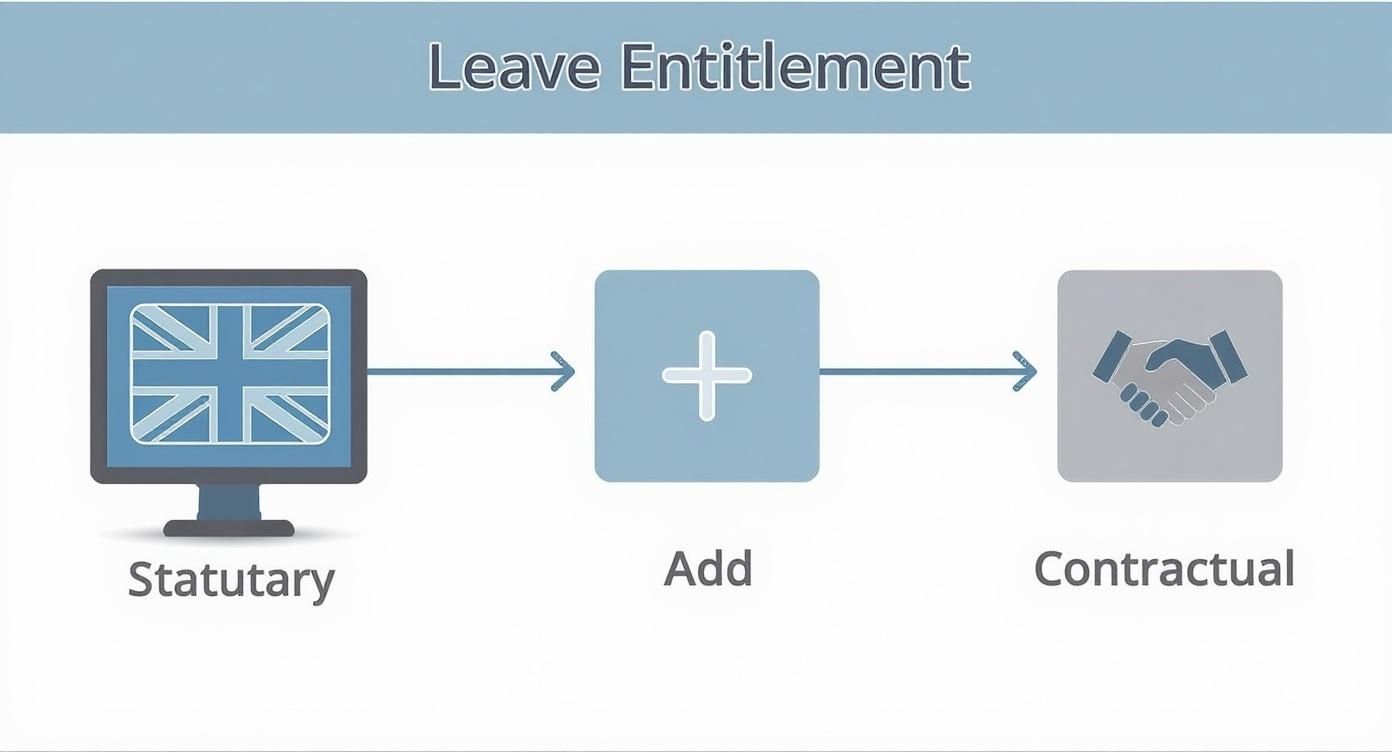
As the infographic shows, your company’s holiday offer is always an addition to the statutory baseline, never a replacement for it.
The Upfront Method: Lump Sum Accrual
The simplest approach by far is the lump sum method. Think of it like giving an employee a gift card on their first day of the holiday year. They get their entire annual leave allowance in one big drop, ready to be used whenever they want (subject to your approval process, of course).
This method is beautifully straightforward. If a full-time employee gets 28 days of annual leave, all 28 days are in their account from day one of the leave year. No fiddly month-to-month maths, which makes it a breeze to administer.
But there’s a catch. An employee could take all their leave early in the year and then hand in their notice. This means they’ve used more holiday than they've technically "earned" through their service, leaving you to untangle the mess in their final pay packet.
The Gradual Method: Accrual Per Pay Period
A far more common—and cautious—approach is to have leave accrue with each pay period. Instead of that one-time drop, holiday entitlement builds up bit by bit throughout the year. It’s like a savings account where a small, consistent amount is deposited each month.
This method neatly ties the amount of leave available to the time an employee has actually worked.
It's the default practice for calculating leave for new starters in their first year. This ensures fairness and protects the business from the risks that come with the lump sum method. To get deeper into the mechanics, you can explore our detailed guide on the accrual of leave.
Let's see how this works for a full-time employee with a 28-day entitlement.
-
For Monthly Paid Staff: The calculation is simple. You just divide the total annual entitlement by the number of months in the year.
- Formula:
Total Annual Leave / 12 Months = Monthly Accrual - Example:
28 days / 12 = 2.33 daysearned each month.
- Formula:
-
For Weekly Paid Staff: The same logic applies, but you divide by 52 weeks instead.
- Formula:
Total Annual Leave / 52 Weeks = Weekly Accrual - Example:
28 days / 52 = 0.538 daysearned each week.
- Formula:
This gradual approach provides a robust framework for the calculation of leave. It keeps the system fair for employees while being financially sensible for the business, ensuring holiday entitlement is always aligned with the work performed.
Calculating Holiday for Part-Time and Casual Workers
Things get a bit more complex when you move beyond your standard full-time contracts. Figuring out fair and compliant holiday entitlement for part-time, casual, or zero-hour workers is exactly where many businesses trip up.
The key principle to always come back to is pro-rata. It’s a fancy term for a simple idea: an employee's holiday should be directly proportional to the time they actually work. Getting this right isn’t just good practice; it's a legal must-have to ensure everyone on your team is treated equitably.
Calculating Pro-Rata Leave for Part-Time Staff
For part-timers who work a set number of days each week, the pro-rata calculation is pretty straightforward. You just multiply the statutory entitlement of 5.6 weeks by the number of days they consistently work.
Let’s walk through a common scenario:
- Employee A works three days per week.
- The calculation is: 5.6 weeks × 3 days/week = 16.8 days of annual leave.
It's crucial to be precise here. The entitlement is 16.8 days, not rounded up to 17 at this stage. Any rounding should only happen at the very final calculation, and the law is clear that you must always round up, never down.
This method guarantees a part-time worker gets the same proportional holiday time as their full-time colleagues, keeping everything fair and compliant. For a more detailed walkthrough, you can find helpful examples in our guide to calculating annual leave for part-time staff.
The Percentage Method for Irregular Hours
But what about casual or zero-hour contract workers whose hours can fluctuate wildly from one week to the next? A fixed day-based calculation just won't work. For these situations, the standard method is to calculate their holiday entitlement as a percentage of the hours they've actually worked.
The magic number you need to remember is 12.07%.
This figure isn't just pulled out of thin air. It’s derived directly from the statutory leave entitlement. A standard working year is 52 weeks long. Since employees are entitled to 5.6 weeks of holiday, they are only working for 46.4 weeks of the year (52 – 5.6).
The calculation to find the percentage is:(5.6 weeks of holiday / 46.4 working weeks) × 100 = 12.07%
This percentage ensures that for every single hour someone works, they accrue the correct, proportional slice of their statutory holiday time.
Important Note: Following recent legal changes, the 12.07% method is now the legally mandated approach for calculating leave for part-year and irregular-hour workers for holiday years beginning on or after 1st April 2024. For workers with regular hours, holiday should still be calculated based on their average pay over the previous 52 weeks.
Putting the 12.07% Rule into Practice
Applying this method is just a case of simple multiplication. You track the total hours an employee has worked over a given period (usually a pay period, like a month) and multiply that number by 12.07%.
Example Calculation
Imagine you have a zero-hour contract worker who put in 80 hours last month.
- Formula:
Total Hours Worked × 0.1207 = Holiday Hours Accrued - Calculation:
80 hours × 0.1207 = 9.656 hours
So, in that pay period, the employee has earned 9.656 hours of paid holiday. This amount can then be added to their running total, ready for them to use. This method gives you a clear, consistent, and legally sound way to manage the calculation of leave for your most flexible workers, ensuring they are always treated fairly.
Right, let's get into the nitty-gritty. While the basic holiday calculations cover most day-to-day situations, real life in HR is rarely that simple. You're bound to run into tricky edge cases and exceptions.
This is where a solid grasp of the rules for more complex scenarios is crucial, not just for fairness but for staying on the right side of the law. Think of this as your go-to guide for when things get a little more complicated, like handling staff joining or leaving mid-year, or figuring out carry-over requests.
Calculating Leave for Starters and Leavers
One of the most common puzzles is figuring out holiday for people who don’t work a full leave year. Whether someone is just joining your team or heading off to a new role, you have to calculate their holiday entitlement on a pro-rata basis. It’s only fair they get the leave they’ve earned for their time with you.
The logic is straightforward. You just work out what fraction of the year the employee has been on the payroll and apply that same fraction to their total annual holiday entitlement.
Here’s an example for a leaver:
Imagine an employee has a 28-day annual entitlement and leaves exactly six months into your company's leave year.
- The calculation:
28 days × (6 months worked / 12 months in a year) = 14 days - The result: They were entitled to 14 days of leave during their employment. If they took less, you’ll need to pay them for the remaining days in their final salary. If they've taken more, your contract might allow you to deduct the excess.
The Rules on Carrying Over Unused Leave
What about when your team doesn't use all their holiday? It happens. UK law has some clear guidelines on this, but your own company policy plays a massive part, too.
- Statutory Leave: The law wants people to rest. That’s why the first four weeks of statutory leave (20 days for a full-timer) generally can't be carried over. They're meant to be used within the leave year.
- Additional Leave: The remaining 1.6 weeks (8 days) of statutory leave, plus any extra contractual leave you offer, can be carried over, but only if you have a written agreement for it (like a clause in the employment contract).
- Company Policy: This is where you get to set your own rules. You might cap the number of days that can be carried over (e.g., a maximum of 5 days) or set a deadline for when they must be used (e.g., by 31st March of the next year).
A quick but important note: These rules aren't set in stone. If someone couldn't take their holiday because they were on long-term sick leave or statutory family leave (like maternity), they must be allowed to carry over the untaken portion of their statutory holiday.
Other Absences and Why Rounding Matters
Holiday entitlement doesn’t just stop when an employee is off for other reasons. It continues to accrue during periods of sickness or maternity leave. Someone on maternity leave, for example, accrues their full statutory and contractual holiday for the entire time they are away. This can lead to a hefty amount of leave to be taken or carried over when they return.
Another detail that’s easy to miss is rounding. The law is crystal clear on this: you must always round leave entitlement up to the next half or full day. You can never, ever round down.
If a part-timer's pro-rata calculation comes out at 16.8 days, you have to round it up to 17 days. Rounding down to 16.5 or 16 would be illegal. It’s a simple rule that stops employees from being short-changed, even by a fraction of a day.
Interestingly, while holiday entitlement is a core right, how much we use can change. Recent data shows the average number of annual leave days taken by UK employees actually dropped from 38 days in 2020 to 33.9 days in 2023. It’s worth taking a look at the bigger picture of UK annual leave entitlement and trends to understand what might be behind these shifts.
Why You Should Automate Leave Calculations
Trying to manage leave calculations with spreadsheets can feel like building a house of cards. It might stand up when you only have a few full-time staff, but the moment you introduce part-timers, complex accrual rules, or staff turnover, the whole thing comes tumbling down.
This manual approach isn't just inefficient; it's a genuine business risk. A single misplaced decimal or an out-of-date formula can easily lead to incorrect holiday pay, frustrated employees, and even legal headaches. All the time spent double-checking, cross-referencing, and fixing those fragile spreadsheets is time that could be spent growing the business.
Eliminate Errors and Guarantee Accuracy
The single biggest win from automation is waving goodbye to human error. Manual calculations, by their very nature, are prone to mistakes. In fact, research suggests that nearly 90% of spreadsheets contain errors. When you're dealing with something as personal and important as employee pay and leave, even a tiny mistake can seriously damage trust.
An automated system is like having an expert mathematician on your team, running the correct calculation of leave every single time. It doesn't forget to apply pro-rata rules for a new starter or miscalculate the accrued holiday for someone who's leaving.
- Complex Scenarios Handled: It automatically applies the right accrual rates, handles rounding rules correctly (always up!), and adjusts for part-time or irregular hours without anyone needing to lift a finger.
- One Source of Truth: All data is in one central place. That means no more version control nightmares with multiple copies of a spreadsheet floating around. Everyone—from HR to managers to employees—is working from the same, up-to-date information.
This level of precision ensures every employee gets exactly what they're entitled to, creating a culture of fairness and transparency across the entire company.

A clean, clear interface like the one above replaces cluttered spreadsheets with useful data you can understand at a glance. This kind of immediate visibility is key to spotting potential issues before they become problems.
Save Time and Boost Productivity
Just think about the hours your HR team or line managers spend each month answering questions like "How much holiday do I have left?", manually updating balances, and checking requests against team schedules. This administrative grind quickly adds up, pulling your team away from strategic tasks that actually move the business forward.
An automated system gives you that time back. By giving employees self-service portals, they can check their own balances and request leave in a few seconds. Managers get an instant view of team availability and can approve requests with a single click, confident that all the calculations are being handled correctly in the background.
To get a better sense of how different technologies can work together to simplify your workload, it's worth exploring how business automation SaaS integration connects systems to help you work smarter, not harder.
Enhance Transparency and Employee Experience
For your team, a lack of clarity around their holiday entitlement is a major source of frustration. People just want to know where they stand so they can plan their lives outside of work. An automated system provides this clarity whenever they need it.
With a dedicated platform, your employees get:
- 24/7 Access: They can view their current leave balance, see how much they've accrued, and check their request history anytime, from any device.
- Clear Visibility: The system shows exactly how their entitlement is calculated, taking all the mystery out of the process.
- Faster Approvals: Requests are sent instantly to the right manager, which dramatically speeds up the entire approval workflow.
This shift turns leave management from a confusing, admin-heavy chore into a smooth and positive experience for everyone. When you implement dedicated employee leave management software, you're not just buying a tool; you're investing in a fairer, more efficient, and more trusting workplace.
Manual Spreadsheets vs Automated Leave Systems
To put it all into perspective, here’s a quick comparison of the old way versus the new way of managing leave calculations.
| Feature | Manual Spreadsheet Method | Automated System (e.g., LeaveWizard) |
|---|---|---|
| Accuracy | Prone to human error, formula mistakes, and typos. A single error can cascade. | Guarantees 100% accuracy with built-in rules for accrual, pro-rata, and rounding. |
| Time Investment | Requires significant manual data entry, updates, and cross-checking. | Drastically reduces admin time. Employees self-serve and approvals take seconds. |
| Transparency | Opaque. Employees must ask HR or a manager for their balance. | Provides a clear, 24/7 view for employees to check their own balances and history. |
| Compliance | Difficult to keep up with changing legislation. Risk of non-compliance is high. | Rules are updated centrally to ensure constant compliance with statutory requirements. |
| Scalability | Becomes chaotic and unmanageable as the team grows. | Easily scales from a small team to hundreds of employees without extra complexity. |
| Reporting | Creating reports is a manual, time-consuming process of pulling data together. | Generates instant reports on absence trends, liability, and team availability. |
The difference is stark. While spreadsheets might seem like a free and simple option initially, their hidden costs in time, errors, and risk quickly become apparent. An automated system, on the other hand, provides a robust, reliable, and efficient foundation for managing leave fairly and effectively.
Your Path to Flawless Leave Management
Getting leave calculations right isn’t just about the numbers on a spreadsheet. It’s about fairness, staying on the right side of the law, and building a positive culture where people feel valued. By now, you've seen how statutory and contractual leave entitlements set the stage, how different accrual methods work, and the right way to handle pro-rata calculations for everyone on your team. Each piece of the puzzle, from managing carry-over to rounding days correctly, helps you build a system that’s both solid and fair.
The journey from manual spreadsheets to a perfect system starts with a solid grasp of these core ideas. It gives you the confidence to manage leave knowing every single employee is getting exactly what they’re entitled to. That kind of precision heads off disputes before they start and builds trust, which is the foundation of any great team.
From Complexity to Clarity
Stepping away from error-prone manual methods is probably the single biggest improvement you can make. An automated system like LeaveWizard isn't just another bit of software; it's a partner that ensures accuracy and gives your whole organisation peace of mind. It takes care of the tricky maths so you can get back to looking after your people.
Embracing an automated solution turns leave management from a high-risk administrative headache into a simple, transparent, and fair process. Everyone benefits, from new starters right up to senior leadership.
Of course, when you're looking at a holistic approach to employee welfare, it's also wise for businesses to understand how to manage employee benefit plans responsibly. This is where things like fiduciary liability insurance can come into play.
Ultimately, flawless leave management is well within your reach. By applying the principles we've covered and using modern tools, you can create a system that doesn't just tick the compliance boxes but actively makes your company a better place to work.
Frequently Asked Questions About Leave Calculation
Even when you’ve got a handle on the basics, real-world leave management throws up some tricky questions. Let's face it, the working world is full of unique situations, and knowing how to handle them is what separates a good manager from a great one.
Here are some quick, clear answers to the queries that pop up most often in the UK. Think of this as your go-to guide for those "what if" moments that a standard spreadsheet just can't solve.
How Should We Handle Bank Holidays for Part-Time Staff?
This is a classic HR puzzle, and one that trips up a lot of businesses. If a part-timer’s usual working day happens to land on a bank holiday, they get that day off, just like a full-time employee would. Simple enough.
But what about the person whose regular days off always seem to coincide with bank holidays? To keep things fair for everyone, the best practice is to calculate holiday entitlement on a pro-rata basis, making sure to include bank holidays in that total figure.
This means you figure out their full allowance (for example, 5.6 weeks multiplied by the number of days they work per week), and they simply book a day from that total pot for any bank holiday that falls on their working day. This way, everyone gets their fair, proportional share of leave, no matter their work pattern.
Do Employees Accrue Holiday While on Sick Leave?
Yes, they absolutely do. An employee's statutory holiday entitlement keeps building up while they're off sick, regardless of how long they are away from work. This applies to their full 5.6 weeks of statutory leave.
Key Point: If someone is unable to take their statutory holiday because of long-term illness, they must be allowed to carry it over into the next leave year. Company policies that try to prevent this carry-over won't hold up in this specific situation.
What about contractual holiday—any extra leave you offer on top of the minimum? That also continues to accrue, unless your employment contract specifically says otherwise.
What Happens if a New Starter Leaves Within Their Probation Period?
When a new hire leaves—whether during probation or later—the rules are the same. You calculate their final holiday entitlement on a pro-rata basis for the exact amount of time they were with you.
You’ll need to work out the fraction of the leave year they were employed and apply that to their full annual entitlement.
For instance, if their probation was three months and they leave right at the end, they've earned a quarter of their annual leave. The final step is to check this against any leave they've already taken. If they have holiday days owing to them, that amount must be paid out in their final salary.


