
Let's cut through the jargon and get straight to it. In the UK, every worker is legally entitled to a minimum of 5.6 weeks of paid holiday each year. Simple as that.
If you work a standard five-day week, this works out to 28 days of paid time off. Think of it as a mandatory annual rest account, topped up and ready for you from your very first day on the job.
Understanding Your Basic Holiday Entitlement

This statutory holiday entitlement is a cornerstone of UK employment law. It’s there to make sure everyone gets a proper chance to rest and recharge, preventing burnout and promoting a healthier work-life balance.
This legal minimum applies to nearly everyone, from full-time employees to those on zero-hours contracts and agency workers. Your employer can certainly offer more holiday—and many do—but they absolutely cannot offer less. It’s a protected right.
What Does 5.6 Weeks Actually Mean?
For most people working a Monday-to-Friday job, the maths is straightforward: 5.6 weeks x 5 days = 28 days. This is the number you’ll hear most often, but the real magic is in the 5.6-week rule itself, as it ensures fairness for everyone, no matter their work schedule.
Because it's based on weeks, the entitlement scales perfectly. Someone working three days a week still gets 5.6 weeks of holiday. For them, that calculates to 16.8 days of paid leave per year (5.6 weeks x 3 days). The principle is the same for everyone.
You can dive deeper into how these calculations work in our detailed guide on UK holiday entitlement rules.
To make it even clearer, here's a quick breakdown for common full-time work patterns.
Statutory Holiday Entitlement at a Glance
| Work Days Per Week | Minimum Entitlement in Weeks | Minimum Entitlement in Days |
|---|---|---|
| 5 days | 5.6 weeks | 28 days |
| 4 days | 5.6 weeks | 22.4 days |
| 3 days | 5.6 weeks | 16.8 days |
This table shows how the 5.6-week rule applies universally, ensuring your holiday time is always proportional to the days you work.
The Bank Holiday Question
This is where things can get a bit confusing for people. Are bank holidays included in your 28 days, or are they an extra perk?
The simple answer is: it depends on your employment contract. An employer is perfectly within their rights to include the eight annual bank holidays (or nine in Scotland) as part of your minimum 28-day entitlement.
Many companies, however, offer a more generous package of 28 days plus bank holidays, but this isn't a legal requirement. Your employment contract is the key here—it will state exactly how your company handles bank holidays.
Getting a firm grasp of this basic framework is the first step to feeling confident about your leave. Once you know the rules, you can check your contract and make sure you're getting the paid time off you're legally owed.
Calculating Holiday for Different Work Patterns
The magic number for UK holiday entitlement is 5.6 weeks. For someone working a standard Monday to Friday, that's simple enough. But what about everyone else? Our workplaces are more flexible than ever, filled with part-time schedules, compressed hours, and all sorts of shift patterns.
This is where the real genius of the 5.6-week rule comes into play. It’s all about proportional fairness. The law is designed to make sure everyone gets the same amount of holiday relative to the time they put in. A part-timer isn't short-changed; their allowance is just scaled to match their hours. The goal is simple: a 'week off' should feel the same for every single employee, no matter how they work.
This infographic is a great visual starting point to see how it all breaks down.
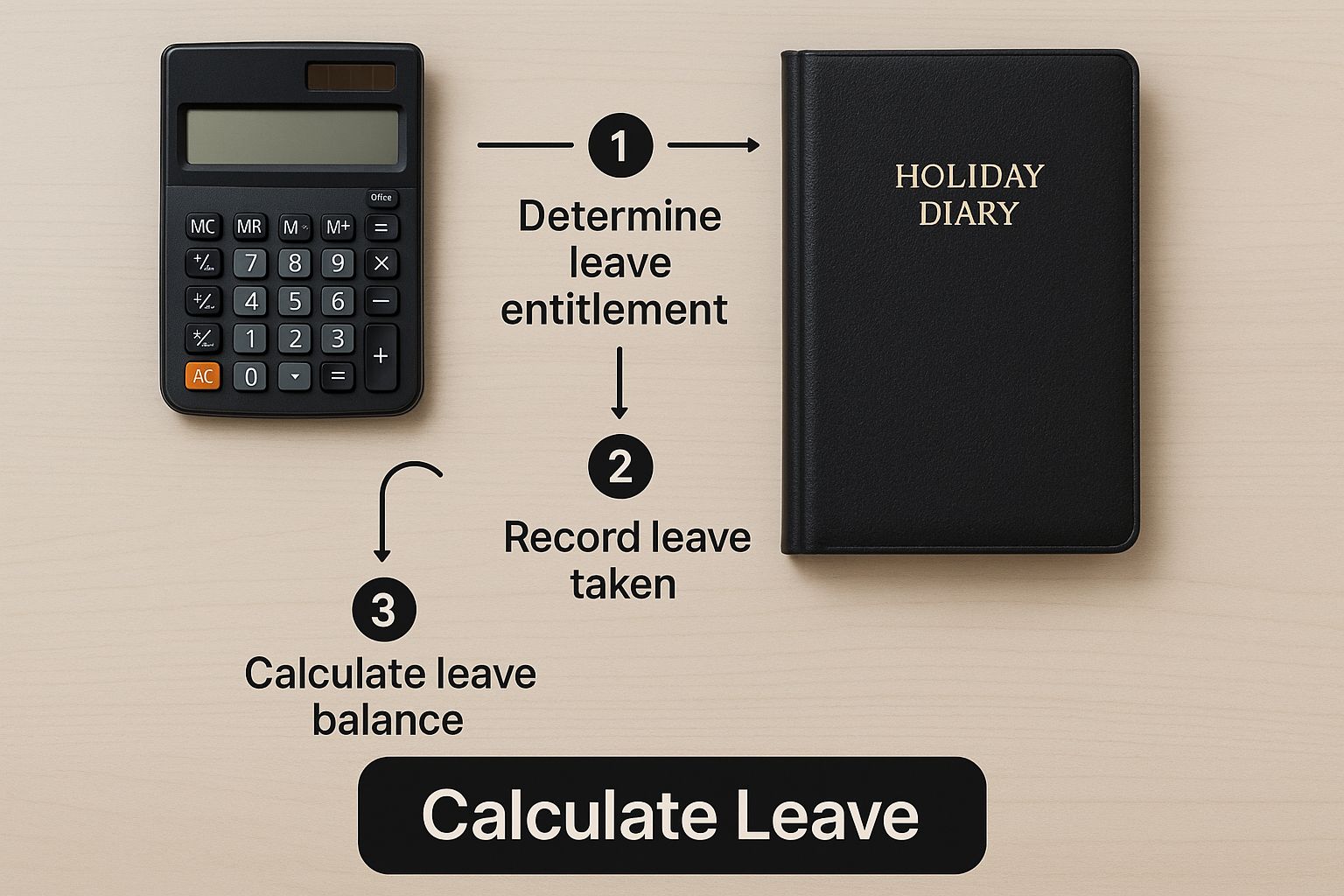
As you can see, whether you work fixed days or varied hours, there’s a clear and fair way to work out what you’re owed.
Calculating for Part-Time Workers
Let’s start with the most common scenario: a part-time worker with set days. If someone works fewer than five days a week, the maths is just simple multiplication. You take the standard 5.6 weeks and multiply it by the number of days they work.
Here’s how that looks in practice:
- An employee works 3 days a week.
- Their holiday entitlement is 5.6 weeks x 3 days = 16.8 days of paid leave per year.
It’s good practice (and very common) for employers to round this up to the nearest half or full day, so in this case, it would become 17 days. Just remember, you can round up, but you can never legally round down.
And if someone works half-days? The exact same logic applies. An employee working 2.5 days a week gets 5.6 weeks x 2.5 days = 14 days holiday.
Tackling Calculations Based on Hours
Things get a bit more interesting when an employee’s workdays change, but their total weekly hours stay the same. This is perfect for people on compressed hours (like working a full week over four days) or other flexible schedules. In these cases, calculating in hours is far more accurate.
To do this, you just multiply their weekly working hours by 5.6.
The Key Formula for Hourly Calculation:
(Number of hours worked per week) x 5.6 weeks = Total annual holiday hours
Let's put that into a real-world context. Imagine someone works 20 hours a week, but their shifts vary.
- The calculation is: 20 hours x 5.6 weeks = 112 hours of paid holiday each year.
- When they book a day off that would have been a 4-hour shift, they simply use 4 hours from their 112-hour holiday bank.
This method keeps everything perfectly fair and transparent, ensuring the minimum holiday entitlement UK rules are followed to the letter.
Dealing with Shift Work Patterns
Shift work often throws another spanner in the works. The patterns can be complex, spanning more than a standard week, so calculating leave in days just won’t cut it. A popular rota is the ‘4 on, 4 off’ schedule, with four 12-hour shifts followed by four days off.
For rotas like this, the first step is to figure out the average hours worked per week across the entire shift cycle. A ‘4 on, 4 off’ pattern repeats every 8 days.
Here’s the step-by-step breakdown:
- Calculate hours in the cycle: The employee works 4 x 12-hour shifts, which is 48 hours over the 8-day cycle.
- Find the weekly average: Now, we work out the weekly equivalent: (48 hours / 8 days) x 7 days = 42 average hours per week.
- Apply the 5.6-week rule: With the average weekly hours sorted, we can find the annual entitlement: 42 hours x 5.6 weeks = 235.2 hours of holiday.
When a shift worker on this pattern books a day off, they deduct the full length of their shift (12 hours) from their total pot. This ensures that even those with the most unconventional schedules get the exact holiday time they're entitled to.
Holiday Rules for Irregular and Part-Year Workers
Figuring out holiday entitlement for zero-hours contracts, seasonal roles, or gig economy work has often felt like a bit of a maze. For years, this corner of employment law has been a headache for both workers and employers. The good news? Recent changes have finally brought some much-needed clarity, creating a fairer system based on one simple idea: you earn holiday as you work.
This modern approach ensures your minimum holiday entitlement UK rights are protected, no matter how unpredictable your schedule might be. It’s a move away from confusing weekly calculations and towards a far more logical accrual method.
The Shift to Accrual Based on Hours Worked
The real game-changer here is the formal adoption of an accrual system. In January 2024, the UK rolled out significant reforms to simplify holiday calculations for anyone with non-standard hours. This new method makes sure your holiday entitlement is earned fairly based on the hours you actually work, calculated at 12.07% of those hours in a pay period. If you want to dive deeper into these updates, you can explore the details of the holiday pay reforms from January 2024.
That percentage isn't just a random number. It's worked out directly from the statutory 5.6 weeks of holiday everyone is entitled to.
- A standard working year has 52 weeks.
- Take away the 5.6 weeks of statutory leave, and you're left with 46.4 working weeks.
- The maths is simple: (5.6 weeks ÷ 46.4 weeks) x 100 = 12.07%.
This gives everyone a transparent and consistent way to calculate leave, even for the most varied work patterns.
How the 12.07% Accrual Method Works
Let’s see how this plays out in the real world. Imagine you're on a zero-hours contract and your hours are different every month. The 12.07% rule makes calculating your earned holiday totally straightforward.
Example Calculation:
You work 60 hours one month. To figure out how much holiday you've earned, you just do this calculation:
60 hours x 12.07% = 7.24 hours of paid holiday accrued.
You can then bank these hours. When you want to take a day off that would normally be an 8-hour shift, you’d simply use 8 hours from your accrued holiday pot. This system makes sure your holiday entitlement perfectly mirrors the amount of work you’ve done. For a more detailed look at this, check out our comprehensive guide on holiday entitlement for zero-hours contracts.
Demystifying Rolled-Up Holiday Pay
Another term you’ll hear a lot is rolled-up holiday pay. This is when an employer includes an extra amount with your regular wages to cover your holiday pay, instead of paying you when you actually take the time off. For a long time, this practice was technically unlawful, but recent rule changes have made it okay for irregular and part-year workers, but only under specific conditions.
With rolled-up holiday pay, your payslip will show your basic pay plus an extra 12.07% on top, clearly marked as holiday pay. This means you are paid for your holiday as you earn it, rather than when you take leave.
There are important protections in place, though. Employers who use this method have to make sure that:
- They only use it for genuinely irregular or part-year workers.
- The holiday pay is clearly listed as a separate item on the payslip.
- They still encourage workers to take their time off, even though it will be technically unpaid when they take it (since it's been paid in advance).
This approach tries to simplify payroll for businesses with a highly flexible workforce, while still making sure workers get the right financial compensation for their statutory leave. It's a pragmatic solution to a long-standing payroll headache, offering much-needed clarity for the modern workforce.
How Holiday Pay Is Actually Calculated

Knowing your holiday entitlement is one piece of the puzzle, but getting paid correctly for it is another thing entirely. Holiday pay isn't always as simple as just getting your basic salary for the days you’re off. In fact, the law is very clear: your pay during leave should reflect what you would have normally earned if you'd been at work.
This is a crucial point. For many people, "normal pay" is much more than a flat rate. It often includes regular overtime, commission, and certain bonuses that are a consistent part of your income.
Think of it this way: taking a well-deserved break shouldn't leave you out of pocket. If you regularly boost your earnings with overtime, your holiday pay needs to reflect that reality. Otherwise, taking time off would feel more like a penalty than a benefit.
What Counts as Normal Pay
To figure out what you should receive, employers must look at your average pay over a specific reference period. This is the only fair way to account for all those variable bits of your pay.
The key things that legally have to be included are:
- Regular Overtime: This covers both compulsory and voluntary overtime, as long as you do it regularly enough for it to be considered part of your normal working pattern.
- Commission Payments: If your earnings are tied to sales or performance targets, these payments absolutely must be factored into your holiday pay.
- Performance-Related Bonuses: Any bonuses directly linked to your work and paid consistently should also be part of the calculation.
The core idea is that holiday pay should be based on your actual earnings, not just your contracted base salary. This prevents employees from losing out financially when they take the statutory leave they are entitled to.
This ensures the minimum holiday entitlement UK provides is financially protected, encouraging everyone to take their necessary breaks without worrying about a smaller payslip.
The Two Tiers of Holiday Pay
Here’s where it gets a little more complex. UK law actually splits the statutory 5.6 weeks of holiday into two different pots, and each one has slightly different rules for how the pay is calculated. This is a hangover from how UK and EU employment laws were originally blended.
The two tiers are:
- The first 4 weeks: This chunk comes from the EU's Working Time Directive. For these weeks, your holiday pay must include all the variable extras we've just discussed, like regular overtime and commission.
- The remaining 1.6 weeks: This is an additional entitlement granted purely under UK law. For this bit, employers are generally only required to pay you at your basic rate, unless your contract says something different.
This two-tier system can make the sums tricky, which is why it’s so important to understand what makes up your pay. If you need a hand with the figures, you can learn more about how to calculate holiday pay to make sure you're being compensated correctly for every single day you take off. The best thing you can do is check your payslip against these rules to confirm you’re getting everything you're owed.
Booking and Taking Your Annual Leave
So, you know how much holiday you're entitled to – that's the first hurdle cleared. But now comes the practical bit: actually booking and taking your time off. There's a bit of a process to it, with rules for both you and your employer to make sure the whole thing runs smoothly.
The most basic rule of thumb is about giving notice. You need to give your boss at least twice as much notice as the amount of leave you want to take. Simple, right? If you fancy a week off, you need to ask for it at least two weeks before you plan to jet off. This just gives the business a fair chance to plan for your absence.
But hold on – before you put that request in, check your employment contract. Your company can set its own notice periods, and many do. Always look at your contract or the employee handbook first, as those are the specific rules that apply to you.
Can Your Employer Say No or Tell You When to Take Holiday?
Here's something that catches people out: while you have a right to your holiday, you don't have an absolute right to take it exactly when you want. Your employer can turn down a leave request, but they need a solid business reason to do so. Maybe it's during a massive project deadline or the Christmas rush in a shop – things like that.
If your employer does have to refuse your request, they also have to play by the notice rules. They must tell you "no" with a notice period at least as long as the holiday you asked for. So, if they need to cancel your two-week getaway, they must give you at least two weeks' warning before it was supposed to start.
It's also worth knowing that your employer can actually require you to take your leave on certain dates. This is really common for businesses that have a set shutdown period, like factories closing over Christmas and New Year.
This is completely above board, as long as they give you the correct notice and the rule applies to everyone fairly. Again, this kind of policy should be clearly laid out in your employment contract.
Common Holiday Booking Rules
To stop everyone from booking the same two weeks in August, most companies have some specific policies in place. These are all about balancing your need for a break with the needs of the business.
Here are a few common rules you might come across:
- Blackout Periods: Retailers often block leave requests in December, while an accountancy firm might do the same around the end of the tax year.
- Leave Length Rules: Some places might say you have to take holiday in full-week blocks, or they might limit you to a maximum of two weeks off at any one time.
- First-Come, First-Served: This is the big one. Most companies approve leave in the order it was requested. If you want time off during the school holidays, get your request in early!
These policies are perfectly legal, provided they don't make it impossible for you to actually take all your statutory holiday within the leave year. The system has to be fair and give everyone a reasonable chance to use their entitlement.
What About Carrying Over Unused Leave?
What happens if you get to the end of the leave year with a few days left in the bank? For the first four weeks of your statutory holiday (the bit that comes from original EU law), the rule is simple: use it or lose it.
However, that extra 1.6 weeks of leave granted under UK law is a bit different. You can carry this over, but only if you have a written agreement with your employer allowing it. Some companies have more generous policies that let you carry over even more days, but that's a contractual perk, not a legal right.
There are, of course, some important exceptions. If you couldn't take your holiday because you were on long-term sick leave or maternity leave, you are legally protected. In those cases, you're allowed to carry that untaken leave into the next year.
Why Taking Your Full Holiday Entitlement Matters
Knowing you're legally entitled to paid leave is one thing, but actually taking it? That’s a different battle altogether. The law provides a solid foundation with the minimum holiday entitlement UK workers can expect, but it's often the workplace culture that decides if people feel comfortable using their full allowance. And a worrying trend is emerging: many of us are leaving precious days of rest on the table.
This isn't just a hunch; the data tells a clear story. Between 2020 and 2023, the average number of annual leave days taken by UK workers took a nosedive. Even though the statutory minimum didn’t change, usage dropped to 36.7 days in 2022 and then fell another 7.67% to just 33.9 days in 2023. That’s a reduction of nearly 12% in just three years. You can dive deeper into this trend in the full UK annual leave report.
So, what's behind this growing reluctance to switch off? The pressures are coming from all sides.
The Pressures Pushing Against Taking Leave
Several factors are fuelling this issue of unused holiday. For many, workload anxiety is the biggest barrier; the fear of coming back to an avalanche of emails and tasks is enough to put them off booking time away in the first place. This creates a vicious cycle where the need for a break is at its peak, but the ability to take one feels impossible.
On top of that, economic pressures and the rising cost of living mean some people simply can't afford a trip. When that happens, a "staycation" can feel less like a genuine escape and more like just being at home without the work calls.
A strange paradox has also popped up with modern policies like 'unlimited holidays'. They sound generous, but in reality, they can create uncertainty and peer pressure, often leading to employees taking even less time off than colleagues with a fixed allowance.
The True Cost of Unused Holidays
Failing to take regular, proper breaks isn't a badge of honour or a sign of dedication—it's a fast track to burnout. Consistent rest isn't a luxury; it's absolutely essential for maintaining long-term productivity, creativity, and mental health.
Organisations that create a culture where taking leave is actively encouraged and celebrated see huge benefits:
- Reduced Burnout: Employees who use their full holiday entitlement are far less likely to suffer from chronic stress.
- Increased Productivity: A well-rested mind is sharper, more effective, and more innovative. Simple as that.
- Improved Morale: When people feel their well-being is genuinely valued, their loyalty and engagement go through the roof.
Ultimately, a company culture that champions rest isn't just doing something nice for its people; it's making a smart business decision. Proper breaks are a vital investment in a healthy, sustainable, and high-performing team.
Common Questions on UK Holiday Entitlement
Sorting out the finer points of UK holiday rules can get tricky, especially when your work situation changes. Let's tackle some of the most common questions that pop up for both employees and employers.
We'll break down what happens to your holiday when you start a new job or leave, what your rights are if you get sick during your leave, and how part-time work and bank holidays mix. The aim here is to give you straightforward, practical answers for these real-world scenarios.
What Happens When I Start or Leave a Job?
When you join a company or move on to a new role, your holiday entitlement is worked out on a pro-rata basis. It's a simple concept: you get a fair slice of the full year's leave based on how much of the leave year you’ve actually worked.
Your holiday time starts building up from your very first day on the job. For every month you work, you earn one-twelfth of your total annual entitlement.
- Starting a Job: If you join a company six months into its leave year, you’ll be entitled to half of the annual holiday allowance for that year. Simple as that.
- Leaving a Job: When it's time to leave, your employer will calculate the holiday you've earned against what you've taken. If you have leave left over, you should get paid for those unused days in your final payslip. On the flip side, if you've taken more holiday than you've accrued, your employer can usually deduct the value of that extra time from your final pay, as long as this is mentioned in your contract.
What if I Fall Sick on Holiday?
Getting ill during your annual leave is a real downer, but thankfully, your rights are very clear. You can report your sickness to your employer and essentially "reclaim" the holiday days you lost to being unwell.
You are entitled to take the holiday you missed at a later date. UK employment law treats sickness and holiday as two separate things, so you shouldn't lose out on a well-earned break just because of bad luck with your health.
To reclaim the time, you need to follow your company's usual sickness reporting process, just as you would if you were meant to be working. This usually involves calling your manager and might require a doctor's note if you're ill for more than seven days.
How Are Bank Holidays Handled for Part-Time Workers?
Part-time workers must not be treated any less favourably than their full-time colleagues, and that principle absolutely applies to bank holidays. Because most bank holidays fall on a Monday, someone who doesn't work Mondays could easily miss out.
To keep things fair, employers should give part-timers a pro-rata bank holiday allowance based on the hours or days they work. For instance, if a full-time employee gets eight bank holidays, a part-timer working three days a week is entitled to 60% of that, which comes out to 4.8 days. This makes sure everyone gets their fair share of paid time off, no matter their working pattern.


