
Leave accrual is simply the process where employees earn their holiday time progressively as they work.Leave accrual is simply the process where employees earn their holiday time progressively as they work. Instead of getting a full year's worth of holiday allowance dropped into their lap on day one, they build it up over time.
Think of it less like a one-off bonus and more like earning a wage—it’s time off you accumulate with each pay period. This approach provides a clear and fair system for everyone involved.
What Exactly Is Leave Accrual?

Let's use an analogy. Picture your annual leave as a savings account for your well-deserved breaks. With each month you put in at work, you're making a "deposit" into that account. Rather than starting with a lump sum of 28 days, your balance grows steadily throughout the year. That gradual accumulation is the heart of leave accrual.
In the UK, this isn't just a popular method; it's the standard and legally required approach for a very good reason: fairness. It cuts through any potential confusion for both you and your staff by creating a transparent, running tally of earned holiday time. This becomes especially vital in a couple of everyday business situations.
Why Progressive Accrual Matters
For any new hire who joins part-way through your company's holiday year, the accrual system ensures they get a fair, pro-rata share of holiday time. They don't have to wait months on end for a break; they can use their leave as it's earned, in line with your company policy.
It works just as well when an employee moves on to a new opportunity. The system guarantees they are paid for the exact amount of holiday they've rightfully earned but haven't used. This simple bit of maths prevents squabbles over the final payslip and makes for a much smoother, more professional exit process.
The whole point of the accrual system is to directly tie holiday entitlement to the time an employee has actually worked. It turns leave from an abstract yearly perk into a tangible, earned asset—just like their salary.
The accrual method is designed to be a straightforward and fair calculation as an employee’s time with you adds up. For a typical full-time employee in the UK working regular hours, leave accrues each month at one-twelfth of their total annual entitlement. So, someone entitled to 28 days a year will build up around 2.33 days of holiday each month.
This systematic process means both you and your employee know precisely where things stand at any given moment. You can dive deeper into the official guidance on how these calculations work on the government's website.
Ultimately, leave accrual offers a logical and legally sound framework. It protects the business's interests while respecting the rights of your team, creating a predictable and manageable way to handle one of the most valued workplace benefits.
Your Legal Duties for Annual Leave

Getting to grips with UK law on annual leave isn't just a box-ticking exercise—it's a fundamental legal requirement. Handling your duties correctly from the get-go prevents costly mistakes down the line and builds a crucial foundation of trust with your team. For any employer, this is non-negotiable.
The absolute cornerstone of your responsibility is providing the statutory minimum holiday entitlement. In the UK, this is set at 5.6 weeks of paid holiday per year for nearly all workers, and yes, that includes those on zero-hours contracts. For a typical employee working five days a week, this translates to 28 days of paid annual leave.
This mandatory 28-day allowance can include bank holidays if you wish. You have the flexibility to either count them as part of the 28 days or give them as extra time off. This allows you to shape a policy that fits your business operations, as long as you never dip below that legal minimum.
Prorating Leave for Fairness and Compliance
A one-size-fits-all approach to leave just doesn't cut it in today's varied workforce. For your part-time staff, you must calculate their holiday allowance on a pro-rata basis. This ensures they get a fair entitlement proportional to the hours or days they work, which is vital for preventing any form of discrimination.
For instance, an employee who works three days a week is entitled to 16.8 days of leave per year (3 ÷ 5 × 28 days). It's a simple but essential calculation for maintaining fairness across your entire team.
Here’s a point many employers trip up on: the accrual of leave begins from the very first day of employment. An employee doesn't need to pass a probation period to start earning holiday time; it builds up from the moment they join your business.
Legally, an employee earns holiday entitlement from day one, accumulating it as they work. This is a continuous process, not something that activates after a few months. Ignoring this can lead to serious compliance issues, especially when an employee leaves.
Leave Accrual Rates and Carry-Over Rules
In practice, this means leave builds up incrementally. The most common way to track this is for a full-time worker to accrue their leave at a rate of roughly 2.33 days for each month they work. This system gives you a clear, up-to-date record of how much leave has been earned at any point during the year.
Another legal area you'll need to manage is the carry-over of unused leave. While you can set your own policy, there have been specific government adjustments to these rules in the past to help businesses and workers handle leave balances during exceptional times. You can read more about the UK government changes to annual leave carry-over rules to see how this can work.
Finally, your duties extend right up to an employee's last day. When someone leaves your company, you are legally required to pay them for any statutory holiday they've accrued but haven't taken. Calculating this final payment accurately is critical to avoid legal disputes and ensure a smooth, professional offboarding process for everyone involved.
How to Calculate Leave Accrual Accurately
Getting your head around leave accrual isn't just a box-ticking exercise; it’s one of the cornerstones of fair and compliant people management. Get the numbers wrong, and you could be facing payroll nightmares, disgruntled employees, and even legal headaches. The good news is, it doesn't have to be a minefield.
For most businesses in the UK, it boils down to two main ways of calculating holiday entitlement. Which one you use really depends on your employees' contracts and how they work. One method is built for the steady rhythm of salaried roles, while the other offers the flexibility needed for staff with variable hours.
This snapshot gives you a clear picture of the key figures an employer might track for a single employee over a year.
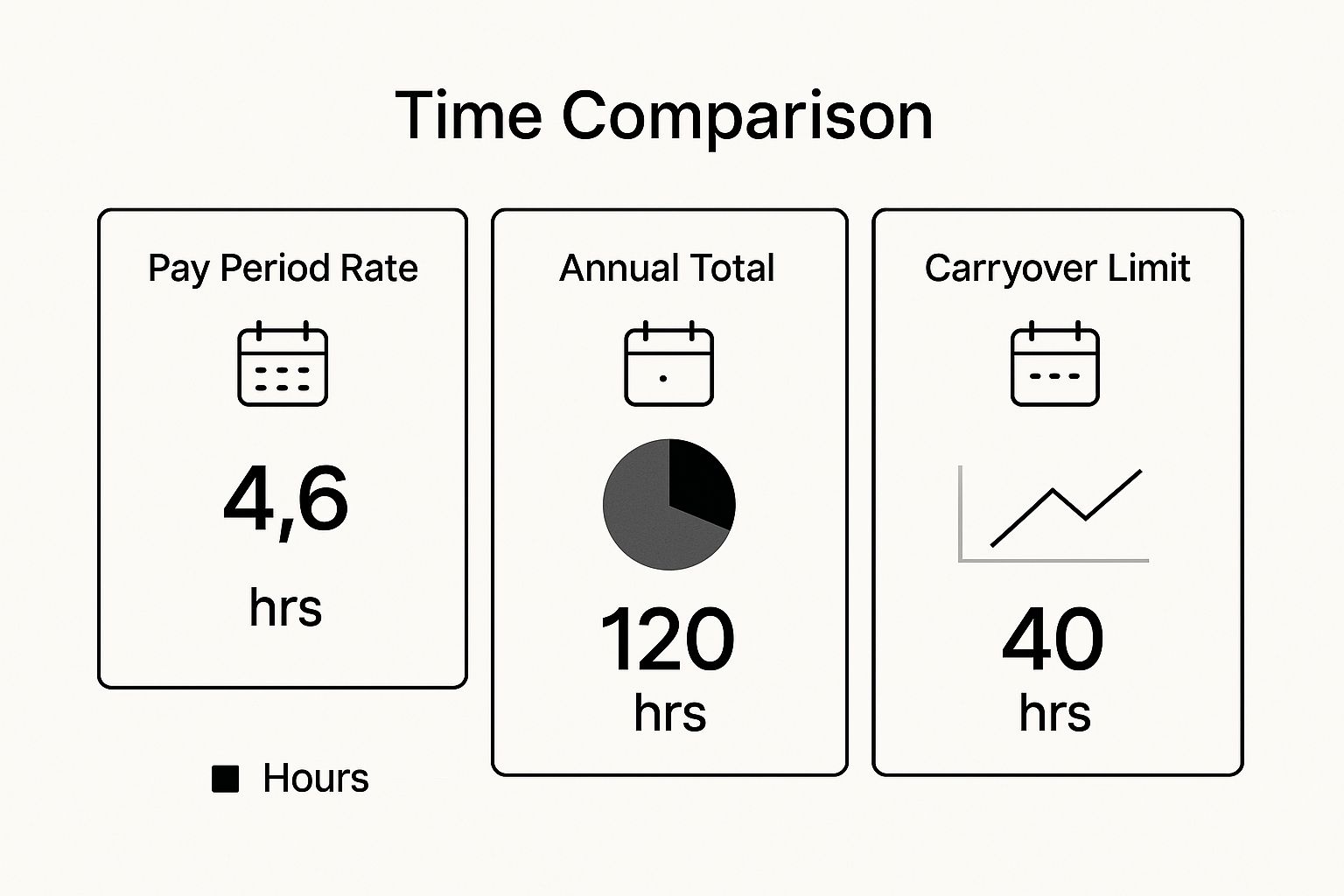
Seeing these metrics laid out—from the small amount earned each pay period to the annual total and any carry-over—really helps to visualise how those small, regular accruals add up to a significant benefit for your team.
Method 1: Monthly Accrual for Salaried Staff
For your full-time and part-time staff on fixed salaries and set hours, the calculation is refreshingly simple. This approach ensures that leave is earned evenly throughout the year, which makes life easier for everyone when it comes to tracking and planning.
The formula is straightforward: just divide their total annual holiday entitlement by 12.
Formula: (Total Annual Leave Days) / 12 = Monthly Leave Accrual
Let’s put it into practice. Say you have a full-time employee, Sarah. She works five days a week and gets the statutory minimum of 28 days of paid holiday a year.
- Calculation: 28 days / 12 months = 2.33 days of leave accrued each month.
After three months with your company, Sarah will have earned 6.99 days of holiday (2.33 x 3). This method brings a level of predictability that both you and your employees will appreciate, making holiday planning a much smoother process. For an even more detailed breakdown, you can learn more about how to calculate annual leave accrual in our dedicated guide.
Method 2: The Percentage Method for Variable Hours
But what about your casual staff, people on zero-hours contracts, or anyone whose working pattern fluctuates? A fixed monthly accrual just doesn't make sense when their hours change from one week to the next. This is where the percentage method steps in, making sure their holiday pay is directly linked to the hours they actually put in.
The legally accepted standard is to calculate holiday entitlement as 12.07% of the hours worked.
This figure isn't just plucked out of thin air. It comes from the statutory 5.6 weeks of leave, divided by the remaining 46.4 working weeks of the year (52 weeks – 5.6 weeks). That simple sum (5.6 / 46.4) gives you 12.07%.
Formula: (Total Hours Worked in Pay Period) x 12.07% = Holiday Hours Earned
Let’s take another example. You employ a student, Tom, on a casual basis. In May, he worked a total of 60 hours.
- Calculation: 60 hours x 0.1207 = 7.24 hours of paid holiday earned.
This method is the fairest way to handle leave for workers without a fixed schedule. Their holiday entitlement simply rises and falls with their workload, which is exactly how it should be. If you want to get really precise, exploring some practical data analysis techniques in Excel can give you the tools to manage this with confidence.
Leave Accrual Calculation Methods at a Glance
Picking the right calculation method is vital for staying compliant. Using the wrong approach can lead to underpaying or overpaying holiday entitlement, creating a tangle of admin and potential legal trouble down the line.
To help you choose correctly every time, here’s a quick-glance table comparing the standard methods.
| Employee Type | Recommended Accrual Method | Calculation Formula | Example |
|---|---|---|---|
| Full-Time or Part-Time Salaried | Per Pay Period (Monthly/Weekly) | (Annual Entitlement / Number of Pay Periods) | A full-time employee with 28 days leave earns 2.33 days per month. |
| Zero-Hours or Casual Staff | Percentage of Hours Worked | (Hours Worked x 12.07%) | An employee working 50 hours in a month earns 6.035 holiday hours. |
| Term-Time or Seasonal | Percentage of Hours Worked | (Hours Worked x 12.07%) | A term-time worker’s holiday pay is based only on the hours worked during term. |
By carefully matching the calculation method to the employment contract, you build a system that’s transparent, fair, and legally sound. This clarity takes the guesswork out of the equation, empowering you to manage leave and payroll with confidence.
Building a Fair and Clear Leave Policy

A leave policy isn't just another piece of paperwork. It’s a genuine statement about how much you value your team's well-being and a framework that builds mutual respect. When everyone knows the score, you can sidestep confusion, foster trust, and seriously cut down on administrative headaches. The aim is to craft a policy that's not just legally sound, but also clear, fair, and truly supportive of your staff.
Think of a well-written policy as the single source of truth for everything time-off related. It should clearly map out how to book leave, the rules on carrying over unused days, and how the accrual of leave works in different scenarios. This kind of transparency is the bedrock of a positive workplace, where employees feel secure and confident about their entitlements.
Must-Have Clauses for Your Policy
To be worth the paper it’s written on, your leave policy needs to cover a few essential bases. These are the non-negotiable building blocks of your document. Skipping any of them is a recipe for ambiguity and, frankly, arguments down the line.
Your policy must spell out:
- The Leave Year: Define the 12-month period for holiday entitlement. Is it 1st January to 31st December, or something else? Be specific.
- Booking Procedures: Detail exactly how someone requests time off, the notice they need to give, and who signs it off.
- Carry-Over Rules: Explain if unused leave can be carried over, and if so, how much. You need to be crystal clear about statutory minimums versus any extra contractual days.
- Payment for Unused Leave: Clarify that paying out statutory holiday is only an option when an employee leaves the company.
Getting these elements documented properly creates consistency for everyone. A well-thought-out policy can make a massive difference to both employee happiness and how well they stick to company guidelines. You can learn more about how a great annual leave policy can boost satisfaction and adherence in our detailed guide.
Managing Accrual During Extended Absences
One area that often trips businesses up is how leave continues to build up during long-term absences. UK law is very direct on this: an employee’s statutory holiday entitlement keeps on accruing, even when they’re away from work on specific types of leave.
This applies to extended periods of:
- Sick leave
- Maternity or paternity leave
- Parental leave
This means that even if an employee is off for several months, their holiday pot keeps growing just as if they were at their desk. Your policy has to reflect this legal duty. It also needs to explain how staff can use this accrued time when they return, or how it will be paid out if they move on.
A fair and legally sound policy acknowledges that life happens. Ensuring leave accrues during parental or sick leave isn't just a legal duty; it's a powerful way to show your employees that you support them through major life events.
Considering Popular Perks and Advanced Options
Once you've got the legal basics nailed down, you can start thinking about offering more attractive leave perks. These can be brilliant tools for attracting and keeping great people, but you need to think them through carefully to make sure they work for your business.
Two popular options are:
- Buying and Selling Holiday: This lets staff purchase extra days off or sell unused contractual days back to the company. It’s a fantastic perk for flexibility but demands very careful tracking to manage the financial and accrual side of things.
- "Unlimited" Paid Time Off (PTO): This model scraps the cap on holiday days, putting trust in employees to take the time they need. While it can be a huge boost for morale and autonomy, it really depends on a high-trust culture and clear guidelines to stop it from being misused and to ensure work still gets done.
Ultimately, whether you stick to the statutory minimums or introduce flashier perks, the goal is the same. You need a transparent, fair, and consistently applied framework for the accrual of leave. This clarity doesn't just keep you on the right side of the law—it boosts morale and helps build a reputation as a genuinely great place to work.
Managing Common Scenarios and Complexities
Real life is rarely straightforward, and managing the accrual of leave is certainly no exception. Even with crystal-clear policies and spot-on calculations, tricky situations are bound to pop up. How you navigate these moments—fairly and consistently—is what really counts for team morale and keeping things running smoothly.
By tackling these challenges head-on, you stop minor hiccups from turning into major headaches. When you understand how to apply the principles of leave accrual to specific, real-world scenarios, you can handle anything that comes your way with confidence. It solidifies your reputation as a fair and organised employer.
Adjusting Accrual for Part-Time Transitions
One of the most common curveballs is when an employee's working pattern changes. Let's say a full-time employee, David, who works a standard five-day week, decides to go part-time, working three days a week from the start of July. His leave accrual needs to be adjusted properly.
Here’s how you’d handle that transition:
- Calculate leave accrued as a full-timer: First, figure out the holiday David has already earned. If your holiday year runs from January to December, you’ll calculate his entitlement for the first six months (January-June) based on his full-time contract.
- Calculate leave for the remaining year: Next, you work out his entitlement for the last six months (July-December) based on his new part-time hours. This is a simple pro-rata calculation.
- Combine the totals: Add the two figures together, and you have his total holiday entitlement for the year. This two-step process makes sure he gets the exact amount of leave he’s entitled to for the work he’s done.
Managing Holiday During Long-Term Sick Leave
UK law is very clear on this: statutory holiday entitlement continues to build up during sick leave. An employee who is off work due to a long-term illness is still accruing their holiday pot, just as if they were working. This is a massive point of compliance you can't afford to get wrong.
This brings up practical questions, like when they can actually take this leave. If an employee can't use their holiday within the leave year because they're sick, they must be allowed to carry it over to the next year. Your policy has to reflect this legal protection, making sure people aren't penalised for being unwell.
Fairly managing leave accrual during sickness isn't just a legal duty; it’s a powerful signal of support. It shows your team that you value their well-being, which is fundamental to building a compassionate and resilient workplace culture.
Calculating Final Pay for Leavers
When someone hands in their notice, you need to calculate their final holiday pay with precision. This means working out exactly how much leave they've accrued up to their very last day and comparing it against how much they've already taken.
If they've accrued more holiday than they’ve used, you must pay them for those outstanding days in their final payslip. On the flip side, if they've taken more holiday than they’ve actually earned, your employment contract should clearly state whether you can deduct the value of those extra days from their final pay. Getting this right prevents disputes and ensures a clean, professional offboarding.
Handling Bank Holidays for Part-Time Staff
Bank holidays often cause a lot of confusion for part-time workers. A common mistake is to only give a part-timer a bank holiday off if it happens to fall on one of their usual working days. This can easily lead to claims of discrimination.
The correct and fair approach is to give part-time staff a pro-rata entitlement to all bank holidays, no matter what their work schedule looks like. You simply add their pro-rata bank holiday entitlement to their regular annual leave. This way, if a bank holiday falls on a day they wouldn’t normally work, they can use one of their accrued days to take a different day off instead.
This method guarantees fairness and equal treatment for everyone. After all, making sure staff take proper breaks is vital. Interestingly, recent data reveals that just over 50% of UK workers took a full week off in the last year. This really highlights how important regular breaks are for well-being, and you can dig into more UK leave trends in The State of Annual Leave Statistics for 2024-2025.
Answering Your Top Questions About Leave Accrual
Even with a rock-solid policy in place, leave accrual can still throw up some tricky questions. Let's be honest, these queries can cause a bit of a headache for everyone involved, from managers to employees. To clear things up, we’ve put together the most common questions we hear, with straightforward answers to reinforce what we've covered.
Think of this as your go-to cheat sheet for sorting out those specific sticking points and making sure you’re confident in how leave accrual works day-to-day.
Does Holiday Entitlement Keep Accruing During Sick or Maternity Leave?
Yes, it absolutely does. This is a big one, but UK law is crystal clear: an employee’s statutory holiday entitlement continues to build up during any kind of statutory leave. This covers sick leave, maternity, paternity, and parental leave. For all intents and purposes, their holiday balance grows as if they were still at their desk.
So, what does that mean for you? You must allow them to take this accrued holiday. If their job ends during or just after this leave period, you’re required to pay them out for any holiday they've earned but not taken.
How Should We Calculate Holiday for a Zero-Hours Contract Worker?
For workers on irregular or zero-hours contracts, there’s a standard, legally sound method you should be using. You calculate their leave entitlement at 12.07% of the hours they have actually worked. This keeps everything fair and ensures their holiday pay is directly proportional to the work they’ve done.
This percentage isn't just a random number. It comes from the 5.6 weeks of statutory holiday, divided by the remaining 46.4 working weeks of the year. For each pay period, you just multiply their total hours by 12.07% to get the exact amount of paid leave they’ve earned.
Key Takeaway: The 12.07% method is your best friend when it comes to fairness and compliance for casual and zero-hours staff. It removes all the guesswork by linking their holiday entitlement directly to their contribution.
Using this method means you won't fall into the trap of trying to apply a fixed accrual rate to a work pattern that’s anything but fixed.
What Are the Rules for Carrying Over Unused Annual Leave?
Under UK law, employees have to take at least four weeks of their statutory leave within the leave year. But what about the rest? You can allow your team to carry over the remaining 1.6 weeks (plus any extra contractual holiday you offer), but only if you have a clear, written agreement setting this out.
There's a critical exception, though. If an employee couldn’t take their holiday because they were on long-term sick leave or another type of statutory leave (like maternity), you must allow them to carry it over. And remember, paying someone in lieu of their statutory holiday is only allowed when their employment ends.
How Should We Handle Bank Holidays in Leave Accrual?
Believe it or not, there's no automatic legal right for employees to have bank holidays off as paid leave. It’s up to the employer. You can choose to include bank holidays as part of the total 5.6-week statutory entitlement. For example, a contract might state 20 days of holiday plus the 8 standard bank holidays.
If you need an employee to work on a bank holiday, they still have to get their full 5.6 weeks of leave on other days. For part-time workers, it's absolutely crucial to prorate their total holiday entitlement—including bank holidays—to make sure you’re treating everyone fairly and not discriminating.


