
To calculate annual leave for part-time staff, you need to give them the same statutory 5.6 weeks of holiday as your full-time employees, just adjusted proportionally for the days or hours they actually work. This principle, known as pro-rata, is the bedrock of fairness and legal compliance under UK employment law.
Understanding Pro-Rata Holiday Entitlement in the UK

Figuring out annual leave for part-time employees can feel like a headache, but the core concept is surprisingly simple. UK law is built on a foundation of fairness. It ensures every employee, no matter their working pattern, gets a proportional slice of paid time off.
Getting this right isn't just about ticking a legal box; it’s about creating a positive and equitable workplace where every single team member feels valued.
In the UK, the statutory minimum annual leave for a full-time worker is 5.6 weeks. For someone on a standard 5-day week, that works out to 28 days (5 days × 5.6 weeks). Part-time employees are legally entitled to this same 5.6 weeks, just scaled down to reflect their working schedule.
The Two Main Calculation Approaches
When you sit down to calculate part-time annual leave, you'll find there are two main ways to go about it, each suited to different work setups:
- For employees with fixed working days: This is the most common situation you'll encounter. Their holiday entitlement is calculated based on the set number of days they work each week.
- For employees with variable or irregular hours: This method is your go-to for zero-hour contracts or staff whose hours change week to week. Their leave typically accrues based on the total hours they've worked.
Knowing which approach fits your employee's contract is the first crucial step to getting the calculation right.
The fundamental rule is proportionality. A part-time employee working three days a week is entitled to three-fifths of the full-time holiday allowance. This simple ratio is the key to fair pro-rata calculations.
Why Accuracy Is Non-Negotiable
Getting these calculations spot-on is essential for keeping you compliant and maintaining trust with your team. Even small mistakes, like rounding entitlements down instead of up, can lead to underpayment and, in the worst-case scenario, employment tribunals.
Having a clear, consistent process removes any grey areas and ensures every person on your team receives exactly what they're entitled to. If you ever need a quick way to double-check your figures, a reliable leave pro-rata calculator can give you peace of mind and confirm your process is solid.
Calculating Leave for Employees with Fixed Part-Time Days
When an employee works the same set days each week, you're looking at the most straightforward scenario for calculating their pro-rata annual leave. Thankfully, the maths is clean and easy to apply once you know the basic principle.
The core formula is built around the UK's statutory holiday entitlement of 5.6 weeks of paid leave. You simply multiply this figure by the number of days your part-time employee works each week.
The Formula: 5.6 weeks x (Number of days worked per week) = Total annual holiday days
Let’s see how this works in a couple of common real-world situations.
Example for a Three-Day Week Employee
Imagine you have an employee, Sarah, who works consistently every Tuesday, Wednesday, and Thursday. That’s a regular three-day week.
Using the formula, her entitlement is:
- 5.6 weeks x 3 days = 16.8 days of annual leave per year.
It's that simple. But what about that pesky decimal? UK law is very clear on this point.
You must always round up fractional holiday entitlements to the next half or full day. You can never, ever round them down. Failing to do so means you are providing less than the statutory minimum, which is unlawful.
So, for Sarah, her 16.8 days must be rounded up to 17 days of paid annual leave. This simple step ensures you remain fully compliant and are treating your employee fairly.
Example for a Two-Day Week Employee
Let's take another example. David works in your finance department every Monday and Friday—a consistent two-day week.
Applying the same calculation gives us:
- 5.6 weeks x 2 days = 11.2 days of annual leave per year.
Again, we have a fraction to deal with. Following the legal requirement, you must round this up. David's final entitlement for the year is 11.5 days. Of course, if your company policy is to always round up to the nearest full day, you would give him 12 days.
Handling Bank Holidays
One of the most frequent points of confusion for managers is how to handle bank holidays. What happens if a bank holiday falls on a Monday, but your part-time employee doesn’t work on Mondays?
It's crucial to remember that part-time workers are still entitled to a pro-rata allocation of bank holidays, regardless of whether those dates fall on their working days. They absolutely must not be at a disadvantage compared to full-time staff.
You have two main options to manage this fairly:
- Give them their full pro-rata holiday entitlement (like the 17 or 11.5 days calculated above) and let them book bank holidays off from this total if they fall on their normal working day. This is often the simplest and cleanest method.
- Calculate their standard holiday entitlement and then add a pro-rata amount for bank holidays separately. This requires a bit more admin but achieves the same fair outcome.
The key is consistency and transparency. Make sure your approach is clearly laid out in your company’s holiday policy. For a seamless way to verify your calculations, it's a good idea to use a specialised holiday calculator for part time workers, which can automate these steps and drastically reduce the risk of manual error.
Handling Leave for Variable and Zero-Hour Contracts
When an employee’s hours change from one week to the next, calculating their annual leave can feel a bit like trying to hit a moving target. The simple formula you use for staff on fixed-day contracts just won't work here. Luckily, there’s a clear, compliant method designed specifically for these flexible working arrangements.
For staff on variable or zero-hour contracts, holiday entitlement isn't based on days but on the actual hours they work. This is the fairest approach, ensuring their leave accrues in direct proportion to their contribution. The system is built to adapt to fluctuating schedules, whether it’s a retail worker covering extra weekend shifts or a contractor working on a project-by-project basis.
The key to getting this right is the 12.07% accrual method. That number might seem a bit random at first glance, but it's a carefully calculated percentage that keeps you fully compliant with UK law.
The 12.07% Accrual Method Explained
So, where does that 12.07% figure come from? It’s derived directly from the statutory holiday entitlement.
A standard working year is 52 weeks. But since every full-time employee gets 5.6 weeks of paid holiday, the actual number of working weeks in a year is 46.4 (that's 52 weeks minus the 5.6 weeks of leave).
The calculation to find the percentage is straightforward: (5.6 weeks of holiday ÷ 46.4 working weeks) x 100 = 12.07%.
You then apply this percentage to the total hours an employee has worked in a given pay period. For instance, if someone on a zero-hour contract works 40 hours in a month, they accrue 4.828 hours of holiday for that period (40 x 12.07%). It's crucial to track this accrual carefully over time.
This visual decision tree helps simplify the process of calculating leave for fixed part-time staff, outlining the key steps from identifying days worked to rounding up the final figure.
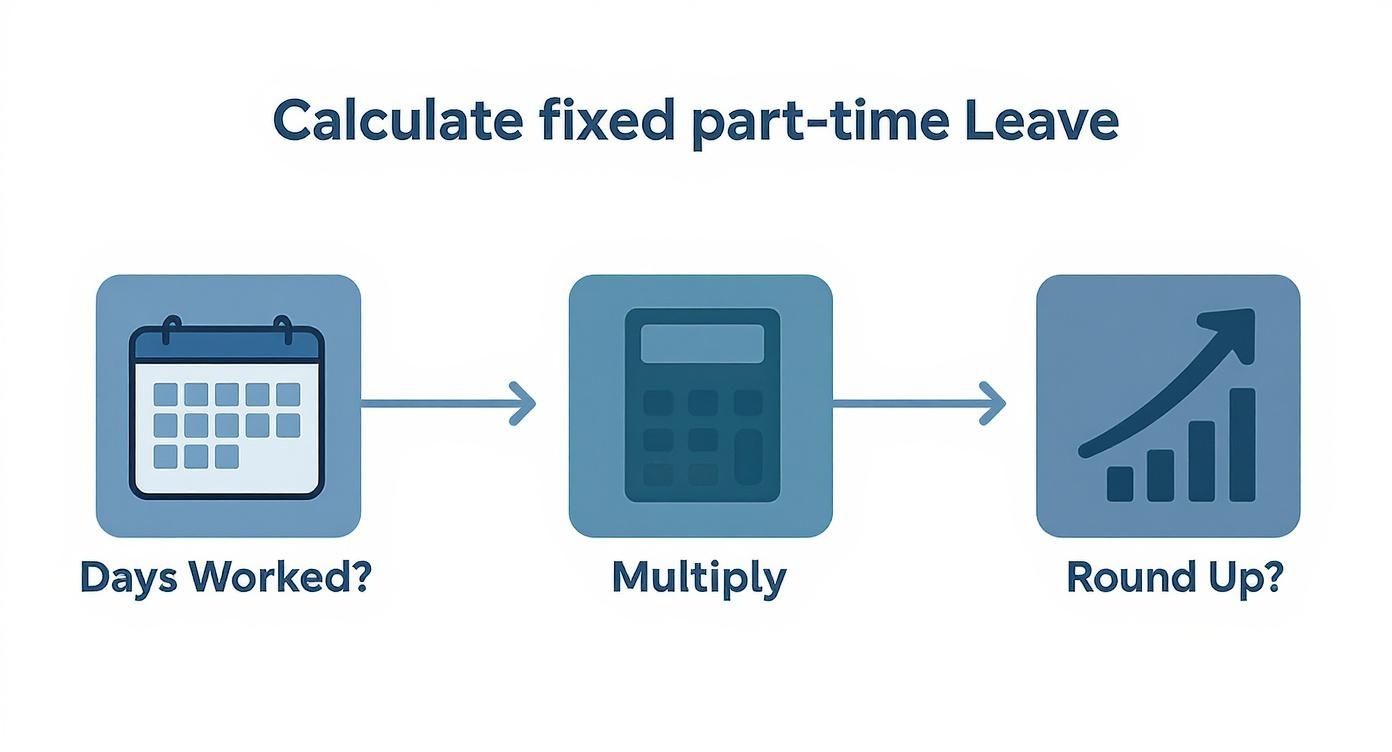
As the infographic shows, multiplying the working days by the statutory 5.6 weeks is the core calculation. And don't forget that final step—rounding up is a legal requirement, not just good practice.
Calculating Holiday Pay with the 52-Week Reference Period
Accruing the leave is one part of the puzzle; paying for it is the other. To calculate the correct holiday pay for an employee with irregular hours, UK law requires you to use a 52-week reference period.
This means you must look back at the previous 52 weeks in which the employee actually earned money, ignoring any weeks where they didn't work and received no pay. You then calculate their average weekly pay over this period. This average figure becomes the amount they are paid for one week of annual leave.
Using this method ensures their holiday pay accurately reflects their typical earnings, including any regular overtime or commission. For a deeper dive into the specifics, check out our guide on holiday entitlement on zero hours contract.
Key Takeaway: For variable-hour employees, holiday leave is earned as they work. The 12.07% accrual rate and the 52-week pay reference period are the essential tools for ensuring your calculations are both fair and legally compliant.
Common Annual Leave Calculation Mistakes to Avoid
Getting the maths right is a great start, but so many businesses still trip up on small, preventable errors when calculating annual leave for part-timers. Knowing what these common pitfalls are is the best way to make sure your process isn't just accurate, but also fair and legally watertight.
Even a minor slip-up can quickly snowball into compliance headaches, employee disputes, and a serious breakdown of trust. Let's walk through the most frequent mistakes I see so you can confidently steer clear of them.
Mismanaging Bank Holidays
A classic error is mishandling bank holidays for part-time staff. If a bank holiday falls on a day your part-time employee doesn't normally work, they are still entitled to a pro-rata share of that paid day off. Forgetting to account for this means you're disadvantaging them compared to full-time staff, which is unlawful.
You must always check that their total annual leave pot reflects their proportional entitlement to all public holidays, regardless of their working pattern.
The Dangers of Rounding Down
When your calculations spit out a fraction, like 16.8 days, the law is crystal clear: you must always round up, never down. Rounding down to 16.5 or even 16 days would mean you’re providing less than their statutory minimum entitlement.
The only legally compliant options are rounding up to the next half day or the next full day (17 days in this case), depending on your company policy. This rule is non-negotiable and a frequent tripwire for employers.
Lacking a Clear Written Policy
Without a clear, accessible holiday policy, you’re basically inviting confusion and inconsistency. Your policy needs to spell out exactly how pro-rata leave is calculated, how bank holidays are handled for part-timers, and the process for booking time off. This document is your first line of defence against disputes.
A fuzzy policy doesn't just create legal risk; it can also affect employee wellbeing. Recent data shows the average annual leave taken by UK employees fell from 38 days in 2020 to just 33.9 days in 2023—a drop of around 12%. A transparent policy ensures everyone, especially part-timers, feels confident and encouraged to take the time they're owed. You can discover more insights about UK annual leave trends and their impact on workplace culture.
Ignoring Changes in Working Hours
What happens when a part-time employee increases their hours from two days a week to three halfway through the year? It's surprisingly common for employers to forget to adjust their holiday entitlement, leaving the employee short-changed.
Any time an employee's hours change, you must recalculate their leave to reflect it. This usually involves two separate sums:
- One for the period they worked their old hours.
- A second for the period after their hours increased.
Just add these two figures together to get their correct total entitlement for the year. Being proactive with these adjustments prevents payroll errors and shows your team that you're committed to fairness.
Effective Tools for Managing Part Time Holiday

If you're still trying to calculate part-time annual leave manually, you're probably all too familiar with the tangled mess of spreadsheets and sticky notes. It’s a headache. As your team grows, this approach doesn't just eat up your time; it dramatically increases the risk of human error, which can easily lead to incorrect pay and compliance headaches.
Let's be honest, moving beyond spreadsheets isn't a luxury anymore—it's a necessity for running a fair and efficient business. Modern HR software and dedicated leave management tools offer a much smarter way forward.
These systems are built to automate the tricky pro-rata calculations we've been talking about. They can handle fixed-day patterns, variable hours, and even mid-year starters or leavers without you needing to touch a calculator. This kind of automation creates a clear, indisputable record of leave for both you and your staff, which is brilliant for building transparency and trust.
Automating for Accuracy and Efficiency
The biggest win from using a dedicated tool is waving goodbye to manual calculation errors. A good system automatically applies the correct accrual rules, manages bank holiday entitlements for part-timers, and makes sure you always round fractions of leave up, keeping you on the right side of UK law.
Of course, accurately processing holiday pay is just one piece of the puzzle. To ensure compliance across all employee entitlements, your overall payroll needs to be watertight. For many businesses, integrating leave management into their financial systems is a game-changer, and understanding the basics of setting up payroll for small businesses provides a solid foundation.
Key Takeaway: The right tool does so much more than just track days off. It builds a robust, fair, and legally sound framework for managing your most valuable asset—your people. It turns a complex admin task into a simple, automated process.
Comparing Leave Management Tools
Choosing the right method for tracking leave can make a huge difference. From simple spreadsheets to sophisticated software, each has its place. Here’s a quick look at the pros and cons to help you decide what's best for your business.
| Method | Pros | Cons | Best Suited For |
|---|---|---|---|
| Manual Spreadsheets | – No cost – Highly customisable |
– Prone to human error – Time-consuming to update – Lacks employee self-service – Risk of compliance issues |
Very small teams (1-3 people) with simple, fixed work patterns. |
| HR Software with Leave Module | – Integrated with other HR functions (payroll, records) – Centralised employee data – Often includes self-service portal |
– Can be expensive – May have features you don't need – Less specialised than dedicated tools |
Growing businesses that need an all-in-one HR solution. |
| Dedicated Leave Management Software | – Specialised for complex leave rules – High level of automation – Excellent reporting and visibility – Reduces admin burden significantly |
– An additional subscription cost – Requires integration with other systems |
Businesses of any size with part-time or variable-hour staff. |
Ultimately, while spreadsheets might seem like the easy option, investing in a dedicated tool or a comprehensive HR system almost always pays for itself by saving time and preventing costly mistakes.
Developing a Transparent Annual Leave Policy
A powerful tool is only as good as the policy behind it. Your annual leave policy is the rulebook that ensures everyone is on the same page. It needs to be written in plain English and be easy for all your staff to find and read.
To avoid any confusion down the line, make sure your policy covers these key points:
- How Leave is Calculated: Briefly explain the pro-rata principle for part-time staff and the accrual method you use for those on variable hours.
- Requesting Time Off: Detail the exact process for submitting leave requests, including required notice periods and who gives the final approval.
- Bank Holiday Rules: Clarify how bank holidays are handled for part-timers, especially when a bank holiday falls on one of their non-working days.
- Carrying Over Leave: State your rules on carrying unused holiday into the next leave year, making sure to include any limits or deadlines.
Building a system that is both efficient for the business and fair for your team is the ultimate goal. With clear rules and the right tools, you can take the stress out of managing part-time holiday for good.
Your Part-Time Annual Leave Questions Answered
Even with the formulas down, real-world scenarios for part-time holiday pay can still throw you a curveball. It’s those specific "what if" situations that often cause the most confusion.
Let's walk through some of the most common questions we see. Think of this as your go-to guide for navigating those tricky grey areas, ensuring your process is fair, consistent, and legally sound. Getting these details right is about more than just compliance; it builds trust and shows your team you’ve got their back.
What Happens If a Bank Holiday Falls on a Part-Timer’s Non-Working Day?
This is probably the number one query we get, and for good reason. It’s crucial that part-time employees are not penalised just because a bank holiday, like Easter Monday, happens to fall on a day they don't usually work.
The law is clear: they are still entitled to a pro-rata amount of paid time off for that holiday.
So, if a full-time employee gets eight bank holidays, a part-timer working three days a week is entitled to three-fifths of those. That works out to 4.8 days. You must make sure their total annual leave reflects this, either by adding it to their overall holiday allowance or by giving them a day off in lieu.
How Do I Calculate Leave for Someone Starting or Leaving Mid-Year?
When an employee joins or leaves part-way through your company's holiday year, you just need to calculate their entitlement based on the time they've actually worked. It's a straightforward pro-rata calculation.
First, figure out what their full annual entitlement would have been for the entire year. Then, divide that number by twelve to get a monthly accrual figure. From there, you can multiply this by the number of full months they’ve been with you. For any partial months, breaking it down into a daily accrual rate is the most precise way to handle it. Having a clear starters and leavers policy in your handbook is a must to avoid any confusion.
Crucial Tip: Never, ever round down statutory holiday entitlement. If a calculation results in a fraction, like 16.8 days, you are legally required to round it up to the next half or full day (so, 17 days in this case). Rounding down is unlawful because it means you're providing less than the legal minimum.
Do I Have to Include Bank Holidays in the 5.6 Weeks?
This is up to you as the employer. You have the flexibility to decide whether the statutory 5.6 weeks (which is 28 days for a full-timer) either includes bank holidays or is provided in addition to them. There's no single right or wrong way to do it.
The most important thing is consistency. Whichever path you choose, you must state it clearly in your employment contracts so everyone knows where they stand. If you do decide to include bank holidays within the 28 days, you still have to ensure your part-timers who don't typically work on Mondays receive their full, pro-rata holiday entitlement. The goal is always fair and equitable treatment for every single employee, regardless of their working pattern.


