
A leave pro rata calculator is just a simple tool that works out the right holiday entitlement for anyone not working a full-time, full-year schedule. In the UK, getting this calculation right isn't just good practice—it's a legal requirement to ensure fairness for part-time staff, people who've just joined, and those who are leaving.
What Is Pro Rata Holiday Entitlement?
Put simply, pro rata holiday entitlement is just a way of calculating annual leave in proportion to the hours or days someone actually works, compared to a full-time employee. Think of it as making sure everyone gets their fair slice of the holiday pie, no matter their working pattern.
It's a cornerstone of UK employment law, specifically designed to prevent part-time workers from being treated less favourably than their full-time colleagues.
This calculation is absolutely essential for a few common situations you'll definitely come across:
- Part-Time Employees: Staff who work fewer days or hours than your standard full-time employee.
- Mid-Year Starters: New hires who join the company partway through its holiday year.
- Leavers: Employees who leave their role before the holiday year is up.
- Variable Hours: Workers on contracts with irregular hours, where their leave has to build up based on the time they've worked.
The Legal Framework for UK Holiday Pay
UK law is pretty clear on the baseline for paid time off. For a full-time employee working a 5-day week, the statutory minimum annual leave is 28 days (or 5.6 weeks). This can include bank holidays.
For anyone working less than that, you have to calculate their entitlement on a pro rata basis. If you want to dig deeper into the specifics, you can find more details on how to calculate leave allowances at whosoff.com.
The bottom line is fairness and legal compliance. Getting pro rata calculations wrong can lead to unhappy employees and, in the worst-case scenario, potential employment tribunals. A golden rule I always follow: it's always better to round a fractional day of leave up, never down.
The UK government provides clear guidelines on these rights to help employers stay on the right side of the law.

As you can see, even the government provides its own calculator to help break down entitlements for different working patterns. This just reinforces how important it is to have an accurate, systematic approach. It's all about making sure every employee receives the correct amount of paid holiday they have legally earned.
To give you a clearer picture, here’s how the basic statutory minimums stack up for full-time versus part-time work.
Statutory Holiday Entitlement At a Glance
| Working Pattern | Days Worked Per Week | Statutory Minimum Annual Leave (Days) |
|---|---|---|
| Full-Time | 5 days | 28 days |
| Part-Time | 3 days | 16.8 days |
| Part-Time | 2 days | 11.2 days |
| Part-Time | 1 day | 5.6 days |
This table shows the starting point for calculations. Remember, if your company offers more than the statutory minimum, your pro rata calculations must be based on that higher, more generous figure.
The Formula for Calculating Pro Rata Leave
Diving into the maths behind pro rata leave can feel a bit daunting, but the idea behind it is actually quite simple. At its core, the calculation is all about being fair.
The most common method, especially for part-time staff who work the same days each week, is logical and easy to use once you get the hang of it.
The standard formula looks like this:
(Full-Time Holiday Entitlement ÷ Full-Time Working Week) x Number of Days the Employee Works
Let’s break that down. You start with the standard holiday allowance your company gives a full-time employee (say, 28 days). Then, you divide this by the number of days in your standard working week (usually 5) to figure out how much leave is earned per day.
Finally, just multiply that number by the days your part-time employee actually works. Simple as that.
A Practical Worked Example
Let's put this into a real-world scenario. Imagine you have a new team member, Sarah, who works three days a week. Your full-time staff get the statutory minimum of 28 days annual leave, and your standard working week is five days.
Here’s how the calculation plays out:
- (28 days ÷ 5 days) = 5.6
- 5.6 x 3 days = 16.8 days
So, Sarah is entitled to 16.8 days of paid holiday for the year. It's really important to get this right. The law is very clear: you must not round this figure down. You can either leave it as 16.8 days (and work out the pay for 0.8 of a day) or round it up to the next half or full day, like 17 days.
This infographic breaks down the key steps of the calculation.
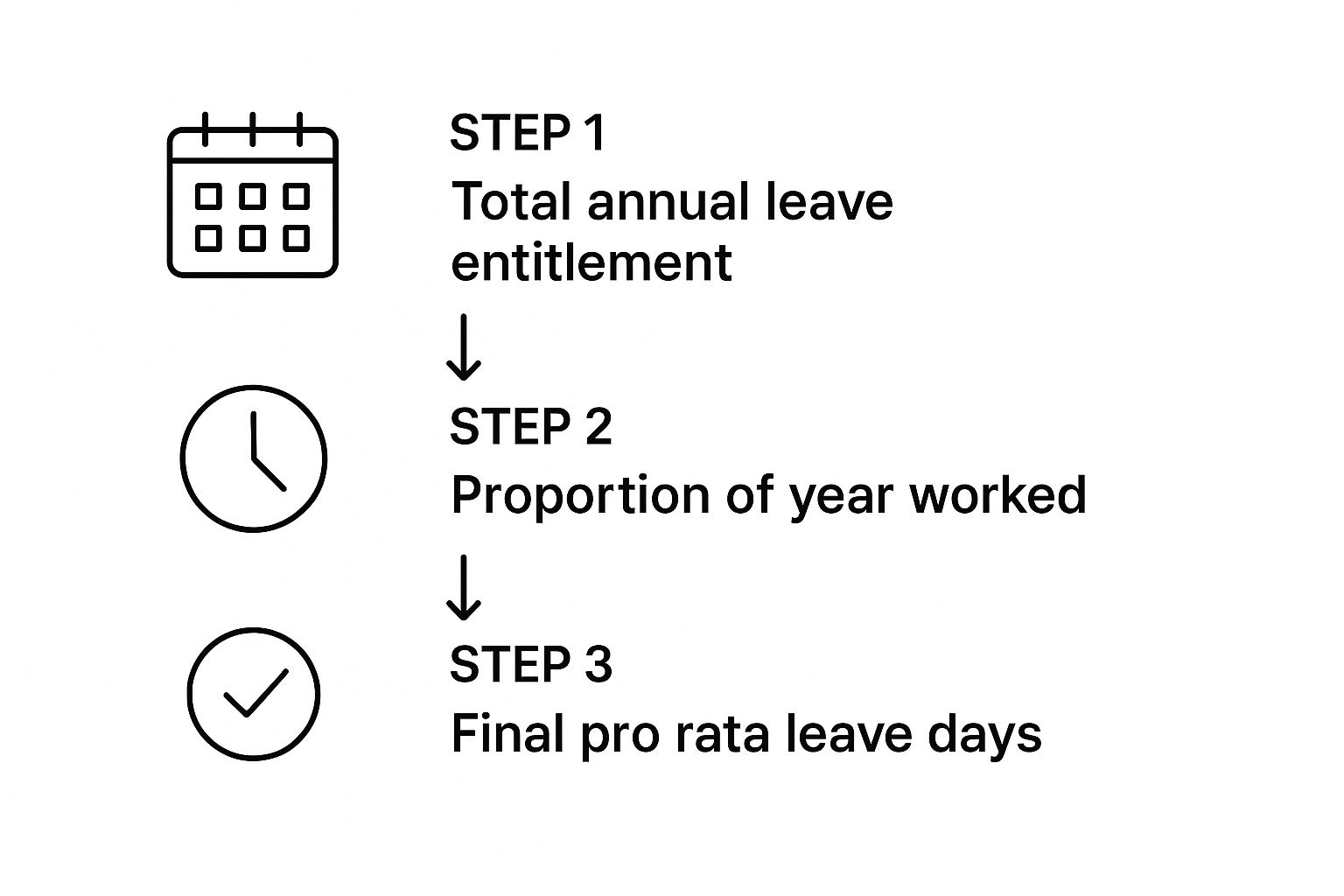
As you can see, the process flows logically from the full-time entitlement to the final prorated figure, ensuring a result that's both fair and proportional. While this formula is perfect for fixed-day schedules, things can get trickier with variable hours or people starting mid-way through the year. For a deeper look into those situations, check out our complete guide on how to calculate prorated leave.
Key Takeaway: The goal is always proportionality. If someone works 60% of a full-time week (3 days out of 5), they are entitled to exactly 60% of the full-time holiday allowance. This simple logic is the foundation of every pro rata holiday calculation. Once you've mastered this basic formula, you're well on your way to managing leave with confidence and staying compliant.
Calculating Holiday Accrual for New Employees

When a new team member joins partway through your company’s holiday year, they don't get the full annual allowance right away. Instead, their holiday entitlement builds up gradually from their first day of employment. This is known as an accrual system, and it’s the standard way to ensure everything is fair and legally compliant.
The most common approach here in the UK is what's often called the 'one-twelfth' rule. Essentially, government guidelines state that annual leave accrues progressively from the employee’s start date. Under this system, a worker earns one-twelfth of their total annual leave for each month they work. So, for someone entitled to the statutory minimum of 28 days a year, they'll build up about 2.33 days of leave per month.
This method is practical. It prevents a new hire from taking their entire year's worth of holiday in their first few months and then leaving, which is a real risk for businesses. It also gives the employee a clear picture of what leave they've earned at any point.
Real-World Accrual Scenario
Let’s see how this works in practice.
Imagine your holiday year runs from January to December. A new full-time employee, David, starts on the 1st of April, and your company offers the statutory 28 days of annual leave.
By the end of August, David has been with you for five full months (April, May, June, July, and August). To work out his accrued leave, the logic is straightforward:
- Total Annual Leave: 28 days
- Monthly Accrual: 28 days ÷ 12 months = 2.33 days per month
- Total Accrued Leave: 2.33 days x 5 months = 11.65 days
It’s standard practice to round this figure up to the nearest half or full day. So, David has 12 days of holiday available to book by the end of August. This kind of clear calculation is vital for managing everyone's expectations.
Of course, effectively integrating new hires involves much more than just calculations. Having a solid process in place is key, and an Onboarding Checklist for New Employees can make all the difference.
While you can do these sums manually, you might find that tracking them becomes a real headache as your team grows. If you often spend too much time calculating holiday pro rata, it might be time to look into an automated tool to handle it for you.
Using an Online Pro Rata Leave Calculator
While knowing how to calculate pro rata leave by hand is a handy skill, let's be realistic—using an online calculator is much faster. More importantly, it dramatically cuts down on the risk of human error. These tools are built to give you accurate answers instantly, freeing you up to focus on more important work.
Of course, any calculator is only as good as the numbers you feed into it. To get a precise figure, you’ll need to have a few key details ready before you start.
What Information Will You Need?
Before you open up a calculator, take a moment to gather these bits of information about the employee:
- Holiday Year Start and End Dates: The tool needs to know the full period your company’s leave year covers.
- Full-Time Holiday Entitlement: This is the total number of annual leave days a full-time employee at your company gets, including bank holidays.
- Employee’s Start or End Date: You’ll only need this if the employee is joining or leaving part-way through the holiday year.
- Employee’s Work Pattern: This is simply how many days or hours they work each week.
Expert Tip: I always recommend keeping a quick reference sheet with your company’s standard full-time entitlement and holiday year dates. This simple habit saves a surprising amount of time and ensures you’re consistent every time you need to run a calculation.
With this information in hand, the rest is easy. A good holiday entitlement calculator will have clear fields for you to enter each piece of data.

The screenshot above shows a typical online tool. You just plug in the numbers, and it spits out the prorated entitlement straight away. It’s always a good idea to double-check the figures you’ve entered—a small typo can throw off the entire result. After all, the goal here is accuracy, not just speed.
To make things even clearer, here’s a quick summary of what you'll need.
Inputs for an Online Leave Calculator
| Required Information | Why It's Needed | Example |
|---|---|---|
| Holiday Year Dates | Defines the full calculation period. | 1st January – 31st December |
| Full-Time Entitlement | Establishes the baseline for a full year's leave. | 28 days (including bank holidays) |
| Employee Start/End Date | Narrows the calculation to the relevant part of the year. | Started on 1st July |
| Weekly Work Pattern | Adjusts the entitlement based on their part-time schedule. | 3 days per week |
Having these four pieces of information ready makes the whole process quick, painless, and—most importantly—accurate.
Navigating Tricky Holiday Calculation Scenarios
Let's be honest, payroll and HR are rarely as simple as they seem on paper. While the basic pro rata formula works for many situations, you're bound to run into more complex cases sooner or later. Knowing how to handle these tricky scenarios with confidence is crucial for keeping things fair and staying compliant.
It's time to move beyond the simple examples and look at the real-world situations you’ll actually face.
When an Employee Leaves Mid-Year
One of the most common complexities is figuring out the final holiday pay for an employee who leaves partway through the year. The process is all about determining what they've accrued up to their last day and then comparing it to the holiday time they’ve already taken.
Let's imagine your holiday year runs from January to December. A full-time employee, entitled to 28 days of annual leave, hands in their notice. Their last day is the 30th of June, meaning they've worked for exactly half of the holiday year (that's 6 out of 12 months).
Here’s how you'd work it out:
- Total Annual Entitlement: 28 days
- Proportion of Year Worked: 6 months ÷ 12 months = 0.5
- Accrued Holiday: 28 days x 0.5 = 14 days
If this person has already taken 10 days of leave, you would owe them pay for the remaining 4 days in their final salary. On the flip side, if they had taken 16 days, they would owe the company for the 2 extra days they used.
When Someone Switches from Full-Time to Part-Time
What happens when an employee cuts back on their hours? This situation calls for a split calculation to get the numbers right. You need to calculate their entitlement for the period they were full-time and the period they were part-time separately, then simply add the two figures together.
A critical mistake to avoid is just recalculating their entire year's entitlement based on their new part-time hours. Doing this would unfairly take away the holiday they earned while working full-time.
For instance, say an employee works full-time for the first 3 months of the year, then switches to a 3-day week for the final 9 months.
- Full-time accrual: (28 days / 12 months) x 3 months = 7 days
- Part-time entitlement (annual): (28 / 5) x 3 = 16.8 days
- Part-time accrual: (16.8 days / 12 months) x 9 months = 12.6 days
Their total entitlement for the year is 19.6 days (7 + 12.6).
Calculating Leave for Irregular Hours
For team members on casual or zero-hours contracts, holiday entitlement is tied directly to the hours they work. For leave years starting on or after 1st April 2024, the law has made this much simpler. You can now calculate holiday entitlement as 12.07% of hours worked.
So, if a casual worker has logged 100 hours, their accrued holiday is straightforward:
- 100 hours x 12.07% = 12.07 hours of paid leave
This method, which also applies to part-year workers, means you can skip the complex reference periods of the past. While a dedicated leave pro rata calculator can handle all of these scenarios for you, understanding the logic behind the numbers is what really empowers you to tackle any situation that comes your way.
Your Pro Rata Leave Questions Answered
To wrap things up, let's tackle a few common questions that often cause confusion. These tricky edge cases are where a reliable leave pro rata calculator becomes invaluable, but understanding the logic behind the answers is just as important for both managers and employees.
What Happens with Bank Holidays for Part-Time Workers?
Fairness is the name of the game for part-time staff. If a bank holiday falls on a day they'd normally be working, they simply get that day off like any full-time colleague.
But what about those who don't work on Mondays, when most bank holidays fall? To keep things equitable, their total pro rata entitlement must include a proportional share of all bank holidays for the year. The best practice is to calculate their total annual leave (including all bank holidays) and then deduct any bank holidays that land on their working days. This ensures they receive their full, fair allowance without being penalised for their working pattern.
Can I Round Holiday Entitlement Down?
Absolutely not. UK law is crystal clear on this point. You must never round holiday entitlement down.
If a calculation results in a fraction, say 16.8 days, you are legally required to round it up to the next half or full day. In this case, the employee is entitled to 17 days of leave.
This is a non-negotiable compliance point. Always round up to ensure you're meeting your legal obligations and treating your employees fairly.
How Is Leave Calculated for Zero-Hours Contracts?
For workers on zero-hours contracts, things work a bit differently. Their holiday entitlement accrues based on the hours they actually work, calculated at a rate of 12.07%.
Where does that number come from? It's the result of dividing the 5.6 weeks of statutory leave by the 46.4 working weeks in a year. To figure out their earned holiday, you just multiply the hours they've worked by 12.07%.


