
A holiday calculator for part-time workers is a handy tool that takes the guesswork out of leave entitlement. It applies what's known as 'pro-rata' rules to your specific schedule, making sure you get the correct amount of paid time off. The goal is to ensure you receive the same benefit as full-time staff—the statutory 5.6 weeks—just scaled to your hours.
Understanding Part-Time Holiday Entitlement in the UK

Figuring out holiday leave when you work part-time can feel a bit complicated at first glance. But the principle behind it is simple: it’s all about fairness. Your legal right to paid time off doesn't shrink just because you work fewer hours; it’s just adjusted to match your actual work pattern. This is what we call pro-rata entitlement.
In the UK, every worker is legally entitled to 5.6 weeks of paid holiday each year. For a full-timer, that usually means 28 days. If you work half the hours of a full-time colleague, you're entitled to half the leave, which works out to 14 days. It's a straightforward proportional calculation.
This legal protection is in place to ensure every employee gets the same core benefits, no matter their contract type. For a broader look at the legal frameworks that govern employee rights, an International Employment Law Guide can be a really useful resource.
Days Versus Hours Calculation
How you should calculate your holiday really comes down to how you work. Picking the right method is the key to getting an accurate figure.
- Calculating in Days: This is the best approach if you work a set number of days each week, even if the hours on those days aren't always identical. It’s clean, simple, and easy for everyone to follow.
- Calculating in Hours: If your schedule is less predictable—think irregular hours, zero-hours contracts, or shift work—calculating in hours is the way to go. It’s the most precise method, ensuring every hour you work fairly contributes to your holiday pot.
The Role of Bank Holidays
Bank holidays are often a source of confusion, especially for part-time teams. While an employer isn't legally forced to give you paid time off on a bank holiday, they must include these public holidays within your minimum 5.6 weeks of statutory leave.
Here's the crucial point: you shouldn't be penalised if a bank holiday happens to fall on a day you don't normally work. Your employer has a duty to make sure your total holiday allowance is calculated correctly on a pro-rata basis, factoring in all public holidays.
Let's say a bank holiday Monday is your usual day off. A fair employer might add a day to your overall leave allowance to make up for it. This approach keeps things equitable across the board, ensuring everyone gets their fair share of time off, regardless of their working pattern. Nailing down these basics gives you a solid foundation before you dive into the numbers.
How to Calculate Holiday Pay for Fixed Part-Time Schedules

If you work the same days every week, figuring out your holiday entitlement is refreshingly simple. The consistency of a fixed part-time schedule means we can sidestep the more complicated maths needed for variable hours.
The foundation for this is the statutory 5.6 weeks of annual leave that every UK worker is entitled to. For part-timers, we just scale this down to reflect the actual number of days you work. It’s a straightforward pro-rata calculation.
So, how do you do it? It’s a simple multiplication that will give you your total holiday allowance for the year, in days.
The Go-To Formula for Fixed Days
The calculation couldn't be simpler. You just need to know how many days you work each week.
[Number of days you work per week] x 5.6 = Your total annual holiday entitlement in days
This one formula tells you the total number of paid days off you’re legally entitled to over a full year. Crucially, this figure includes any bank holidays.
Let’s Look at a Real-World Example
To bring this to life, think of someone like Sarah. She has a fixed part-time role, working three days a week: Tuesday, Wednesday, and Thursday. Her full-time colleagues work five days and get the standard 28 days off (which is 5 days x 5.6 weeks).
Applying the formula to Sarah's schedule gives us:
3 (days per week) x 5.6 (weeks) = 16.8 days
This means Sarah is entitled to 16.8 days of paid holiday per year. In practice, many employers round this up to the nearest half or full day, which would give her 17 days.
Remember, this 16.8-day total already accounts for bank holidays. So, if a bank holiday falls on her normal Tuesday workday, she would book it off, and it would be deducted from her total allowance.
Comparing Different Part-Time Work Patterns
It’s useful to see how this entitlement changes based on your weekly schedule. The formula itself doesn’t change, just the number of days you plug into it. This makes it easy to compare different working arrangements.
To make it even clearer, here’s a quick reference table showing the statutory holiday entitlement for common fixed schedules.
Pro-Rata Holiday Entitlement Based On Days Worked Per Week
| Days Worked Per Week | Calculation (Days x 5.6 Weeks) | Total Annual Leave Days |
|---|---|---|
| 1 Day | 1 x 5.6 | 5.6 days |
| 2 Days | 2 x 5.6 | 11.2 days |
| 3 Days | 3 x 5.6 | 16.8 days |
| 4 Days | 4 x 5.6 | 22.4 days |
As you can see, the calculation is consistent and predictable, making it easy to work out your allowance no matter how many fixed days you work.
While doing the maths yourself is good for understanding the principle, you can remove any doubt by using a digital tool. For a quick and guaranteed-accurate answer, you can use a dedicated holiday calculator for part time workers to get it done in seconds, ensuring you always have the right number.
How to Calculate Holiday for Irregular and Casual Hours
What happens when your hours aren't the same every week? This is the reality for countless part-time and casual workers, and figuring out holiday entitlement requires a completely different tack. The standard fixed-day calculations just won't cut it when there's no set pattern to your work.
To handle these situations fairly, UK employment law now champions a more precise method. Instead of relying on old shortcuts, the correct approach is to look back at your recent work history to figure out what a typical week's pay really looks like. This makes sure your holiday pay genuinely reflects what you would have earned.
The Shift Away from the 12.07% Method
For years, a lot of employers took a seemingly simple route: calculating holiday entitlement as 12.07% of the hours someone worked. This figure came from dividing the 5.6 weeks of statutory leave by the remaining 46.4 working weeks of the year. While it looks neat on paper, this method has proven to be flawed and is no longer the recommended practice.
A landmark legal case, Brazel v The Harpur Trust, really brought its shortcomings into the spotlight. The ruling confirmed that the 12.07% approach could short-change employees, particularly those who work part-year or on term-time contracts. The court made it clear that a method based on an average of your pay over a longer period is a much better reflection of your true earnings.
Adopting the 52-Week Average Method
The legally preferred approach today is the 52-week reference period. It offers a far more accurate and fair way to calculate holiday pay for anyone with irregular hours, making it the gold standard for those on casual or zero-hours contracts. You can dive deeper into this in our guide on holiday entitlement for zero-hours contract workers.
So, how does it actually work? The principle is straightforward:
- Look back over the last 52 weeks you were actually paid.
- Any weeks where you didn't work and received no pay are skipped over.
- If you have unpaid weeks, your employer must go back further until they have 52 weeks of pay data, up to a maximum of 104 weeks.
- They then calculate your average weekly pay across those 52 paid weeks.
That average figure is exactly what you should be paid for one week of annual leave.
Putting the 52-Week Calculation into Practice
Let's look at a real-world example. Alex is a casual events assistant, so his hours fluctuate wildly throughout the year depending on the season. To work out his holiday pay, his employer needs to look at the last 52 weeks he was paid.
In that time, his total earnings were £9,360.
£9,360 (total pay) ÷ 52 (weeks) = £180 (average weekly pay)
Simple as that. When Alex books a week off, he’s entitled to be paid £180. This approach ensures his holiday pay accounts for his busier, higher-earning periods, not just the quiet spells.
The main takeaway: The 52-week average method ensures your holiday pay is a true reflection of your typical earnings, smoothing out the peaks and troughs of an irregular work schedule. It stops you from being penalised for taking leave during a quiet period.
This is where a digital holiday calculator can be a massive help, simplifying the whole process.
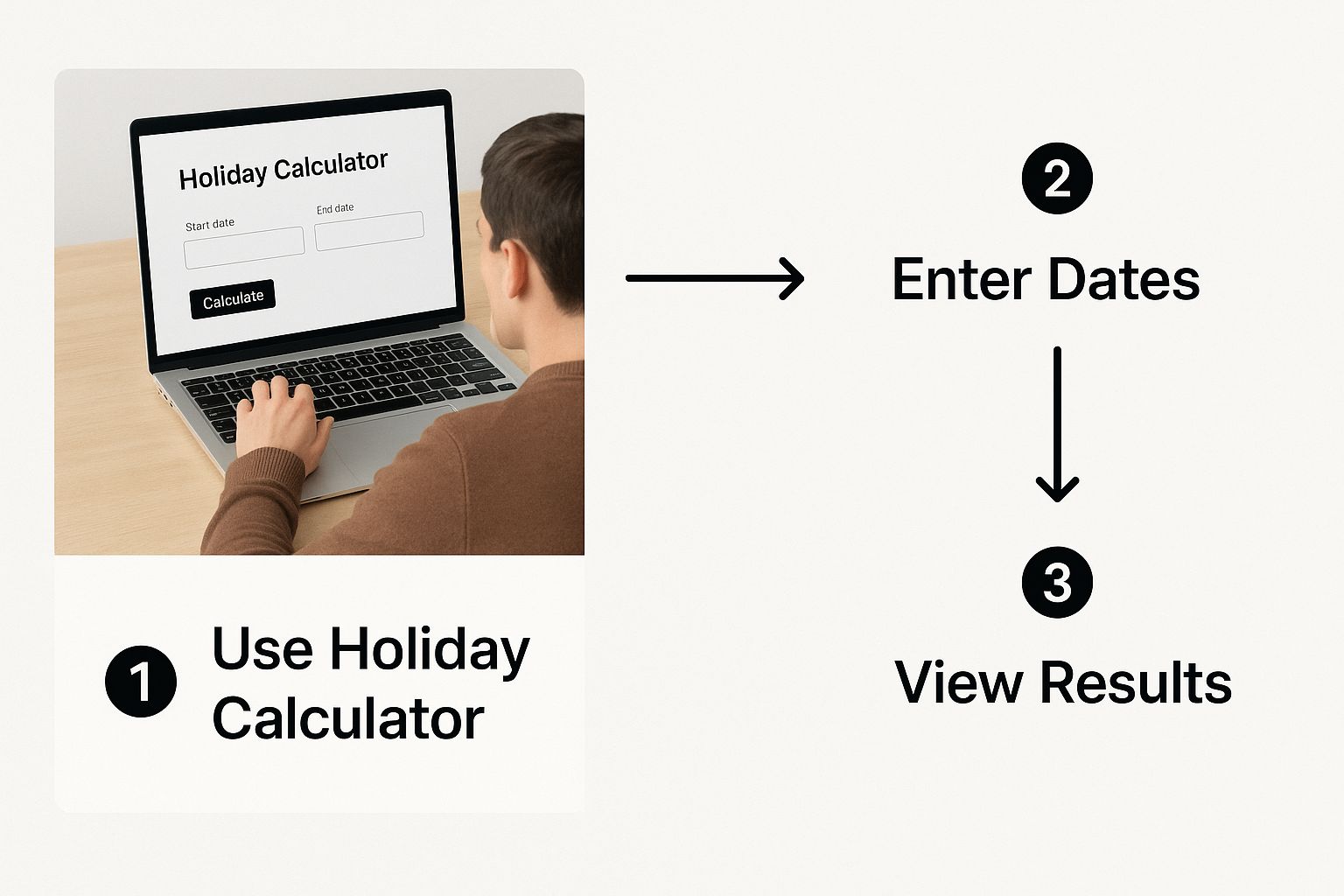
Using a tool like this completely removes the headache of manually tracking and averaging pay. It gives you instant, accurate results that are fully compliant with the correct legal framework.
Want an Instant, Accurate Answer? Use a Holiday Calculator
While it's good to understand the maths behind pro-rata holiday, let's be honest: a digital holiday calculator for part-time workers is much faster and completely removes the risk of errors. These tools are built to crunch the numbers for you, giving you a precise and immediate answer without any manual work.
Using one couldn't be simpler. You just need to plug in a few key details about your job, and the calculator handles all the complex formulas in the background.
What Information to Have Ready
To get the most out of a calculator, it’s best to have a few pieces of information handy before you start. This makes the whole process take just a few seconds.
- Your work pattern: Are you working a fixed number of days each week, or do your hours change?
- The full-time entitlement: Find out how many days of annual leave a full-time colleague gets at your company, making sure to include bank holidays. The statutory minimum in the UK is 28 days, but your company might offer a more generous allowance.
- Your start/end dates: If you've joined or are leaving the company mid-way through the holiday year, you'll need these dates so the tool can accurately prorate your leave for that specific period.
Once you’ve entered these details, the tool will instantly tell you your total holiday allowance. It's especially useful for those tricky situations, like figuring out what happens when a bank holiday falls on one of your non-working days – the software just handles it.
Here’s a glimpse of what a typical online calculator looks like.
As you can see, it’s really just a matter of inputting your schedule to get an immediate result, broken down into both days and hours.
Always Double-Check the Results
Even when you're using a reliable tool, it's always a good idea to give the final number a quick "sense check". Does the figure feel right based on what you know about the pro-rata concept?
For example, if you work three days a week (which is 60% of a full-time five-day week), your holiday should be exactly 60% of the full-time allowance.
So, if a full-timer at your company gets 28 days, you should be looking at 16.8 days (28 x 0.6). If the calculator's result is right in that ballpark, you can feel confident that it's spot on.
A calculator isn't just about speed; it's about getting it right. A simple human error in your own calculations could mean you end up short-changed on your time off. These tools are programmed with current employment law, so you know the figures are compliant.
For a reliable and easy-to-use tool, you can learn more about the features of a dedicated UK holiday calculator on the LeaveWizard site. It's the perfect way to get a definitive answer in seconds and ensure you’re getting the annual leave you're entitled to.
Tackling Tricky Holiday Scenarios
Work life is never as straightforward as we'd like, and part-time holiday entitlement can throw up some real head-scratchers. Getting your head around how different situations affect your leave is crucial for making sure you get the time off you're entitled to.
While these scenarios can seem complex on the surface, they all come back to the same core principle of pro-rata entitlement. Your rights are protected, whether you're just starting out, heading off on parental leave, or dealing with an illness.
Starting or Leaving a Job Mid-Year
Let's face it, hardly anyone starts a new job on the exact first day of the company's holiday year. When you join or leave part-way through, your holiday allowance is simply calculated pro-rata for the time you've actually been on the payroll.
So, imagine you start a new job working three days a week, exactly halfway through the holiday year. You’d get half of your full annual allowance for the rest of that year. If your total entitlement is 16.8 days, you’d have 8.4 days to use over the next six months. A good holiday calculator for part time workers can handle this for you in seconds – just pop in your start date.
Holiday Accrual During Maternity Leave
This is one area where the rules are refreshingly clear. You absolutely continue to build up your holiday entitlement at your normal rate for the entire time you are on maternity leave. That includes both the statutory minimum and any extra days your contract gives you.
Your employment contract is still in place, so your leave keeps ticking up just as if you were in the office. A common and really smart approach is to tack this accrued holiday onto the end of your maternity leave, giving you a bit more paid time off before you dive back into work.
What Happens When You're on Sick Leave
Just like with maternity leave, you keep accruing your statutory holiday entitlement even when you're off sick. It’s a key protection that means you don’t lose out on important paid leave just because you’ve been unwell.
Here's a useful tip: you can choose to take paid holiday while you're on sick leave, but your employer can never force you to. This can be a practical way to boost your income for a week if you’re only receiving statutory sick pay.
It’s also worth noting that external pressures can affect how much time people take off. Recent data revealed that the average UK employee took 33.9 days of annual leave in 2023, which is a significant drop from 36.7 days in 2022. This could well be a reflection of the wider cost of living crisis, making it more important than ever to understand and claim every day of leave you are owed. You can dig into more of these UK annual leave trends on peoplehr.com.
Your Part-Time Holiday Questions, Answered
Working out the finer points of part-time holiday can feel a bit tricky. Let's tackle some of the most common questions that pop up, giving you clear, practical answers.
Do I Get Paid for Bank Holidays if I Don’t Work Them?
This is a classic point of confusion, but the short answer is no, not automatically. Your employer has to include bank holidays within your total 5.6 weeks of statutory leave, but you don't have a right to take the specific bank holiday off if it's not one of your normal working days.
A fair system will make sure you aren't penalised. Often, a good employer will add a day's worth of holiday hours to your overall allowance as compensation. This ensures you get the same total leave, pro-rata, as your full-time colleagues.
What if My Hours Change During the Year?
If your working hours change permanently, your holiday entitlement needs a fresh calculation from the date of the switch. It’s essentially a two-part sum:
- First, you have the leave you earned on your old work pattern.
- Second, you have the leave you’ll earn on your new pattern for the rest of the holiday year.
You should flag this with your manager or HR right away. They can give you an accurate, updated figure for your remaining time off, so you know exactly where you stand.
The golden rule here is that your total holiday for the year should fairly reflect the hours you've actually worked across both schedules. A proper holiday management system can handle this kind of recalculation without any fuss.
Can My Employer Tell Me When to Take My Holiday?
In a word, yes. An employer can legally require you to take annual leave on specific dates, provided they give you enough notice. The standard rule is that they must give you notice that is double the length of the holiday they want you to take. So, for a one-week break, they need to tell you two weeks in advance.
This is most common during company-wide shutdowns, like the period between Christmas and New Year. Any such policy should be laid out clearly in your employment contract or the company handbook.
What Happens if I Don't Use All My Holiday?
The rules around carrying over unused leave can be a bit of a mixed bag. Legally, the 4 weeks of leave granted under the original EU Working Time Directive can't be carried over. However, the extra 1.6 weeks provided by UK law can be carried forward, but only if your employment contract explicitly allows for it.
Frankly, most companies operate a "use it or lose it" policy for the bulk of annual leave. Your best bet is to always check your contract and plan your time off properly to make sure you don't miss out on a well-earned break.


