
Let's cut straight to the chase: do workers on a zero-hours contract get paid holiday?
Absolutely, yes. It's a common myth that the flexibility of a zero-hours contract means giving up basic rights like paid time off, but that's just not true. Under UK law, you're entitled to the same 5.6 weeks of statutory paid annual leave as any other worker.
Your Holiday Rights on a Zero Hours Contract
Many people assume that having irregular hours somehow disqualifies them from getting paid leave. This is a huge misunderstanding. Your legal status as a 'worker' gives you a solid safety net of protections, and holiday entitlement is a big part of that.
The real difference isn't if you get holiday, but how it's calculated. Since your hours go up and down, your holiday time builds up based on the hours you actually put in, rather than being a fixed number of days each year.
Foundational Principles of Fair Treatment
Getting a handle on your holiday rights is much easier when you have a good grasp of the basics, starting with understanding different types of employment contracts. These documents are the foundation of your legal entitlements.
Ultimately, the law is all about ensuring fairness. The Working Time Regulations 1998 state that everyone, including those on zero-hours contracts, gets 5.6 weeks of paid holiday. For someone working a typical five-day week, this works out to 28 days, and your entitlement is simply scaled to match the hours you work. We cover this in more detail in our guide to statutory holiday entitlement in the UK.
The key principle to remember is this: holiday entitlement for a zero-hours contract is earned as you work. For every hour you clock in, you're building up your paid leave allowance. This makes sure you get compensated fairly for your time off, just like a full-time employee.
This approach means your holiday pay will accurately reflect what you normally earn. To see how your core rights stack up, let's compare them side-by-side with someone on a fixed-hours contract.
Holiday Entitlement At a Glance Zero Hours vs Fixed Hours
This table breaks down the core statutory rights to show that, when it comes to paid leave, the law treats both types of workers with parity.
| Right | Zero Hours Contract Worker | Fixed-Hours Employee |
|---|---|---|
| Statutory Leave | Entitled to 5.6 weeks per year. | Entitled to 5.6 weeks per year. |
| Paid Leave | Holiday pay is calculated based on average pay. | Holiday pay is based on normal salary. |
| Accrual Method | Holiday is accrued based on hours worked. | Holiday is typically accrued monthly. |
As you can see, the fundamental right to 5.6 weeks of paid leave is exactly the same. The only difference lies in the mechanics of how that leave is calculated and paid, ensuring the system is fair for workers with irregular hours.
Why Your Legal Status as a Worker Matters

To really get to grips with your holiday rights, you first need to understand where you stand legally. It’s a common point of confusion, but the vast majority of people on zero-hours contracts aren't technically 'employees'. Instead, they fall into a category called 'workers'.
This might sound like a minor detail, but that one word changes everything. It’s the very foundation that defines the framework of your rights at work.
Being a 'worker' rather than an 'employee' is a crucial distinction. While employees have a broader set of protections, the 'worker' status still provides a solid legal safety net. Think of it as the bedrock upon which your most fundamental workplace rights are built.
Crucially, this means you're protected from unlawful discrimination and are entitled to certain statutory payments. And for our purposes, it confirms your absolute, non-negotiable right to paid annual leave.
Key Protections as a Worker
As a worker, your holiday entitlement for a zero-hours contract is just one piece of the puzzle. UK law guarantees you several other core protections that ensure fair treatment. You're also entitled to:
- The National Minimum Wage: No matter what, your employer has to pay you at least the minimum hourly rate for your age for every single hour you work.
- Statutory Rest Breaks: You have a legal right to proper breaks during your shifts. This isn't a perk; it's a requirement to protect your well-being.
- A Written Statement: Your employer must give you a clear written statement that lays out the terms of your arrangement, including exactly how your holiday pay is worked out.
These rights create a baseline standard, preventing exploitation and making sure everything is transparent. It’s a confirmation that flexibility in your hours doesn't mean you lose out on fundamental protections.
Understanding your 'worker' status is all about empowerment. It’s not just knowing you get holiday pay; it’s about grasping the legal foundation that guarantees it, so you can make sure you’re being treated fairly.
This legal status isn't a niche issue; it affects a huge slice of the UK workforce. According to the Office for National Statistics (ONS), as of late 2023, around 1.05 million people were on zero-hours contracts. The majority of these individuals are classified as 'workers', which is what grants them these vital statutory rights. You can explore more about these employment trends and what they mean for the modern workforce.
Why This Matters for Your Holiday Pay
So, what’s the bottom line? Your classification as a 'worker' is precisely why you build up holiday pay. An employer can't legally turn around and deny you paid leave just because your hours aren't fixed.
This status forces them to keep track of the hours you put in and calculate the holiday pay you've rightfully earned.
Ultimately, your legal standing provides clarity and security. It completely shifts the conversation from if you get paid holiday to how it should be calculated and paid correctly. And that’s the next critical step to making sure you get every penny you're owed.
Figuring out holiday pay for workers on shifting schedules can feel like a headache, but it really just boils down to one simple idea: the pay should match what you would have normally earned. Thankfully, UK law gives us a clear framework to make sure this is done fairly and consistently.
Let's walk through the two main ways to calculate holiday entitlement for people on zero-hours contracts. Getting these right is vital, whether you're a worker checking your payslip or an employer trying to stay on the right side of the law.
Each method is designed for a different situation. Using the correct one is the key to preventing disputes and making sure everyone gets a fair deal. This visual guide is a great starting point for understanding the essential steps.
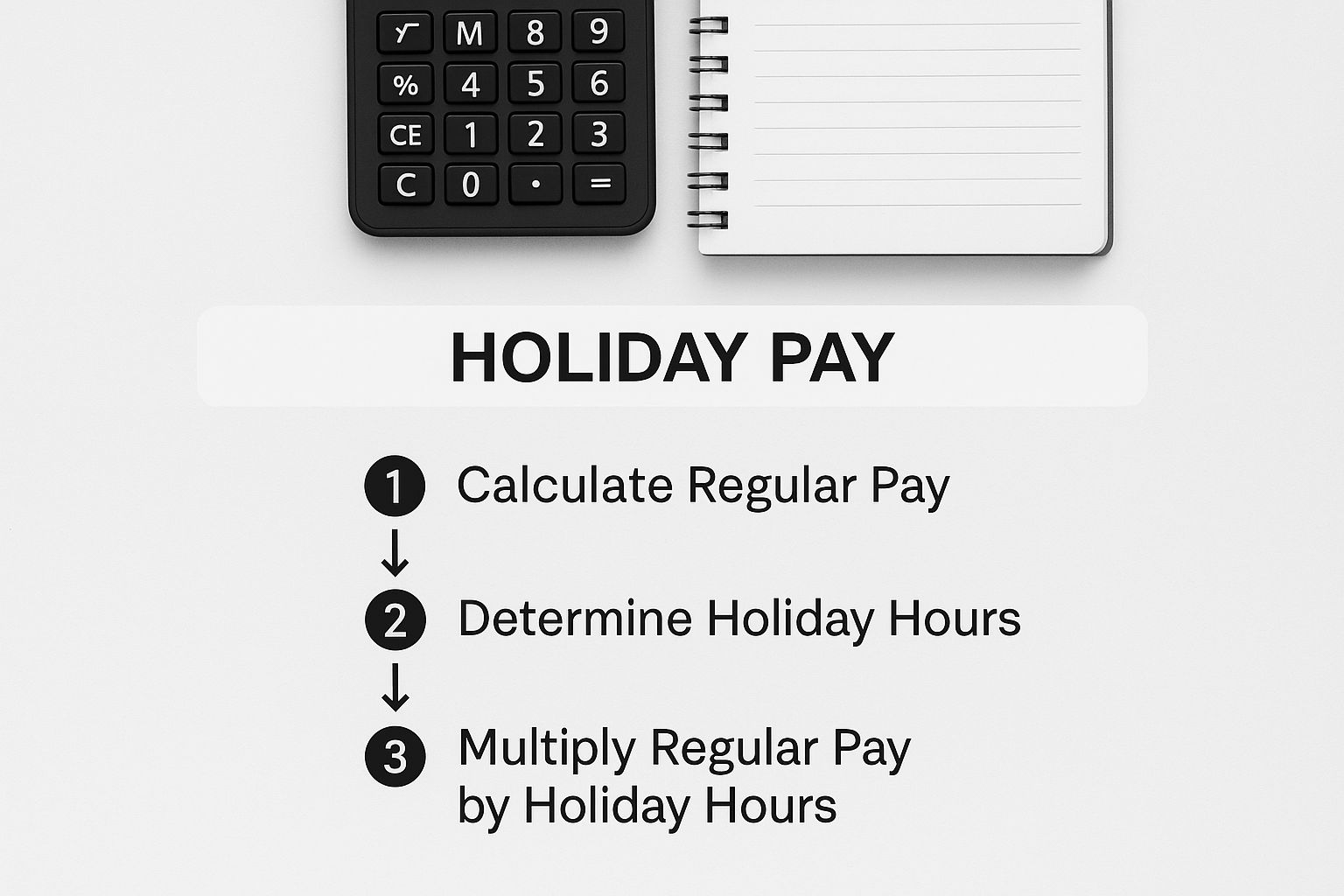
As you can see, it all starts with keeping accurate records. That’s the bedrock of any fair holiday pay calculation.
Holiday Pay Calculation Methods Compared
Choosing the right calculation method isn't just about crunching numbers; it's about legal compliance and fairness. The two main approaches serve different purposes, and knowing when to use each one is crucial for any employer. Here's a quick breakdown to help you see which method fits your situation.
| Calculation Method | How It Works | Best For | Key Consideration |
|---|---|---|---|
| 52-Week Reference Period | Calculates average weekly pay using the last 52 weeks of earnings, ignoring any unpaid weeks. | Most zero-hours contract workers who work consistently throughout the year, even with irregular hours. | This is the legally required standard for most situations, providing the most accurate reflection of average earnings. |
| 12.07% Accrual Method | Holiday pay is calculated as 12.07% of the hours worked. For every hour worked, the employee accrues holiday pay. | Genuinely part-year workers (e.g., term-time staff) or those at the very beginning or end of their employment. | Following a Supreme Court ruling, its use is now very limited. Using it for year-round workers is legally risky. |
Ultimately, the 52-week reference period is the go-to method for ensuring you're compliant and fair. The 12.07% method should only be used in very specific, legally defined circumstances.
The 52-Week Reference Period Method
The government's standard, and the legally required method in most cases, is the 52-week reference period. Think of it as a way to get a true picture of a worker's average earnings, smoothing out all the peaks and troughs that come with irregular hours.
Here’s the process, step by step:
- Step 1: Look back at the last 52 weeks where the worker actually got paid.
- Step 2: Completely ignore any weeks where no work was done and no pay was received. If you need to, you can go back as far as 104 weeks to find 52 paid weeks.
- Step 3: Add up the total pay the worker earned across those 52 weeks.
- Step 4: Divide that total by 52 to find their average weekly pay.
That final number is exactly what a worker should be paid for one week of holiday.
Let's see it in action.
Imagine Alex, a barista who works different hours each week. To work out his holiday pay, his employer checks the last 52 weeks he was paid, skipping three weeks he took as unpaid time off. They see he earned a total of £13,000 over those 52 paid weeks.The calculation is simple: £13,000 ÷ 52 weeks = £250 per week.
So, Alex is entitled to £250 for every week of annual leave he takes.
This method is the gold standard for compliance. Why? Because it’s based on actual earnings, ensuring that holiday pay is a fair reflection of what the person would have made if they'd been at work.
The 12.07% Accrual Method
You’ve probably come across the 12.07% method. For a long time, it was a very common shortcut for calculating holiday pay. The figure comes from taking the statutory 5.6 weeks of holiday away from the 52 weeks in a year, which leaves 46.4 working weeks. 5.6 is 12.07% of 46.4.
The basic idea was that for every hour someone worked, their holiday pay pot grew by 12.07% of that time.
However, things have changed. A major Supreme Court ruling clarified that this method is no longer appropriate for most workers. It should now only really be used in very specific situations, like for workers who are genuinely part-year (think term-time workers in a school).
For the vast majority of people on zero-hours contracts who work throughout the year, the 52-week reference period is the only correct and legally sound approach. If you want to dig deeper into the nuts and bolts, our guide on how to calculate holiday pay has all the details you need.
Common Mistakes to Avoid with Zero Hours Holiday Pay

Managing holiday pay for workers on zero-hours contracts can feel like navigating a minefield. Even the most well-meaning employers can slip up, making simple errors that snowball into complex legal challenges, hitting both their finances and their reputation.
The good news? Most of these mistakes are entirely preventable once you know what to look for. Think of them as tripwires. Understanding where they are is the first step to building a fair, compliant, and transparent system that protects your business and properly supports your workers.
Let's break down the most frequent errors employers make. We’ll look at what they are, why they're so problematic, and most importantly, give you clear, actionable steps to stay on the right side of the law.
The Trap of Rolled-Up Holiday Pay
One of the most stubborn—and unlawful—practices is rolled-up holiday pay. This is where an employer simply adds a bit extra to a worker's hourly rate, telling them it's to cover their holiday pay, instead of paying them when they actually take their leave.
It might seem like a simpler, more straightforward approach, but it’s been ruled unlawful by the courts for a very good reason. It actively discourages workers from taking the breaks they are legally entitled to. The whole point of paid leave is to allow people to rest and recharge without worrying about a smaller pay cheque. Rolling it all into one hourly rate completely defeats that purpose.
The Solution: Always keep holiday pay separate from regular wages. You need to calculate it using the 52-week reference period and pay it out when the worker actually takes their annual leave. This isn't just about compliance; it's about promoting a healthier work-life balance for your team.
Incorrect Calculation and Shoddy Record Keeping
Another major pitfall is getting the maths wrong or just keeping sloppy records. Many businesses still cling to the outdated 12.07% accrual rate, but for most workers, this method is now legally risky and often leads to them being underpaid. The gold standard, and the one required by law, is the 52-week average.
This mistake often goes hand-in-hand with poor record-keeping. If you don't have an accurate, consistent log of the hours each person has worked and the pay they've received, it's impossible to calculate their average earnings correctly. This can quickly lead to some hefty back-pay claims down the line.
To steer clear of these issues, you absolutely must:
- Use the 52-Week Reference Period: This is the government-mandated method for figuring out a week's pay for anyone with irregular hours. No shortcuts.
- Maintain Meticulous Records: Keep detailed, accessible logs of all hours worked and payments made for at least two years. Digital systems are your friend here.
- Be Transparent on Payslips: Clearly show the holiday time a worker has accrued and any holiday payments made. This way, everyone knows exactly where they stand.
By sidestepping these common errors, you can ensure your system for holiday entitlement for zero hours contract workers is not only compliant but also fair. It builds a foundation of trust and helps you avoid getting tangled up in costly legal disputes.
Managing Holiday Requests and Accrual Systems
Getting the calculations right is the engine of a fair holiday system, but how you manage everything is the steering wheel that keeps it all on the road. For any employer, creating a transparent and organised process for handling leave isn't just good practice—it's absolutely essential for maintaining trust and staying compliant, especially with holiday entitlement for zero hours contract workers.
A clear, accessible system stops misunderstandings before they start. It empowers workers to take the paid leave they’ve rightfully earned and dramatically cuts down on your administrative headaches. The real goal is to build a process that’s both fair to your team and efficient for the business.
This boils down to having a straightforward policy for requesting leave and a bulletproof method for tracking accrued holiday hours. Every single worker should know how to book their time off and be able to see exactly how much holiday pay they have saved up.
Creating a Clear and Efficient Process
First things first: get your process down in writing. Your workers need to know who to contact, how much notice they should give, and how they’ll get confirmation that their time off is approved. Any ambiguity here is a recipe for frustration and, eventually, disputes.
Next, you need a robust way to track the hours people work and the leave they accrue. Let's be honest, manual spreadsheets might seem fine at first, but they are prone to human error and become a nightmare to manage as your team grows. To keep things running smoothly and accurately, it's wise to use effective tracking of contract obligations strategies designed for zero-hours workers. This ensures every hour is accounted for correctly, without the manual slog.
Modern software can automate all of this, giving you a single source of truth that both you and your workers can rely on. A simple dashboard can make a world of difference.
This kind of visual tool provides instant clarity on who is off and when. It makes managing staffing levels and approving requests a breeze, without accidentally creating gaps in your operations.
A well-managed holiday system is a sign of a respectful workplace. It shows workers they are valued and that their right to paid rest is taken seriously, which directly contributes to higher morale and lower staff turnover.
Finally, transparency is completely non-negotiable. Payslips should clearly break down the accrued holiday hours and show any holiday pay that has been paid out. This simple act of clear communication helps prevent confusion and proves you’re handling their entitlements correctly and fairly. For a deeper dive, our essential guide for HR on the accrual of annual leave provides an in-depth look at best practices. By taking these steps, you build a system that is not only legally sound but also fosters a positive and organised work environment for everyone.
Your Zero Hours Holiday Entitlement Questions Answered
Even when you feel you’ve got a handle on the rules, real-world situations have a knack for throwing up new questions. This is especially true with holiday entitlement for zero hours contracts.
To cut through the confusion, we’ve pulled together the most common queries we see from both workers and employers. Think of this as your quick-reference guide for those tricky, "what if" scenarios.
What Happens to Holiday Pay When a Zero Hours Contract Ends?
Let's be crystal clear: when a zero-hours contract ends, any holiday time you’ve built up but haven't used must be paid out. This isn’t a perk or a bonus that can be forgotten; it's a legal right.
This final payment needs to be calculated using the 52-week reference period to figure out your average weekly pay, ensuring it properly reflects what you’d normally earn. Your employer should show this clearly on your final payslip.
For employers, this is one area where you can't afford to get it wrong. Keeping precise records of all hours worked is non-negotiable. It's the only way to accurately calculate that final holiday payment and steer clear of a potential employment tribunal claim.
Can an Employer Make a Zero Hours Worker Take Holiday?
Yes, they can. An employer has the right to tell a worker when to take their holiday. A classic example of this is a mandatory shutdown over the Christmas period where everyone is required to take leave.
But they can't just spring it on you. The law is very specific about giving proper notice. The rule is simple: the notice period must be at least twice as long as the leave they want you to take.
- For 1 week of leave: The employer has to give at least 2 weeks' notice.
- For 3 days of leave: The employer has to give at least 6 days' notice.
This rule is all about fairness, giving you enough time to make plans. Ideally, your company's approach to this should be clearly laid out in your employment contract.
Are Zero Hours Workers Entitled to Bank Holidays?
This is a common point of confusion. There’s no automatic legal right for any worker, including those on a zero-hours contract, to have paid time off for bank holidays.
Your statutory 5.6 weeks of annual leave can include bank holidays, but it doesn't have to be on top of them. So, if your workplace closes for a bank holiday, your employer can absolutely require you to use one of your accrued holiday days to cover it. This is a standard—and perfectly legal—practice.
The key is your contract. It should spell out exactly how bank holidays are handled, leaving no room for doubt.
What if a Worker Has Not Worked for 52 Weeks?
This happens all the time, and the calculation method simply adapts to the situation. If someone has been with the company for less than 52 weeks, their holiday pay is still based on their average earnings.
Instead of looking back over 52 weeks, you just use the number of full weeks they have worked. For example, if someone has been on the books for 30 weeks, you'd add up their pay across those 30 weeks and divide it by 30 to get their average weekly pay.
The guiding principle never changes: holiday pay must be a fair reflection of a worker's normal earnings, no matter how long they've been part of the team.


