
Right, let's get this sorted. Figuring out holiday entitlement can feel like a bit of a minefield, but it all starts with one key number.
Before you can tackle the trickier stuff like pro-rata for part-timers or how holiday accrues, you need to get the basics down. Everything else builds from here.
In the UK, the legal minimum paid holiday for a full-time employee is 5.6 weeks per year. Simple as that. If someone works a standard five-day week, that translates to 28 days of paid time off. It's crucial to remember that employers are perfectly entitled to include bank holidays as part of this total.
The Baseline: Statutory Holiday Entitlement
Getting your head around this core principle is the first step to making sure everyone gets the time off they're entitled to. Without this foundation, trying to work out holiday for someone on a non-standard contract is going to end in a mess.
This 5.6-week rule comes from a combination of regulations – 4 weeks from EU law and an extra 1.6 weeks tacked on by UK law. This is the absolute minimum you must provide.
To give you a clearer picture, here's how the statutory minimum breaks down for a typical full-time employee.
Quick Guide to Statutory Holiday Entitlement
| Entitlement Type | Minimum Weeks | Equivalent Days (For a 5-Day Week) |
|---|---|---|
| Statutory Minimum | 5.6 weeks | 28 days |
This table shows the absolute baseline. Any calculations for part-time, irregular hours, or new starters will be based on this figure.
What About Bank Holidays?
This is where a lot of confusion comes in. How do bank holidays fit into the 28 days? An employer can handle this in a couple of ways:
- Inclusive: The 28 days can include the usual public bank holidays. This often means an employee gets 20 days to book whenever they like, plus the 8 bank holidays.
- On Top: Some companies offer a more generous package of 28 days plus bank holidays. This is a great perk, but it’s not a legal requirement.
The employee's contract is king here. It must clearly state how bank holidays are handled. If it's ambiguous, you're opening the door to disputes, so always make the contract your first port of call.
This handy visual breaks down the simple conversion from the weekly figure to a daily total.
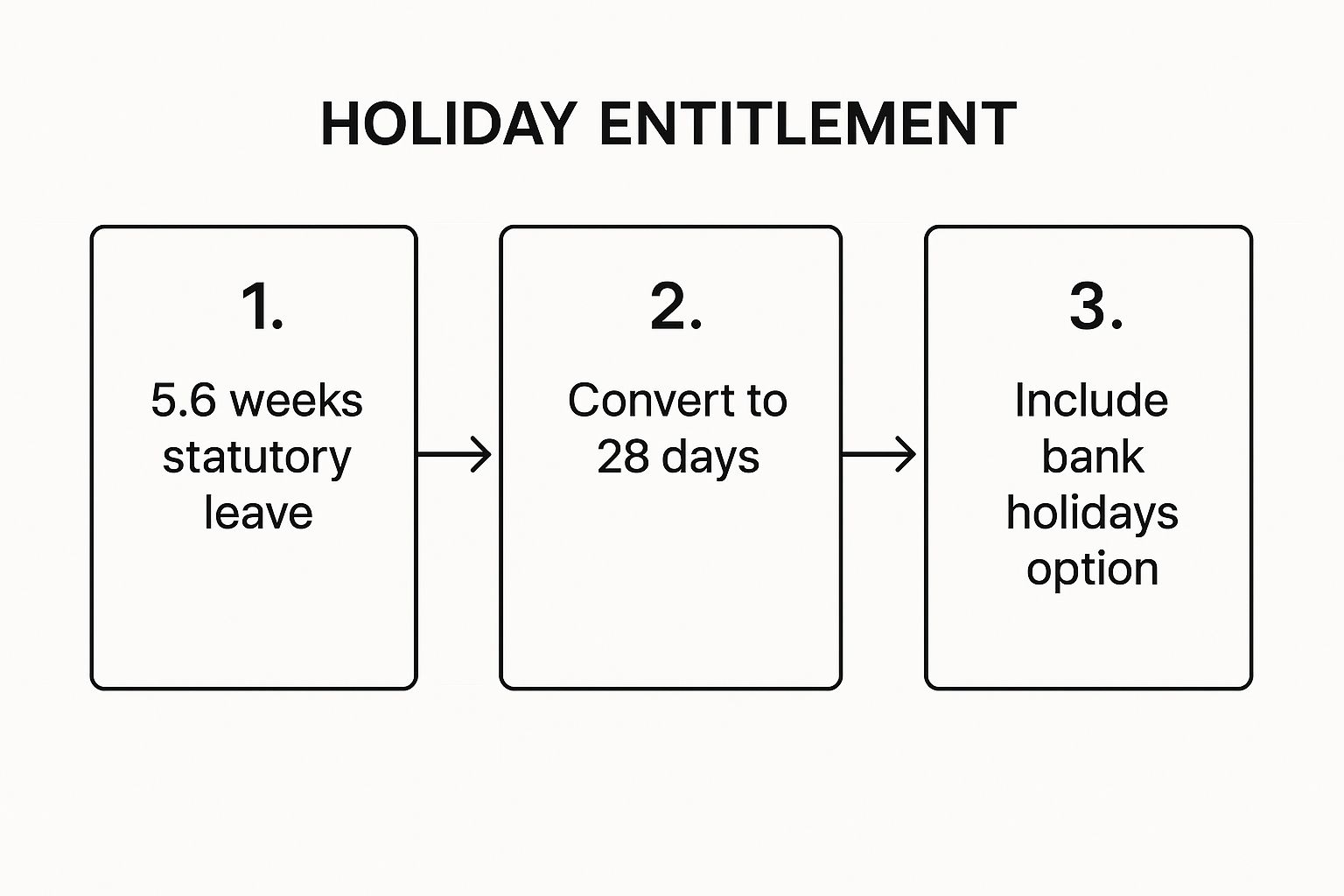
As the infographic shows, it’s a straightforward path from the 5.6-week entitlement to the final number of days, with bank holidays factored in as needed.
If you want to dig deeper into the legal side of things, our complete guide on statutory holiday entitlement in the UK has all the detail you'll need. Once you're comfortable with this, all the other calculations become much less daunting.
Calculating Leave for Part-Time Staff

Working out holiday entitlement for part-time staff is one of those things that can feel tricky, but it's actually quite straightforward once you get the hang of it. The golden rule is to ensure they get the same statutory 5.6 weeks of leave as their full-time colleagues, just on a pro-rata basis.
It’s all about fairness. If someone works fewer days, their holiday allowance is proportionally smaller. The easiest way to get your head around this is to stop thinking in terms of individual days and start thinking in weeks. Every part-time employee is entitled to 5.6 of their specific working weeks off.
The Pro-Rata Calculation in Action
Let's walk through a real-world example. Imagine you have an employee, Sarah, who works a regular three-day week. How do you calculate her annual leave?
- First, you take the number of days she works each week, which is 3.
- Then, you simply multiply that by the statutory entitlement of 5.6 weeks.
- The calculation looks like this: 3 days/week × 5.6 weeks = 16.8 days of paid holiday for the year.
It's really that simple. This formula works for any part-time pattern. If another employee works four days a week, their calculation would be 4 × 5.6, giving them 22.4 days. Just remember, while you can round fractions of a day up, you're not allowed to round them down.
Treating part-time employees less favourably than full-time staff when it comes to holiday entitlement isn't just bad practice; it's unlawful. The pro-rata system is there to guarantee fairness and keep you compliant, no matter the working pattern.
Handling Bank Holidays for Part-Timers
Ah, bank holidays. This is where things can get a bit tangled. A classic headache is when a bank holiday falls on a day your part-time employee isn't scheduled to work. Say most bank holidays are on a Monday, but your employee works Tuesday to Thursday. They'd consistently miss out if you just gave everyone the bank holidays off as they happen.
The fair way to manage this is to include bank holidays within their total pro-rata allowance. For Sarah, her 16.8 days entitlement is her entire pot of leave for the year. If a bank holiday falls on one of her working days (like a Tuesday), she simply uses one of her 16.8 days to cover it. If it falls on a Monday (her non-working day), her allowance isn't affected at all.
This approach ensures everyone gets their full, correct holiday entitlement, regardless of which days of the week they happen to work. For a deeper dive into this, we've got more examples in our holiday calculation for part-time workers guide.
Handling Holiday When Staff Join or Leave

Holiday entitlement isn't something that just appears as a lump sum on day one. It's earned bit by bit, month by month, throughout the year. This is what we call holiday accrual, and getting it right is crucial when you have people joining or leaving your team midway through your holiday year.
Think of it this way: for every month an employee is on the payroll, they "earn" one-twelfth of their total annual leave. This is particularly important for new starters, as it ensures they can take some well-deserved paid time off without having to wait a full year.
The Basic Accrual Calculation
Working out accrued holiday for someone who has only been with you for a short time is thankfully quite straightforward. You simply take their full annual entitlement and divide it by 12 to see how much leave they build up each month.
Let’s take a new team member with a full-time entitlement of 28 days. The monthly accrual works out like this:
- 28 days ÷ 12 months = 2.33 days per month
So, after three months on the job, this employee would have earned 7 days of holiday (that's 3 months x 2.33 days). This simple method keeps things fair, transparent, and consistent for everyone coming on board.
Accrual is all about making sure holiday is earned in proportion to the time someone has actually worked. It’s the fairest way to handle leave for new starters and an absolute must-have process for calculating final pay when someone leaves.
Sorting Out Final Holiday Pay for Leavers
The same accrual principle is absolutely vital when an employee moves on. You have to figure out exactly how much holiday they've earned right up to their last day, and then check that against how much they've already taken.
Let's imagine an employee with a 28-day allowance leaves six months into the year. At the halfway point, they will have accrued exactly half of their annual leave, which comes to 14 days.
- What if they've only taken 10 days? You owe them for the 4 unused days, which needs to be added to their final payslip.
- What if they've taken 16 days? In this case, they've used 2 days more than they'd earned. You can usually deduct the value of those two days from their final pay, but only if this is clearly laid out in their employment contract.
Navigating Rules for Irregular Hours and Part-Year Workers
The modern workforce is more flexible than ever, which is great, but it can make holiday calculations a real headache. If you employ people on zero-hours contracts or term-time-only schedules, you know what I mean. Thankfully, some recent rule changes have brought a bit more clarity to the process.
For leave years starting on or after 1 April 2024, the old method using 12.07% of hours worked is officially back on the table. However, a much more robust and compliant approach is to use a 52-week reference period. This method helps calculate average pay and holiday entitlement much more fairly.
Calculating Holiday with a 52-Week Reference Period
So, how does this work in practice? You need to look back over the previous 52 weeks that an employee actually worked and got paid.
This is a key detail. Any weeks where they didn't work or earn anything are skipped. You just keep going back until you have 52 full weeks of pay data to work with. This stops periods of inactivity—like the long summer break for a term-time worker—from unfairly dragging down their holiday pay.
Here's a simple breakdown of the calculation for someone on an irregular schedule:
- Gather the Data: First, add up all the hours the employee worked over that 52-week reference period.
- Find the Average: Divide the total hours by 52. This gives you their average working week.
- Calculate the Leave: Finally, multiply this average weekly figure by the statutory 5.6 weeks.
Let's imagine a casual worker logged 910 hours over their last 52 paid weeks. Their average week comes out to 17.5 hours (910 ÷ 52). Based on that, their holiday entitlement for the year would be 98 hours (17.5 × 5.6).
Defining a Week's Pay
Calculating holiday pay for these workers follows the same logic. You need to figure out what a 'week's pay' actually is for them.
You do this by averaging their total earnings over the same 52-week reference period. This average figure then becomes the amount they are paid for each week of holiday they take. It's a fair system because it ensures their holiday pay properly reflects their typical earnings, including any commission or overtime they might have worked.
The core principle here is fairness. It doesn't matter if someone works set hours or a variable pattern—they are still entitled to the equivalent of 5.6 weeks of paid leave. Using a 52-week reference period is the government's recommended method to get this right, both accurately and legally.
This approach is crucial for staying compliant, especially when you're dealing with the complexities of flexible work arrangements. If you manage staff with unconventional working patterns, you can find more specific guidance on the rules for workers in the gig economy. Getting this right helps you manage your flexible workforce with confidence.
How Bank Holidays Can Complicate Your Calculations

Most of us look forward to a bank holiday, but for anyone trying to work out holiday entitlement, they can be a real headache. The number of bank holidays isn't fixed each year, which creates unexpected problems for employers, especially those with contracts stating something like "20 days plus bank holidays".
On the surface, that wording seems simple enough. But it directly ties your employees' total leave to the number of public holidays in any given year. If an extra bank holiday is declared for a royal event, your staff get an extra day off. If the number of bank holidays dips, however, you could find yourself accidentally falling short of the legal minimum.
When Bank Holidays Decrease
This isn't just a theoretical problem; it has happened recently. For the holiday year running from April 2024 to March 2025, there was a notable drop in bank holidays, with the total varying between six and seven depending on an employee’s holiday year start date.
This meant staff on a "20 days plus bank holidays" contract received only 26 or 27 days off in total—less than the statutory 28-day minimum.
When something like this happens, the legal responsibility falls squarely on the employer to "top up" the employee's leave to ensure they receive their full 28 days.
An employee's statutory right to 5.6 weeks of paid holiday is absolute. No matter what the contract says or how many bank holidays there are in a year, their total leave can never fall below this legal minimum.
To avoid this recurring headache, many businesses are moving towards specifying a fixed number of days, such as "28 days including all bank holidays". This approach decouples the entitlement from the fluctuating number of public holidays, giving both you and your staff much-needed clarity year after year. Keeping track of the exact number of working days in a year is also essential for accurate planning and compliance.
Common Questions About Holiday Entitlement
Even when you’ve got the calculations down, real-world situations always throw up a few tricky questions. Things can get complicated when you start to navigate the rules around sick leave, bank holidays, and whether your boss can actually tell you when to take your holiday.
Getting your head around your rights and your employer’s obligations is the key to managing leave fairly and avoiding any nasty surprises. To help clear things up, we've tackled some of the most frequent queries we hear.
Can an Employer Tell Me When to Take My Holiday?
In short, yes, they can. It’s perfectly legal for an employer to decide when their staff take some, or even all, of their annual leave. This is a common practice in certain industries, like manufacturing plants that have a summer shutdown or schools that close for fixed holiday periods.
The key thing to remember is that they must give you proper notice. The general rule is that the notice period has to be at least double the length of the holiday they want you to take. So, if they need you to take one week off, they must give you a minimum of two weeks' notice. Your employment contract should spell out these specific rules.
What Happens to My Holiday If I am on Sick Leave?
Good news here: you continue to build up your holiday entitlement as normal, even while you’re off sick.
If you’re on long-term sick leave and can’t use your holiday as a result, you are generally allowed to carry over up to 4 weeks (which is 20 days for a full-timer) into the next leave year.
This carried-over leave typically needs to be used within 18 months from the end of the leave year in which it was accrued. An employer can't force you to take annual leave while you are on sick leave, but you can request to do so if you want to.
Is Rolled-Up Holiday Pay Legal in the UK?
The rules around this have recently changed, so this is one to watch. For a long time, rolled-up holiday pay—where a bit extra is added to your regular pay packet to cover holiday pay—was unlawful. The thinking was that it discouraged people from actually taking their time off.
However, for leave years starting on or after 1 April 2024, the practice is now legally allowed again, but with a big catch. It's only for irregular-hours and part-year workers. For everyone else, including full-time and part-time staff with regular hours, rolled-up holiday pay is still not permitted.


