
When you're navigating the world of employee benefits, you'll often come across two key terms: Statutory Maternity Pay (SMP) and Occupational Maternity Pay (OMP). Think of SMP as the legal minimum that the government requires employers to provide. OMP, on the other hand, is the extra financial support a company chooses to give.
It’s often called enhanced maternity pay, and it’s a powerful way for businesses to attract and keep great people.
Defining Occupational Maternity Pay for Your Business

While every eligible new parent has a right to Statutory Maternity Pay, OMP is a discretionary, contractual benefit. This means it's designed and funded entirely by the employer, showing a real commitment to supporting employees during one of life's biggest moments.
Offering an enhanced package isn't just about goodwill; it’s a smart business move. When companies provide more generous pay during maternity leave, they foster a supportive and fair workplace culture. This has a direct and positive impact on employee loyalty, morale, and long-term retention.
A Growing Trend in Employee Benefits
More and more UK businesses are seeing the value in offering OMP, marking a real shift in how they approach parental leave. It wasn't always this common. For instance, the 2019 Parental Rights Survey found that only 13% of mothers received OMP, with most relying solely on the statutory minimum.
But things are changing fast. Recent research from the campaign group Pregnant Then Screwed shows the percentage of private sector companies offering enhanced maternity pay has jumped to 74.1%. That's a significant leap from 65.5% in 2021 and shows that family-friendly policies are now seen as essential for any competitive employer. You can dig deeper into these trends by looking at the UK government's findings on parental leave.
Understanding the Core Differences
To really get what OMP is all about, it helps to see it side-by-side with its statutory counterpart. While they both provide financial support, their origins, amounts, and rules are completely different. A key thing to remember is that OMP schemes always build on top of SMP—they never replace it.
To help clear things up, let's break down the key elements that set OMP apart from the government-mandated scheme.
At a Glance OMP vs SMP
Here's a quick comparison to highlight the fundamental differences between Occupational Maternity Pay and Statutory Maternity Pay.
| Feature | Statutory Maternity Pay (SMP) | Occupational Maternity Pay (OMP) |
|---|---|---|
| Source | A legal requirement mandated by the government. | A contractual benefit offered by the employer. |
| Funding | Mostly reclaimed from the government (HMRC). | Funded entirely by the company's own resources. |
| Pay Rate | Set national rate (£184.03 per week or 90% of average earnings, whichever is lower) after the first 6 weeks. | Varies by company; can be full pay or half pay for a set period. |
| Eligibility | Based on government criteria (e.g., length of service, minimum earnings). | Set by the employer and often requires longer service. |
| Legal Status | A legal right for all eligible employees. | A discretionary benefit, but contractually binding once offered. |
Ultimately, a good OMP policy needs to be carefully designed, clearly written into employment contracts, and managed with absolute precision to stay compliant.
Comparing OMP and SMP in Detail
So, we've covered the basics. But for anyone managing HR or payroll, getting into the nitty-gritty of how Occupational Maternity Pay (OMP) and Statutory Maternity Pay (SMP) differ is essential. They might work together, but they come from completely different places and play by separate rules. Getting this wrong can quickly lead to payroll headaches and compliance issues.
Think of it like this: SMP is the government-issue, standard-spec car. It’s reliable, does the basic job of getting you from A to B, and everyone who qualifies gets one. OMP is the optional upgrade package your company chooses to invest in—leather seats, a better sound system, and a smoother ride. It’s designed to provide a much better experience.
Let’s break down the four key distinctions you really need to understand.
Source of Funds and Legal Standing
The first and most fundamental difference is simple: who foots the bill?
Statutory Maternity Pay is a government mandate. While you process it through your payroll, it’s not really your money. You’re legally obligated to pay it, but you can claim back 92% of it from HMRC. If you’re a small business, you can even reclaim 103%. It's a legal right for any employee who meets the criteria.
OMP, on the other hand, is a direct investment from your company's own pocket. It’s a contractual benefit, not a legal must-have. Because you fund it entirely, it shows a clear decision to offer more than the bare minimum. The moment you write OMP into an employment contract, though, it becomes a legally binding promise you have to keep.
Pay Structure and Generosity
This is where your employees will truly feel the impact. SMP follows a rigid, two-stage formula:
- First 6 weeks: Paid at 90% of the employee’s Average Weekly Earnings (AWE).
- Next 33 weeks: A flat rate of £184.03 per week (for the 2024/25 tax year) or 90% of their AWE, whichever is lower.
OMP schemes are much more flexible and almost always more generous. Their entire purpose is to top up SMP payments so the employee takes home more. You might see packages offering several weeks or even months at full pay, followed by a period at half pay, before eventually dropping to the SMP-only rate.
An OMP scheme is designed to bridge the financial gap that SMP leaves behind. It ensures that talented employees feel valued and are not financially penalised for starting a family, which in turn encourages them to return to work after their leave.
Eligibility Rules and Conditions
The rules for getting SMP are the same for everyone across the UK. An employee just has to meet the government's set criteria for length of service and average earnings. If you need a refresher, you can learn more about what is statutory maternity pay in our detailed guide.
With OMP, you’re in the driver's seat. The employer sets the rules, and they’re usually a bit stricter than the government's. It's common to see extra conditions like:
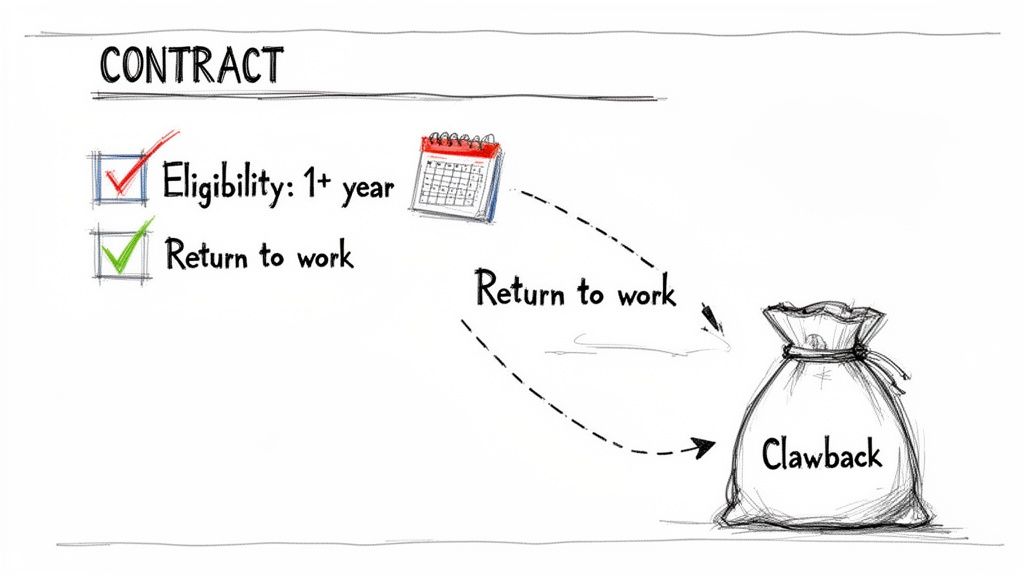
- A longer continuous service period, such as one year or more with the company.
- A "clawback" clause requiring the employee to return to work for a minimum period after their leave.
- Following specific internal procedures for notifying the company about the pregnancy and leave dates.
These custom rules are your way of rewarding loyalty and making sure your investment in enhanced pay brings a return to the business.
Navigating the Overlap
This is a critical point that often causes confusion. OMP doesn't replace SMP; it sits on top of it. An employee getting OMP is also receiving their full SMP entitlement at the same time.
Your payroll has to be smart enough to calculate the SMP portion first, then figure out the OMP 'top-up' needed to hit the enhanced figure you've promised.
For instance, say your OMP scheme offers full pay for 12 weeks. For the first six weeks, the employee gets 90% of their pay from SMP, so your OMP only needs to top it up by 10%. But for the next six weeks, they get the flat SMP rate. Your OMP top-up will be much larger to bring their total pay back up to 100%. Keeping track of these two overlapping payments is vital for staying compliant and keeping your payroll accurate.
Getting to Grips with OMP Eligibility and Clawback Clauses
Unlike Statutory Maternity Pay, which has its rules set in stone by the government, Occupational Maternity Pay (OMP) is your company's own creation. This gives you the freedom to shape a scheme that really works for your business, but it also means the ball is in your court to set clear, fair, and legally solid eligibility criteria.
These conditions are what turn an enhanced benefit into a contractual perk rather than a universal right. Think of them as a way to ensure your investment in better pay goes to employees who've shown real commitment to your organisation. The most common string attached is a minimum length of service.
For instance, an employee qualifies for SMP after only 26 weeks, but you might decide your OMP is only for those who've been with the company for at least one year before their qualifying week. It's a perfectly standard way to reward loyalty and give people a good reason to stick around.
Structuring Your Eligibility Criteria
When you're deciding who gets to benefit from your OMP scheme, clarity and consistency are everything. Your criteria must be laid out in black and white in your employment contracts and staff handbook. This isn't just good practice; it's your best defence against any confusion or claims of unfair treatment down the line.
Common conditions for OMP eligibility often boil down to a few key things:
- Minimum Service Period: This is a big one. You might require staff to have completed a specific period of continuous employment, like 12 or 24 months, before their leave starts.
- Intention to Return: It’s fair to include a clause stating the employee plans to come back to work for a minimum period after their maternity leave is over.
- Proper Notification: This just means the employee needs to follow your internal process for telling you about the pregnancy and when they plan to take their leave. You can dig deeper into the timings in our guide on when to go on maternity leave.
These rules are your main tool for managing the scheme effectively and making sure it pays off for both you and your team.
Understanding the Clawback Clause
One of the most crucial, and sometimes misunderstood, parts of an OMP policy is the clawback clause. Put simply, this is a contractual safety net that protects your financial investment. It specifies that an employee must repay some or all of the enhanced part of their maternity pay if they don't return to work for a set period after their leave.
Think of a clawback clause as a safeguard. It ensures the extra benefit you're offering is tied to an employee's continued contribution to the company. This makes your OMP policy a sustainable investment in your long-term talent, not just a short-term expense.
This is a completely legal and widespread practice, but it needs to be handled carefully and with total transparency from day one. A typical clawback clause might require an employee to return for at least three to six months to avoid having to pay back the OMP top-up.
This is a significant consideration, especially when you think about the financial pressures new parents are under. Research from UNISON shows that a staggering 50% of parents feel pressured to return to work early because of money worries, with 52% receiving only the statutory minimum. By offering OMP with clear conditions, you're providing vital support while also managing business expectations fairly.
The absolute key is to make sure the terms are reasonable and clearly written into the employment contract before the employee even thinks about going on leave. Any vagueness here can easily lead to disputes and bad feelings, completely wiping out all the goodwill your generous OMP policy was meant to build.
How to Accurately Calculate Occupational Maternity Pay
Figuring out Occupational Maternity Pay (OMP) can seem daunting, but it really just boils down to understanding your company's specific policy. Unlike the fixed rates you get with Statutory Maternity Pay (SMP), your OMP calculation is entirely based on the scheme you've put in place. The first step is always getting to grips with that structure.
Most OMP schemes are tiered. A common approach is to offer a period of full pay, which then steps down to half pay, before finally reverting to the standard SMP rate for the rest of the maternity leave. This layered system gives your employees a much-needed financial cushion during those crucial first few months with their new baby.
Understanding Common OMP Structures
The landscape for OMP in the UK has shifted quite a bit recently. As of 2022, a whopping 74.1% of private sector organisations were offering enhanced packages, a significant jump from 65.5% in 2021. For any finance controller, understanding the typical ways these schemes are built is the starting point for calculating costs and budgeting effectively. You can read more about the growth of enhanced maternity pay to see just how much policies are changing across the country.
To give you a better idea, here are a few examples of typical schemes you might come across. These can also serve as a great blueprint if you're thinking about designing a competitive package for your own team.
Common OMP Scheme Structures
| Scheme Component | Example Scheme A | Example Scheme B | Example Scheme C |
|---|---|---|---|
| Weeks 1-6 | 100% of Average Weekly Earnings | 100% of Average Weekly Earnings | 90% of Average Weekly Earnings |
| Weeks 7-18 | 50% of Average Weekly Earnings | 100% of Average Weekly Earnings | 50% of Average Weekly Earnings |
| Weeks 19-39 | SMP Rate Only | SMP Rate Only | SMP Rate Only |
| Total Enhanced Period | 18 weeks | 18 weeks | 39 weeks |
These examples show how different companies balance the length and generosity of their enhanced pay periods to attract and retain talent.
Step-by-Step OMP Calculation
Let's walk through a real-world example to see how this all fits together.
Imagine your employee, Sarah, has Average Weekly Earnings (AWE) of £600. Your company offers a generous OMP scheme: 12 weeks of full pay, followed by 27 weeks at the SMP rate.
Step 1: Calculate the first 6 weeks.
- First, SMP pays 90% of her AWE, which comes to £540 (£600 x 0.90).
- But your OMP scheme promises her full pay, which is £600.
- So, your OMP "top-up" is the difference between the two: £60 per week (£600 – £540).
Step 2: Calculate weeks 7-12.
- After the first six weeks, SMP drops to the standard weekly rate of £184.03 (for the 2024/25 tax year).
- Your scheme, however, still promises her full pay (£600).
- This means your OMP top-up becomes much larger: £415.97 per week (£600 – £184.03).
Step 3: Calculate weeks 13-39.
- At this point, Sarah's enhanced pay period is over.
- She now only receives the standard SMP rate of £184.03 per week.
- Your OMP top-up for this period is £0.
This example highlights a key point: OMP isn't a separate payment. It's an enhancement that works alongside SMP. Your payroll system needs to calculate both concurrently to get the numbers right. To make life easier, you might consider using a dedicated maternity leave calculator to simplify these figures.
Tax and National Insurance Contributions
A question that pops up all the time, from both employees and payroll managers, is how tax is handled. The answer is simple: Occupational Maternity Pay is treated just like a regular salary.
OMP payments are subject to the same deductions as normal earnings. This includes PAYE (Pay As You Earn) income tax and National Insurance contributions. Your payroll software should handle these deductions automatically, keeping you fully compliant.
This means that when you offer "full pay," you're referring to the employee's gross pay before any deductions. It also ensures that other salary-based calculations, like pension contributions, stay consistent during the enhanced pay period.
Keeping this straight is vital for managing your employees' expectations and making sure your payroll is accurate and compliant with all HMRC regulations. Getting tax and NI deductions wrong can cause major headaches for both the employee and the business down the line.
Building the Business Case for Offering OMP
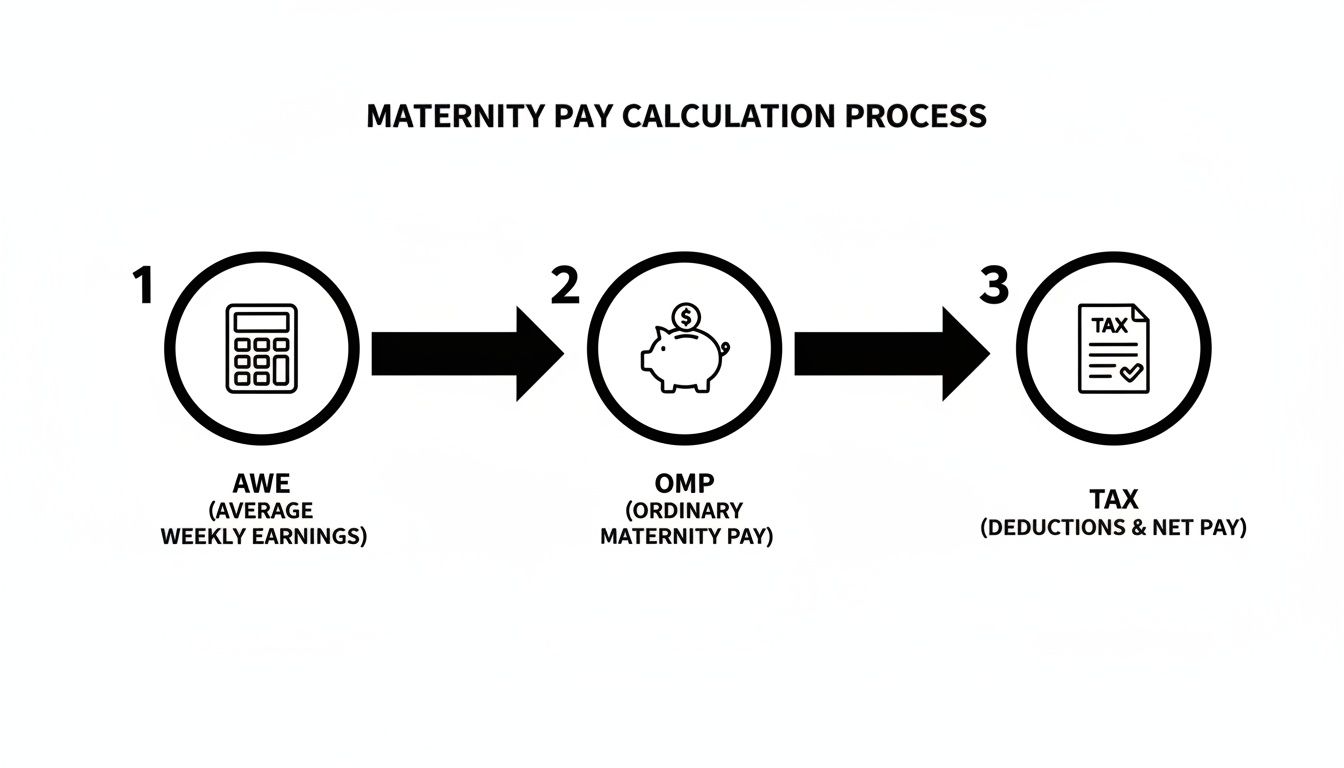
This process flow shows how Average Weekly Earnings, OMP, and tax deductions all connect to determine the final payment. The key takeaway is that OMP is not a separate payment but an integrated top-up to SMP, all processed through standard payroll with tax.
It’s easy to look at Occupational Maternity Pay (OMP) as just another business cost, but that’s a common and shortsighted mistake. In reality, a well-structured OMP scheme is one of the most powerful investments a business can make in its people and its future. It’s more than just a benefit; it becomes a cornerstone of your company culture.
Think of it this way: the cost of replacing a skilled employee is huge. It's often estimated to be anywhere from six to nine months of their salary when you factor in recruitment, onboarding, and lost productivity. A generous OMP package directly tackles this expense by fostering loyalty and making it much more likely your valuable team members will return.
Enhancing Talent Attraction and Retention
In today’s competitive job market, top candidates look well beyond the salary; they’re scrutinising the entire benefits package. Offering enhanced maternity pay sends a clear signal that you’re a forward-thinking employer who genuinely supports and values working parents. This single policy can elevate your employer brand, turning your company into a magnet for the best talent.
It also builds incredibly deep-rooted loyalty. When an employee feels financially and professionally supported during such a huge life event, they’re far more likely to return to work engaged, motivated, and committed to the company's success. This is a game-changer for reducing staff churn.
When building a business case for offering OMP, it's essential to quantify the benefits, such as improved employee retention. Understanding how to effectively measure key HR metrics, like calculating employee turnover rate, can significantly strengthen your proposal.
Boosting Morale and Productivity
The positive impact of OMP doesn’t just stop with the person receiving it. It creates a ripple effect across the entire organisation, improving overall morale. When employees see their colleagues being treated well, it reinforces their own sense of job security and pride in the company.
A strong OMP policy demonstrates a genuine investment in employee well-being. This fosters a supportive work environment where people feel valued not just for their output, but as individuals with lives outside of the office.
This positive culture translates directly into productivity. Happy, secure employees are more focused, collaborative, and innovative. They’re more willing to go the extra mile because they know the business has their back. Ultimately, framing OMP as a strategic investment in talent retention, brand reputation, and workplace culture makes the business case compelling and clear.
Common Questions About Occupational Maternity Pay
As you start to get your head around Occupational Maternity Pay (OMP), a few common questions are bound to pop up. Let's tackle some of the most frequent queries from both HR managers and employees to clear up any lingering confusion.
Can an OMP Policy Be Changed?
Yes, you can change an OMP policy, but it’s all about timing. Because OMP is a contractual benefit, any changes can't short-change an employee on their existing rights. You could introduce a less generous policy for new starters, for example, but you can’t just switch the terms for a current employee who is already pregnant or on maternity leave.
If you want to change the policy for your existing team, you’ll need to go through a proper consultation process to amend their employment contracts. Trying to change things without agreement can lead to claims for breach of contract, so it’s always a good idea to get some legal advice first.
What Happens to Pension Contributions?
During any period of maternity leave where an employee is receiving pay (that’s OMP or just SMP), pension contributions carry on as usual.
The crucial thing to remember is that employer contributions must be based on the employee's normal, pre-maternity leave salary, not their reduced maternity pay. The employee's own contributions, however, are based on the actual pay they receive.
Once an employee's paid leave is over and they move into the unpaid part of their maternity leave, the employer is no longer required to keep making pension contributions.
Do I Still Accrue Annual Leave?
Absolutely. An employee’s right to build up their statutory annual leave is protected by law throughout their entire maternity leave, which can be up to 52 weeks. This includes any time they are on unpaid leave.
This means that even while they're off receiving OMP and SMP, their holiday entitlement is ticking up just as if they were still at work. It’s vital for employers to manage this carefully. A common approach is to arrange for the employee to take this accrued leave before their maternity period begins, or to pay them in lieu of the holiday if they decide not to return to the company.
Is OMP Available for Other Family Leave?
This one is completely down to your company policy. While OMP is specifically for maternity, many forward-thinking organisations offer similar enhanced pay schemes for other types of family leave to create a fair and equal workplace.
You might see things like:
- Enhanced Adoption Pay: Topping up statutory pay to a similar level as OMP for employees who are adopting.
- Enhanced Paternity Pay: Offering more than the statutory two weeks of paternity pay.
- Enhanced Shared Parental Pay: Providing enhanced pay for parents who decide to share their leave entitlement.
Offering these kinds of benefits sends a strong message that you’re committed to supporting all working families in your team.


