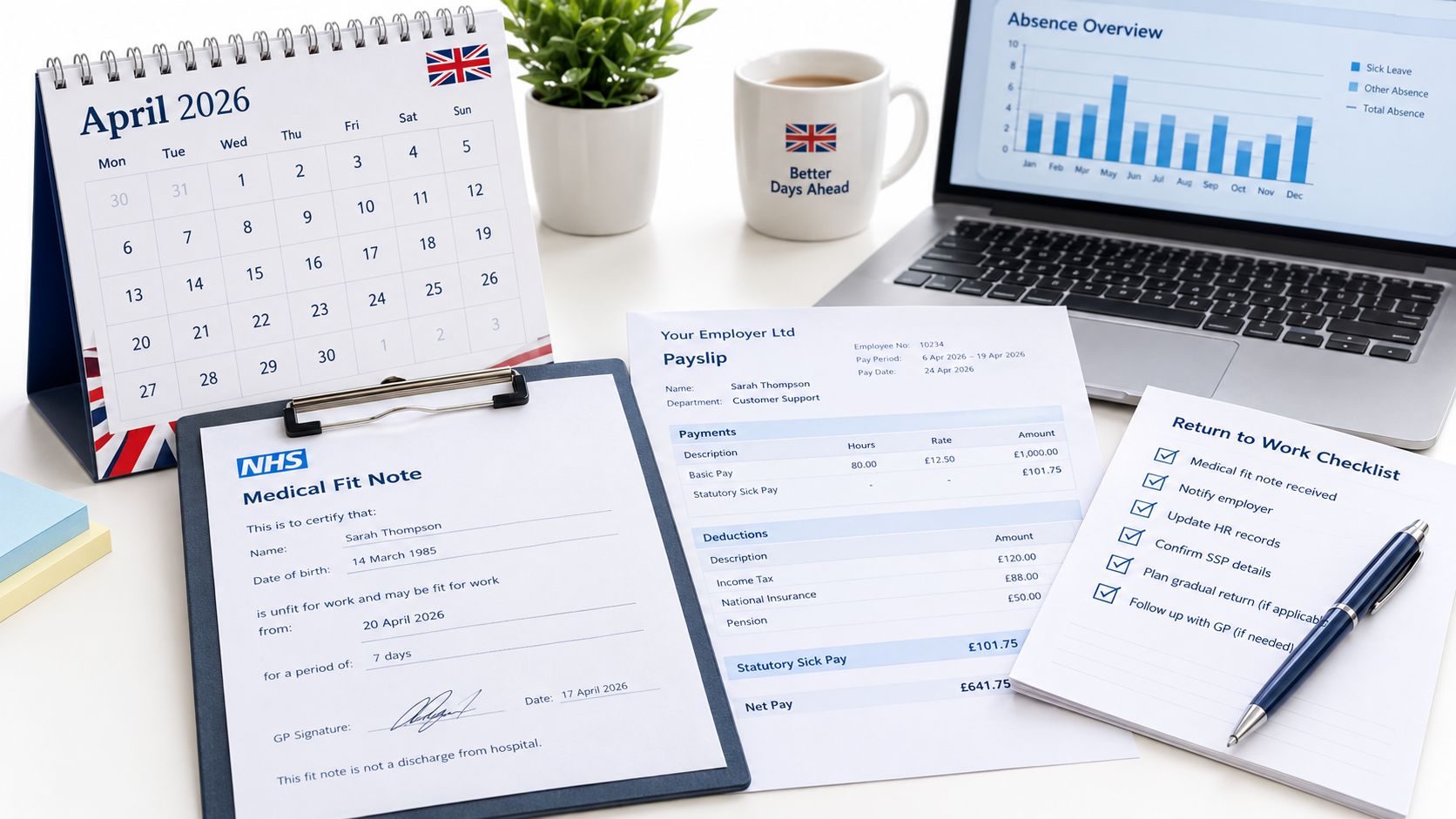
A maternity leave calculator is a brilliant starting point, giving you an instant estimate of your key leave dates and potential pay based on your due date and salary. Think of it as an essential tool for getting your finances in order and understanding the timeline for your time away from work.
Understanding Your UK Maternity Leave Rights

Before you start plugging numbers into a calculator, it’s really important to get your head around the maternity rights framework here in the UK. The system is built on two core parts: the legal minimum set by the government, and any extra benefits your employer might offer. Understanding both is the first step to getting a forecast you can actually rely on.
Every eligible employee in the UK is entitled to Statutory Maternity Leave, which can last for up to 52 weeks. This is neatly split into 'Ordinary Maternity Leave' (the first 26 weeks) and 'Additional Maternity Leave' (the last 26 weeks). You don't have to take the full year, but you are required to take at least two weeks off right after your baby is born.
Statutory Entitlement vs Company Policy
Now, this is where things can differ quite a bit. Your employer’s maternity policy will either match the statutory minimum or, if you're lucky, offer more generous terms. This is often called an ‘enhanced’ or ‘contractual’ maternity scheme, and it might mean more pay for a longer period or other non-financial perks.
You should always dig out your employee handbook or have a chat with your HR department to find this policy document. It contains the specific rules you need to follow, like notice periods and how to apply. For a deeper look, you can explore our detailed guide on understanding the benefits of maternity leave to see how these policies support new parents.
Knowing which policy applies to you is absolutely crucial. A calculator needs this information to give you a correct financial breakdown. The government sets the baseline, but your company’s policy dictates the reality of your pay packet and leave conditions.
Key Dates and Deadlines
One of the most important dates you'll work with is your Expected Week of Childbirth (EWC). This single date is the anchor for several key timelines.
It determines the earliest you can start your leave (which is 11 weeks before your EWC) and also sets the deadline for notifying your employer (by the end of the 15th week before your EWC). Getting these dates right is fundamental for both legal reasons and for making sure your calculations are spot on.
It’s also interesting to see how parental leave is evolving. For a broader sense of how workplaces are supporting new parents, including fathers and non-birthing parents, it's worth looking into recent developments where companies are offering extended parental leave benefits.
The length of leave taken by mothers has been growing. In the United Kingdom, about 75 percent of mothers took the statutory minimum maternity leave of 39 weeks or more, with the average duration rising to nearly 44 weeks in recent years.
Finding the Right Numbers for Your Calculation
The accuracy of any maternity leave calculator hinges entirely on the quality of the information you feed it. Rubbish in, rubbish out, as the old saying goes. To get a truly reliable forecast of your pay and leave dates, you first need to gather a few key bits of information. It might feel like a bit of admin, but getting these details right from the start saves you from nasty surprises later.
The two most critical numbers are your employment start date and your average weekly earnings. These figures are the bedrock for working out if you're eligible and for calculating your Statutory Maternity Pay (SMP), which is the foundation of most maternity packages in the UK.
Pinpointing Your Average Weekly Earnings
For most people on a fixed monthly salary, this is pretty straightforward. But it can get a bit tricky if your pay varies because of things like commission, bonuses, or fluctuating hours. The SMP calculation isn't based on your last payslip; it's based on your gross earnings during a very specific eight-week "relevant period."
This period is usually the eight weeks leading up to the end of the "qualifying week," which is the 15th week before your baby is due. You'll need to dig out your payslips for these two months, add up your total gross pay (before tax and other deductions), and then divide that by eight. That’s the magic number the calculator needs.
Key Takeaway: Don't just estimate your weekly pay. Your official SMP is calculated based on a specific eight-week window. Using the wrong figure is one of the most common reasons people get an inaccurate forecast.
A Real-World Scenario with Variable Income
Let's think about a sales professional, we'll call her Anna. Her income is a mix of a base salary and a quarterly commission. To use a maternity leave calculator accurately, Anna can't just plug in her basic pay.
She needs to identify her qualifying week and then look at the payslips from the eight weeks just before it. If a big commission payment landed during that specific window, her average weekly earnings will be higher, which in turn boosts the amount of SMP she'll get for the first six weeks. On the flip side, if it was a quiet sales period, her average will be lower. This is exactly why pinpointing the earnings from that specific relevant period is so crucial.
The government provides specific guidance on eligibility and pay calculations for Statutory Maternity Pay, which can be seen here.
This official guidance clearly lays out the core components of statutory leave and pay, reinforcing just how important it is to use precise dates and earnings for your own calculations.
Don't Forget These Other Key Details
Besides your earnings, you'll need a few other pieces of information ready for a complete picture:
- Your Expected Week of Childbirth (EWC): This is the anchor date for everything else.
- Your Intended Leave Start Date: The earliest you can start is 11 weeks before your EWC.
- Company Policy Details: Does your employer offer enhanced or contractual pay? If so, you'll need the details (e.g., full pay for 12 weeks followed by half pay).
Gathering these numbers is the single most important step in planning your maternity leave finances. If you're looking for a deeper dive into the rules, our guide explains in detail what is Statutory Maternity Pay and how it works. With all this information to hand, you can confidently use a calculator to build a clear and accurate financial plan.
How to Use a Maternity Leave Calculator
Right, so you've gathered all your key dates and earnings info. Now you’re ready to actually use a maternity leave calculator and see what your finances will look like. The process itself is usually simple, but knowing exactly what to pop in each field is crucial for getting a forecast you can genuinely rely on.
The first, and most important, things you'll be asked for are your dates. These are the anchors for the entire calculation. You'll typically see fields for your baby’s Expected Week of Childbirth (EWC) and the date you plan to start your leave. These two dates work together to map out your full 52-week entitlement and, crucially, determine the "qualifying week" for your pay calculation.
Entering Your Key Dates and Pay Details
Once the timeline is locked in, the focus shifts to your earnings. This is where you’ll need that average weekly earnings figure you worked out from your payslips during the eight-week relevant period. Be precise here – don't round it up or take a guess. A good calculator will use this exact number to figure out the first six weeks of your Statutory Maternity Pay (SMP), which is paid at 90% of this average.
The following infographic gives a quick visual rundown of the essential data points you need to have ready.
As you can see, getting an accurate result is all about combining your leave dates, your regular pay, and any extra earnings into one complete picture.
Many calculators also let you input details about your company’s own maternity policy. This is a vital step if your employer offers an enhanced or contractual scheme that’s more generous than the statutory minimum.
You might see fields asking for things like:
- The number of weeks you get at full pay
- How many weeks you'll receive half pay
- Any other unique payment structures your company has
Entering these details allows the tool to build a much more realistic financial picture, showing exactly how your company’s enhanced pay tops up the baseline SMP. It essentially layers your employer's policy over the government's, giving you a week-by-week breakdown of your actual income. For more practical advice on picking a start date, our article on when to go on maternity leave is a great resource.
Expert Tip: Before you hit 'calculate', double-check everything. A simple typo in your due date or a mistake in your average earnings can throw the entire result off, leaving you with a flawed financial plan. It's worth taking that extra minute to review each number.
Selecting Your Leave Options
Finally, most tools will ask you how long you plan to be off work. While you’re entitled to 52 weeks, you don't have to take it all. You can choose to take less. By selecting your planned duration – whether that’s 39 weeks (to cover the paid portion) or the full year – the calculator can give you a precise return-to-work date to help with your planning.
By carefully plugging in these details—your dates, specific earnings, and company policy—you turn a generic tool into a powerful, personalised planner. This is what gives you the clarity and confidence you need to prepare for your time away with your new baby.
Making Sense of Your Calculator Results

Right, you’ve carefully punched in your dates and earnings, and now you’ve got a detailed forecast sitting in front of you. At first glance, it might seem like a jumble of figures and dates, but this report is actually your financial roadmap for the next year. Knowing how to read it properly is the key to planning with real confidence.
Think of the results as more than just a final number. The real gold is in the week-by-week breakdown of your income. This is absolutely essential for budgeting because, let's be honest, your pay is going to change, probably quite a bit. It shows you exactly when your income will drop from your enhanced company pay or the higher initial rate of Statutory Maternity Pay (SMP).
Your Payment Schedule Explained
One of the first things you'll spot is that your pay isn't a flat line. For most eligible employees here in the UK, the first chunk of maternity leave is the most financially comfortable.
This is because the first six weeks of SMP are paid at 90% of your average weekly earnings, with no upper limit. It's designed to give you a solid financial cushion while you’re finding your feet with a newborn. It’s a significant boost, but it’s temporary.
After that initial six-week period, your income steps down. For the following 33 weeks, your SMP will be paid at a standard flat rate set by the government, or 90% of your average weekly earnings if that happens to be lower. Seeing this drop-off clearly laid out in the calculator’s results is invaluable – it helps you prepare for the change and get your household budget in order ahead of time.
Your calculator’s timeline is your single source of truth for financial planning. It helps you anticipate income changes, plan for major expenses, and decide if you need to dip into savings during the lower-paid months of your leave.
Understanding Your Key Dates
Beyond the money, the calculator also gives you a crystal-clear timeline marked with some crucial dates. This schedule is a game-changer for coordinating everything from childcare arrangements to your eventual return to work.
You’ll typically see these key dates pinned out for you:
- Leave Start Date: The official first day of your maternity leave.
- SMP End Date: The final day you’ll receive statutory pay, which is usually after 39 weeks.
- Full Leave End Date: This marks the end of your full 52-week entitlement, should you choose to take it all.
- Official Return-to-Work Date: The day your employer will be expecting you back in the office (or logged on!).
This timeline simply removes all the guesswork. It allows you to plan with precision, ensuring there are no nasty surprises when your pay stops or when it’s time to start thinking about your professional life again.
While many mothers in the UK take a substantial amount of time off, it's interesting to see that recent data shows the average leave duration is 74 days—or about 10.5 weeks. You can discover more insights about leave trends in the UK and see how this stacks up against other countries. Having your personal dates mapped out gives you the clarity to make the right choices for you.
Common Maternity Calculation Mistakes to Avoid
A simple input error on a maternity leave calculator can completely throw off your financial planning. That can lead to some seriously stressful surprises right when you can least afford them.
Navigating all the rules is tricky, but if you know the most common pitfalls, you can make sure your forecast is as accurate as possible. Trust me, even a tiny miscalculation can have a huge knock-on effect.
One of the most frequent slip-ups is getting your average weekly earnings wrong, especially if your pay isn't a fixed monthly salary. It’s so easy to forget about a one-off bonus or a commission payment that landed during that crucial eight-week "relevant period." Forgetting this extra income will give you a lower calculation for your first six weeks of Statutory Maternity Pay (SMP), which is a costly oversight.
Confusing Company Pay with Statutory Pay
This is another classic error: misunderstanding how company schemes work alongside SMP. So many people assume their employer's enhanced maternity pay completely replaces the statutory amount.
In reality, it nearly always just tops it up.
For example, your company might offer a generous 12 weeks at full pay. What they're typically doing is using the SMP you're entitled to from the government and then adding the difference to bring it up to your normal salary. A good calculator will account for this, but you have to give it the right details about your company’s policy. If you don't, it might look like you’ll get both payments in full, which is rarely ever the case.
Real-World Pitfall: Miscalculating your 'qualifying week' is easier to do than you'd think. It's the 15th week before your expected week of childbirth. Getting this date wrong by even one week can shift your entire eight-week earnings assessment period, potentially cutting out a high-earning month and reducing your pay.
Forgetting Key Timeframes and Rules
It's absolutely vital to remember all the specific rules tied to maternity leave. These are the details that are easily overlooked but can make a massive difference to your planning and the accuracy of any calculation.
Here are a few of the most commonly forgotten rules:
- The 11-Week Start Date: You can’t start your leave any earlier than 11 weeks before your due date. If you plan for an earlier start in the calculator, it’s just going to give you an invalid result.
- Notice Periods: You must give your employer at least 28 days' notice before you intend to change your return-to-work date.
- Unpaid Leave: Remember that if you take the full 52 weeks, the final 13 weeks are usually unpaid. A calculator will show this, but it’s a detail many people forget when budgeting for the full year off.
By double-checking these common tripwires, you can move forward with a financial forecast that's both realistic and reliable. It’ll give you the peace of mind to focus on what really matters: your growing family.
Frequently Asked Questions About Maternity Leave
Figuring out the finer points of maternity leave can feel a bit like solving a puzzle. It’s completely normal to have questions pop up, even after you’ve run the numbers through a calculator. We’ve pulled together some of the most common queries to give you clear, straightforward answers so you can plan with total confidence.
One of the biggest questions is always about holiday entitlement. The good news is that your contractual paid holiday keeps building up during your entire maternity leave—yes, even during the unpaid part.
You can't take holiday and maternity leave at the same time, but a common approach is to use your accrued holiday either right before your maternity leave kicks off or just before you head back to work. It’s a great way to extend your time off.
What if My Due Date Changes?
This happens all the time, so there’s no need to worry. If your baby decides to make an early entrance, your maternity leave and Statutory Maternity Pay (SMP) will simply start automatically the day after the birth.
All you need to do is let your employer know the new date as soon as it's reasonably practical.
If your baby is late, it usually won’t affect your planned start date, assuming you’ve already begun your leave. The key is to keep your employer in the loop so they can update their records.
Can I Work During Maternity Leave?
Yes, you can, but only in a limited way through what are known as "Keeping in Touch" (KIT) days. You're allowed to work for up to 10 KIT days during your leave without it affecting your leave or pay.
These days are completely optional and have to be agreed upon by both you and your employer. They can be really useful for things like attending a training session, popping into a key team meeting, or just easing your transition back into the workplace. It's important to agree on your pay rate for these days before you work them.
Remember, KIT days are a tool for staying connected, not an obligation. You can’t be forced to work them, and your employer can’t demand you offer them. It's a mutual agreement designed to benefit both sides.
How Will Recent Changes Affect Me?
It’s always a good idea to keep an eye on potential updates to parental leave policies. The UK government is kicking off a review of its parental leave and pay system in July 2025.
This review will look at all types of parental leave, including maternity, with the aim of improving support for families. You can read more about the government's review of parental leave to get a sense of what changes might be on the horizon.
As you get ready for your baby’s arrival, you might also be thinking about extra support. Getting ahead on things like finding the right help can make a huge difference, so it’s worth looking into the leading questions to ask before hiring a maternity nurse to ensure you find the perfect fit for your family. Planning ahead on all fronts can make this exciting time feel so much more manageable.