The last Monday in May arrives quickly. One team member has booked leave, another assumes the office will close, and a customer still expects an answer. Without a clear plan, a long weekend can leave a small business with uncovered shifts, delayed approvals, confused payroll records, and an unpleasant Tuesday morning backlog.
The Spring Bank Holiday in the UK is predictable, but the operational consequences aren't automatic. Employers need to understand the 2026 date, regional calendars, contractual holiday rules, and the practical cover required for customer-facing and essential services. This guide turns the calendar into an actionable leave-management process for HR managers, business owners, and team leaders.
Table of Contents
- Why Spring Bank Holiday Planning Matters
- Understanding Spring Bank Holiday Dates and History
- Setting Up Effective Leave Policies
- Navigating Regional Variations Across the UK
- Managing Payroll and Staff Coverage
- Proactive Planning for Business Continuity
- Leveraging Leave Management Software
- Preparing Your Team for Upcoming Holidays
Why Spring Bank Holiday Planning Matters
A small business can lose control of a holiday weekend through a series of reasonable assumptions. An employee believes the bank holiday is paid leave on top of their allowance. A manager approves annual leave without checking who else is absent. Finance processes payroll using a national calendar, while a distributed colleague works under a different regional schedule.
By Friday afternoon, the office may have several people away, no agreed escalation route, and unfinished customer work sitting in shared inboxes. The problem isn't the holiday itself. It's the absence of a single, visible record showing who is away, who is working, what must be completed, and which services need cover.

Turn a date into an operating plan
Start with the calendar, then move immediately to decisions:
- Confirm the closure position: Decide whether the business will close, operate normally, or provide reduced cover.
- Review contractual terms: Check whether the holiday forms part of annual leave or is provided separately.
- Map critical work: Identify customer support, payroll, fulfilment, compliance, and other tasks that can't wait.
- Set approval rules: Give managers a deadline for reviewing competing requests and resolving cover gaps.
- Communicate one version: Publish the final arrangement in the employee handbook, calendar, and leave system.
Practical rule: A bank holiday should trigger a coverage review, not just a calendar reminder.
Proactive planning also protects the return to work. Assigning ownership for urgent issues, setting an out-of-office message, and bringing deadlines forward can prevent the post-holiday scramble. The strongest approach combines accurate dates with a policy employees can understand and managers can apply consistently.
Understanding Spring Bank Holiday Dates and History
For HR managers setting rotas and leave calendars, the date is the starting point. In 2026, the Spring Bank Holiday falls on Monday 25 May in England and Wales, according to the official UK bank-holiday listings. Scotland also lists 25 May 2026 as its Spring bank holiday. Northern Ireland includes that date in its regional calendar, alongside additional observances.
The legal framework comes from the Banking and Financial Dealings Act 1971, which replaced the older Whit Monday arrangement with a holiday held on the last Monday in May. The Bank Holidays Act 1871 established the formal basis for recognised bank holidays in the UK.
Why the historical change still matters
Whit Monday was linked to Pentecost and moved through the calendar, falling anywhere from 11 May to 14 June, according to the background on UK public holidays. That movement complicated rota planning, payroll runs, school schedules, deliveries, and customer-service cover.
Reforms tested during the 1960s and early 1970s led to the late-May arrangement becoming a stable calendar feature from 1971 onward. The change replaced a religiously anchored movable date with a predictable secular long weekend.
The planning advantage is clear. The numerical date changes each year, while the rule remains fixed. Government listings show 29 May 2023 and 31 May 2027, demonstrating that the holiday follows the last-Monday rule rather than a single recurring date.
What to put into the 2026 planning file
Record Monday 25 May as the relevant date, then check the wider calendar for every operating location. A generic UK calendar may miss regional differences, especially where teams work across England, Wales, Scotland, and Northern Ireland.
For small businesses, the date should be matched against opening hours, customer commitments, delivery schedules, and planned staff leave. LeaveWizard can help teams record requests against the correct holiday calendar, while managers still need to decide the required staffing level and approve exceptions. The date is easy to identify. The operational and employment decisions require deliberate review.
Setting Up Effective Leave Policies
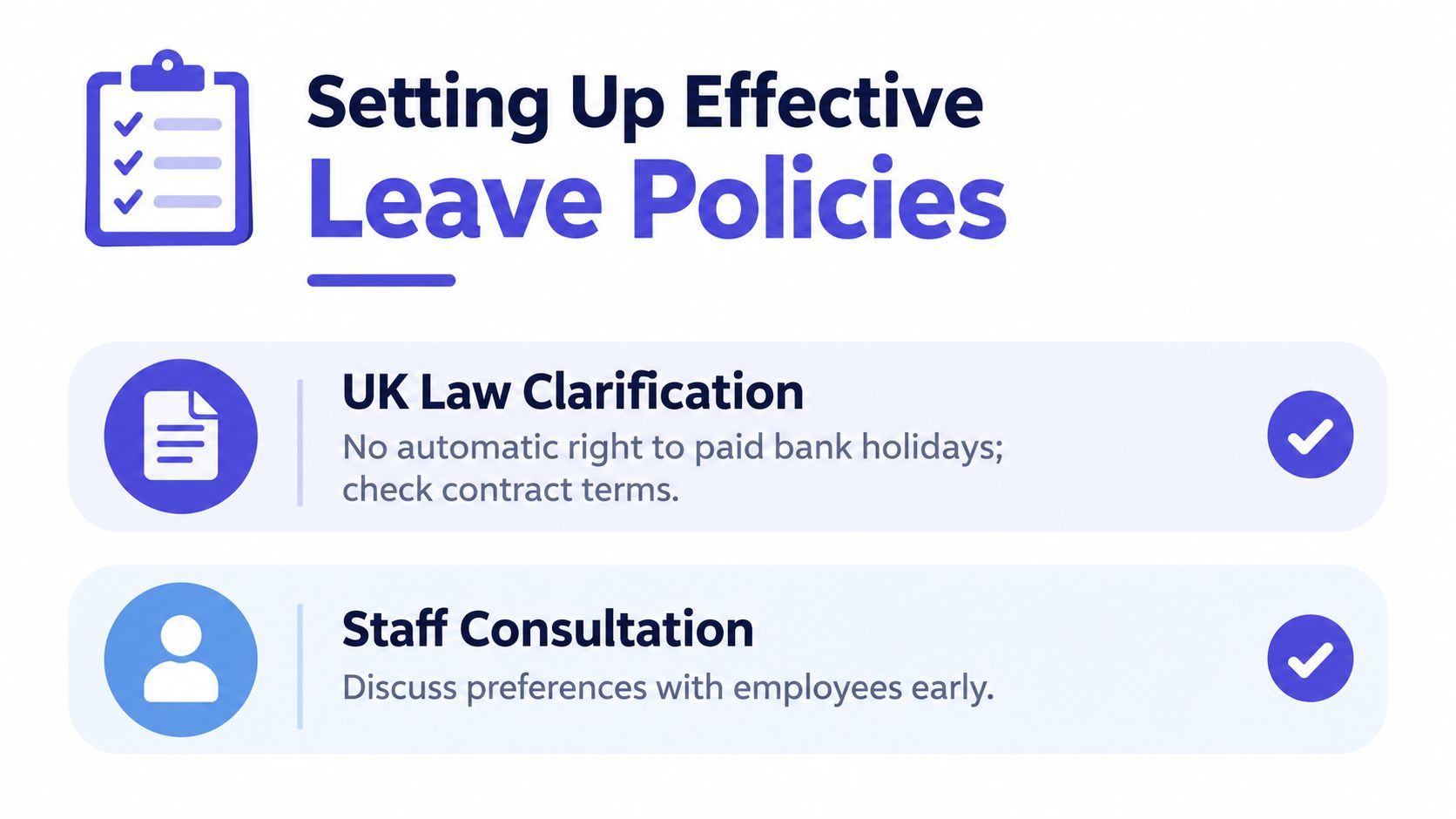
A Spring Bank Holiday request can expose a weak leave policy quickly. An employee may assume the day is extra paid leave, while the manager records it against annual allowance or expects normal attendance. UK employers do not automatically have to provide paid time off or additional pay for bank holidays. The day may be included in the statutory 5.6 weeks of annual leave, depending on the employment contract and workplace policy. The government guidance on holiday entitlement rights explains this distinction.
Write the policy so employees can check the answer without interpreting a general statement such as “bank holidays are holidays.” Specify whether bank holidays form part of annual leave, whether the business closes, how part-time workers are treated, and what happens when a bank holiday falls on a normal non-working day.
Build the policy around decisions employees can check
Use a short statement that covers:
- Define the entitlement. State whether bank holidays are included in annual leave or granted separately.
- Explain closure days. If the business closes, say how the closure is recorded and whether employees must reserve leave for it.
- Cover working arrangements. State whether employees may need to work and how managers communicate rota decisions.
- Handle part-time staff fairly. Explain how the day is recorded when it falls on a worker's usual working day or a non-working day.
- Set notice and approval rules. Give employees a clear request process and managers consistent approval criteria.
- Document enhanced arrangements. Record any additional pay or time off in the contract or policy, rather than relying on informal promises.
For practical guidance on calculations and statutory allowance, direct employees and managers to LeaveWizard's UK holiday entitlement guide.
The contract determines an individual's entitlement. The policy explains how the organisation administers it. Managers should check both before refusing a request or requiring attendance.
Consult before the busy period
Ask teams about planned absences early, particularly where several employees cover the same role, shift, or customer queue. Consultation cannot guarantee approval, but it gives employees a fair explanation when staffing requirements limit leave.
Keep the policy accessible and maintain a visible leave calendar. Record approved requests consistently, identify any closure days in advance, and review exceptions with the relevant manager. Clear rules, a consistent approval process, and accurate records prevent more conflict than a late reminder in a team chat.
Navigating Regional Variations Across the UK
A single “UK holidays” setting can mislead managers. Public-holiday dates differ across England, Wales, Scotland, and Northern Ireland, and the British Council's explanation of UK holidays notes that most institutions and businesses close on public holidays while regional calendars vary.
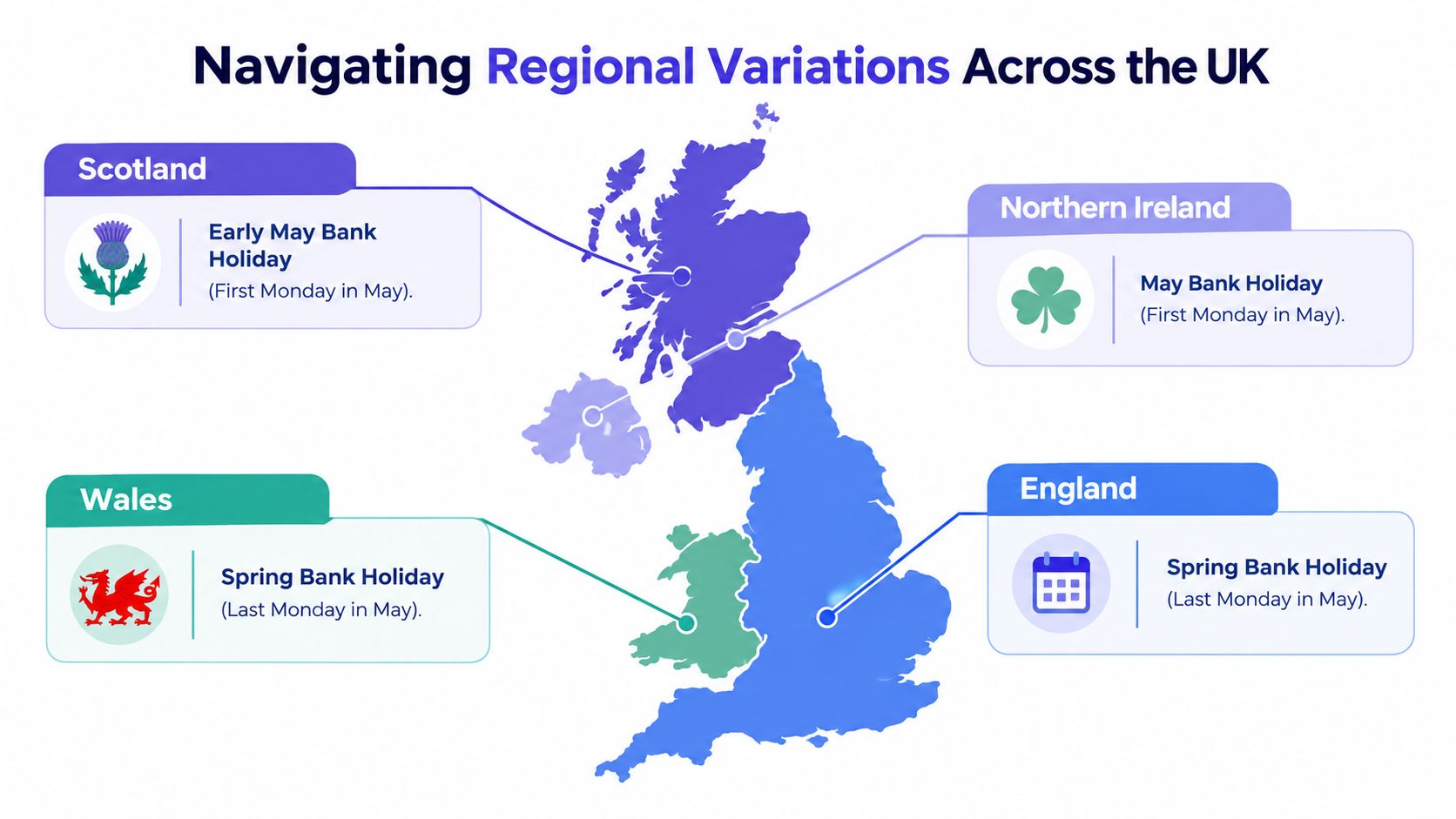
For the Spring Bank Holiday itself, the four nations broadly align around the late-May observance, but the surrounding calendars don't match. Official 2026 listings show England and Wales observing the Spring bank holiday on 25 May, Scotland also showing 25 May, and Northern Ireland including additional regional holidays such as St Patrick's Day and the Battle of the Boyne substitute day. Scotland has a different summer bank-holiday date from England, Wales, and Northern Ireland, which can affect later staffing plans.
Compare calendars before approving leave
| Region | Observance |
|---|---|
| England | Spring Bank Holiday on the last Monday in May |
| Wales | Spring Bank Holiday on the last Monday in May |
| Scotland | Spring Bank Holiday on the last Monday in May, with other regional dates differing |
| Northern Ireland | Spring Bank Holiday on the last Monday in May, with additional regional observances |
The table gives a useful starting point, not a complete scheduling rule. A Glasgow-based employee, a Belfast-based employee, and a London-based employee may have different non-working days elsewhere in the year, even when their Spring Bank Holiday date aligns.
Apply regional rules to people, not just offices
Assign each worker a location-based holiday calendar. Check the employee's contractual workplace, normal working location, and any arrangement that allows work from another nation. Then make sure the leave system calculates working days against the right calendar.
A spreadsheet may handle a single office adequately, but it becomes fragile when managers copy rows between regional tabs or manually adjust holidays. Use a documented regional field, approval checks, and a shared calendar view. For a location-specific reference point, managers can consult LeaveWizard's England bank-holiday guidance, then verify the applicable calendar for other nations before making decisions.
Managing Payroll and Staff Coverage
A bank holiday can leave payroll, rota planning, and service coverage out of step if HR treats the date as a standard day off. Start with each worker's contract and policy. The day may count within annual leave, be granted separately, or remain a normal working day for roles operating across the long weekend. As noted in the leave-policy section, the correct treatment depends on the employment arrangement.

Before payroll closes, HR and finance should reconcile approved leave, scheduled shifts, unpaid absence, and contractual enhancements. For employees working during the holiday, check the contract, collective arrangements, and internal policy for overtime or shift premiums. A bank holiday does not automatically create extra pay.
Coverage choices affect cost and staff relations. Relying on one employee to work repeated popular holidays may protect service temporarily, while increasing fatigue and retention risk. Rotate responsibility, agree flexible hours where practical, and cross-train colleagues so coverage does not depend on one person.
Use a service-based coverage check
List the work that must continue and assign a named owner:
- Customer queries: Set response expectations and nominate an on-call contact.
- Payroll and finance: Confirm cut-off dates and approval ownership before closure.
- Operations: Match staffing to expected demand rather than habit.
- Escalations: Define urgent issues and where staff should record them.
- Return-day work: Reserve time for backlog review instead of filling every hour with meetings.
A visual payroll and availability review lets managers compare shifts with approved leave before they publish the rota. It also gives finance a final opportunity to identify missing approvals or inconsistent pay treatment.
Proactive Planning for Business Continuity
Continuity planning works best when managers make decisions before leave requests become urgent. Begin with the 2026 calendar, mark Monday 25 May for the Spring Bank Holiday, and identify the work that could be delayed, delegated, or paused. Then ask each team leader to submit a coverage plan rather than just reporting who is absent.
Use a short planning cycle
- Review demand: Look at customer commitments, delivery dates, payroll deadlines, and regulated tasks around the holiday.
- Set minimum cover: Define the people or skills required for each essential process.
- Resolve conflicts early: If too many people request the same period, apply the published policy consistently and offer workable alternatives.
- Create handovers: Record open tasks, owners, deadlines, contact details, and escalation routes.
- Test access: Confirm that on-call staff can reach the systems and information they need.
- Schedule the return: Give managers a plan for reviewing urgent work when the business reopens.
Small businesses often plan the closure but forget the transition back to normal work. A short handover and an agreed first-day triage can prevent every unresolved issue from landing with the same manager.
For a broader framework, the Safety Space continuity plan example can help owners structure responsibilities, risks, communications, and recovery actions. For leave-specific planning, use this guide to planning leave effectively as a reference when setting approval deadlines and coverage rules.
Continuity principle: Every critical task needs a named owner, a fallback owner, and a clear point at which the issue is escalated.
Leveraging Leave Management Software
Manual spreadsheets can record requests, but they struggle to provide a reliable live view when several managers edit them, employees work in different regions, or approval decisions change close to the holiday. The practical test is simple. Can a manager see who is away, which requests are awaiting approval, and whether a team still has the skills needed to operate?
A dedicated leave platform can bring those decisions into one workflow. Employees submit requests through a self-service portal or smartphone app, managers approve or decline them, and HR retains a current calendar instead of reconciling email threads and separate files.
What automation should handle
Look for functions that reduce repetitive administration:
- Holiday calculations: Apply the relevant working-day rules and account for regional bank holidays.
- Approval routing: Send requests to the correct manager and retain a decision history.
- Availability views: Show planned absences alongside team and department schedules.
- Policy controls: Apply different rules for full-time, part-time, shift, and regional workers.
- Reporting: Give HR and finance a dependable absence record for planning and reconciliation.
- Employee visibility: Let staff check balances, submit requests, and view decisions without asking an administrator.
LeaveWizard is one option for small businesses. It provides leave calculations, approval workflows, regional calendars, real-time availability views, self-service access, and absence reports. Those capabilities don't replace a well-written policy. They make the policy easier to apply consistently and give managers better information before they commit to a rota.
The trade-off is implementation effort. A system needs accurate employee records, clear policies, and manager adoption. Moving a poorly defined process from a spreadsheet into software won't solve ambiguity. Configure the rules first, then use automation to make the agreed process visible and repeatable.
Preparing Your Team for Upcoming Holidays
Before the Spring Bank Holiday, confirm the applicable regional date, review contracts, collect requests, and test service cover. Give employees one clear source of truth, so managers are not rebuilding the process from emails and separate files.
For the 2026 planning cycle, England and Wales list the Spring Bank Holiday on 25 May. Scotland and Northern Ireland follow wider regional calendars, so record each employee's location and check the official bank-holiday tables before updating calendars or leave rules.
HR readiness checklist
- Calendar: Apply the correct holiday to every employee location.
- Contracts: Confirm whether the day is included in annual leave or treated separately.
- Requests: Set a submission deadline and explain who approves leave.
- Coverage: Assign owners for customer service, operations, payroll, and escalations.
- Payroll: Reconcile approved leave, shifts, and contractual pay treatment.
- Communication: Share closure, working, handover, and return-day arrangements early.
- Records: Keep the approved schedule and decisions available for future checks.
The goal is predictable absence, not restricted leave. A visible calendar, clear regional rules, and early communication help employees take time off while small businesses maintain appropriate customer service.
LeaveWizard helps small businesses calculate holiday entitlement, route approvals, and view availability across teams and regional calendars. LeaveWizard can replace scattered spreadsheets with a clearer leave process. Configure policies and employee records first, then use the system to apply decisions consistently and identify coverage gaps before the holiday.