
Let's be honest, getting your head around UK holiday entitlement can feel like a bit of a minefield. But at its heart, the baseline is refreshingly simple: nearly every worker in the UK has a legal right to 5.6 weeks of paid holiday each year.
This isn't just a nice-to-have perk; it's a statutory right baked into UK employment law. Think of it as the absolute legal floor for annual leave—a non-negotiable minimum designed to make sure everyone gets enough time to rest and recharge.
Demystifying UK Statutory Holiday Entitlement
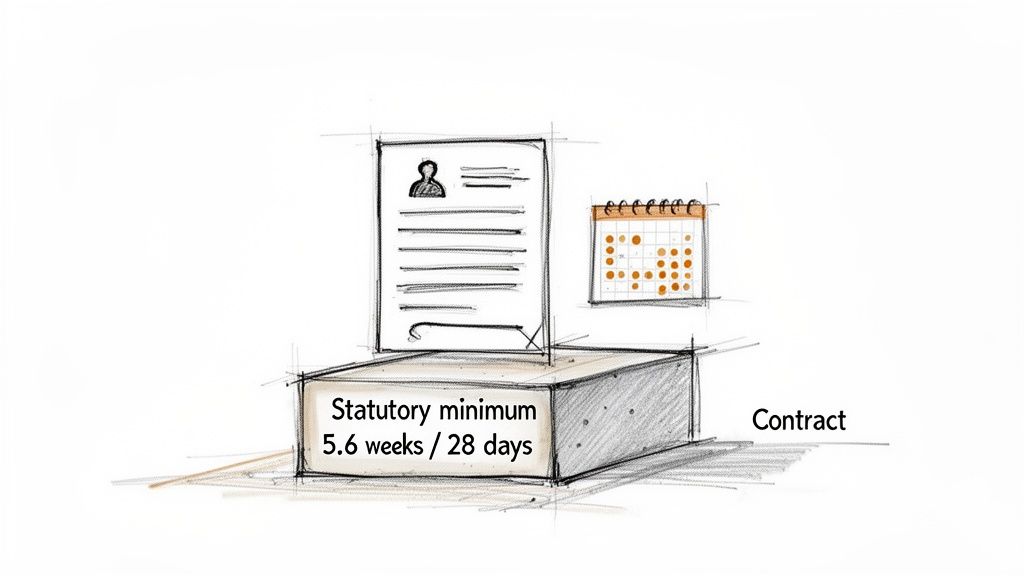
As an employer, understanding your obligations starts with that word: "statutory". It's the legal minimum you must provide. Of course, you can always offer more—and many businesses do to attract top talent—but you can never, ever offer less.
For a full-time employee on a typical five-day week, this 5.6 weeks translates neatly into 28 days of paid annual leave. This has been the standard since April 2009, when the entitlement was increased from the previous 24 days under the Working Time Regulations 1998.
To help you get a quick overview, here's a simple breakdown of the core rules:
UK Statutory Holiday Entitlement At A Glance
| Entitlement Component | Legal Minimum (Full-Time) | Key Consideration For Employers |
|---|---|---|
| Total Annual Leave | 5.6 weeks (equivalent to 28 days) | This is the minimum; you can offer more but not less. |
| Bank Holidays | No automatic right to time off | Your contract must clearly state if bank holidays are included in or on top of the 28 days. |
| Part-Time Staff | Pro-rata entitlement | Must receive the same holiday entitlement, calculated proportionally to hours worked. |
| Payment In Lieu (PILON) | Only on termination of employment | You cannot 'pay out' statutory holiday instead of letting staff take it during the year. |
| Carry-Over | Limited circumstances | Rules for carrying over leave are strict and typically relate to sickness or parental leave. |
This table covers the basics, but as you can see, things like bank holidays and part-time staff bring their own set of questions.
The Role of Bank Holidays
Here’s where a lot of business owners get tripped up. How do bank holidays fit into the equation? The law is actually quite flexible on this point.
- No Automatic Right to Time Off: It might sound surprising, but your staff don't have an automatic legal right to take bank holidays off.
- Included in the 5.6 Weeks: You can absolutely choose to include the bank holidays as part of their statutory 28 days.
- Offered in Addition: Alternatively, you can give bank holidays on top of the 28-day minimum as a contractual benefit.
The golden rule here is clarity. Your employment contracts need to spell out exactly how bank holidays are handled to prevent any confusion down the line. For a closer look, you can find more details in our complete guide on https://www.leavewizard.com/statutory-holiday-entitlement-in-the-uk/.
Why This Matters for Your Business
Getting holiday entitlement right isn’t just about ticking a compliance box. It’s a fundamental part of running a fair and legal business, impacting everyone from your full-timers to part-time and irregular-hours staff. It's also crucial to correctly classify your team, as the risks of engaging employees as sham contractors are significant.
At its core, statutory holiday entitlement is a cornerstone of modern UK employment law. It acknowledges that rest is a right, not a perk, contributing to a healthier, more productive workforce.
Get it wrong, and you could be facing disputes, employment tribunals, and serious damage to your company’s reputation. But by understanding the 'why' behind the rules, you can build a holiday policy that is not only legally sound but also shows your team you genuinely care about their well-being. And that makes your business a much better place to work.
Calculating Holiday Pay For Different Work Patterns
Getting your head around the 5.6-week rule is the first step, but the real test is applying it correctly across your team. Holiday entitlement isn't a one-size-fits-all calculation; different work patterns demand different sums. Getting the maths right is absolutely critical for staying compliant and, just as importantly, being fair to your staff.
Let's break down the calculations for each type of employee, from the most straightforward scenario to the trickiest ones. This will ensure every member of your team gets the precise holiday time they're legally entitled to under UK regulations.
Full-Time Employees With Fixed Hours
This is the easiest one to tackle. For an employee working a standard five-day week, their holiday entitlement is simply their working week multiplied by the statutory minimum.
- Formula: 5 days per week × 5.6 weeks = 28 days of paid annual leave.
If your full-time staff work a different pattern, say four days a week, the same logic applies. You’re just adjusting the starting number.
- Example: 4 days per week × 5.6 weeks = 22.4 days of paid annual leave.
It’s common practice for employers to round fractions up to the nearest half or full day to keep things simple. While you’re not legally required to do this, you must never round down.
Part-Time Employees
Part-time employees are entitled to the same 5.6 weeks of holiday, but it's worked out on a pro-rata basis. This just means their entitlement is proportional to the time they work.
Think of holiday entitlement like a cake. A full-time employee gets the whole cake, while a part-timer gets a slice that's the same relative size as their working week.
Let’s take an employee who works three days a week.
- Calculation: 3 days per week × 5.6 weeks = 16.8 days of paid annual leave.
This approach ensures a part-time worker receives the same amount of time off relative to their schedule as their full-time colleagues. In essence, they get 5.6 of their own working weeks off.
Irregular Hours and Zero-Hours Contracts
For a long time, figuring out holiday for workers with no fixed hours was a massive headache for employers. Many fell back on the old "12.07% method," but recent legal shifts have finally cleared things up.
For leave years starting on or after 1st April 2024, the government has thankfully simplified the process for irregular hours and part-year workers. Holiday now accrues based on the actual hours they work in a pay period.
The new standard is that holiday entitlement is calculated as 12.07% of the actual hours worked in a pay period. This percentage comes from the statutory 5.6 weeks of leave, divided by the remaining 46.4 working weeks of the year (52 – 5.6).
Here's how this works in practice for someone on a zero-hours contract:
- Track Hours Worked: Let's say an employee works 80 hours in a given month.
- Calculate Holiday Accrued (in hours): 80 hours × 12.07% = 9.656 hours of paid holiday.
- Pay for Holiday: When they take this leave, you pay them for those 9.656 hours at their average hourly rate.
This method directly ties their holiday entitlement to the work they’ve actually done, removing all the guesswork and creating a much more transparent system. Of course, tracking this manually can be incredibly time-consuming, which is why many businesses now use tools that automatically calculate holiday pay to guarantee accuracy and cut down on admin.
It's also useful to remember that holiday pay is just one piece of the puzzle when it comes to an employee's total rewards. For a deeper understanding of how this fits into the bigger picture, you can learn more about how to calculate total compensation accurately.
Ultimately, mastering these calculations is about more than just numbers. It’s about showing you’re committed to fair and lawful employment practices, which builds trust and boosts morale across your entire team, no matter what their working pattern looks like.
Managing Bank Holidays, Sickness, And Leave Carry-Over
Once you’ve got the basic holiday calculations down, you'll inevitably run into the trickier, real-world situations. What happens when an employee gets sick during their holiday? Do you have to give bank holidays off? And what are the rules around carrying unused days into the next year?
These are the questions that can trip up even experienced managers. Having a clear, legally sound policy isn't just about ticking boxes; it's your best defence against confusion and disputes. Let's walk through how to handle these three common complexities fairly and consistently.
The Truth About Bank Holidays
One of the most persistent myths in UK employment law is that staff have an automatic right to a paid day off for bank holidays. That’s simply not true. The reality is much more flexible and comes down to one thing: what's written in the employment contract.
As a business, you have a few ways to approach the eight annual bank holidays in England and Wales:
- Include them in the statutory 28 days: This is a common approach. You can state that the 28 days of annual leave are inclusive of bank holidays. If an employee has to work on one, you must let them take that day off at another time.
- Offer them on top of the 28 days: Many employers offer bank holidays as an extra perk. This creates a more generous package of 36 days off in total (28 + 8).
- Require staff to work: For businesses in sectors like retail or hospitality, working on bank holidays is often essential. The contract just needs to make this clear, and employees are still entitled to their full 5.6 weeks of leave to take at other times.
The golden rule here is clarity. Your employment contract must spell out exactly how bank holidays are handled to prevent any misunderstandings down the line.
When Sickness and Holidays Collide
So, what happens if an employee falls ill right before or during a pre-booked holiday? It can feel like a grey area, but the legal position is surprisingly straightforward. If an employee is genuinely sick, they are on sick leave, not annual leave.
This means they have the right to "reclaim" their holiday days and take them later. To manage this properly, your policy should insist that employees follow your standard sickness reporting procedure, even if they're away. That includes calling the right manager and providing a doctor's note if the illness lasts more than seven days.
An employee who is unfit for work is entitled to be on sick leave, regardless of whether they had previously booked that time as a holiday. The entire point of annual leave is for rest and relaxation, which illness completely undermines.
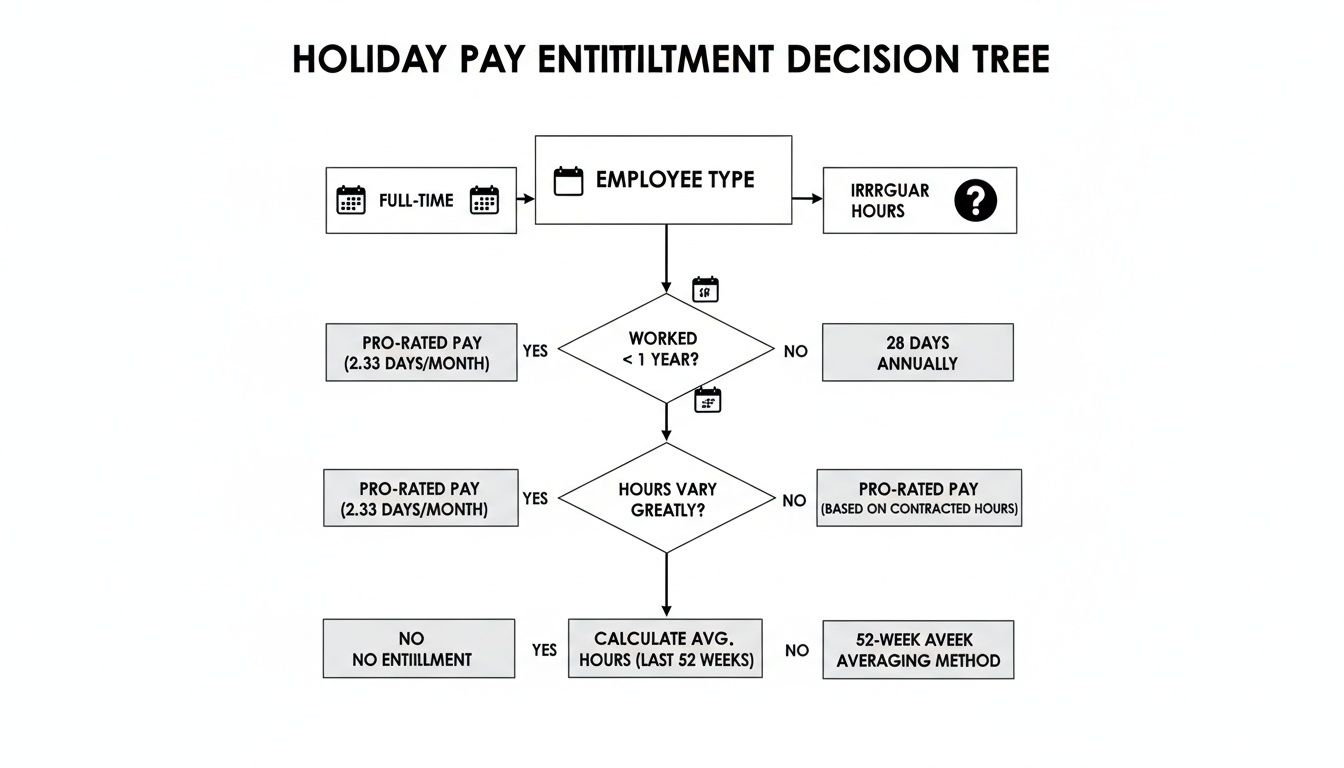
This decision tree shows how holiday pay calculations branch out based on an employee's work pattern, from fixed-hour contracts to more variable arrangements.
Demystifying Leave Carry-Over Rules
The old "use it or lose it" attitude is common, but what does the law actually say about carrying holiday into the next leave year? The statutory rules are quite specific, though you always have the flexibility to offer more generous terms.
The statutory 5.6 weeks of leave is split into two distinct pots:
- 4 weeks (from EU law): This chunk can only be carried over if an employee was physically unable to take it, for example, due to long-term sick leave or statutory family leave (like maternity).
- 1.6 weeks (a UK-specific top-up): You can allow this portion to be carried over into the next leave year, but only if there's a written agreement in place with your employee.
Many businesses choose to offer a limited carry-over—say, up to five days—as a contractual benefit. This can be a really valuable perk, especially given the recent cultural shift towards taking time off. Unused annual leave has plummeted by 71% since 2019, dropping from 18.5 days per person to just 5.3 days in 2024, as highlighted in this report on annual leave statistics. Whatever you decide, your policy needs to be crystal clear on how many days can be carried over and the deadline for using them.
Holiday Entitlement During and After Employment
An employee's holiday entitlement isn't just a static figure you set at the start of the year. It’s a living thing that grows from their first day and only gets settled up on their final payslip. Getting this right is crucial for a smooth welcome for new joiners and a legally sound farewell for leavers.
The moment a new person joins your team, their holiday pot starts to fill up – or accrue, in official terms. This kicks off from day one, even if they're still in their probationary period. Each month, they earn one-twelfth of their total annual entitlement.
This system keeps things fair for people who start part-way through your company's leave year. They're legally entitled to a pro-rata slice of the full 28-day statutory minimum, based on how much of the year they'll actually be working for you.
Calculating Entitlement for New Starters
Working this out is pretty straightforward. Let's say your holiday year runs from January to December, and a new full-time employee starts on 1st July. They'll be with you for six months of that leave year.
Here’s the simple sum:
- (28 days / 12 months) × 6 months worked = 14 days of holiday for the rest of the year.
This pro-rata calculation means new starters get the leave they're due without having to wait for the next holiday year to roll around. It's a small but vital part of managing their onboarding properly and staying on the right side of the law.
Calculating Final Holiday Pay on Termination
When someone leaves, their final payslip is one of the most important calculations you'll make. You absolutely must pay them for any statutory holiday they've accrued but haven't taken. This is a legal requirement, and it’s a key part of the offboarding process.
The calculation is much the same as for a new starter. You just need to figure out what proportion of their annual leave they've earned up to their final day.
Example of a Leaving Employee:
Sarah, a full-time employee, is leaving on 30th June. Your company's leave year is January to December, so she's worked for exactly half the year (6 months). She's already taken 10 days of holiday.
- Calculate Accrued Leave: (28 days / 12 months) × 6 months = 14 days accrued.
- Calculate Untaken Leave: 14 days accrued – 10 days taken = 4 days untaken.
- Final Payment: You must pay Sarah for these 4 untaken days in her final salary.
Following this process ensures departing employees are paid fairly for the leave they’ve rightfully earned. It's the professional way to wrap up their employment.
When an Employee Has Taken Too Much Leave
Now and then, you get the opposite situation: an employee leaves after taking more holiday than they’ve actually accrued. Imagine someone takes a two-week holiday in February but hands in their notice in March.
So, can you get that money back? The short answer is yes, but only if you have a crystal-clear clause in their employment contract that explicitly says you can.
Without that specific clause, you have no legal right to deduct the value of that "excess" holiday from their final pay. This is a massive reason to double-check your employment contracts. A well-worded clause here protects your business and makes the offboarding process much less awkward for everyone.
Why Accurate Record Keeping Is Non-Negotiable
Knowing the rules around legal holiday entitlement UK is one thing, but being able to prove you’ve followed them is another beast entirely. This is the point where meticulous record-keeping stops being a simple admin chore and becomes a critical legal safeguard for your business. It’s the very backbone of compliance.
As an employer, you have a legal duty to keep adequate, accurate records demonstrating you're meeting your obligations under the Working Time Regulations. If you don’t, the consequences can be serious, especially if a disagreement with an employee escalates to an employment tribunal.
Without a clean paper trail, you have very little to stand on against claims of underpayment or leave being denied. The burden of proof almost always falls on the employer to show they've done everything by the book, and a messy spreadsheet just won't cut it under legal scrutiny.
The Pitfalls of Manual Tracking
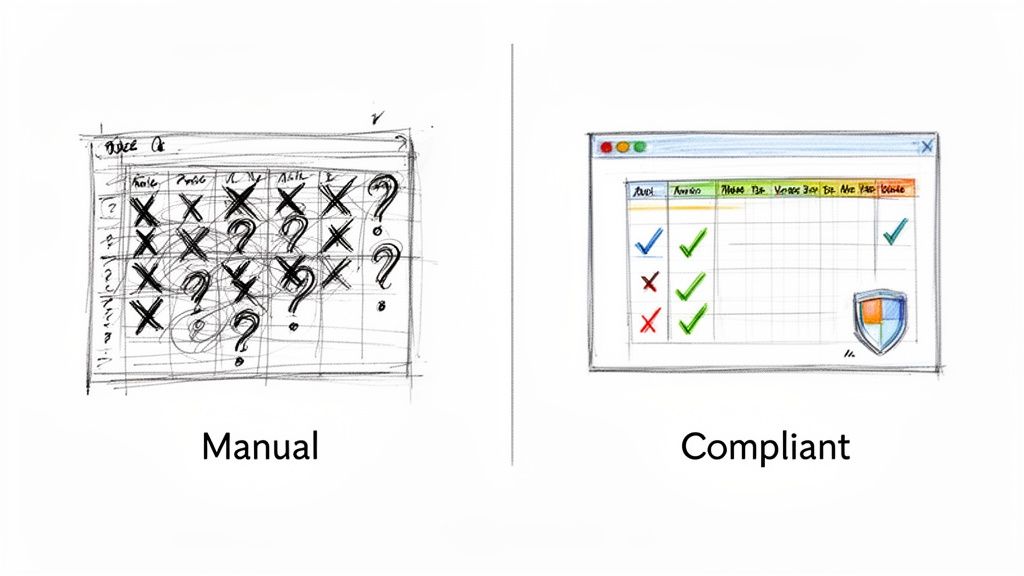
For many small businesses, the go-to tool for tracking holidays is a spreadsheet. It seems simple and free, but this manual approach is riddled with risks that can completely undermine your compliance efforts and create massive administrative headaches.
Human error is the number one culprit. A tiny typo in a formula or an accidentally deleted row can throw off holiday calculations, leading to payroll mistakes and chipping away at employee trust. These "small" mistakes have a nasty habit of snowballing into much bigger, more expensive problems.
On top of that, spreadsheets offer zero real-time visibility. Managers can't easily see who's off and when, making it a nightmare to approve requests, plan workloads, or stop half the team from booking the same week off. This lack of a central, accessible system creates operational jams and a lot of frustration, a world away from modern, automated staff holiday tracking.
From Compliance Tool to Strategic Asset
Moving away from manual methods isn't just about dodging legal bullets; it’s a smart, strategic move. A dedicated leave management system turns record-keeping from a reactive chore into a proactive tool for better business planning and a healthier company culture.
These systems automate all the fiddly calculations for different work patterns, ensuring everyone—from full-timers to zero-hours staff—gets their exact entitlement. This isn't just about compliance; it's about creating a transparent, fair environment where people feel valued.
Accurate, accessible holiday records are a sign of a well-run business. They demonstrate fairness, support operational planning, and provide a solid legal defence, making them an indispensable asset for any employer.
Manual Spreadsheets Vs Automated Leave Management
The difference between clinging to spreadsheets and adopting a purpose-built system is night and day. One path is paved with admin burdens and legal risks, while the other offers efficiency and genuine peace of mind.
Let's look at a direct comparison of the two approaches.
| Feature | Manual Spreadsheets | Automated System |
|---|---|---|
| Accuracy | Prone to human error, typos, and formula mistakes. | Guaranteed accuracy with automated, compliant calculations. |
| Visibility | Limited, often outdated, and not accessible to the whole team. | Real-time visibility via a central calendar for easy planning. |
| Employee Access | None. Employees must email or ask managers for balances. | Self-service portal for staff to check balances and request leave. |
| Reporting | Manual and time-consuming to create absence reports. | Instant reports on leave patterns, balances, and Bradford Factor. |
| Compliance Risk | High. Difficult to prove compliance during a dispute. | Low. Creates an auditable trail of all leave records. |
When it comes down to it, accurate record-keeping is the final, crucial piece of the legal holiday entitlement UK puzzle. It’s what connects your understanding of the law to your practical, day-to-day proof of upholding it—protecting your business and supporting your team in the process.
Your UK Holiday Entitlement Questions Answered
When you're running a business, navigating the rules around holiday pay can throw up some tricky, real-world questions. This final section is your go-to guide for those common queries, giving you clear, straightforward answers to help you handle those niche situations with confidence.
How Much Notice Does An Employee Have To Give To Book Leave?
This is a classic point of confusion. While it's always best to set your own rules in the employment contract, there's a legal default if you haven't specified anything.
The statutory rule is beautifully simple: an employee must give notice that is twice as long as the leave they want to take.
- To book one day off, they need to give two days' notice.
- For a two-week holiday, they need to provide four weeks' notice.
Even with this fallback, I’d strongly recommend setting out your own notice periods in your holiday policy. It gives you much more control over staffing levels and helps you avoid being left short-staffed, especially during your busiest times.
Can I Refuse A Holiday Request?
Yes, you absolutely can refuse a holiday request, but you can't just say "no." You need a solid business reason and you must give the right amount of notice.
To turn down a request, you must give notice that is at least as long as the holiday being asked for. So, if an employee wants one week off, you have to tell them 'no' at least one week before their holiday was supposed to start.
Good reasons for refusal usually boil down to practicalities like:
- The employee didn't give you enough notice.
- The request falls during a critical business period.
- Too many other people are already scheduled to be off at the same time.
Always put the reason for the refusal in writing. Being transparent helps maintain a good relationship with your team and demonstrates you're being fair and consistent.
Do Part-Time Workers Get Bank Holidays Off?
This is one of the most frequent mix-ups I see. Part-time workers don't automatically get bank holidays off. The key is to treat them fairly compared to full-timers, which means their entitlement is calculated on a pro-rata basis.
Think of it like this: a full-time employee gets 28 days of leave, which includes the 8 bank holidays. A part-timer working three days a week is entitled to a proportion of that total, which comes out to 16.8 days.
If a bank holiday falls on one of their normal working days, that day is simply subtracted from their 16.8-day total. If it falls on a day they don't work, nothing happens – they don't get an extra day in lieu unless your contract says otherwise. The goal is to ensure their total paid time off is proportional to the hours they work.
What Happens To Holiday Entitlement During Maternity Leave?
An employee on maternity, paternity, adoption, or shared parental leave continues to build up their holiday entitlement as if they were still at work. This is a non-negotiable right.
Since it’s usually impossible for them to use this holiday while they're away, this is one of the few situations where the law is crystal clear about carrying leave over.
- Employees must be allowed to carry over any untaken statutory holiday into the next leave year.
- It's a good idea to chat with them about taking some of their accrued leave before their family leave starts, or agree on a plan for them to use it when they return.
- If their employment ends during or just after their maternity leave, you can also agree to pay them for any holiday they couldn't take.
Getting this right is a vital part of supporting your team through major life events and staying on the right side of UK employment law.


