
On average, a standard year in the UK has 253 working days. This number isn't just trivia; it's the starting point for some of the most critical calculations your business will make.
Understanding Your UK Working Days
Figuring out "how many working days in a year" might seem like a simple question, but the answer is the bedrock of effective business planning. It's a crucial metric that directly impacts payroll, project timelines, and how you allocate resources across your team. Getting it right is fundamental to running a smooth operation and managing your staff fairly.
Think of this initial number as the maximum operational capacity for your business—before you even begin to factor in individual employee holidays or absences. It gives you a clear, company-wide baseline. But of course, it's just the first step. To get a truly accurate picture, you need to dig a little deeper.
Factors That Adjust the Total
That baseline figure of 253 days isn't set in stone. It shifts based on a few key variables that every manager needs to keep in mind:
- Leap Years: A leap year, like we had in 2024, adds an extra day to the calendar. This bumps the total up to 254 working days, which can be an unexpected curveball for HR managers juggling rotas if they haven't planned for it. You can find out more about how leap years impact planning with these working day insights.
- Annual Leave: Every UK employee is entitled to paid holiday, and each day they take directly reduces their personal number of working days for the year.
- Flexible Schedules: The rise of part-time contracts and compressed hours means you can't apply a one-size-fits-all number. Each employee's available days will be unique to their schedule.
To help you get started, here is a quick breakdown of how the standard working days are calculated for the UK.
UK Working Days At a Glance
The table below breaks down the calculation for a standard and a leap year, assuming the 8 bank holidays in England and Wales.
| Calculation Component | Standard Year | Leap Year |
|---|---|---|
| Total Days in the Year | 365 | 366 |
| Less Weekend Days (104) | -104 | -104 |
| Less Bank Holidays (8) | -8 | -8 |
| Total Working Days | 253 | 254 |
Remember, this table provides the most common baseline for a full-time employee. Public holidays can vary across Scotland and Northern Ireland, which would adjust the final count.
By understanding these initial components, you can move from a generic number to a precise calculation tailored to your business and team. This foundation is essential for everything from accurate forecasting to maintaining legal compliance.
Nailing down these nuances sets the stage for creating a realistic and practical work calendar for your entire organisation.
The Simple Formula for Calculating Working Days
Trying to figure out the exact number of working days in a year shouldn't feel like you're back in a maths lesson. It’s actually a pretty straightforward process that starts with a simple subtraction formula anyone can get their head around.
Getting this number right is the bedrock of all your resource planning, project timelines, and, of course, your leave management.
Everything kicks off with the total number of days in the year. For a standard year, that’s 365 days, and for a leap year, it’s 366. From this starting point, we just need to chip away at the days people aren’t expected to be at work.
Your Step-by-Step Calculation
The first, and biggest, chunk to come off is the weekends. With 52 weeks in a year, that means we get to subtract 104 days for all the Saturdays and Sundays. Straight away, this dramatically reduces the number of potential working days and gives us a much clearer picture of our actual operational time.
Next up are public holidays. In England and Wales, you're looking at 8 bank holidays in a typical year. Just remember, this figure can shift depending on where you are – Scotland usually has 9 and Northern Ireland has 10, so always use the correct number for your specific location.
The Basic Formula:
Total Days in Year (365/366) – Weekend Days (104) – Bank Holidays (8) = Total Working Days
This simple equation turns the vague question of "how many working days in a year?" into a concrete, usable number. It gives you a solid foundation before you even start thinking about employee-specific deductions like annual leave.
Breaking it down like this also makes it easier when you need to figure out the number of business days per month.
This flowchart breaks down the standard calculation for a year in the UK, making it even clearer.
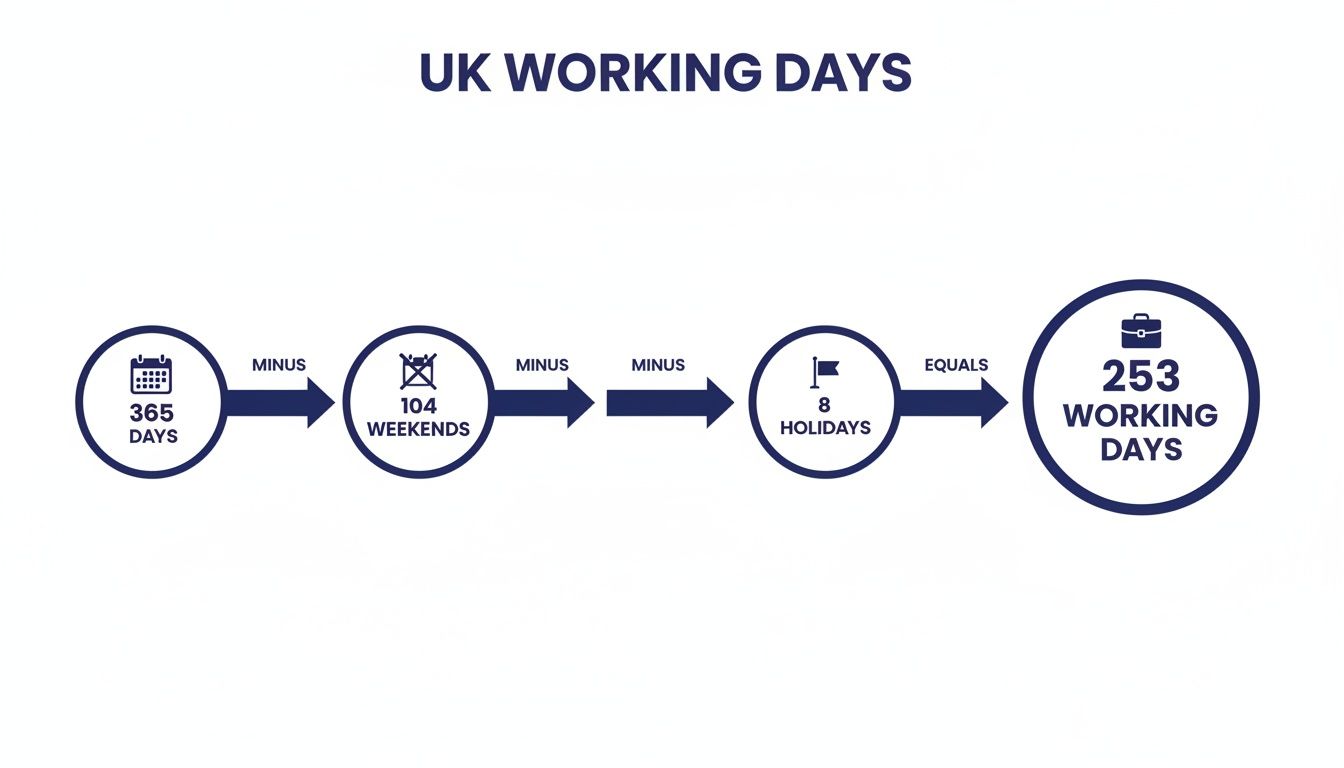
As you can see, starting with 365 days and stripping out the weekends and bank holidays leaves you with a baseline of 253 working days. That’s your magic number for planning your resources.
Accounting for Holidays and Employee Leave
That baseline figure of 253 working days is a great starting point. Think of it as your business's maximum operational capacity for the year. But here's the thing: it's not the reality of your workforce. To get a true picture of an individual's available working days, we need to start peeling back the layers, beginning with their personal time off.

This next step is where the calculation gets personal. We move from a generic, company-wide number to a meaningful metric for each team member. It's the difference between knowing how many days your doors are open and knowing how many days a specific employee is actually there to contribute.
Subtracting Statutory Annual Leave
Here in the UK, every full-time employee has a legal right to a minimum of 28 days (or 5.6 weeks) of paid holiday each year. This statutory minimum is the first number we need to subtract.
However, you'll need to double-check their employment contract. It's very common for businesses to include the 8 bank holidays within this 28-day total. If that's the setup at your company, the employee actually has 20 days of personal holiday to book, since we've already accounted for the bank holidays in our initial calculation.
Let’s see how that works in practice:
- Company-wide baseline: 253 working days
- Employee's personal holiday: 20 days
- Employee's actual working days: 253 – 20 = 233 days
Just like that, we have a much more accurate view of this particular employee's availability for the year. If you want to get into the nitty-gritty of the rules, you can dive deeper into annual leave entitlement in our dedicated guide.
Other Types of Employee Absences
Of course, planned holidays are only part of the story. People get sick, have family emergencies, and go on training courses. These other absences also chip away at an employee’s total working days. While you can't predict them with the same certainty as annual leave, they're an essential piece of the puzzle for realistic workforce planning.
These variables include things like:
- Sick leave: Unplanned time off due to illness.
- Compassionate leave: Time off for family emergencies.
- Training days: Off-site workshops or internal development sessions.
- Maternity or paternity leave: Longer, planned periods of absence.
Tracking these different leave types isn't just admin for the sake of it; it's a strategic necessity. When you track everything meticulously, you get a clear, real-time view of your team’s capacity. This helps prevent project delays and stops workloads from spiralling out of control.
Calculating for Part-Time Staff and Pro-Rata Rules
The one-size-fits-all approach to calculating working days quickly falls apart when you bring a flexible workforce into the mix. For part-time staff, fairness and legal compliance really boil down to one key principle: pro-rata. It’s a simple concept – an employee's entitlement to paid leave should be directly proportional to the hours they work.
Think of your full-time staff's leave allowance as a whole cake, giving them the full 28 days of statutory leave. A part-time employee working three days a week gets a proportional slice of that cake, not the whole thing. Nailing this calculation is vital for building trust and heading off any potential disputes before they start.
The maths behind it is refreshingly straightforward. You just need to figure out what fraction of a full-time week the employee works and then apply that same fraction to the total holiday allowance. This way, everyone is treated fairly, no matter their work pattern.
The Pro-Rata Holiday Formula in Action
Let’s walk through a scenario you’ll likely encounter. A full-time employee at your company works five days a week and gets the statutory minimum of 28 days annual leave, including bank holidays. You then hire a new team member who will be working three days a week.
Here’s how you’d figure out their holiday allowance:
- Find the fraction: The employee works 3 days out of a possible 5, so the fraction is (3 ÷ 5), which equals 0.6.
- Apply it to the full allowance: Now, multiply this fraction by the full-time holiday entitlement.
- Calculate the total: 0.6 x 28 days = 16.8 days of paid leave per year.
It’s common practice to round this up to the nearest half or full day for simplicity, making it 17 days. This quick calculation ensures your three-day-a-week employee receives exactly 60% of the holiday entitlement, perfectly matching their 60% working pattern. You can adapt this method for any schedule, from two days a week to four.
Handling Bank Holidays Fairly
Bank holidays often throw a spanner in the works for part-time staff, especially for those who don't happen to work on Mondays. A common mistake is to only grant them the day off if a bank holiday lands on one of their scheduled workdays. This approach isn't just unfair; it can also put you on the wrong side of compliance.
The correct and fair method is to include all bank holidays within the pro-rata calculation from the start. This way, an employee receives a proportional entitlement to every bank holiday, regardless of which day of the week it falls on.
For our three-day-a-week employee with 16.8 days of leave, if a bank holiday falls on one of their normal workdays, you simply deduct a full day from their total allowance. If it falls on a day they don't typically work, their allowance stays untouched, and they can use that day off at another time.
This ensures that an employee whose schedule is Tuesday-Thursday isn't penalised compared to a Monday-Wednesday worker. It’s a small detail, but it’s absolutely crucial for fair and effective management.
Why This Number Is Critical for Your Business Success
Figuring out the number of working days in a year might sound like a simple maths problem, but it’s actually one of the most important pillars of good business planning. This one figure is the bedrock for building accurate project timelines, setting realistic budgets, and managing your people fairly. Get it wrong, and you can introduce serious risks that ripple through the whole company.
Imagine a project manager confidently setting a launch date, totally unaware their team’s real capacity is much lower because of unaccounted-for holidays. Or a finance lead forecasting revenue based on flawed productivity data. It’s these small miscalculations that quickly snowball into missed deadlines, blown budgets, and operational chaos.
The True Cost of Inaccuracy
The risks go far beyond a few scheduling headaches. Inaccurate calculations can land you in hot water with UK employment law, especially around annual leave and pay. For solid financial planning and handling staff transitions, getting the working days right is essential. It's particularly vital when estimating termination costs, where an accurate day count is fundamental for tools like an Ontario severance pay calculator.
When you don’t have a clear picture of your workforce's actual availability, you risk creating a culture where people feel overworked and undervalued. This has a direct, and often negative, impact on their well-being and, ultimately, your bottom line.
A business that doesn't accurately track working days is essentially flying blind. It compromises your ability to allocate resources effectively, protect employee welfare, and make informed strategic decisions for growth.
More Than a Number: It's About People
At the end of the day, this calculation is about more than just numbers—it’s about your people. When leave and working days are managed with transparency and fairness, it fosters a culture of trust and respect. Your team feels secure, knowing their entitlements are calculated correctly and that their workload is based on what's genuinely possible.
On the flip side, a system riddled with errors leads to frustration, burnout, and disengagement. In the UK, a staggering 40.1 million working days were lost to ill health and injuries in 2024/25, with stress being a massive contributor. These absences show the huge financial and operational hit that comes from not managing workloads and well-being properly—all of which starts with an accurate working day count. For a bit of historical context, it's interesting to see just how many days people worked in England before the industrial revolution.
Treating this calculation with the seriousness it deserves is one of the most powerful things you can do to build a positive, productive, and resilient company culture.
Right, after wading through all the maths behind annual leave, pro-rata rules, and regional bank holidays, it’s pretty clear that sticking with manual spreadsheets is a high-stakes game. One tiny formula error or an out-of-date calendar can easily spiral into compliance headaches, payroll nightmares, and unhappy staff. This is exactly where modern software can step in and take that administrative burden right off your plate.
Automated leave management systems are built to handle every single variable we've talked about. They completely remove the guesswork. The system automatically calculates how many working days in a year each employee has, factoring in everything from their unique work pattern to the correct public holidays for their part of the UK.
This kind of tool isn't just a fancy calculator; it’s a strategic asset that brings clarity and confidence to your entire operation.
Get Real-Time Visibility and Control
Imagine having a single dashboard that shows you, at a glance, who’s in, who’s off, and what your team’s capacity looks like for the next month. That’s what automation delivers.
It turns those tedious, error-prone admin tasks into a smooth and reliable process:
- Spot-On Entitlements: The system nails complex pro-rata allowances for your part-time and flexible workers, ensuring everyone is treated fairly and you’re always legally compliant.
- Effortless Approvals: Staff can request leave through a simple app, and managers can approve it with a click, all while seeing real-time team availability so there are no clashes.
- Plan with Confidence: With a crystal-clear view of your workforce, you can map out projects, build rotas, and manage deadlines without that nagging fear of being caught short-staffed.
By automating all these calculations, you’re not just saving time—you’re freeing up your energy to focus on what actually grows your business. Find out more about getting started with our employee leave management software and see the difference it can make.
Still Got Questions About Working Days?
Even after you've run the numbers, a few specific scenarios can trip you up. It’s completely normal. Let’s tackle some of the most common questions we hear from UK business owners and HR managers, giving you clear, straightforward answers to help you manage your team with confidence.
How Do I Handle Bank Holidays for Part-Time Employees?
This is a big one, and getting it right is crucial for treating your part-time staff fairly. The simple answer is that employees are entitled to bank holidays on a pro-rata basis – meaning their allowance is directly proportional to the hours they work.
If a bank holiday falls on a day they would normally be working, it's easy – they just get that day off as paid leave. But what if it falls on their non-working day? They shouldn't be penalised for that. In this case, they should get a proportional amount of paid time off in lieu to use another time. This ensures someone who doesn't work Mondays isn't unfairly disadvantaged compared to their colleagues.
Does the Number of Working Days Vary Across the UK?
Yes, it absolutely does. While we all get the same weekends, the number of bank holidays changes from country to country, which has a direct knock-on effect on the total number of working days in a year.
Here’s a quick breakdown of a typical year:
- England and Wales: With 8 bank holidays, you get 253 standard working days.
- Scotland: They typically have 9 bank holidays, which brings the total down to 252 working days.
- Northern Ireland: Enjoying 10 bank holidays leaves them with 251 working days.
If your team is spread out across different UK nations, you have to apply the correct local holiday calendar for each person. It’s not optional.
Using the wrong holiday schedule is a classic compliance pitfall. For any business with a distributed workforce, a centralised system that automatically applies the right regional calendar is a lifesaver. It guarantees fairness and accuracy for everyone on the team.
What Is the Best Way to Track Employee Leave?
Honestly? Step away from the spreadsheet. While it might seem like a simple, free solution at first, spreadsheets quickly become a massive liability. They’re clunky, a nightmare to manage for more than a couple of employees, and dangerously prone to human error. One wrong formula can lead to payroll mistakes and serious compliance headaches.
The most reliable and efficient method by far is a dedicated leave management system. It takes all the pain away by automating the complex calculations for both your full-time and part-time staff. You get a central calendar for at-a-glance visibility of who’s in and who’s off, and it handles all the leave requests and approvals digitally.
This isn’t just about saving a huge amount of admin time – it’s about guaranteeing accuracy and helping your business stay fully compliant with UK employment law. It transforms a tedious chore into a simple, reliable process that empowers managers and employees alike.


