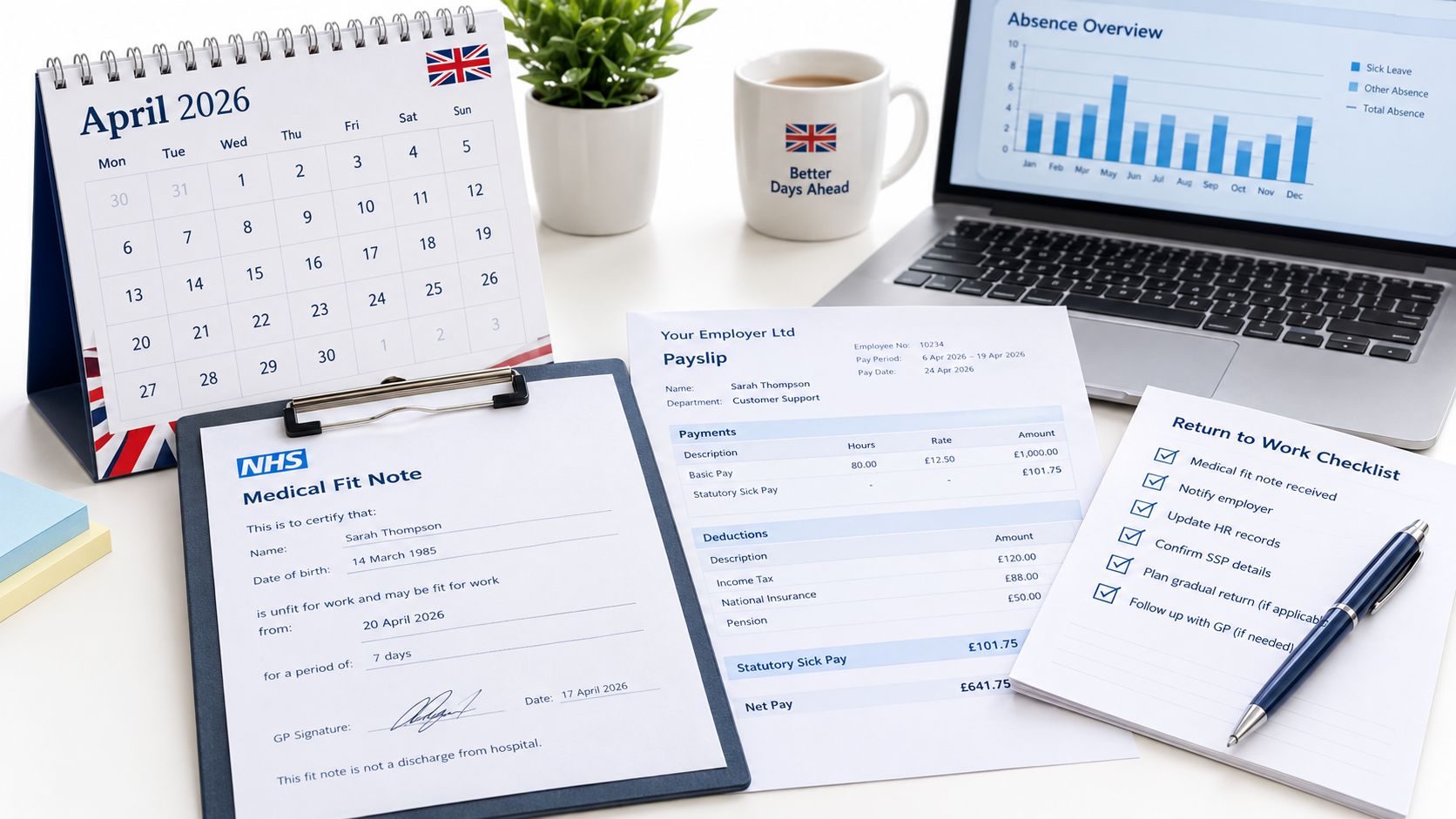
You've probably had this moment already. Payroll is due, a part-time worker asks why holiday pay looks light, and the spreadsheet that was fine last month suddenly doesn't answer the question. In UK small businesses, that's usually where holiday pay rules UK move from theory to Friday-afternoon reality.
The problem isn't the headline entitlement. It's the calculation behind it, especially once overtime, commission, irregular hours, and carry-over start showing up in the same payroll run. If you've ever had to explain a figure that looked “right” on paper but didn't feel right to the employee, this guide is built for that situation.
Table of Contents
- Why Holiday Pay Rules Trip Up Even Experienced UK Employers
- The Statutory Entitlement Every UK Worker Has
- Calculating Holiday for Irregular Hours and Part-Year Workers
- Variable Pay, Overtime, Commission and the 52-Week Rule
- Accrual Timing, Carry-Over and Payments on Termination
- Common Pitfalls That Lead to Underpaid Holiday
- Manual Tracking Versus Automated Holiday Management
- Your Holiday Pay Compliance Checklist and Next Steps
Why Holiday Pay Rules Trip Up Even Experienced UK Employers
A payroll manager I worked with once had a familiar problem. A part-time supervisor queried her holiday pay because it had dipped compared with the previous month, even though she'd worked similar shifts. The manager checked the spreadsheet, saw the 5.6-week entitlement had been applied as a flat allowance, and realised overtime had never been folded into the pay rate.
That's the sort of mistake that slips through when a business treats holiday pay as one number instead of two separate questions. The first question is how much leave the worker gets. The second is what that leave is worth in pay terms, which can change depending on the worker's pattern, pay history, and contract.

What usually goes wrong in real payroll
The most common failure point is not bad intent. It's a gap between the person approving leave, the person running payroll, and the contract sitting in a folder somewhere else. Once overtime, commission, or irregular working patterns enter the picture, a flat entitlement model stops being enough.
Practical rule: if the leave balance looks right but the payment looks off, check the pay reference period before you check entitlement again.
The cost of getting it wrong is messy. Staff get underpaid for leave, managers spend time doing reversals and corrections, and payroll becomes a support desk for things that should have been automated or documented properly. In a small business, that isn't just admin pain, it's trust damage.
There's also a budgeting issue that many owners miss. Holiday pay for variable workers can be materially higher than a basic hourly rate suggests, so under-budgeting accrual is often the bigger risk than misunderstanding the leave allowance itself. Once you understand that split, the rest of the rules become much easier to apply.
The Statutory Entitlement Every UK Worker Has
A worker starts with a simple legal floor. Under UK rules, almost all workers are legally entitled to 5.6 weeks of paid holiday a year, and government guidance translates that into 28 days for a five-day worker. That entitlement sits at the centre of holiday pay compliance across Great Britain, and part-time staff get it pro rata. GOV.UK holiday entitlement guidance
How the baseline scales in practice
For a full-time five-day worker, the headline figure is easy to read. For a part-time worker, the same entitlement is scaled to the pattern they work, so the allowance shifts with their days or hours. The statutory minimum is a floor, not a specific arrangement for each contract.
A compressed-hours worker can still be entitled to the same 5.6 weeks. The contract may spread those weeks across fewer working days, but the entitlement itself does not change just because the timetable looks different. What changes is how payroll and absence records translate that allowance into days or hours.
A simple way to think about it
5.6 weeks is the annual allowance, and the working pattern is the measuring stick used to split it. A five-day worker gets the familiar 28 days. A part-time worker gets fewer absolute days, but the same statutory treatment.
A contract can offer more than the statutory minimum, but it cannot quietly cut below it.
In small businesses, I usually check one thing first. Was entitlement calculated from the pattern the worker works, or from the default payroll template? With a mix of days, shifts, and part-time schedules, that question catches a surprising number of errors before they turn into complaints.
For a plain reference point on the baseline allowance, the statutory holiday entitlement overview at LeaveWizard's UK entitlement guide keeps the focus on the working pattern rather than just the headline number.
Calculating Holiday for Irregular Hours and Part-Year Workers
The main operational shift for many small employers is how holiday is accrued for irregular-hours and part-year workers. From 1 January 2024, for leave years beginning on or after 1 April 2024, statutory holiday entitlement stays capped at 5.6 weeks, but accrual is calculated using 12.07% of actual hours worked. ACAS says accrual happens on the last day of the pay period, and from 6 April 2026 employers must keep records of annual leave and holiday pay for at least 6 years, including carried-over leave. ACAS irregular-hours guidance

Why the 12.07% figure exists
The rate is a practical expression of the statutory minimum, not a separate benefit. In payroll terms, it gives employers a clean way to accrue leave as hours are worked rather than granting a fixed balance up front. That matters for zero-hours staff, seasonal workers, and term-time arrangements where paid work is uneven.
A retail worker on variable shifts does not build entitlement in the same way as a Monday-to-Friday employee. If they work more in one pay period, they accrue more holiday in that period. If they work less, they accrue less. The accrual follows the hours worked, and small employers need that logic built into payroll instead of forcing a fixed annual model onto a variable workforce.
Where the traps are
The calculation itself is only half the job. The operational issues are the bits that cause payroll errors, especially rounding part-hours, deciding what to record for compliance, and making sure accrual lands in the right pay period. The practical question is how to track it accurately without creating payroll errors or gaps in the audit trail.
A sensible workflow is to capture actual hours worked in the pay period, apply 12.07% to those hours, add the accrued amount to the worker's holiday balance on the last day of the pay period, and store the calculation method and the leave record together.
If you want a practical reference for the calculation, a practical holiday pay calculator at LeaveWizard's calculation guide keeps the 52-week pay logic and variable-hour treatment in one place.
Variable Pay, Overtime, Commission and the 52-Week Rule
Once pay starts moving around, the legal question shifts from accrual to normal pay. In England, Wales, and Scotland, holiday pay is calculated using the previous 52 weeks of pay that were worked, and the calculation includes regular bonuses, overtime, and commission where relevant. If the worker has fewer than 52 weeks of pay history, employers use however many complete weeks are available. LITRG holiday pay guidance
The part that catches managers out
A lot of payroll mistakes come from assuming base salary is enough. It often isn't. If someone regularly works overtime or earns commission as part of their normal pattern, leaving those payments out can depress holiday pay and create underpayment risk. That is why holiday pay can end up noticeably higher than a basic hourly or salaried rate for some workers.
The practical point is simple. If pay moves up and down, the leave rate needs to follow the actual pay pattern, not just the contract headline. The 52-week average smooths out that fluctuation, so the worker does not take annual leave during a low-earning spell and end up paid less than they should be.
What belongs in the average
What gets included depends on the worker's pay structure, but the general rule is to include pay that forms part of the worker's normal earnings. Regular overtime and commission matter because they are part of routine pay in a way a one-off bonus usually is not. If payroll is using a basic salary figure while the worker's timesheets show a heavier pattern, the calculation is probably too low.
| Payment Type | Include in 52-Week Average? | Typical Example |
|---|---|---|
| Regular overtime | Yes | A shift worker who routinely stays late |
| Commission | Yes | A sales adviser paid on closed deals |
| Regular bonuses | Yes, where relevant | A recurring performance-linked payment |
| One-off discretionary bonus | No | A rare year-end gesture |
| Truly occasional overtime | No | An isolated extra shift |
A useful warning sign is when holiday pay looks stable across very different working months. If the worker's actual earnings vary but the holiday figure barely moves, the average probably is not capturing the pay pattern properly.
For a more detailed worked explanation, LeaveWizard's detailed holiday pay calculation page is useful because it frames holiday pay around the reference period, not just the entitlement number.
Accrual Timing, Carry-Over and Payments on Termination
Even a correct accrual method can go wrong at the edges. The three moments that matter most are when leave is taken, when it's carried forward, and when someone leaves. If payroll and HR don't treat those moments consistently, the final balance usually becomes a manual dispute.
Carry-over needs a policy, not a guess
The four-week EU-derived part of the 5.6-week entitlement can be carried over by written agreement, and in some situations such as long-term sickness it must be. The remaining 1.6 weeks generally can't be carried over unless the contract says otherwise. That split matters because a casual “roll it all forward” approach creates compliance risk and muddles the employee record.
A good carry-over policy spells out whether leave has to be taken by a certain point, who approves exceptions, and what happens if the worker is absent for a long time. If those rules live only in one manager's head, payroll will inherit the mess later.
Holiday balances should be treated like money, because in payroll they effectively are.
What happens when someone leaves
When employment ends, accrued but untaken statutory leave must be paid out in the final pay packet. That means the leaver's accrued balance has to be checked against what's already been taken, then valued using the correct pay rate. The final wage run is where missing records become expensive, because you can't reconcile a leaver cleanly without a reliable leave history.
A short example helps. If a worker leaves with part of the leave year still to run, payroll still needs to pay whatever statutory leave has built up and not been used by the termination date. The amount depends on entitlement, usage, and the pay reference period, so the final calculation has to be joined up rather than guessed.
For a practical overview of how leave moves forward between years, LeaveWizard's carry-over guide is a sensible reference point for the policy side as well as the payroll side.

Common Pitfalls That Lead to Underpaid Holiday
The failures I see most often are not about entitlement. They're about calculation slips that look minor until someone challenges them. Once that happens, payroll has to explain numbers that were never properly built into the process.
The mistakes that keep coming back
- Missing regular overtime: If overtime is part of the normal pattern, leaving it out of the average can underpay leave.
- Using rolled-up holiday pay loosely: Citizens Advice says rolled-up holiday pay adds an extra 12.07% on top of normal pay each payday for irregular-hours workers, so it needs to be applied and itemised correctly. Citizens Advice holiday pay guidance
- Assuming bank holidays are automatic: Bank holidays only sit inside the 5.6 weeks if the contract is clear about that treatment.
- Ignoring record retention: From 6 April 2026, employers must keep annual leave and holiday pay records for at least 6 years, including carried-over leave. ACAS irregular-hours guidance
The practical consequence varies. A missed overtime component can lead to back pay. A sloppy rolled-up holiday pay process can create payslip compliance problems. Weak records make it much harder to defend the calculation if an employee queries it later.
What not to assume
A lot of employers assume the statutory minimum answers every question. It doesn't. The minimum tells you how much leave exists, but not how the pay figure is built for variable patterns. That's why “we've always done it this way” is such a weak defence in payroll.
If the worker's pay changes, the holiday calculation has to change with it.
The other mistake is treating record-keeping as background admin. In reality, it's part of compliance. Without a clean trail of hours, leave taken, and the calculation method used, you're relying on memory and spreadsheets to defend a payroll decision. That's not a great place to be when someone asks for the basis of their final payslip.
Manual Tracking Versus Automated Holiday Management
A spreadsheet can work for one or two simple contracts. Once you have mixed working patterns, it starts to creak. The usual failure points are inconsistent rounding, missed carry-over, and no clear view of remaining entitlement when a manager approves leave.
What manual tracking gives you, and what it costs
Manual tracking is cheap at the start, but it ultimately becomes expensive in staff time. Someone has to calculate entitlement, update balances, check reference periods, and reconcile changes after sickness, overtime, or leaver processing. If more than one person is touching the sheet, the audit trail usually gets fuzzy fast.
Automated systems solve a different problem. They keep entitlement balances visible in real time, apply the 12.07% accrual method for irregular-hours workers, and build the 52-week pay logic into the calculation rather than leaving it to memory. For a small business that's growing or dealing with mixed work patterns, that difference matters.
The decision point for a small employer
The question isn't whether software is fashionable. It's whether the business can tolerate calculation drift, handover gaps, and record-keeping errors on a repeated basis. If payroll, line managers, and HR all need the same answer but are pulling it from different places, automation usually wins on control rather than convenience.
One option worth comparing in that space is AI hiring compliance from WorkSignal, especially if your wider HR process already needs stronger audit discipline across hiring and workforce records. It's not a holiday-pay tool, but it's the same general question, how much manual checking can your team safely carry?
For leave management specifically, LeaveWizard supports small businesses with leave calculations, approvals, visibility, and reporting, which is the kind of structure that helps when holiday balances and payroll need to stay aligned.
Your Holiday Pay Compliance Checklist and Next Steps
A good holiday pay process is less about memorising the law and more about standardising the checks. If you run the same audit on a quiet Monday morning every month, most problems surface before they become employee complaints.
A practical checklist for small employers
- Confirm the baseline entitlement: Check that workers are receiving the statutory 5.6 weeks, with pro-rata treatment for part-time staff.
- Apply the right accrual method: Use 12.07% for irregular-hours and part-year workers, and make sure accrual lands in the right pay period.
- Build the 52-week pay reference correctly: Include relevant variable pay where it belongs, and don't shortcut the average.
- Review carry-over wording: Make sure the policy matches how leave is being handled.
- Check leaver payments: Accrued but untaken statutory leave should be paid in the final payroll run.
- Set the record trail now: From 6 April 2026, the records need to be retained for at least 6 years, including carried-over leave. ACAS irregular-hours guidance
The next decision is usually practical, not legal. If your workforce is mostly fixed-hours and simple, a clean spreadsheet and a disciplined review process may be enough for now. If you've got irregular hours, overtime-heavy shifts, and managers approving leave across multiple locations, the risk of a manual system rises quickly.
Rolled-up holiday pay also deserves a deliberate decision, not a habit. It can fit certain variable-hour arrangements, but it needs the right configuration and clear payslip presentation. Long-term sickness, family leave, and termination cases need separate handling too, because these are the places where assumptions usually break.
If your team is still juggling holiday balances in spreadsheets, use this guide as the trigger to tighten the process before the next payroll run. LeaveWizard gives small businesses a way to automate leave calculations, keep approvals visible, and maintain the records that holiday pay compliance depends on. Visit LeaveWizard if you want to compare your current process with a system built for real payroll complexity.