A colleague returns from maternity leave, and the first question is often, “How much holiday does she have left?” The wrong answer can create a payroll error, an avoidable dispute, or both. Maternity leave doesn't stop annual leave building up, and a standard “use it or lose it” setting may remove entitlement your business is legally required to preserve.
For UK employers, the practical job is to separate three things: holiday accrued before maternity leave, holiday accrued during it, and any additional contractual entitlement. Then record what can be taken before leave, what must carry forward, and what should be scheduled after the employee returns.
Table of Contents
- A Returning Employee With 28 Days of Unused Leave
- What Holiday Entitlement Means During Maternity Leave
- How Holiday Accrues Across the 52 Weeks of Leave
- The 2024 Carry-Over Rule and When It Applies
- Worked Examples for Full-Time and Irregular-Hours Staff
- Jurisdictional Variations Beyond the UK
- A Recommended Employer Process From Offer to Return
A Returning Employee With 28 Days of Unused Leave
Priya, an HR manager at a 40-person marketing agency in Bristol, sits down with the payroll lead on the first Monday after Chloe returns from 12 months of statutory maternity leave. Chloe's contract promises 28 days of paid holiday each year, and the agency's holiday year runs from 1 January to 31 December.
Priya opens the HRIS expecting a routine balance. Instead, she sees an untouched 28 days from the period affected by Chloe's absence, alongside the entitlement generated for the current holiday year. The balance is larger than the manager expected, and the finance team hasn't budgeted for a sudden block of paid time off.
The problem isn't that Chloe has gained an unexpected perk. The problem is that the organisation failed to plan for a right that continued while she was away. Employees remain employed throughout statutory maternity leave, and annual leave continues to accrue during that period. Chloe can't take annual leave at the same time as statutory maternity leave, so the leave needs to be used before maternity leave begins or after it ends, subject to the applicable carry-over rules.
Practical rule: Never close a maternity case by setting annual leave to zero at the end of the holiday year.
Priya's next step is to inspect the contract, holiday policy, leave-year dates and payroll history. The 28-day figure may include bank holidays, depending on how the agency's written terms describe the entitlement. She also needs to establish whether the balance is statutory, contractual, or a mixture of both.
The manager then talks to Chloe about a return-to-work plan. Some holiday might be taken immediately after maternity leave, while the remainder could be scheduled later. Payment instead of taking statutory holiday generally isn't the answer during employment. A payment in lieu is normally relevant when employment ends, not as a shortcut for clearing an active employee's balance.
Chloe's case is ordinary, not exceptional. Small businesses get into difficulty because their spreadsheets treat maternity leave as a pause in service. It isn't. The safest approach is to review balances before leave starts, at intervals during the absence, and before the employee returns.
What Holiday Entitlement Means During Maternity Leave
The legal baseline is 5.6 weeks of paid annual leave per year, which is usually 28 days for a full-time worker working five days a week. The statutory minimum applies to almost all workers, and maternity leave doesn't reduce it. Acas explains how holiday and maternity leave interact, including the continuing accrual of statutory and contractual holiday.
Think of holiday as two accounts.
The first account is the statutory minimum. It's the legal balance an employer must provide. The second is the contractual top-up, made up of any additional days offered under the employment contract or company policy. If a contract grants more leave than the statutory floor, the extra days may be governed by different wording.
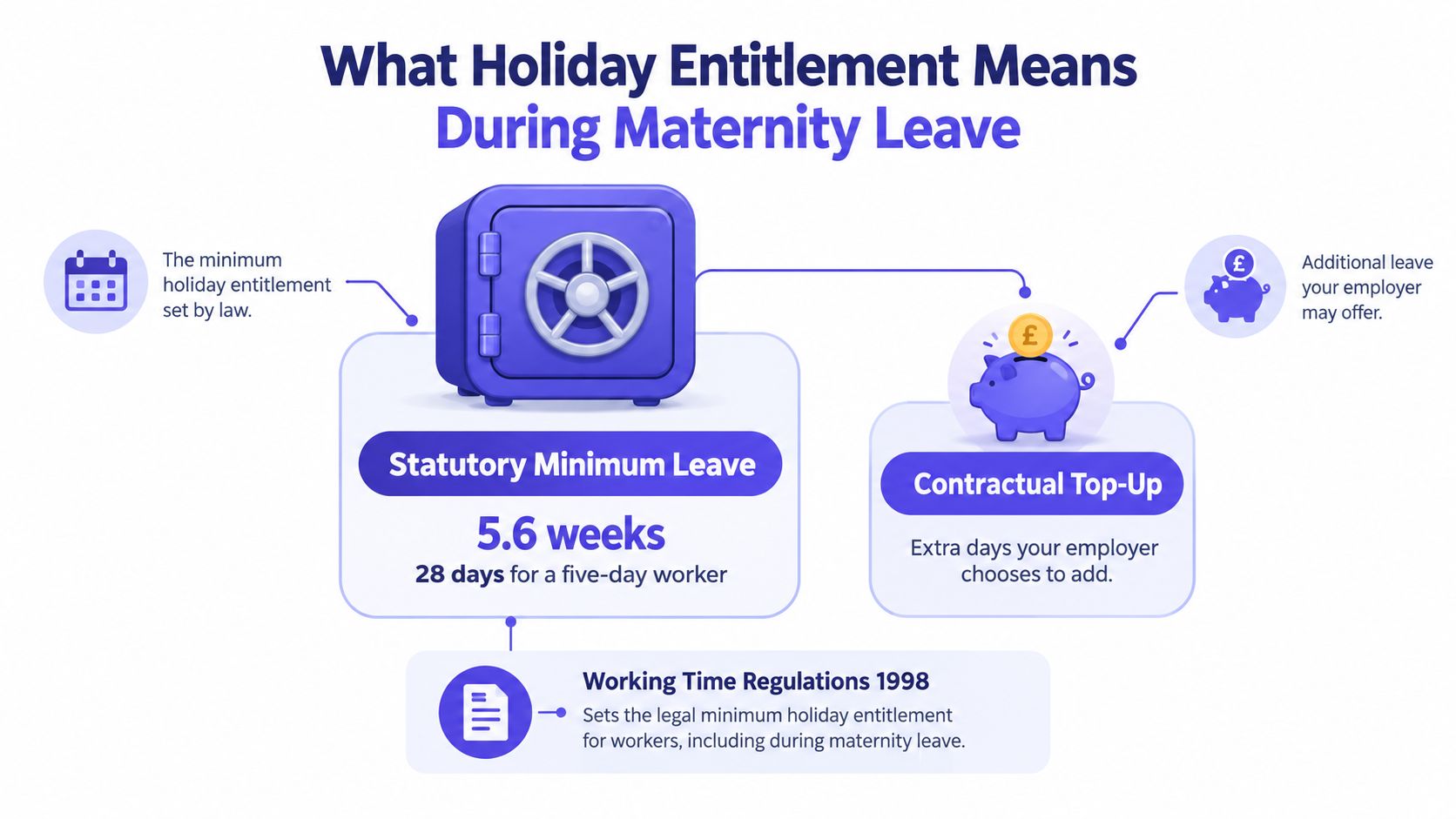
Separate the legal floor from the contract
An employee on ordinary or additional maternity leave continues to accrue both statutory and contractual holiday in the same way as if they were at work. The employer shouldn't apply a reduced accrual rate just because the employee isn't performing duties.
Bank holidays need closer attention. They form part of the employee's entitlement where the contract or holiday policy includes them. A contract promising 28 days inclusive of bank holidays is different from one promising 28 days plus bank holidays. Don't infer the answer from custom. Read the written terms.
The entitlement also doesn't disappear because the employee can't physically take it while absent. Annual leave and statutory maternity leave are separate forms of leave. They can't run concurrently, so an employee must use accrued annual leave before maternity leave starts or after statutory maternity leave ends.
Apply the right balance to the right person
For a straightforward full-time employee, the calculation usually starts with the contractual annual entitlement and the holiday-year dates. For irregular-hours and part-year workers, the calculation requires more care because the relevant working pattern and reference period affect accrual.
A useful internal record should show:
- Statutory balance: The portion protected by the legal minimum.
- Contractual balance: Any additional days promised by the contract.
- Bank holiday treatment: Whether those days are included or added.
- Leave-year dates: The period in which entitlement is normally used.
- Maternity dates: The start, expected end and actual return date.
Employers can use a detailed guide to holiday entitlement during maternity leave when checking the distinction between accrual, scheduling and carry-over. The key recommendation is simple: don't let an HRIS default decide a legal entitlement.
How Holiday Accrues Across the 52 Weeks of Leave
Statutory Maternity Leave lasts 52 weeks, split into 26 weeks of Ordinary Maternity Leave and 26 weeks of Additional Maternity Leave. An employee must take at least 2 weeks after the birth, or 4 weeks if they work in a factory. The entitlement to annual leave continues across that statutory period.
For a full-time employee with a 28-day annual entitlement, a planning calculation can treat the yearly balance as accruing evenly across the 52 weeks. That produces roughly 0.54 days per week, but payroll should still use the employer's normal accrual convention and preserve the correct total. The figure is a planning aid, not permission to round down the employee's entitlement.
The standard calculation
Suppose an employee starts maternity leave with no remaining holiday from the relevant leave year. If the employee remains on maternity leave for the full statutory period, the annual entitlement continues to build even though no hours are worked during the absence. The employee may return with a substantial balance to schedule, and statutory leave that couldn't be taken because of maternity leave must be carried over into the next leave year.
The calculation becomes less intuitive for variable-hours staff. Updated rules use the 12.07% accrual method for irregular-hours and part-year workers, while the relevant 52-week reference period excludes weeks affected by maternity or other family-related leave when average hours are calculated. That means the business must preserve the person's recent working pattern rather than treating maternity weeks as zero-hour weeks.
| Worker Type | Accrual Method | Example Over 52 Weeks |
|---|---|---|
| Full-time worker | Annual contractual or statutory entitlement continues throughout maternity leave | A worker with 28 days' annual leave continues to accrue against that annual entitlement during the leave period |
| Irregular-hours worker | Accrual based on the 12.07% method and the applicable reference-period rules | The employer uses eligible working hours and excludes affected family-leave weeks from the average-hours calculation |
| Part-year worker | The same variable-hours framework applies where the worker falls within the relevant category | Payroll retains the qualifying work pattern rather than treating maternity leave as a break in entitlement |
Don't confuse accrual with holiday pay
Accrual tells you how much leave exists. Holiday pay tells you what the employee receives when that leave is taken. Those are related but separate payroll tasks. A returning employee might have an established leave balance while the pay calculation still requires the employer to check the contractual terms, normal remuneration rules and any changes in working pattern.
For teams building or auditing a process, a resource on paid leave computation help can help frame the payroll questions that sit behind the balance. It shouldn't replace UK employment-law advice, but it can prompt finance and HR to document the calculation rather than relying on a manual adjustment.
The operational lesson is blunt: configure the system to preserve entitlement during maternity leave, and review the result against the contract. For further guidance on the mechanics, see annual leave accrual during absence. A spreadsheet that multiplies active weeks worked will understate the balance.
The 2024 Carry-Over Rule and When It Applies
The 1 January 2024 holiday reforms clarified an important protection. If an employee can't take statutory holiday because they're on maternity leave or another relevant family-related leave, the employer must allow the unused statutory entitlement to carry into the following leave year. Government guidance on the holiday-pay and entitlement reforms sets out the updated position and the 52-week reference-period approach.
Before applying the rule, identify the leave year and the point at which maternity leave prevents the employee from using the entitlement. Don't treat the year-end as an automatic expiry date.
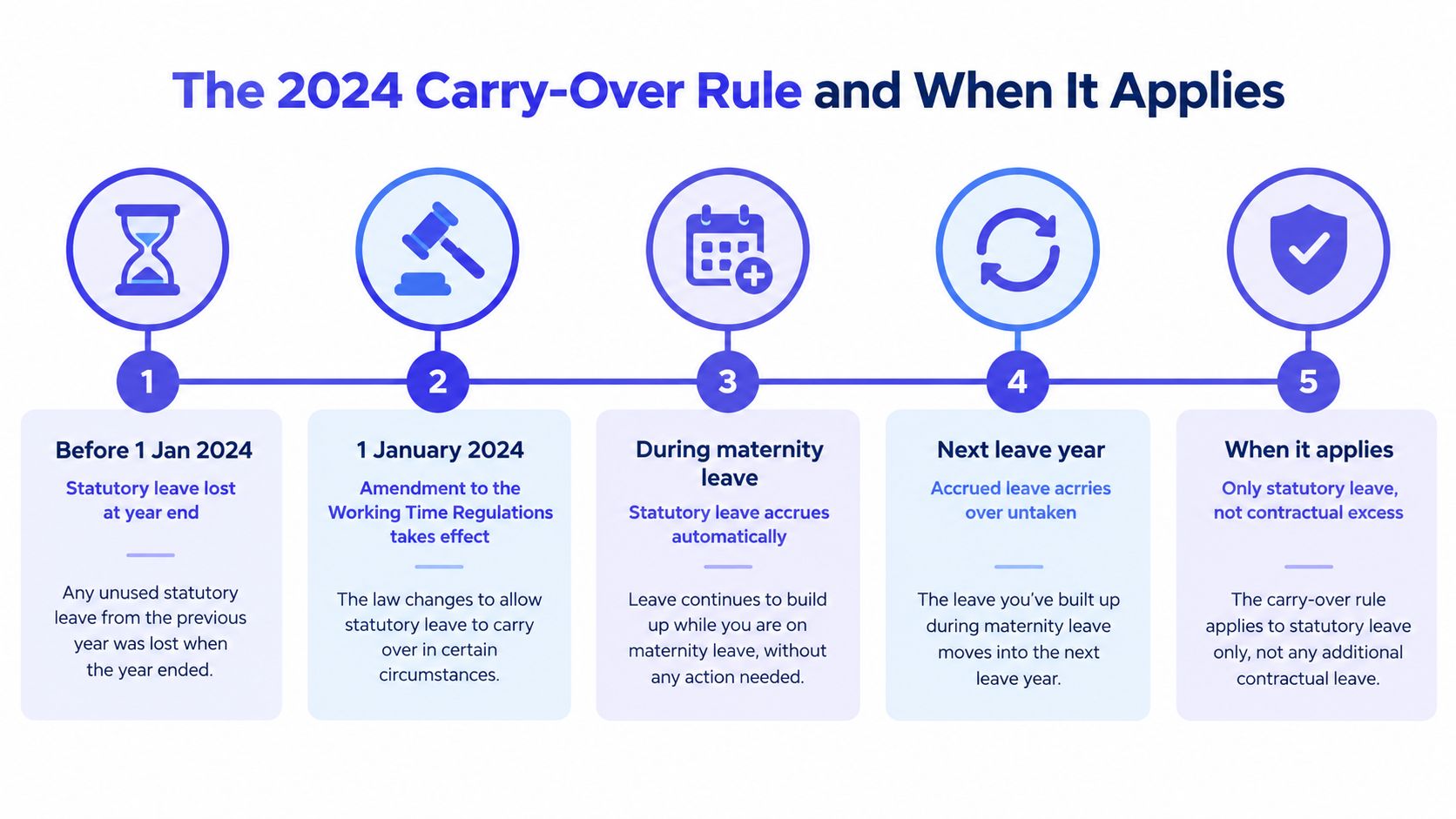
A worked timeline
Assume the leave year runs from 1 April to 31 March. An employee starts maternity leave during the leave year and returns in November, after the next leave year has already begun.
- Before maternity leave: The employee has the normal opportunity to book holiday, subject to the employer's process and the planned maternity start date.
- During maternity leave: Statutory holiday continues to accrue, but the employee can't take annual leave at the same time as statutory maternity leave.
- 31 March year-end: Any statutory leave the employee couldn't take because of maternity leave must be carried forward.
- From 1 April: The carried-over statutory leave remains available in the next leave year.
- Return in November: HR should show the carried-over balance separately, agree when it will be taken, and retain the calculation.
Government guidance refers to a protected use period of 18 months from the end of the leave year in which the leave accrued for this family-leave carry-over protection. That deadline should be tracked in the HR record rather than left to the employee to discover.
The rule protects the statutory floor. It doesn't automatically impose the same carry-over treatment on contractual excess, although an employer's contract or policy may offer equivalent protection. If a business promises additional days, its handbook should state whether those days carry forward, expire, or follow the statutory treatment.
Rewrite the risky policy wording
A blanket “use it or lose it” clause is unsafe if it attempts to remove statutory leave that the employee couldn't use because of maternity leave. Likewise, a capped-accrual rule shouldn't override statutory entitlement.
Update the handbook so it:
- Separates statutory and contractual leave: Keep the two balances visible.
- Recognises protected carry-over: Refer expressly to maternity and relevant family-related leave.
- Sets a scheduling process: Explain how carried-over leave will be booked after return.
- Records the deadline: Capture the relevant protected use window.
- Aligns payroll and HR: Make sure both systems show the same balance.
Don't make the returning employee negotiate for leave the law already protects. Give them the balance, explain it clearly, and agree a workable schedule.
Worked Examples for Full-Time and Irregular-Hours Staff
A good calculation should be reproducible by someone who wasn't involved in the original maternity case. The following examples show the logic, but employers should replace the assumptions with the employee's contract, actual dates and payroll records.
Priya's full-time balance
Priya is a full-time marketing executive with 28 days of annual leave, plus bank holidays under her contract. She starts maternity leave on 6 January and returns 12 months later. Her holiday year runs from 1 January to 31 December.
For planning, payroll records the annual entitlement across the year rather than stopping it on 6 January. The monthly view can be presented as a running schedule:
| Month of Leave | Priya's Planning Balance |
|---|---|
| January | Annual entitlement continues to build |
| February | Annual entitlement continues to build |
| March | Annual entitlement continues to build |
| April | Annual entitlement continues to build |
| May | Annual entitlement continues to build |
| June | Annual entitlement continues to build |
| July | Annual entitlement continues to build |
| August | Annual entitlement continues to build |
| September | Annual entitlement continues to build |
| October | Annual entitlement continues to build |
| November | Annual entitlement continues to build |
| December | The annual entitlement reaches the contractual total of 28 days |
The important figure is the 28-day annual entitlement, not an invented payment amount. If Priya couldn't use the statutory leave because she was on maternity leave, the 1 January 2024 protection carries the relevant statutory balance into the following leave year. Her employer should then distinguish that balance from any fresh entitlement generated after the new leave year began.
Priya's file should contain the contract, holiday policy, leave dates, balance before maternity leave, accrual record, year-end carry-over decision and agreed return schedule. If employment ends before she takes accrued statutory holiday, payroll should assess payment in lieu at termination.
Jordan's irregular-hours balance
Jordan is an irregular-hours retail assistant whose holiday accrues using the 12.07% method. Jordan takes 39 weeks of statutory maternity leave. The calculation shouldn't treat those 39 weeks as ordinary zero-hour weeks, because weeks affected by maternity or family-related leave are excluded from the relevant average-hours calculation under updated guidance.
Payroll should:
- Identify the qualifying reference period: Use Jordan's recent working pattern before maternity leave, excluding affected family-leave weeks.
- Apply the accrual method: Calculate holiday from eligible hours worked using 12.07%.
- Track each pay period: Record hours, holiday accrued and holiday already taken.
- Convert the result into usable time: Express the balance in hours or shifts using the contract and the applicable reference-period information.
- Check payment separately: Calculate holiday pay from the correct pay data when Jordan takes the leave.
The result isn't a universal number of days because Jordan's hours vary. A payroll team that guesses a weekly pattern will create a false balance.
| Week of Leave | Priya, Full-Time, Days | Jordan, Irregular Hours, Hours | Cumulative Entitlement |
|---|---|---|---|
| Start of leave | Record the contractual balance | Establish the qualifying working pattern | Opening balance documented |
| Early leave | Continue annual entitlement | Preserve the reference-period treatment | Add accrual under the correct method |
| Mid leave | Continue annual entitlement | Exclude affected family-leave weeks from the average calculation | Review the running balance |
| End of leave | Confirm the annual total | Reconcile hours and holiday accrued | Prepare the return schedule |
Don't invent a “net payment owed on return” for either employee. During employment, statutory holiday should normally be taken as leave rather than cashed out. The employer should retain the calculation and pay records, then pay accrued but unused statutory holiday in lieu if employment ends.
Jurisdictional Variations Beyond the UK
A UK policy shouldn't be copied across a multinational workforce. Holiday rights, maternity protections and carry-over rules depend on the country where the employee works and, in some cases, the governing law in the contract.
The UK position is clear for the issue covered here: statutory holiday continues to accrue during maternity leave, and protected statutory holiday that couldn't be taken because of maternity or family-related leave must carry forward. That approach shouldn't be assumed elsewhere.
A comparison for planning purposes
| Jurisdiction | Statutory Minimum | Accrual During Leave | Carry-Over Rule |
|---|---|---|---|
| UK | 5.6 weeks of paid holiday per year | Continues during statutory maternity leave | Protected statutory leave carries into the following leave year when maternity or relevant family leave prevented use |
| Ireland | Local statutory and public-holiday rules apply | Check the employee's statutory leave framework | Maternity-related inability to take leave can require carry-over |
| EU member states | The EU baseline is four weeks, with national additions possible | National implementation determines the detail | Family-leave protections and deadlines vary |
| Australia | Rules depend on the employment framework and worker classification | Check the applicable award, agreement and legislation | Local rules govern the treatment of untaken leave |
| United States | No federal holiday entitlement | Maternity and holiday coordination depends on state law and contract | Employer policy and state requirements determine the result |
Ireland is often treated as a close comparison, but a similar headline rule doesn't make the administration identical. The same applies across the EU. Germany, France and Spain use their own national approaches to annual leave, public holidays and family-leave carry-over, so a UK spreadsheet formula is not a compliant international policy.
Australia requires particular care around worker status and the legal framework covering the engagement. In the United States, employers can't rely on a federal annual-leave baseline because there isn't one. State law, collective arrangements and the written contract may control the outcome.
For staff outside England and Wales, ask local counsel or a qualified adviser to confirm the rule before changing balances. HR should record the employee's work location, employing entity and applicable policy, not just their home address.
A Recommended Employer Process From Offer to Return
Maternity leave should be managed as a lifecycle, not as a handover followed by silence. The best process starts when the employee gives notice and ends only after HR, payroll, the manager and employee agree the outstanding holiday balance.
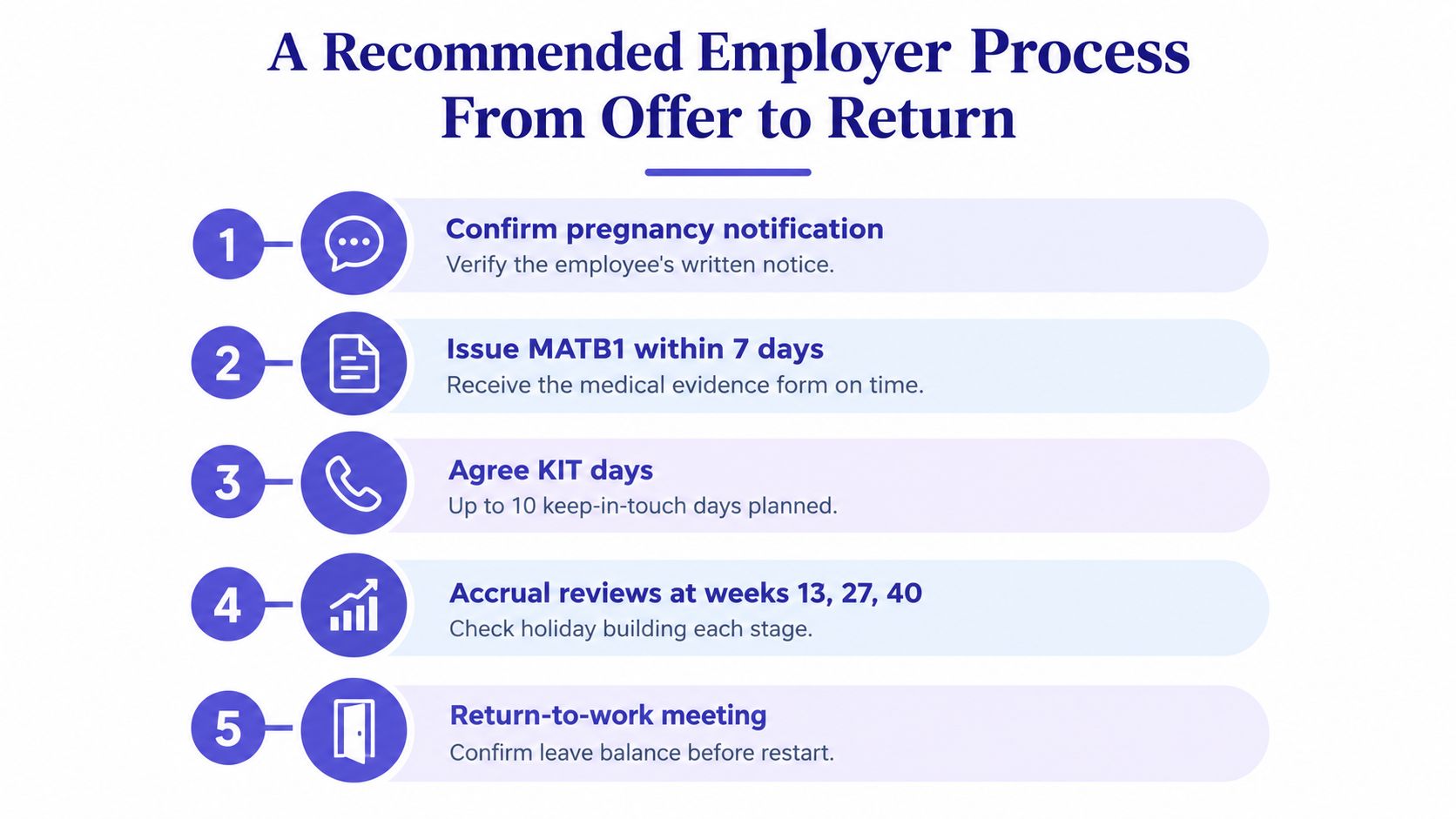
Before leave begins
Confirm the pregnancy notification and expected maternity dates in writing. Issue the MATB1 within 7 days where the required evidence is provided, and record the employee's stated return date. Discuss annual leave before maternity leave starts, but don't pressure the employee to use leave when health, timing or preference makes that inappropriate.
Agree any Keeping in Touch days in advance. An employee can use up to 10 KIT days, so the manager should document the proposed work, dates and pay treatment rather than treating informal contact as a working arrangement.
During the absence
Maintain one HR log. It should contain:
- Maternity dates: Start date, statutory leave period and expected return.
- Holiday balances: Accrued statutory leave, contractual excess and any bank-holiday treatment.
- Review points: Check accrual around weeks 13, 26 and 39.
- KIT activity: Record agreed days and work completed.
- Year-end position: Note what expired, what carried over and why.
- Employee communication: Keep copies of balance updates and scheduling discussions.
The review points aren't a substitute for checking the actual balance. They're prompts that stop the case disappearing into a spreadsheet while the holiday year closes.
For the people side of the handover, guidance on smooth handover and boundary setting can help managers structure responsibilities without encouraging unnecessary contact during leave. Keep operational communication proportionate and respect the employee's time away.
On return
Hold a return-to-work meeting and confirm the leave balance before assigning the employee back into the rota or project plan. Agree dates for carried-over holiday, explain how contractual excess is treated, and send the outcome to payroll.
Use a controlled leave management process with clear approval ownership. Managers shouldn't make one-off promises about payment or expiry. Payroll should approve any payment calculation, and HR should preserve the audit trail.
Train line managers to ask about availability and work arrangements, not intrusive questions about health or family choices. Script the key conversations, centralise exceptions with HR, and give the employee a written summary after the meeting.
The recommendation for small businesses is straightforward. Add maternity cases to the same compliance calendar as payroll deadlines, review the balance before every leave-year end, and never rely on a default absence setting to decide whether holiday exists.