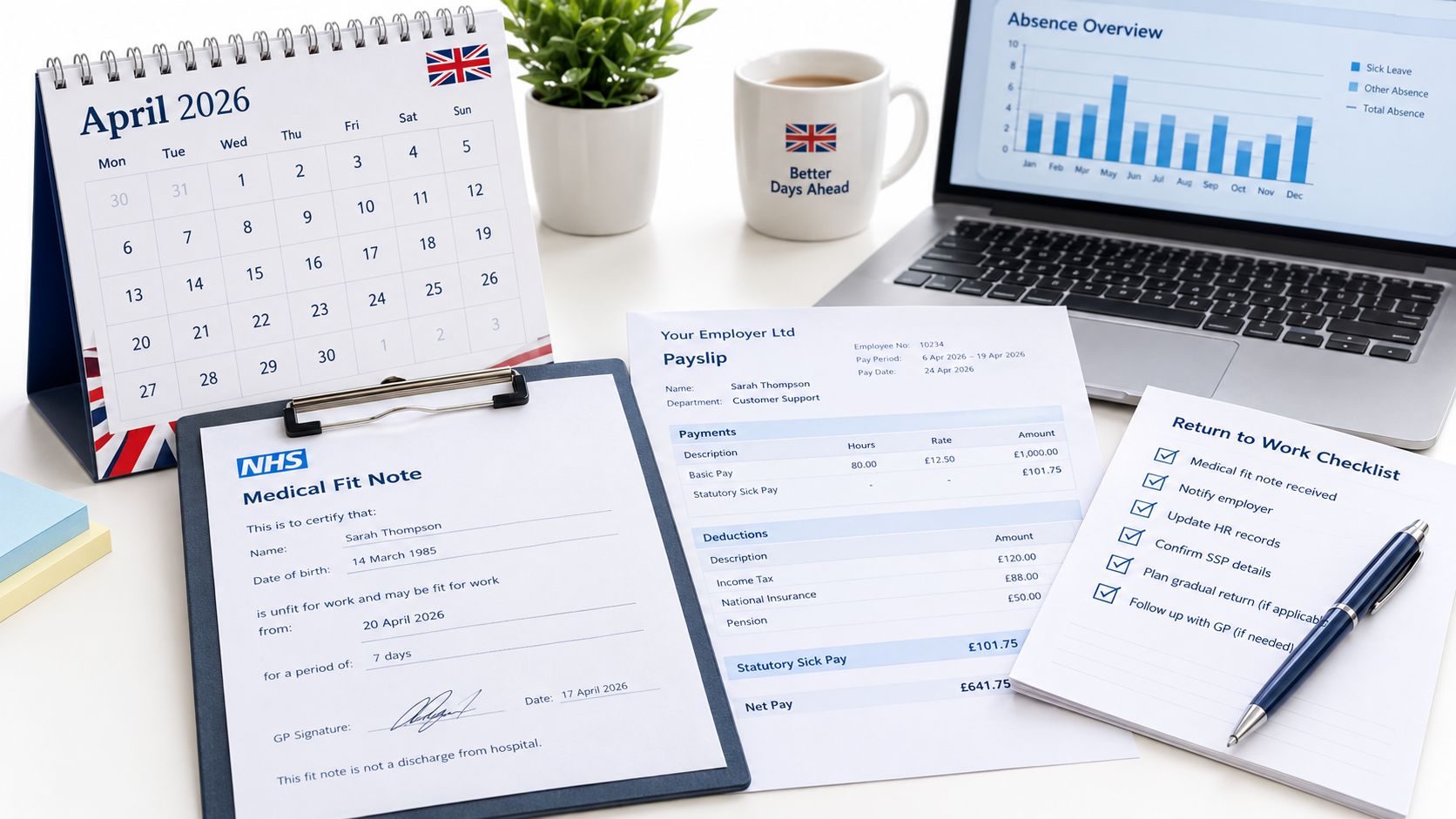
Think of annual leave accrual like a 'time off' savings account. Instead of getting a full year's holiday allowance dumped in their lap on day one, your employees earn it as they go. It’s a simple, fair system that directly ties their holiday entitlement to the time they've actually spent working for you.
Understanding Annual Leave Accrual and Why It Matters

At its heart, annual leave accrual is the process of building up paid holiday bit by bit. Rather than giving everyone a lump sum of 28 days on the 1st of January, an employee’s holiday balance grows with each pay period—whether you pay them weekly, fortnightly, or monthly. This methodical approach is a game-changer for managing a modern workforce, especially when you’ve got people on different working patterns.
Imagine someone new starts in June. If you use a lump-sum system, they technically get access to a full year's holiday before they've even earned it through their service. The accrual method neatly solves this problem by linking their entitlement directly to their time with the company. It just makes more sense for everyone involved.
The Business Case for Getting Accrual Right
Nailing your annual leave accrual isn't just admin box-ticking; it's a critical business function with serious legal and financial weight behind it. For any UK small business, a clear, accurate accrual process is non-negotiable for a few key reasons:
- Legal Compliance: The UK's Working Time Regulations 1998 are clear: nearly all workers are entitled to 5.6 weeks of paid holiday per year. An accrual system is the most dependable way to make sure you’re meeting this statutory minimum, especially for part-time, casual, or zero-hours staff whose hours can be all over the place.
- Financial Accuracy: Every hour of accrued but untaken holiday is a financial liability sitting on your company's balance sheet. Tracking it properly means you can forecast these costs accurately, avoiding nasty financial surprises when people leave or at the end of the holiday year.
- Employee Morale and Fairness: When your accrual policy is transparent, every team member knows exactly how their leave is earned. This clarity kills off potential disputes and builds trust. It shows that leave is calculated fairly based on service, which is a big deal for new starters or anyone on an irregular schedule.
A well-managed accrual system acts as a safeguard. It protects your business from legal challenges and financial surprises while ensuring your team feels valued and treated equitably.
Ultimately, getting your head around annual leave accrual is the first step to building a leave management framework that's both robust and compliant. It gives you a solid foundation that supports your business's stability and fosters a positive, open relationship with your employees from their very first day. Without it, you're essentially navigating holiday pay with a blindfold on.
The Different Ways to Calculate Holiday Accrual
Knowing the theory behind annual leave is one thing, but putting it into practice means figuring out the right way to calculate it for your team. There’s no single ‘one-size-fits-all’ formula here. The method you should use really depends on your employees' working patterns, from full-time salaried staff to casual workers with unpredictable hours.
Picking the right approach is crucial. It ensures fairness, keeps you compliant with the law, and gives everyone—you and your employees—total clarity on their holiday entitlement. Let’s break down the most common ways to get this right, using some real-world scenarios to see how each one works.
Calculating Leave Based on Hours Worked
For staff on zero-hours contracts, casual workers, or anyone else with irregular schedules, calculating their holiday based on the hours they work is by far the most accurate and legally sound method. It directly links their paid time off to the hours they've actually put in. No guesswork, no disputes.
In the UK, the legal foundation for annual leave is the statutory minimum of 5.6 weeks of paid holiday a year. For someone working a five-day week, this translates to 28 days. This legal floor means pretty much every worker gradually accrues paid leave as they go.
For casual or zero-hours staff, the standard way to handle this is by using an accrual rate of 12.07% of hours worked. Where does that number come from? Well, if you take the 5.6 weeks of leave out of the 52 weeks in a year, you’re left with 46.4 working weeks. The 5.6 weeks of leave is 12.07% of that working time.
In practice, it means a worker who logs 60 hours in a month would earn 7.24 hours of paid holiday for that month (60 × 12.07%). This percentage-based method is a lifesaver for small businesses because it keeps everything tied directly to actual hours worked, reducing the risk of getting the sums wrong. Systems like LeaveWizard can automate these calculations, applying the 5.6-week rule consistently while still letting you offer more generous allowances, like the 30+ days (including bank holidays) many UK employers now provide.
Key Takeaway: The 12.07% rate is the gold standard for staying compliant with staff on irregular hours. It’s a fair and transparent way to manage their leave without getting bogged down in complex recalculations every month.
This approach stops a casual worker who only clocks 10 hours one month from getting the same leave as someone who worked 100. It’s proportional, fair, and completely defensible if questions ever come up.
Prorated Leave for Part-Time Employees
When you have part-time staff who work the same days each week—say, three days instead of the standard five—a pro-rata calculation is the simplest and fairest way forward. You’re essentially just scaling down the full-time entitlement to match their shorter working week.
The calculation itself is nice and straightforward:
- Step 1: Start with your full-time holiday allowance. In the UK, the statutory minimum is 28 days, including bank holidays.
- Step 2: Figure out the part-timer's week as a percentage of a full week. For someone working 3 days, that’s 60% of a 5-day week (3 ÷ 5 = 0.6).
- Step 3: Multiply the full-time allowance by this percentage.
Example Scenario:
Let's say you hire a marketing assistant, Sarah, who works Monday, Wednesday, and Friday. Your full-time staff get the statutory 28 days.
- Calculation: 28 days (full-time allowance) × 0.6 (Sarah's work pattern) = 16.8 days of annual leave per year.
It’s always good practice to round this up to the nearest half or full day, so Sarah would get 17 days. This avoids any confusion and makes sure she’s treated fairly. For a deeper dive into the specifics, this guide to calculating holiday entitlement in the UK is a brilliant resource.
The Lump-Sum Grant Method
For your full-time employees on fixed salaries and standard hours, giving them their entire holiday allowance in one go is the most common approach. This isn't technically an 'accrual' system in the step-by-step sense, but it’s still managed within that same framework.
On the first day of your holiday year (say, 1st January), the employee gets their whole annual allowance credited to their balance. Simple. A full-timer sees their 28 days pop up, ready to be booked.
But while this is easy on day one, it brings up a crucial question: what happens if someone leaves part-way through the year? This is where the idea of accrual becomes vital again. Even though you granted the leave upfront, they’ve only legally earned a portion of it.
Example Scenario:
Your full-time graphic designer, Tom, hands in his notice at the end of June. His holiday year runs from January to December, and he gets a 28-day allowance.
- Calculate Accrued Leave: By the end of June, Tom has worked 6 of the 12 months.
- Formula: (28 days ÷ 12 months) × 6 months = 14 days.
- Final Pay Calculation: Tom has officially earned 14 days of leave. If he's already taken more than that, you’ll need to deduct the value of those extra days from his final pay. If he's taken less, you must pay him for the untaken days he's accrued.
This is exactly why even businesses that use a lump-sum approach must know how to calculate annual leave accrual to handle leavers properly. Automation tools are incredibly helpful here, as they track the 'earned vs. taken' balance in real-time, making the whole exit process much, much simpler.
Now that we’ve covered the main methods, let’s compare them side-by-side to help you decide which is best for your business.
Comparing Leave Accrual Methods for UK Businesses
This table breaks down the key methods, showing which employee types they suit best and the pros and cons for a small business owner like you.
| Accrual Method | Best For | Pros | Cons |
|---|---|---|---|
| Hourly Accrual (12.07%) | Zero-hours, casual, and variable-hours staff. | The fairest and most accurate method for irregular work patterns. Ensures legal compliance. | Can be administratively heavy to track manually without software. |
| Pro-Rata | Part-time employees with consistent weekly hours. | Simple to calculate and transparent for employees. Ensures equitable treatment. | Not suitable for employees whose hours change from week to week. |
| Lump-Sum Grant | Full-time employees on fixed salaries and hours. | Very simple to administer at the start of the year. Easy for staff to understand. | Requires accrual calculations for mid-year leavers, which can be complex. |
Choosing the right method comes down to understanding your team's structure. For many small businesses, a mix of these methods will be necessary to manage everyone fairly and efficiently.
Navigating UK Leave Accrual Laws and Policies
Getting your annual leave calculations right is only half the battle. The real challenge for many businesses is applying those numbers within the UK's legal framework. This is where things can get tricky.
Understanding the rules around carrying holiday over, handling pay when someone leaves, and what to do during long-term absences is absolutely crucial. These aren’t just administrative niceties—they’re legal requirements that protect both you and your team. Nailing these policies prevents disputes, keeps you compliant, and creates a clear, predictable system for everyone involved.
Let’s demystify some of the most critical legal areas you need to get your head around.
This flowchart shows how the type of employment contract—full-time, part-time, or casual—points you towards the most suitable accrual method.
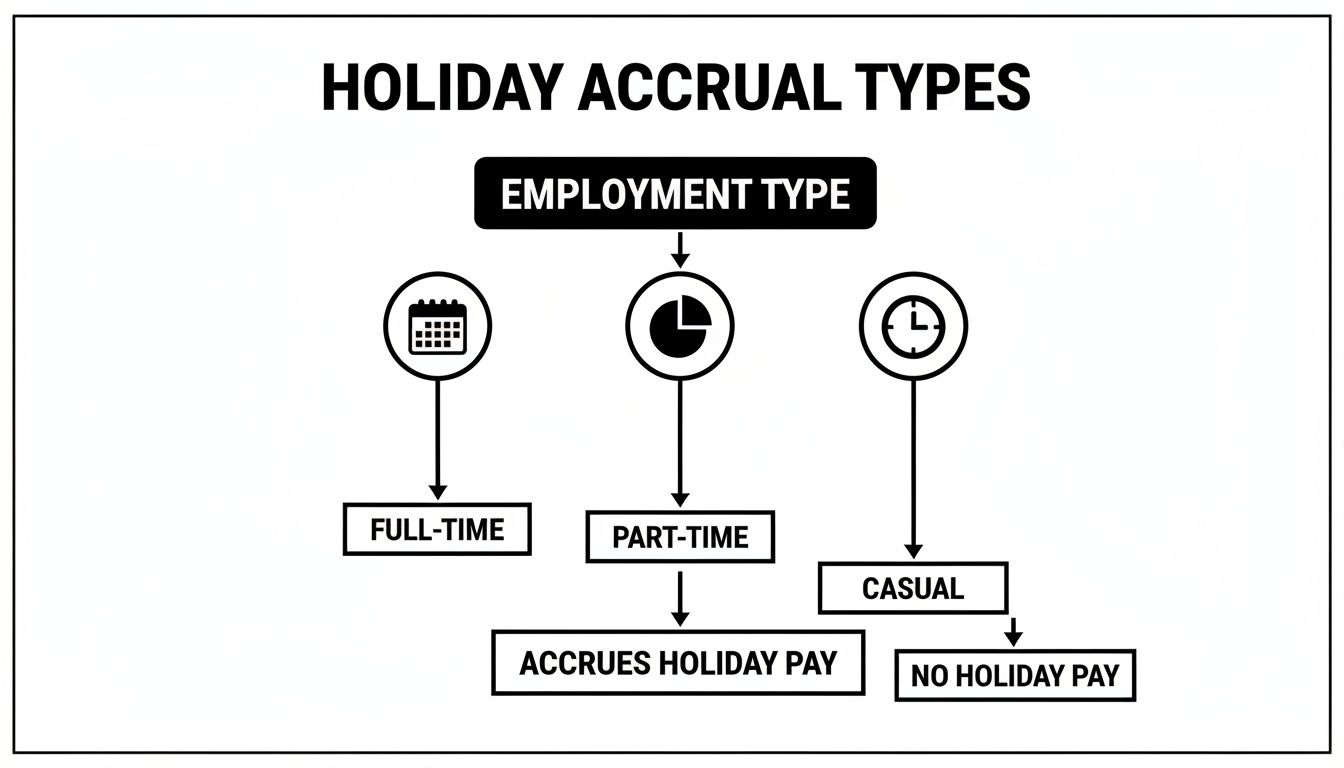
As you can see, the approach moves from a simple calendar-based system for full-timers to more flexible calculations for part-time and casual workers.
Handling Holiday Carry-Over
One of the most common questions I hear from employers is about carrying over unused leave. UK law is very clear on this. Workers must take at least four weeks of their statutory holiday entitlement within the leave year it’s earned. For a full-time employee, that’s 20 days. Crucially, they can't be paid in lieu of this time off, unless they're leaving the company.
However, the remaining 1.6 weeks (or 8 days) of statutory leave can be carried over to the next year, but only if you have a formal agreement in place, like a clause in the employment contract.
Key Rule: For any holiday you offer above the statutory 5.6 weeks, you get to set the rules. You can decide if this extra leave can be carried over, how much of it, and for how long. The secret is having a clear, written policy that’s applied consistently to everyone.
A classic compliance trap is having a vague or non-existent carry-over policy. This ambiguity almost always leads to confusion and arguments at the end of the year. A solid policy might say something like: "Employees may carry over a maximum of 5 days of unused annual leave into the next holiday year, which must be used by 31st March." Simple. Clear. No arguments.
Managing Leave During Long-Term Absences
What happens to holiday accrual when an employee is on long-term sick leave, or taking maternity or paternity leave? The simple answer is that their holiday entitlement continues to build up as normal. This is a vital point of law that many small businesses accidentally overlook.
- During Sick Leave: An employee on sick leave keeps accruing their statutory holiday. If they’re unable to take it within the leave year because they're unwell, you must let them carry it over.
- During Family Leave: Holiday also accrues right through maternity, paternity, adoption, and shared parental leave. It's good practice to encourage employees to use up their leave before their family leave starts, but if they don't, it has to be carried over.
Forgetting to track this can create a huge, unexpected liability down the road. An employee returning from a year of maternity leave will have accrued their full holiday for that year, and you have to let them take it.
Calculating Final Pay When an Employee Leaves
When an employee leaves your company, you are legally required to calculate any holiday they’ve accrued but not yet taken. This amount must be paid out in their final salary. This is one of the most important aspects of accrual of leave, as getting it wrong can easily lead to a legal claim.
The calculation itself is pretty straightforward:
- Work out what fraction of the holiday year the employee has worked.
- Calculate the holiday they’ve earned in that time.
- Subtract the number of days they’ve already taken.
- The final number is what you owe them.
Example Scenario
Let's say an employee leaves on 30th September. They've worked 9 months of the 12-month holiday year. Their full annual entitlement is 28 days, and they've already taken 15 days off.
- Accrued Leave: (28 days / 12 months) × 9 months = 21 days
- Leave Owed: 21 days accrued – 15 days taken = 6 days
You would need to pay this employee for those 6 days in their final payslip. On the flip side, if they had taken more holiday than they’d earned, you can usually deduct the difference from their final pay—but only if this is stated clearly in their contract. A clear policy and accurate tracking are your best defence against costly payroll mistakes.
Why Manual Spreadsheets Are Costing Your Business

It’s a story many small business owners know all too well. You're juggling a thousand tasks, and tracking holiday for your mix of full-time, part-time, and casual staff is just one of them. The go-to tool? A spreadsheet. It seems like a simple, free solution at first, but it quickly spirals into a maze of complex formulas, endless manual entries, and version control nightmares.
While it feels like you're saving a few quid, this manual approach comes with some serious hidden costs. What starts as a quick tracking task morphs into a massive administrative drain, pulling you away from the work that actually grows your business.
These small cracks and inefficiencies don't just stay small. They add up, creating problems that go far beyond a simple admin headache and can actively hold your company back.
The True Cost of Manual Errors
Let’s be honest: the biggest risk with any spreadsheet is human error. A single typo in a formula, an accidental deletion, or a copy-paste mistake can throw off an employee's annual leave accrual for the entire year. These aren't just minor inconveniences; they have real, tangible consequences.
- Payroll Nightmares: An incorrect calculation often leads to overpaying or underpaying an employee when they leave. Sorting out these mistakes is a time-consuming and stressful mess for everyone involved, especially your payroll team.
- Damaged Employee Morale: When a team member questions their holiday balance and uncovers an error, trust takes a hit. They start wondering what else might be wrong, and that uncertainty can really poison the workplace atmosphere.
- Compliance Risks: Miscalculating statutory holiday entitlement, particularly for part-time or casual workers, can land you in hot water with UK employment law. A simple spreadsheet slip-up could escalate into a formal dispute or even a tribunal claim.
A spreadsheet has no built-in safety net. It can't flag a potential compliance issue or double-check a pro-rata calculation for you, leaving your business exposed to risks you might not even realise are there.
These issues show just how much a supposedly "free" solution can end up costing you. To dig deeper, you might want to explore the hidden costs of paper or Excel-based leave management.
Why Visibility and Policy Clarity Matter More Than Ever
Recent UK data reveals a fascinating trend in how we take holidays, reinforcing why precise tracking is crucial. Since 2019, the average number of unused holiday days per employee has plummeted from 18.5 days to just 5.3 days in 2024. That’s a massive 71% drop.
This suggests that employees are getting much better at using the leave they've earned, likely thanks to clearer company policies and easier booking systems. For small businesses, this shift means that accurate, real-time tracking of annual leave accrual is more important than ever to avoid year-end bottlenecks and ensure everyone gets their well-deserved time off.
Without a central, visible system, keeping on top of this becomes almost impossible. A spreadsheet saved on one person's computer is a black hole of information for the rest of the team. This is where so many problems start.
When employees can't easily see their own leave balance, they have to ask someone. This simple question interrupts work for both the employee and their manager, creating an unnecessary administrative back-and-forth that kills productivity. It’s a small friction point that, when repeated across the entire team, adds up to a huge amount of wasted time and energy.
How Automation Can Finally Tame Your Holiday Management
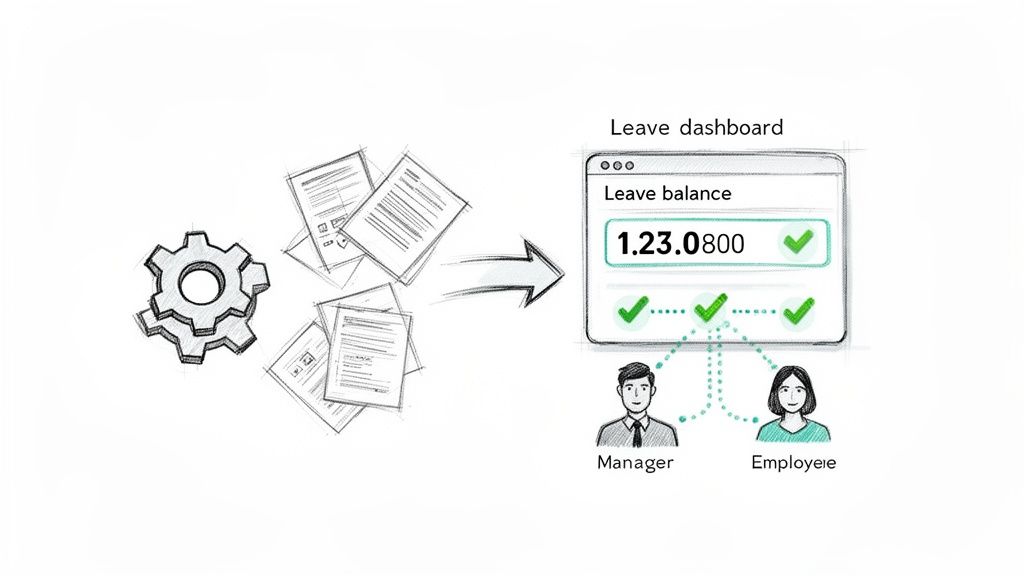
If you've ever wrestled with the risks and wasted hours of manual spreadsheets, moving to an automated system will feel like a breath of fresh air. Dedicated software takes annual leave accrual from a fragile, error-prone chore and turns it into a seamless, reliable process that just runs quietly in the background. It swaps guesswork for genuine certainty.
Instead of having to manually figure out pro-rata entitlements or apply the fiddly 12.07% rule for casual staff, an automated platform like LeaveWizard does all the heavy lifting for you. It applies the correct accrual rules to each employee based on their unique contract and work pattern, making sure every single calculation is precise and compliant with UK regulations from day one.
This isn't just about saving time—it's about getting rid of the human error that leads to payroll mistakes, confusion, and awkward employee disputes. The system becomes the one single source of truth for everything leave-related.
Gaining Some Much-Needed Clarity and Control
One of the biggest wins with automation is the real-time visibility it brings. Managers and employees no longer have to operate in an information black hole, second-guessing holiday balances or chasing up the status of a request. With a dedicated system, everyone gets instant access to the information they actually need.
- For Employees: They can check their accrued leave balance, see the team calendar for any potential clashes, and pop in a request in seconds—all from their phone or computer.
- For Managers: They get a crystal-clear dashboard showing team availability, pending requests, and any staffing gaps on the horizon, allowing for smarter, faster approval decisions.
- For the Business: You get a high-level overview of leave liabilities, can spot trends in absence, and ensure your policies are being applied consistently across the board.
This kind of transparency empowers employees to manage their own time off responsibly, while giving managers the tools they need to plan resources effectively without getting bogged down in endless email chains.
Automation provides the clarity and efficiency that spreadsheets can never deliver. It turns reactive problem-solving into proactive, strategic workforce planning.
This approach is especially vital given what’s happening right now. An industry-wide analysis shows that the average number of annual leave days taken per UK employee dropped from 38 days in 2020 to just 33.9 days in 2023, a fall of almost 12%. For small employers, this means that while leave continues to build up, a growing chunk of it risks going unused. This creates a liability on your balance sheet and increases the risk of burnout.
Systems that track accrual versus usage in real time help you make sure employees not only earn their leave but actually take it. You can discover more insights from the UK annual leave report by industry.
From Manual Effort to Strategic Advantage
Let's be honest: your time is better spent focusing on what truly matters—growing your business and supporting your team. Automating holiday management frees you up from those hours buried in spreadsheets so you can trust the system to handle the tricky details.
The benefits of automating holiday management are part of a much bigger trend towards digital transformation in HR, which can improve tons of processes beyond just leave. With a system like LeaveWizard in place, you can:
- Enforce Policies Automatically: Set up your rules for carry-over, notice periods, and holiday blackouts, and then just let the system enforce them consistently. No more awkward conversations.
- Simplify Approvals: Create multi-level approval workflows so requests are automatically sent to the right manager, saving everyone time.
- Generate Insightful Reports: Instantly pull data on leave patterns, absence rates, and remaining holiday allowances for accurate financial forecasting.
This simple shift moves you from being a constant administrator of leave to a strategic manager of your team's time and well-being. By embracing a bit of automation, you build a resilient, fair, and efficient foundation for holiday management that supports your business as it grows.
Your Annual Leave Accrual Questions Answered
Even with a rock-solid policy, you'll always run into specific situations that make you pause and think. This section tackles some of the most common head-scratchers we hear from UK small business owners, giving you clear, direct answers to handle real-world scenarios with confidence.
How Do I Calculate Holiday for a Zero-Hours Contract Worker?
Calculating holiday pay for someone on a zero-hours contract feels like trying to hit a moving target, but it's actually quite simple once you know the rule. Because their hours can fluctuate wildly, their holiday entitlement must be based on the hours they’ve actually worked. The safest and most common way to do this is with the 12.07% accrual rate.
This percentage isn't just a random number. It represents the statutory 5.6 weeks of holiday as a proportion of the 46.4 working weeks in a year. The formula is refreshingly straightforward and keeps you on the right side of the law:
- Total hours worked in a pay period × 0.1207 = Hours of holiday accrued
Let’s say a team member works 80 hours in one month. They would earn 9.66 hours of paid holiday for that period (80 × 0.1207). This method is fair, transparent, and legally sound because it directly ties their leave entitlement to the work they've put in.
What Happens to Accrued Leave When an Employee Resigns?
When an employee decides to move on, you’re legally required to pay them for any statutory holiday they've earned but haven't used. This is a non-negotiable part of the offboarding process, and getting it wrong can quickly spiral into a dispute or even a formal claim.
The calculation is all about working out their pro-rata entitlement up to their very last day. First, figure out what fraction of the holiday year they’ve worked. Then, calculate how much leave they’ve earned in that time and simply subtract any days they’ve already taken.
Here's a quick example:
An employee leaves on the 30th of June, exactly halfway through your holiday year. Their full annual entitlement is 28 days. By their leaving date, they've accrued 14 days (28 ÷ 2). If they’ve only used 10 of those days, you owe them for the remaining 4 days in their final payslip.
What if they've taken more leave than they've accrued? You can usually deduct the value of those extra days from their final pay, but there's a catch. You must have a clear clause in their employment contract that explicitly allows for this. Without that wording in place, you may not be able to reclaim the cost.
Can We Enforce a Holiday Shutdown or Make Staff Take Leave?
Yes, you absolutely can. UK employers have the right to require employees to take their annual leave on specific dates, which is common for things like a Christmas shutdown or a quiet period for the business. While it's a useful tool, you have to manage it by the book.
To enforce a holiday period, the key is giving proper notice. The rule is simple: you must provide at least twice as much notice as the length of the holiday you're asking them to take.
- For a 1-week shutdown: You need to give at least 2 weeks' notice.
- For a 2-week shutdown: You must provide at least 4 weeks' notice.
This needs to be communicated clearly to everyone affected. A great bit of forward-thinking is to include a clause in your employment contracts stating the company reserves the right to set holiday dates for operational needs. This makes sure everyone is aware of the possibility from day one and helps avoid any friction down the line.