Monday starts the same way in a lot of small businesses. A manager wants to know who's off next Thursday. Payroll is checking whether a day should be coded as holiday or sickness. An employee messages to ask whether they need a fit note yet. Somewhere in the middle of that, someone updates a spreadsheet, someone else forgets to, and by Friday nobody fully trusts the numbers.
That's the point where leave stops being an admin task and becomes an operational problem. A workable leave management process doesn't just record time off. It tells managers what cover they need, tells payroll what to pay, and tells HR whether the business is following its own rules.
Table of Contents
- The Leave Management Reality for Small Businesses
- Designing a Leave Policy That Works
- Leave Request and Approval Workflows
- Accruals, Pro-Rating and Holiday Pay Calculations
- Reporting Across Planned Leave and Sickness Absence
- Best Practices for Operational Continuity
- Frequently Asked Questions About Leave Management
- What if annual leave and sickness overlap?
- What should I do if someone joined part way through the leave year and their balance looks wrong?
- Do employees need a fit note straight away?
- Can bank holidays sit inside statutory annual leave?
- How do we introduce a new system without disrupting everyone?
- What if our current process has already caused payroll discrepancies?
The Leave Management Reality for Small Businesses
The first version of leave tracking in most SMEs is improvised. One spreadsheet sits with HR, another with a line manager, annual leave goes into a shared calendar, sickness is emailed to whoever happens to be on first, and family leave gets handled in a separate folder because nobody is quite sure where else to put it.
That setup works until the team grows, shift patterns get more complex, or two absence types collide in the same week. Then the cracks show up fast. A holiday request is approved in email but never deducted from balance. A sickness absence gets treated like general time off, so reporting stops being useful. Payroll receives one version of events and managers work from another.

What the chaos looks like in practice
In a small team, one missing person can alter the whole week. If you run a shop, clinic, warehouse, agency, or service desk, absence isn't abstract. It affects rota coverage, customer delivery, overtime, and manager time.
The UK data shows why this matters operationally. The Office for National Statistics reported that sickness absence in 2024 accounted for 2.0% of all working hours, with 148.9 million working days lost and an average of 4.4 days lost per worker in the year, according to the ONS sickness absence release for 2023 and 2024. Even when the percentage looks modest, the scheduling burden for employers is not.
Practical rule: If your process can't tell you, in under a minute, who is off, what type of leave it is, and whether cover is needed, the process is already too fragile.
What a proper process actually changes
A good leave management process gives each absence a category, a route for approval, and a record that payroll and managers can both rely on. That sounds simple. In practice, it means annual leave, sickness, and other leave types can't be dumped into one bucket.
What works is a single operational workflow with different rules underneath it. Employees use one request path. Managers see one team view. But the system still distinguishes between planned leave and unplanned sickness, and it applies the right evidence, balance, and pay treatment behind the scenes.
Designing a Leave Policy That Works
Monday morning, two people ask for the same Friday off, one employee calls in sick, and a new starter asks how much holiday they have left. If your policy leaves any of that to manager judgement, the process starts drifting straight away.
A workable leave policy sets the rules behind approvals, accruals, refusals, and payroll records. In small teams, that matters because inconsistency shows up fast. One manager allows half-days without recording them properly. Another rounds balances differently for part-time staff. By the end of the quarter, nobody fully trusts the numbers.
The legal baseline matters, but the policy has to do more than repeat statute. Under the Working Time Regulations 1998, Regulation 13, workers have a statutory right to four weeks' annual leave. In practice, employers usually administer the wider statutory minimum as 5.6 weeks, often expressed as 28 days for a five-day worker.
Write the policy around real decisions
A policy works when it answers the questions managers and admins face each week.
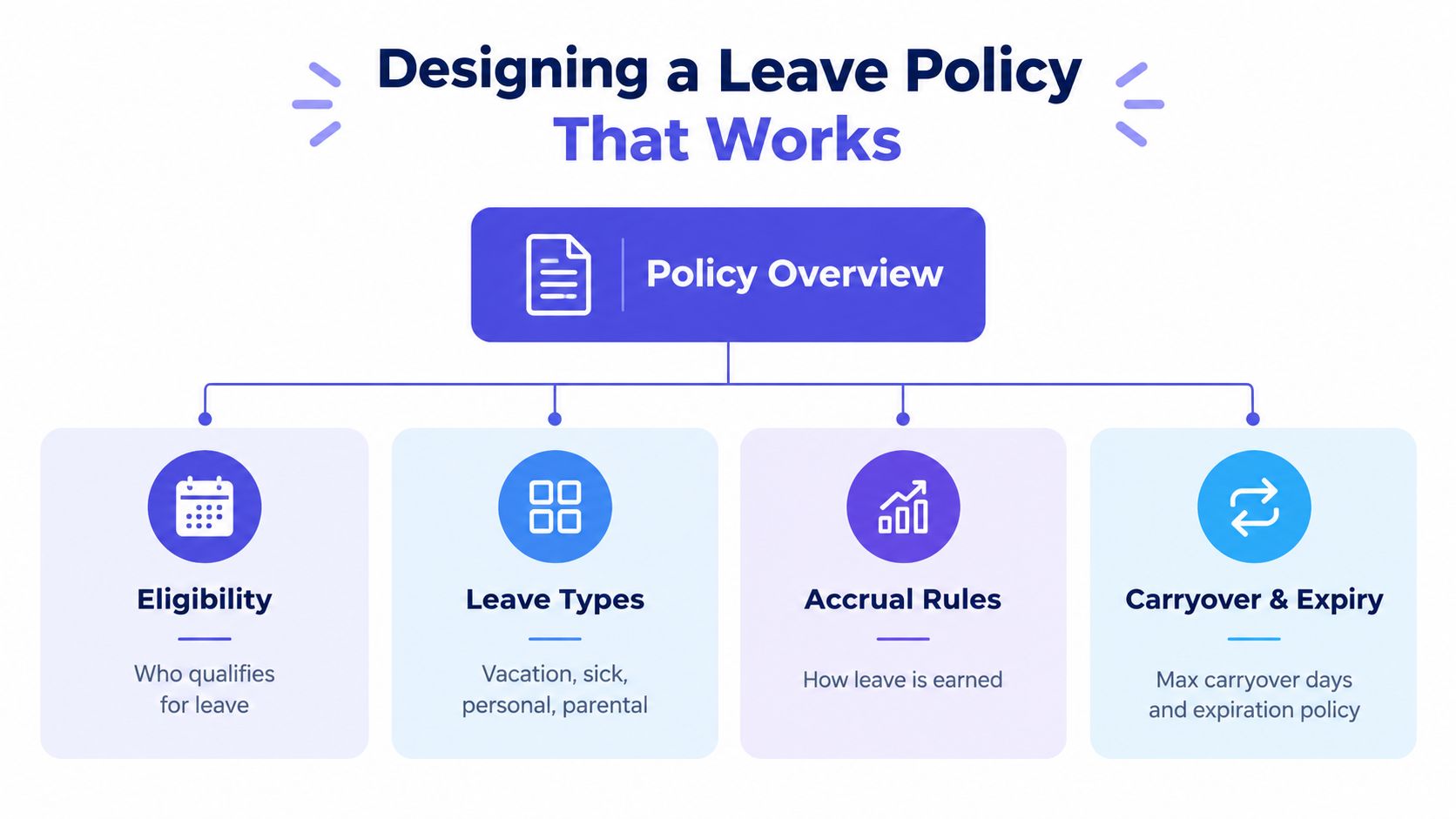
- Entitlement rules: Set out the annual leave entitlement, leave year, worker groups covered, and whether entitlement is given upfront or accrued.
- Bank holiday treatment: State clearly whether bank holidays sit inside entitlement or are added separately, especially for part-time and irregular-hours staff.
- Request notice and approvals: Define how much notice is expected, who approves leave, and the business reasons that justify refusal or alternative dates.
- Evidence requirements: Separate the rules for sickness, family leave, bereavement, and other absence types, because one evidence standard does not fit all.
- Carry-over and closure rules: Confirm what can be carried forward, who approves it, and whether any periods are blocked for operational reasons.
The policy should also settle one point that often gets missed. Planned leave and sickness absence are different records and need different handling. If an employee is ill during booked holiday, managers should not be left guessing whether the time stays as annual leave or is reclassified. The rule needs to be written down, applied consistently, and reflected in the record that payroll sees.
Build for mixed leave types from the start
Annual leave is only one part of the job. In practice, SMEs get into trouble when every absence follows the same route and ends up in the same report.
| Leave type | What the policy should define |
|---|---|
| Annual leave | Entitlement, accrual method, notice, approval, carry-over rules |
| Sickness absence | Reporting route, timing, evidence threshold, trigger points, recording category |
| Family leave | Eligibility, required documents, notice where applicable, payroll treatment, escalation |
| Bereavement leave | Notification route, paid or unpaid status, discretion, recording category |
That distinction matters operationally. Planned leave affects coverage and rota planning. Sickness absence affects reporting, review points, and in some cases statutory payments. If both are coded loosely as "time off", your team calendar may look tidy while your management information is wrong.
Partial-year joiners need special attention. Giving the full yearly allowance on day one can work for some salaried teams, but small businesses often regret it when someone leaves after taking more leave than they have built up. Accrual by leave period is usually cleaner, especially where turnover is higher or hours vary. The trade-off is administrative effort, so the policy needs to say exactly how balances are earned, rounded, displayed, and recovered if overtaken.
Part-time staff need the same level of precision. Bank holidays, compressed hours, and non-standard working patterns create avoidable disputes when the policy only describes a five-day worker. A short sentence in the handbook is not enough. Set out the method.
If managers have to rely on custom and memory, the policy is doing too little work.
If your current document is broad, informal, or silent on accruals and mixed absence types, it helps to benchmark it against a more structured leave management policy template and framework. The useful part is not the wording alone. It is forcing the business to make clear decisions before the requests start coming in.
Leave Request and Approval Workflows
Once the policy exists, the day-to-day pressure lands on the workflow. Small teams either keep control or slip back into messages, favours, and missing records.
The cleanest setup is one front door for every request. Employees shouldn't have to guess whether holiday goes to a manager, sickness goes to HR, and family leave goes by email. They can use one entry point, but the workflow behind it should branch by leave type.
A workflow that managers will actually use
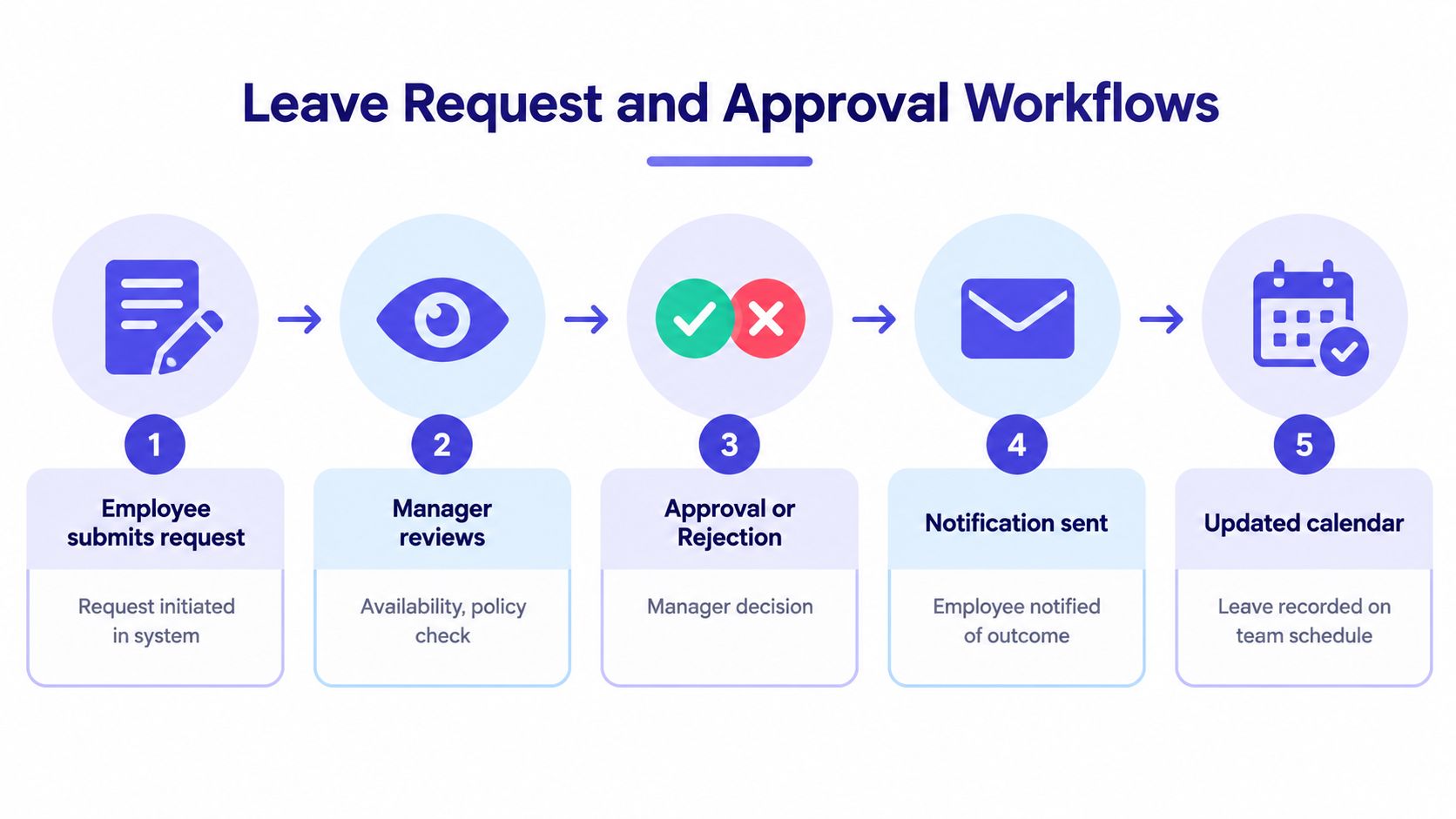
Most practical workflows have five decisions built into them:
- Submission: The employee chooses the leave category, dates, and adds required notes.
- Policy check: The system or admin checks balance, entitlement, and any evidence rule.
- Coverage review: The manager sees who else is off before approving.
- Decision record: Approval or refusal is logged with a reason.
- Calendar and payroll update: The absence flows into team visibility and downstream records.
This sounds obvious, but plenty of SMEs stop at step three. The manager approves, but the calendar isn't updated properly, or payroll receives no coded record.
A useful principle from legal guidance outside the UK is that absence requests work better when call-in expectations and recordkeeping are explicit. For a practical example of how employers frame that clearly, Nick Norris, P.A. has a concise piece on Mississippi employee absence advice that's worth reading for workflow discipline rather than UK law.
Don't treat mixed leave like one process
The failure point is overlap. An employee is on approved holiday, becomes unwell, and tells the manager by text. Another employee requests annual leave right after a period of sickness. Someone else needs time off for a family issue and payroll needs a category before the week closes.
If every absence follows the same approval path, mistakes become routine.
- Annual leave needs entitlement and coverage checks.
- Sickness absence needs recording, evidence tracking, and review dates.
- Family-related leave often needs a more restricted approval path and clearer documentation.
- Bereavement leave needs speed and discretion, not a generic holiday form.
This walkthrough gives a useful benchmark for keeping those routes simple without losing control: simple steps for an efficient leave approval process.
A short explainer is useful when you're training managers on the difference between requesting, recording, and approving leave:
Accruals, Pro-Rating and Holiday Pay Calculations
The errors that cause the most arguments are rarely the obvious ones. They usually start with a new joiner who begins halfway through the leave year, a part-time employee whose working pattern does not fit a standard Monday to Friday setup, or a manager who approves holiday before anyone checks what has accrued.
That is where spreadsheet systems start to drift. Balances look close enough, approvals keep moving, and payroll inherits the cleanup.
For a small team, the practical question is simple. Can you explain, and evidence, how each person's balance was built from their start date, working pattern, and contract terms? If the answer depends on one person's formula tab, the process is fragile.
Where calculations break in practice
Annual leave is usually expressed as weeks, but employees experience it as days or hours. Problems start when a business converts one to the other without agreeing the rule first.
A workable setup needs four points defined clearly:
- Accrual method: Decide whether leave is available upfront under your policy or earned through the year, then apply that rule consistently.
- Partial-year joiners: Calculate from the employee's actual start date in the current leave year, not from a full annual allowance copied across.
- Working pattern: Measure entitlement in days or hours that match the employee's real pattern, especially for part-time staff and compressed hours.
- Bank holiday treatment: Keep the contract rule clear. Included within allowance and additional to allowance produce different balances.
If your team is standardising these calculations, this guide on how to calculate prorated leave for different working patterns is a useful reference.
One operational mistake appears again and again. Businesses treat “approved leave” and “available entitlement” as the same thing. They are not. A person can have holiday approved for August while still accruing the balance that will cover it by the time it is taken. If no one tracks that properly, final pay calculations become messy when someone leaves early.
Accrual and pay scenarios at a glance
| Scenario | Entitlement treatment | Pay treatment |
|---|---|---|
| Full-year worker on a standard contract | Track statutory leave and any extra contractual leave separately across the leave year | Pay according to the correct holiday pay rule for the portion taken |
| Employee joins part way through leave year | Pro-rate from the joining date and record what has accrued to date | Check whether taken leave exceeds accrued entitlement if employment ends |
| Employee changes working pattern mid-year | Recalculate remaining entitlement based on the new pattern, with a clear effective date | Make sure holiday pay reflects the pattern and pay that applied when leave was taken |
| Contract includes bank holidays within allowance | Deduct bank holidays from the same balance used for annual leave | Pay bank holiday leave under the same holiday pay rules as other statutory or contractual leave |
| Employee is off sick during a booked holiday period | Record the sickness absence separately if your reporting and evidence process supports reclassification | Apply sickness rules to the absence record and holiday pay rules only to leave that remains classed as holiday |
Holiday pay needs the same discipline. Since the 2024 reforms, payroll teams need a clearer split between different parts of statutory leave, especially where normal pay and basic pay are treated differently. The government's guidance on holiday pay and entitlement reforms from 1 January 2024 sets out the detail. In practice, small employers need records that show which leave pot has been used, not just a single running balance.
I have seen this become a real problem during audits and leaver calculations. The balance looked fine on the surface, but no one could show which days sat in which pot or whether a mid-year contract change had already altered the remaining entitlement.
Sickness creates a separate calculation issue. If someone becomes unwell during booked holiday, HR and payroll need the record coded correctly before reports and pay are run. The government's sick leave guidance explains the fit note position for longer absences. For internal control, the point is straightforward. Do not let sickness days sit in the annual leave balance just because the holiday was approved first.
Watch for this: The hardest balances to correct are the ones that looked plausible for months, especially where accruals, bank holidays, and sickness were all recorded in one running total.
Reporting Across Planned Leave and Sickness Absence
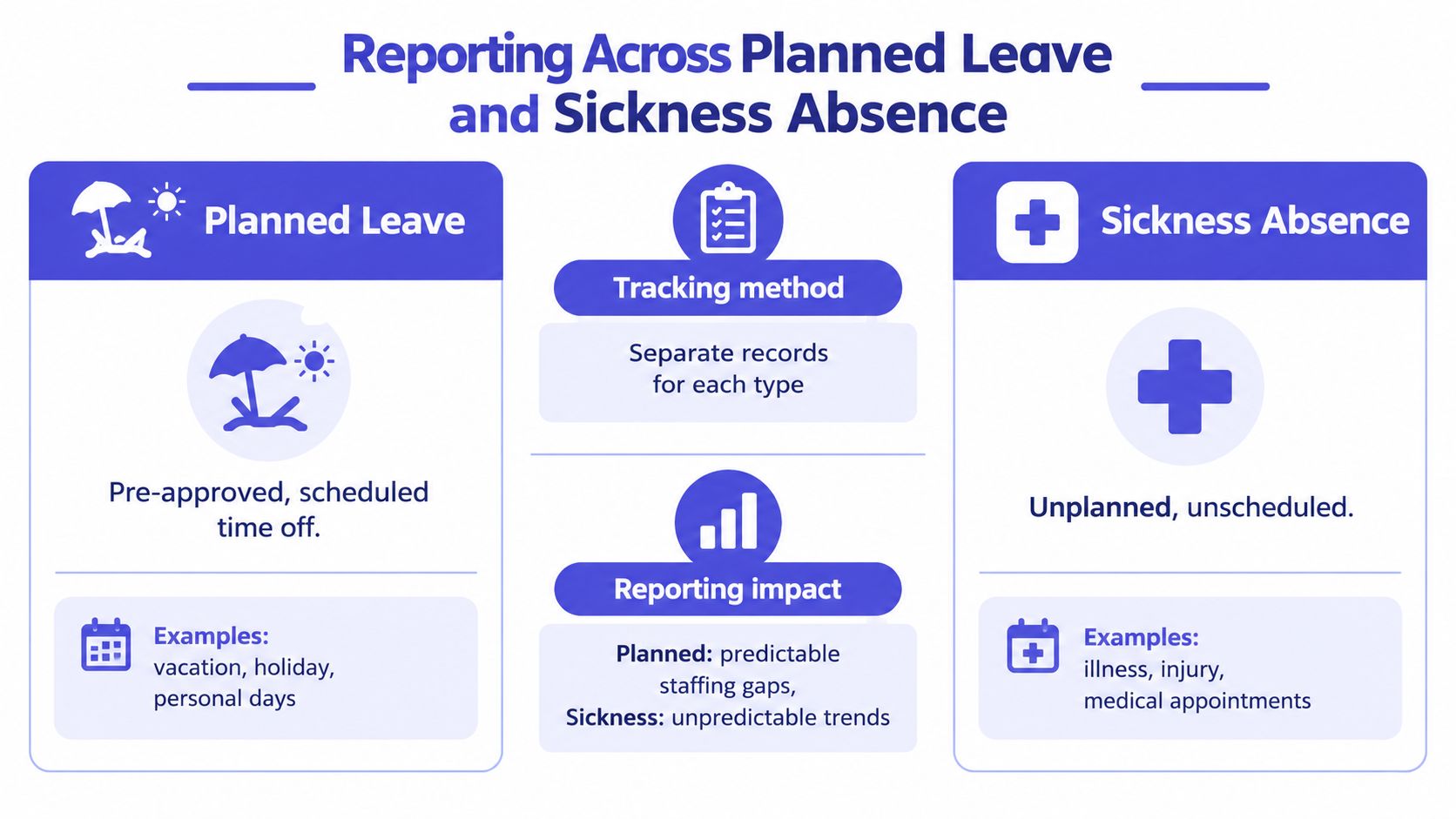
Many SMEs still report all time off in one category because it's easy. It's also misleading. Planned leave and sickness absence serve different management purposes, so they need separate records and separate reports.
The split matters because one stream is predictable and one isn't. Planned leave helps managers schedule cover ahead of time. Sickness absence helps managers understand disruption, evidence status, and operational risk.
Two reporting streams, two different decisions
The ONS treats sickness absence as a distinct labour-market measure, and a UK leave system should do the same, as reflected in the ONS sickness absence datasets and reporting approach. If your internal report lumps sickness together with booked annual leave, managers can't tell whether pressure came from expected holidays or unexpected absence.
| Reporting stream | What it should show | Why it matters |
|---|---|---|
| Planned leave | Approved dates, remaining balance, upcoming team conflicts | Supports rota planning and approval decisions |
| Sickness absence | Start date, category, evidence status, return or review point | Supports operational response and absence oversight |
What good reporting looks like in a small team
A useful report doesn't try to be clever. It shows what managers need this week and what HR needs this month.
For managers, that usually means a forward view of approved leave by team. For HR or operations, it means a sickness log that can be reviewed separately for patterns, documentation, and handover points. The moment you combine the two, both views lose value.
Planned leave is a scheduling issue first. Sickness absence is an operational risk issue first. The records should reflect that difference.
Best Practices for Operational Continuity
Operational continuity usually breaks on an ordinary Wednesday. The payroll cut-off is tomorrow, one manager is off, another employee has called in sick, and a part-time starter who joined in July is asking why their balance looks different from everyone else's. In a small team, that is the test of a leave management process. It has to keep working when the people who normally hold it together are unavailable.
The teams that cope well do not usually have more policy. They have clearer operating rules. Everyone knows where leave is requested, who can approve it if the usual manager is away, how balances are updated, and which absences affect rota planning versus payroll coding.
A workable setup for a small business usually includes four things:
- A live record of entitlement, not a static annual allowance. This matters most for accrual-based contracts, part-time staff, and joiners who start mid-year. If the system shows a flat full-year figure too early, managers approve leave against the wrong balance and payroll ends up correcting it later.
- Approval cover that follows the role, not the person. If a line manager is absent, another named approver needs authority to act in the same system, with the decision recorded there and then.
- A team view that shows operational impact, not just dates. For continuity planning, managers need to see who is off, who is working reduced days, and where a booked holiday differs from sickness absence.
- One source of record for exceptions. Part-time patterns, carry-over agreements, and contract differences should sit inside the process, not in side notes or private spreadsheets.
One example shows where this often goes wrong. A three-day-a-week administrator joins in September, halfway through the leave year. The manager checks the shared calendar, sees only one other person off that week, and approves four days in October. The problem is not the approval itself. It is that nobody checked the pro-rated balance, nobody noticed one of those days falls outside the employee's normal working pattern, and payroll later receives a leave record that does not match the contract. Good continuity means the system flags all three points before approval, not after.
The same principle applies to absence visibility. A shared calendar should help a manager answer two different questions quickly: who is unavailable next week, and why? Planned annual leave helps with cover planning. Sickness absence affects handovers, evidence follow-up, and pay treatment. If both appear as a generic "out of office" block, operations lose the detail they need at the exact point pressure rises.
LeaveWizard supports leave requests, sickness recording, approval actions, balance updates, and calendar visibility through web and mobile access. For a small business trying to replace spreadsheets, inbox approvals, and separate payroll notes, that kind of single record reduces the number of manual checks that usually fail under pressure.
Flexibility still matters. Contracts differ, leave years differ, and some staff accrue while others receive their full allowance at the start of the year. The practical rule is simple. Keep one process, then configure the rules inside it. Once a business starts handling partial-year joiners, sickness coding, or unusual working patterns outside the main workflow, continuity depends on memory again. That is usually when errors start.
Frequently Asked Questions About Leave Management
What if annual leave and sickness overlap?
Use one rule and document it. If someone falls sick during booked holiday, ask the manager to confirm the dates, record sickness against those dates, and return the affected annual leave days to the employee's balance only after the evidence is logged. A simple manager prompt helps: "Please confirm the first day unfit for work, whether the employee had already started leave, and what evidence has been received."
What should I do if someone joined part way through the leave year and their balance looks wrong?
Run a quick three-point check before changing anything: start date, leave year start, and working pattern. In small teams, the error is often not the pro-rating rule itself but a full-week allowance being loaded for someone who works three days, or a starter balance being entered manually and then accrued again by the system. Check the audit trail before you amend the figure.
Do employees need a fit note straight away?
No, but the request for evidence should not sit in someone's memory. Set an automatic reminder for the manager on the day your evidence threshold is reached, then use a standard message so staff get the same instruction each time: "Please send your fit note covering the absence dates by [date] so we can keep your record and pay treatment accurate."
Can bank holidays sit inside statutory annual leave?
Yes, if the contract is clear and the setup matches it. The practical check is at year start. Pull two or three sample records from different contract types and confirm bank holidays are reducing balances only where they should. That catches configuration mistakes before they affect everyone.
How do we introduce a new system without disrupting everyone?
Start with one live leave year, not historic perfection. I usually advise SMEs to migrate current balances, open requests, and core policy rules first, then keep older records accessible in read-only form for reference. For the first month, ask managers to approve inside the new system and stop accepting email approvals. If both channels stay open, staff will use both.
What if our current process has already caused payroll discrepancies?
Reconcile one pay period at a time. Match six fields for each disputed case: employee name, leave type, dates, days or hours, approval status, and payroll treatment. That method shows whether the problem came from the request, the approval, or the payroll handoff. Once you find the break point, write the fix into the process instead of correcting the same error again next month.
Leave management gets easier when the rules, records, and approvals all sit in one place. LeaveWizard helps small businesses manage annual leave and absence with automated calculations, approval workflows, and clear reporting across teams. If your current process still depends on spreadsheets and inboxes, it's worth taking a proper look.