Calculating holiday entitlement for part-time workers all boils down to one simple principle: fairness. It's about taking the standard 5.6 weeks of paid holiday everyone gets and adjusting it on a pro-rata basis. This ensures your part-time staff receive the same entitlement as your full-time team, just scaled to fit their specific working days or hours.
It sounds straightforward, and in many ways, it is. But getting it right is crucial.
Your Legal Duties For Part-Time Holiday Pay

Navigating the rules around holiday pay can feel a bit daunting, but the foundation of UK law here is all about ensuring fair treatment for everyone. The key piece of legislation to know is the Working Time Regulations 1998, which establishes the legal right to paid annual leave for all workers.
This is the bedrock that prevents part-time employees from being treated less favourably than their full-time colleagues. It mandates that everyone gets a minimum of 5.6 weeks of paid annual leave. This figure is then adjusted proportionally—or 'pro-rata'—to match a part-timer's schedule.
Put simply, it means someone working three days a week gets the same relative holiday benefit as someone working five.
Understanding Pro-Rata Entitlement
"Pro-rata" just means "in proportion." When we apply it to holiday entitlement, it’s how we guarantee fairness, no matter how many days or hours a person works.
Let's take a real-world example. A part-time worker contracted for three days per week is legally entitled to 16.8 days of paid leave per year.
The calculation is simple: 3 days × 5.6 weeks = 16.8 days.
This statutory right is a cornerstone of fair employment practice in the UK.
One critical aspect of your legal duties involves correctly classifying your workers as employees or contractors, as this distinction has a massive impact on their holiday entitlements. Contractors, for instance, don't typically have the same statutory rights to paid leave as employees.
Key Takeaway: The principle of pro-rata entitlement is non-negotiable. It’s not about giving fewer holidays; it's about providing an equivalent amount of leave that reflects an employee's specific working pattern, preventing any disadvantage compared to full-time staff.
This legal framework isn't just about compliance; it’s designed to protect both your team and your business. When you understand and apply these rules correctly, you foster a transparent and fair workplace culture. And that foundation of fairness is the most important step in getting part-time holiday calculations right every time.
Calculating Holiday For Fixed Part-Time Schedules
Right, let's move from the legal theory to what you'll actually be doing day-to-day. The most common scenario you'll face is calculating holiday for part-time staff who work fixed, predictable schedules. This is often where managers feel a bit stuck, but I promise the maths is quite simple once you see it laid out.
Whether an employee works a set number of days or a fixed number of hours each week, having a clear formula completely removes the guesswork.
The standard calculation for someone working a set number of days per week is refreshingly straightforward. All you need to do is multiply the number of days they work by the statutory leave entitlement of 5.6 weeks.
Here’s a quick example:
- Employee A: Works a fixed 3 days per week (e.g., Monday, Tuesday, Wednesday).
- Calculation: 3 days × 5.6 weeks = 16.8 days of paid holiday per year.
This method gives you a clear figure in days, which is incredibly easy to track. But what about employees who work fixed hours, but perhaps not full, uniform days?
Shifting From Days To Hours
For some roles, especially where daily hours can vary, calculating in hours just makes more sense and ensures greater accuracy. The process is similar, but we first need to convert the 5.6 weeks of statutory leave into hours. A standard full-time week is often 37.5 or 40 hours – let's use 37.5 hours for this example.
First, find the total full-time holiday allowance in hours. That’s 210 (37.5 hours × 5.6 weeks). Now you can easily work out the pro-rata share for any part-time employee based on their weekly hours.
- Employee B: Works a fixed 20 hours per week.
- Calculation: (20 hours ÷ 37.5 hours) × 210 hours = 112 hours of paid holiday per year.
This hourly approach is invaluable for ensuring total fairness when a "day" isn't a standard 8-hour block. Both methods deliver the same pro-rata principle, just in different units. For a deeper dive, you can explore more examples in our detailed guide on the holiday calculation for part-time workers.
This infographic breaks down the logical flow for these pro-rata calculations perfectly.
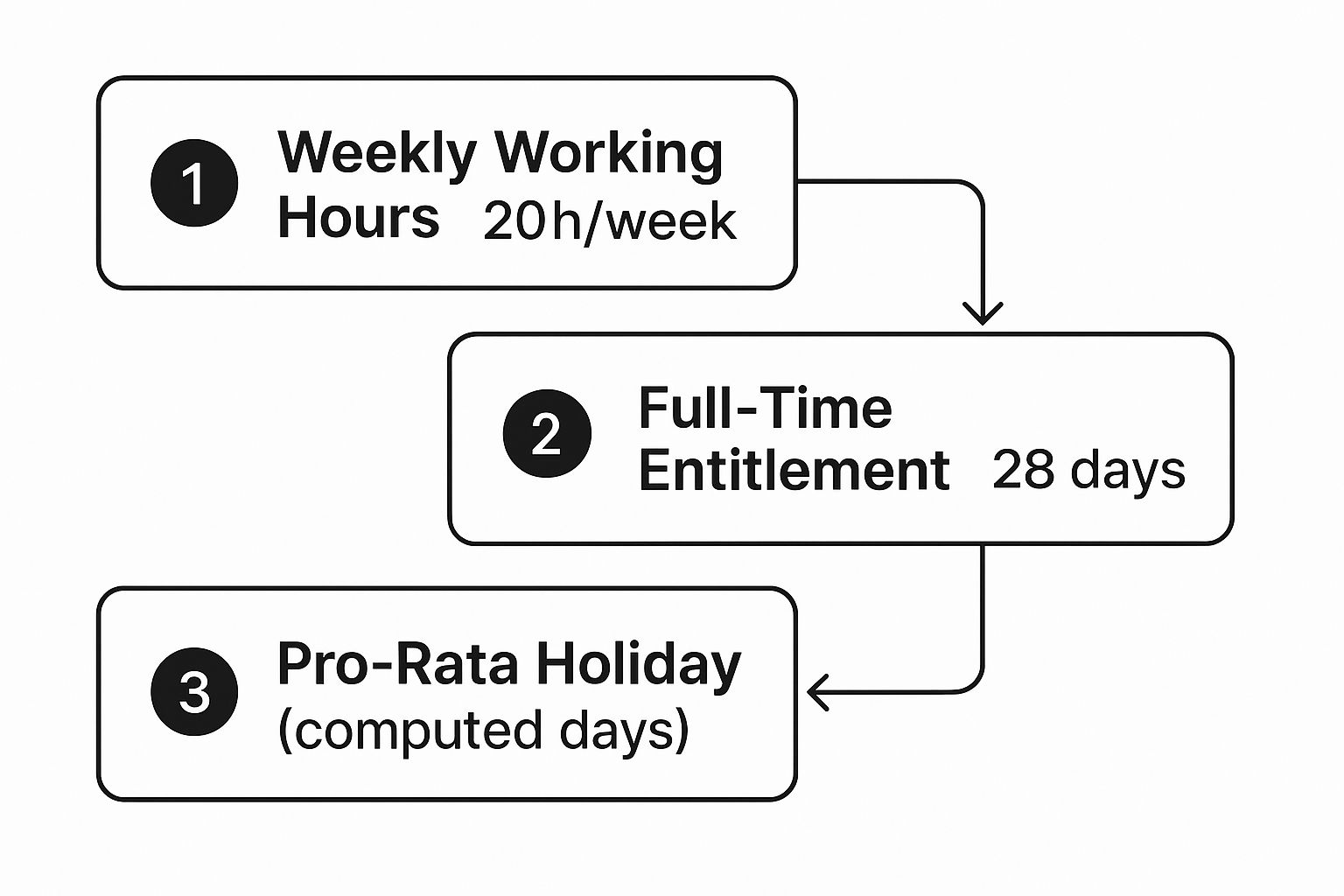
As you can see, the key is always to connect the employee's specific working pattern back to the full-time equivalent. This is how you arrive at their fair, proportional holiday allowance every single time.
A Critical Rule of Thumb: When your calculations result in a fraction of a day or hour (like our 16.8 days example), you must always round the entitlement up to the next half or full unit. You can never round down, as this would mean the employee receives less than their statutory minimum. So, 16.8 days legally becomes 17 days of leave.
How To Handle Holiday Pay For Irregular Hours

Things get a bit tricky when you're calculating holiday pay for part-time staff on variable schedules or zero-hour contracts. Since their working hours can change from one week to the next, a simple fixed-day or hourly calculation just won't cut it.
The whole point is to make sure their holiday pay is a fair reflection of what they'd normally earn, including any overtime or other variable payments they typically receive. To get this right, UK law points us towards the 52-week reference period. It's the most accurate and legally sound way to handle these non-standard working patterns.
The 52-Week Reference Period Explained
The idea behind this method is pretty straightforward. You calculate an average of the employee's pay over the last 52 weeks where they actually earned something. The key word here is earned. If there are weeks where the employee didn't work and wasn't paid, you have to skip over those and look further back until you've collected 52 paid weeks of data. You can go back a maximum of 104 weeks to find them.
This ensures that someone taking a holiday during a slow period gets paid an average rate that also accounts for those busier, higher-earning times of the year.
Let's look at a quick example for a zero-hour contract worker:
- First, add up all their earnings over the last 52 paid weeks. Let's say it comes to £10,400.
- Next, divide that total figure by 52 to get their average weekly pay.
- The calculation is: £10,400 ÷ 52 = £200.
So, for this worker, one week of holiday pay would be £200. This is the legally correct approach. Of course, the calculations are just one part of the puzzle. Employers also have to navigate the challenges of schedule inflexibility when managing leave for their part-time teams.
What About Newer Employees?
What happens if someone hasn't been with you for a full 52 weeks yet? No problem. You just use the number of full weeks they have worked.
If an employee has been on your payroll for 20 weeks, you'd total their pay across those 20 weeks and then divide by 20 to find their average weekly pay. It’s all about basing their holiday pay on their actual earnings history with your company, however long that may be.
A Note on the 12.07% Method: You might remember the old percentage method, where holiday was calculated as 12.07% of hours worked. Following the Harpur Trust v Brazel ruling, this approach is no longer compliant for most workers with irregular hours. It was found to potentially short-change them on the holiday pay they're entitled to. The 52-week average is the new gold standard.
This method is also essential for term-time workers, who often have long, unpaid gaps in their work year. By only counting the weeks they were actually paid, you get a fair reflection of their typical earnings during term time, so their holiday pay isn't unfairly watered down.
Manually tracking all this can be a headache, which is where a tool like LeaveWizard comes in. It can automate the entire process, making sure your calculations are always accurate and compliant with the latest regulations.
Managing Bank Holidays Fairly For All Staff
Bank holidays often become a real headache, creating friction and confusion, especially when you have part-time workers. A common but deeply flawed approach is to just give someone a day off if a bank holiday happens to fall on their scheduled workday. This might seem simple, but it quickly creates an unfair system where some staff get lucky and others miss out.
Think about it. You might have two part-timers: one works every Monday, the other every Wednesday. In England and Wales, most bank holidays land on a Monday. This means the Monday worker gets a bunch of extra paid days off each year, while the Wednesday worker gets nothing. That’s not just unfair; it’s a surefire way to damage team morale.
There's a much better, more equitable way to handle this: treat bank holidays like any other type of annual leave and calculate them on a pro-rata basis. This guarantees every single employee receives a fair allocation, no matter which days of the week they work.
Adopting A Pro-Rata Bank Holiday System
The idea is to work out a proportional bank holiday allowance for each part-time employee. You then add this to their total annual leave entitlement. From there, employees simply use this combined allowance to 'book' time off for any bank holidays that fall on their normal working days.
Let's break down how this works in practice.
If a full-time employee gets 8 bank holidays, a part-timer working 3 days a week would get a proportional amount. The calculation is straightforward:
- (3 days ÷ 5 days) × 8 bank holidays = 4.8 days
This 4.8-day bank holiday allowance is then rolled into their standard pro-rata holiday entitlement. When a bank holiday comes around that lands on their normal workday, they book it off using their total leave pot.
This simple change completely removes the "luck of the draw" from the equation. The Monday worker and the Wednesday worker both get the same fair, proportional allowance. This level of transparency is vital for preventing resentment and keeping the workplace culture positive. The principles here are very similar to those in our complete guide to zero-hour contract holiday entitlement, where fairness is always achieved through proportional calculations.
To help you decide which approach is best for your team, here’s a quick comparison of the two main methods for handling bank holidays for part-time staff.
Choosing The Right Bank Holiday Allocation Method
| Method | How It Works | Pros | Cons / Risks |
|---|---|---|---|
| Give a day off in lieu | An employee gets a paid day off only if a bank holiday falls on their contracted working day. | Simple to explain on a case-by-case basis. Requires minimal initial calculation. | Inherently unfair. Creates inequality among staff based on their work patterns. Can lead to resentment and low morale. |
| Pro-rata allocation | All employees receive a proportional bank holiday allowance based on their working hours, added to their total annual leave. | Ensures fairness and equity for everyone, regardless of their work schedule. Transparent and defensible. | Requires upfront calculation. Can feel slightly more complex to administer without an automated system. |
Ultimately, while the pro-rata method requires a bit of initial setup, it's the only truly fair way to manage bank holidays and is widely considered best practice.
Crucial Insight: By granting a pro-rata bank holiday entitlement, you shift the focus from which day a holiday falls on to ensuring every team member receives their fair share of paid time off. This is a fundamental step in equitable leave management.
Switching to this system might seem like a bit of extra admin, but it’s a small price to pay for the huge return in fairness and employee satisfaction. Using a leave management tool like LeaveWizard can automate these calculations entirely, making the process seamless and error-free. It ensures every aspect of calculating holiday for part-time workers is handled correctly and fairly.
Common Mistakes In Part-Time Holiday Calculations

Even when you have the best intentions, it's surprisingly easy for small errors to slip into holiday calculations. These aren't just minor admin issues; they can lead to serious compliance problems and, just as importantly, unhappy team members. Getting to grips with these common pitfalls is the first real step toward building a holiday process that’s both fair and foolproof.
One of the most frequent mistakes I see is incorrectly rounding holiday entitlement. It’s a classic. A calculation comes out to a fraction, say 16.8 days, and it gets rounded down. But the law is crystal clear on this: you must always round up to the next half or full day. Rounding down to 16.5 or 16 days might seem trivial, but it means you're not giving that employee their full statutory minimum. That’s a shortcut that can easily land you in legal trouble.
Another common slip-up is mishandling bank holidays. As we've touched on, just giving a day off if a bank holiday falls on an employee’s usual workday isn't fair. Think about it—this approach penalises anyone who doesn't typically work on a Monday, creating a two-tier system within your team. The only fair way to handle this is with a pro-rata system for all bank holidays.
Forgetting Key Pay Components
A more subtle, but equally significant, error is forgetting to account for pay rises or other regular payments when calculating holiday pay. This is especially true for staff on irregular hours. Holiday pay isn't just about basic salary; it must reflect an employee's average earnings, which legally includes regular commissions, bonuses, and consistent overtime. Using an old pay rate means you're underpaying them for their well-earned time off.
Getting this wrong is more critical than ever, as it can make employees hesitant to take the breaks they need. Recent research points to a worrying trend of UK employees taking less annual leave, with the average dropping by nearly 12% since 2020. This decline is happening across the board, in sectors like construction (-10.98%) and finance (-9.11%), showing just how vital it is to make taking leave simple and fair.
Key Takeaway: Small errors in holiday calculations can have big consequences. They affect everything from legal compliance and employee morale to whether your team feels they can actually take the time off they're entitled to. A consistent, fair, and legally sound process is absolutely essential.
These mistakes are all too easy to make if you're tracking everything manually in a spreadsheet. This is where a dedicated tool can be a lifesaver by automating the calculations and taking the guesswork out of it. If you're looking for a reliable way to get it right every time, our simple holiday entitlement calculator is designed to do just that.
Right, you’ve sorted out the maths and your part-time holiday policy is legally sound. But what’s the point if your team never actually takes their time off?
Getting the calculations right is one thing. Creating a workplace culture where people feel they can actually use their well-deserved leave is a completely different, and often harder, challenge. The tough reality is that a huge number of UK employees simply don’t take their full holiday allowance. We need to look at why.
Often, it comes down to pressure. Crushing workloads, looming deadlines, and a subtle but powerful company culture that seems to reward "always-on" behaviour can make booking a holiday feel more stressful than it's worth. For part-time staff, this feeling can be even worse, as they often feel immense pressure to prove their commitment during their limited working days just to keep up.
This isn’t just a simple scheduling problem—it's a direct threat to your team's wellbeing and, ultimately, their productivity.
A recent study really brought this home, showing that less than 40% of UK workers used their entire annual leave allowance in both 2022 and 2023. That’s a massive statistic, and it points to some serious cultural or workload-related roadblocks preventing people from getting the rest they need. You can read more about these findings and the knock-on effect for work-life balance on timetastic.co.uk.
Creating a Culture That Genuinely Values Rest
If you want to turn this trend around in your own company, the change has to start at the top. It's that simple. When managers and senior leaders not only take their own holidays but are seen to completely disconnect while they're away, it sends a powerful signal to everyone else: rest isn't just permitted, it's expected.
Beyond just leading by example, here are a few practical things you can do:
- Rethink Your Carry-Over Rules: A rigid "use it or lose it" approach often creates a mad dash at the end of the year, which helps no one. A clear, fair carry-over policy provides flexibility, but it still needs to gently nudge people to take their breaks throughout the year, not just hoard them.
- Make Tracking and Reminders Easy: Forget spreadsheets. Manual tracking is a fast track to forgotten leave and administrative headaches. A simple digital tool that monitors balances and sends out automatic reminders helps both staff and managers stay on top of things without any extra effort.
- Change the Conversation: Start talking about holidays differently. It’s not a "disruption" or a "headache" for the schedule. Frame it for what it truly is: an essential part of your strategy for preventing burnout, sparking creativity, and maintaining the team's long-term performance.
Key Insight: Annual leave isn't a liability you have to manage; it's a direct investment in your team's health and your company's future. A properly rested team is always more engaged, innovative, and effective.
By actively taking these steps, you can start to shift your workplace from one that quietly discourages time off to one that champions it. This is how you make sure your fair holiday calculations for part-time workers translate into what they’re meant for: real, restorative time away from work.