Almost all UK workers are legally entitled to 5.6 weeks of paid annual leave each leave year. For someone working a five-day week, that is 28 days, and the statutory minimum may include public holidays, while many employers provide more through contractual enhancement.
So why do otherwise organised businesses still get holiday entitlement wrong? The answer usually appears when a manager tries to calculate leave for a zero-hours worker, a seasonal employee, or someone whose shifts change from one pay period to the next. The familiar “days multiplied by 5.6” approach stops being reliable as soon as working patterns stop being predictable.
Annual leave entitlement isn't just a number in an employment contract. It determines how much paid leave a worker builds up, how holiday pay is calculated, what happens when leave overlaps with sickness, and which records an employer must retain. For small and growing businesses, the practical question is less “how many days do we offer?” and more “can we prove that every worker has received the right entitlement and pay?”
Table of Contents
- What Annual Leave Entitlement Actually Means
- Who Is Entitled and How Many Days You Actually Get
- Calculating Leave for Irregular Hours and Part-Year Workers
- What Happens When Leave Intersects With Sickness and Termination
- Why Manual Tracking Creates Risk for Growing Businesses
- Building a Compliant Leave Management Approach
What Annual Leave Entitlement Actually Means
A business owner is checking an employee handbook before sending out a new contract. The policy covers full-time staff clearly enough, but then comes a zero-hours worker who accepts shifts when available. The manager searches for a simple annual leave figure and finds several different formulas, each apparently designed for a different type of worker.
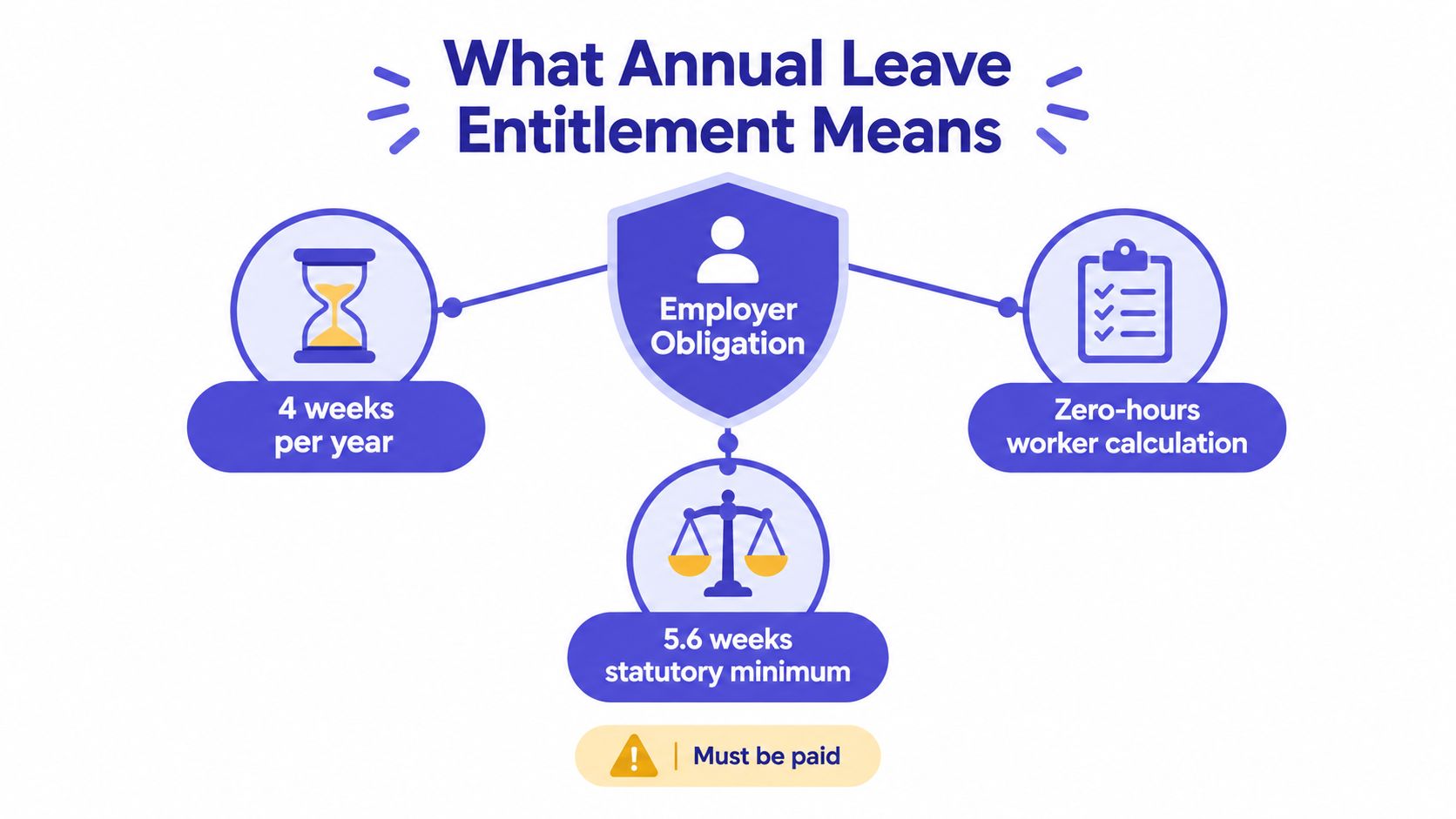
That situation is common because annual leave entitlement describes a legal right, not one universal calculation. In the UK, almost all workers are entitled to 5.6 weeks of paid statutory annual leave each leave year, including agency workers, zero-hours workers and people with irregular schedules. For a worker who normally works five days each week, the statutory minimum is 28 days, and public holidays can count within that allowance. These principles are set out in the GOV.UK guidance on holiday entitlement rights.
The entitlement is paid time off. It isn't an informal benefit that a business can remove when shifts fluctuate or demand falls. The calculation method changes according to the worker's working pattern, but the underlying obligation remains.
Statutory minimums and contractual enhancements
The statutory entitlement is the legal floor. A contract can provide more generous terms, such as extra days, additional company closure days, or a separate allowance for public holidays. Once those enhanced terms appear in the contract or policy, the business must administer them consistently rather than treating them as discretionary goodwill.
A useful policy should therefore identify:
- The statutory allowance: The minimum paid leave required by law.
- The contractual allowance: Any additional leave promised by the employer.
- The working pattern: The days, hours or shifts used to calculate entitlement.
- The leave year: The period during which entitlement is earned and taken.
- The pay treatment: How holiday pay is calculated for that worker.
The mistake is to record only a headline balance. A sound record shows how the balance was produced, which part is statutory, which part is contractual, and how the business handled changes in hours. That information becomes important when an employee changes from regular hours to variable shifts, or when a manager has to explain a final payment.
Practical rule: Treat annual leave as a calculation and record-keeping responsibility, not just a number displayed on a staff portal.
Who Is Entitled and How Many Days You Actually Get
The first step is to classify the worker correctly. Most UK workers receive statutory paid annual leave, regardless of whether they are employees, agency workers, part-time staff, zero-hours workers or people working only during part of the year. Calling someone “casual” or “temporary” doesn't remove the obligation if the person falls within the legal definition of a worker.
For regular-hours staff, the entitlement is usually expressed in weeks and then converted into the worker's normal working days. A full-time employee working five days per week receives the familiar statutory minimum described above. A part-time employee still receives the same number of weeks, but the number of working days is lower because the person works fewer days in each week.
That distinction matters. A business should calculate leave in a way that reflects the employee's normal working pattern, rather than comparing a part-time worker's day balance directly with a full-time colleague's balance. Someone working fewer days may have fewer days recorded but the same statutory number of weeks away from work.
Public holidays and contractual leave
Public holidays don't automatically sit outside annual leave. An employer can count them towards the statutory minimum, provided the worker still receives the required paid entitlement. The policy should say clearly whether public holidays are included, whether the business closes on those dates, and how the closure affects someone who doesn't normally work that day.
Contractual enhancement creates a separate layer. An employer offering more than the statutory minimum needs to define whether the additional allowance is:
- included in one combined holiday balance
- recorded separately from statutory leave
- available on the same booking rules
- adjusted when someone changes working pattern
- subject to special rules for public holidays or company closure days
A combined balance may be simpler for employees, but separate records can make audits easier. The best choice depends on the policy, payroll process and system capability. What doesn't work is leaving the distinction to individual managers, because two teams may then apply different rules to workers with similar contracts.
A quick contract review
Take one contract for each working pattern in the business and ask three questions. Does it state the statutory entitlement? Does it explain any enhanced allowance? Does the calculation method match the way the worker is paid and scheduled?
If the answer to any question is unclear, the problem isn't solved by copying the figure from a full-time contract. The business needs a documented calculation method that payroll, HR and line managers can apply consistently.
Calculating Leave for Irregular Hours and Part-Year Workers
A spreadsheet that worked for regular employees starts producing unreliable results. A worker may complete different hours in every pay period, or work only during a defined part of the year. In those cases, contracted days don't provide a dependable basis for calculating earned leave.
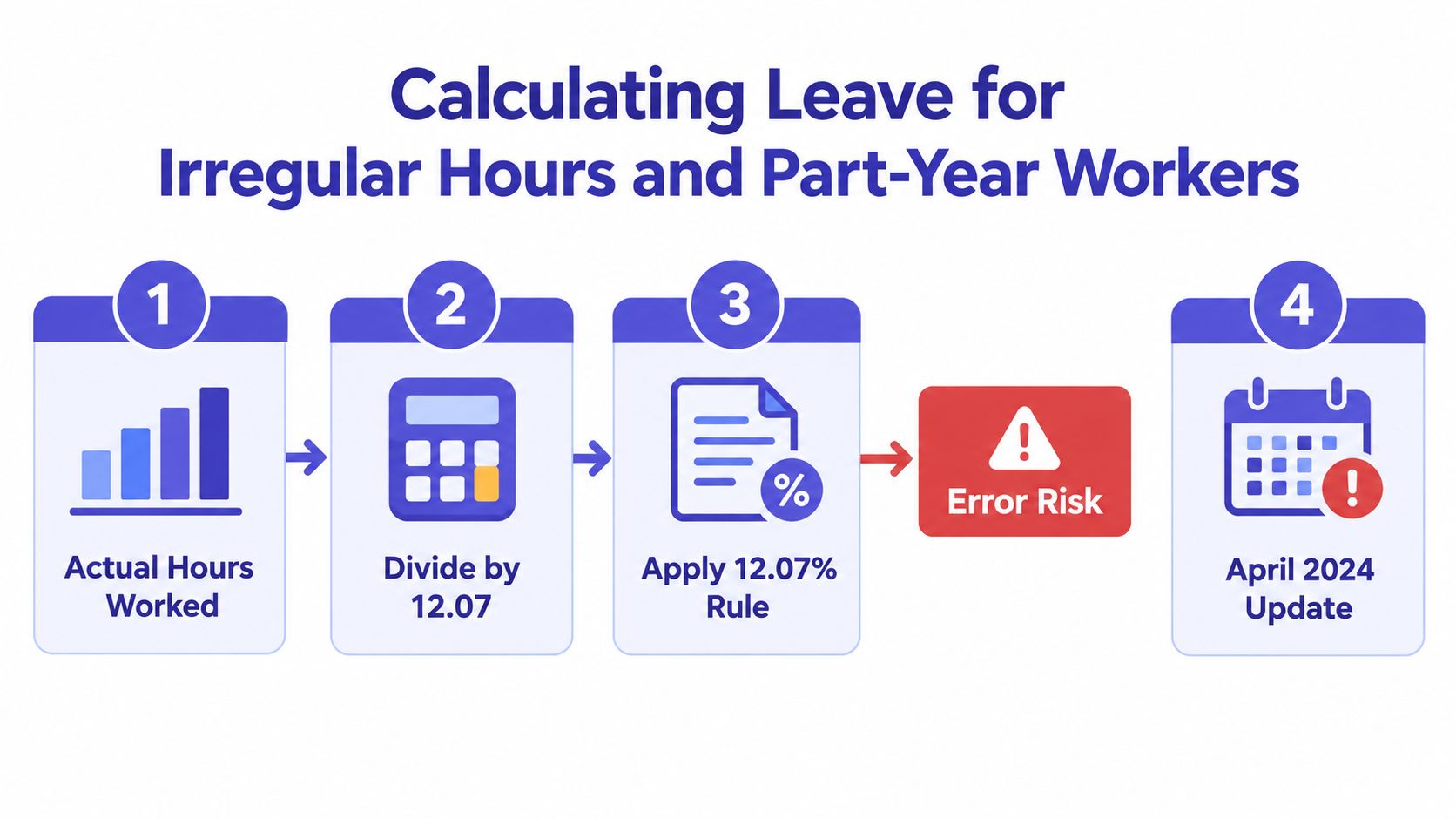
For leave years beginning on or after 1 April 2024, eligible irregular-hours and part-year workers generally accrue statutory leave at 12.07% of the hours worked in each pay period. The entitlement is added on the final day of that pay period. GOV.UK explains the rule and the related holiday-pay changes in its guidance on holiday pay and entitlement reforms.
Apply the calculation in four steps
Capture actual hours worked. Use approved payroll or time records for the relevant pay period. Don't use scheduled hours if the worker completed a different number.
Apply the statutory percentage. Multiply actual hours worked by 12.07%. For example, a worker completing 100 hours in a pay period accrues 12.07 hours of leave, as shown in the government guidance linked above.
Add the result to the worker's balance. The accrual belongs to that pay period and should be visible in the leave record. Recording only an end-of-year total makes it harder to identify an error.
Apply the rounding rule. A fraction below 30 minutes is rounded down, while a fraction of 30 minutes or more is rounded up. The system should preserve the underlying calculation so payroll can explain the final figure.
The 12.07% method isn't a universal shortcut for every worker. It applies to the relevant irregular-hours and part-year categories under the rules for the applicable leave year. Regular-hours workers need a different approach, and an employer with contractual leave above the statutory minimum must adjust the percentage rather than automatically using 12.07%.
The transition also matters. For leave years beginning on or before 31 March 2024, employers could use either a leave-year method or an accrual method in the relevant circumstances. For later leave years, eligible irregular-hours and part-year workers generally move to pay-period accrual based on actual hours. A business should record which leave-year rules apply instead of changing a formula halfway through without an audit trail.
A spreadsheet can calculate a percentage, but it often fails at the surrounding controls. It may contain the wrong hours, miss a worker's status, overwrite a prior adjustment, or apply the statutory percentage to an enhanced entitlement. A reliable workflow links attendance or payroll data to the leave record and flags exceptions for review.
For a practical calculation workflow, businesses can also use this holiday calculator for irregular-hours workers.
The following video provides another explanation of the calculation process:
What Happens When Leave Intersects With Sickness and Termination
A leave balance isn't always settled by the end of the leave year. Sickness, dismissal and changes in working status can all affect what the employee is entitled to take or receive. HR teams that track only approved bookings will miss part of the legal picture.
A worker who couldn't take statutory leave because of illness may be able to carry it into the next leave year. For regular-hours workers, GOV.UK identifies carry-over of up to 20 of the 28 statutory days in relevant circumstances. A worker who is off sick can choose to take holiday during sickness absence, but the employer can't force the person to turn sick leave into annual leave. These rules are explained in the GOV.UK guidance on calculating leave entitlement.
What to check during sickness absence
The manager should record the absence separately from annual leave and avoid cancelling the worker's entitlement just because the leave year has closed. A useful review asks:
- Was the worker prevented from taking leave because of illness?
- Was the statutory leave identified separately from contractual enhancement?
- Did the worker choose to take holiday while absent, or did someone incorrectly require it?
- Has the carry-over decision been recorded with the relevant dates and reason?
This approach protects both sides. The employee can see why a balance remains available, while the employer can show that it didn't ignore a statutory right.
A holiday balance should explain what happened, not merely show what remains.
Final pay and deductions
When employment ends, unused statutory leave must be paid. That obligation applies even if the worker is dismissed for gross misconduct. The final calculation should use the worker's correct entitlement for the part of the leave year worked, account for leave already taken, and distinguish any contractual rules that apply above the statutory minimum.
Over-taken leave is more complicated. An employer will generally need prior written agreement before deducting the relevant amount from wages. A manager shouldn't make a deduction just because a spreadsheet shows a negative balance. Check the contract, the written policy and the calculation before payroll processes final pay.
Records from April 2026
From 6 April 2026, employers must retain detailed annual-leave and holiday-pay records for six years, including leave taken and pay paid. The change makes record quality a compliance issue, not just an administrative preference.
A complete record should connect the worker's status, working hours, accruals, bookings, carry-over decisions, holiday pay and final settlement. Spreadsheets can store some of this information, but only if the business controls versions, protects formulas and retains a clear history of changes.
Businesses preparing for the requirement can use this guide on claiming back annual leave if sick to review how sickness-related leave should be handled.
Why Manual Tracking Creates Risk for Growing Businesses
A spreadsheet looks sensible when the team is small. One tab holds employee names, another records bookings, and a formula produces a remaining balance. The trouble starts when working patterns, pay periods and exceptions multiply.
Manual tracking creates two separate risks. The first is a calculation error, such as using contracted days for an irregular-hours worker or applying the wrong percentage to an enhanced entitlement. The second is an evidence gap, where nobody can show how a balance was calculated, why leave carried over, or which pay was included in a final settlement.
Spreadsheet workflow compared with controlled tracking
| Manual approach | Controlled digital approach |
|---|---|
| A manager updates a balance after an email request | The worker submits a request through a defined approval workflow |
| HR copies hours into a formula | Approved hours feed a documented accrual calculation |
| Changes overwrite previous figures | Adjustments retain a visible history |
| Carry-over sits in a note or separate tab | Carry-over rules and reasons stay with the worker's record |
| Managers ask HR for the latest balance | Managers see current availability and pending requests |
| Payroll reconstructs figures at termination | HR can review the calculation before final pay |
Neither approach removes the need for judgement. A digital system won't decide whether a worker belongs in the irregular-hours category or whether a contractual clause has been drafted correctly. It can, however, reduce repetitive copying and make the decision trail easier to inspect.
What automation should handle
A suitable leave platform should let administrators define allowances, support full-time, part-time and irregular working patterns, show remaining balances, and retain reports for review. It should also support employee self-service, because workers and managers need a shared view of requests and availability rather than separate email trails.
LeaveWizard is one example of a small-business leave management system that provides entitlement calculations, approval workflows, calendars, reports and employee access through web and smartphone interfaces. The relevant question isn't whether a product has the longest feature list. Ask whether it handles the calculations your contracts require and preserves the records your organisation needs.
Before choosing a system, document one difficult real-world example. Test a variable-hours worker, a sickness carry-over case and a leaver's final calculation. If the software can't make those cases understandable to HR and payroll, it won't solve the underlying risk.
For businesses assessing the cost of keeping requests in disconnected spreadsheets and email, this analysis of paper-based, Excel and email leave management costs offers a useful starting point.
Building a Compliant Leave Management Approach
Compliance improves when the business treats leave as a repeatable process with named owners. A policy document alone won't protect an employer if payroll uses one formula, managers use another and nobody reviews the records before the leave year closes.
Start with the policy, then test the workflow against the workers who create the most complexity.
A practical implementation checklist
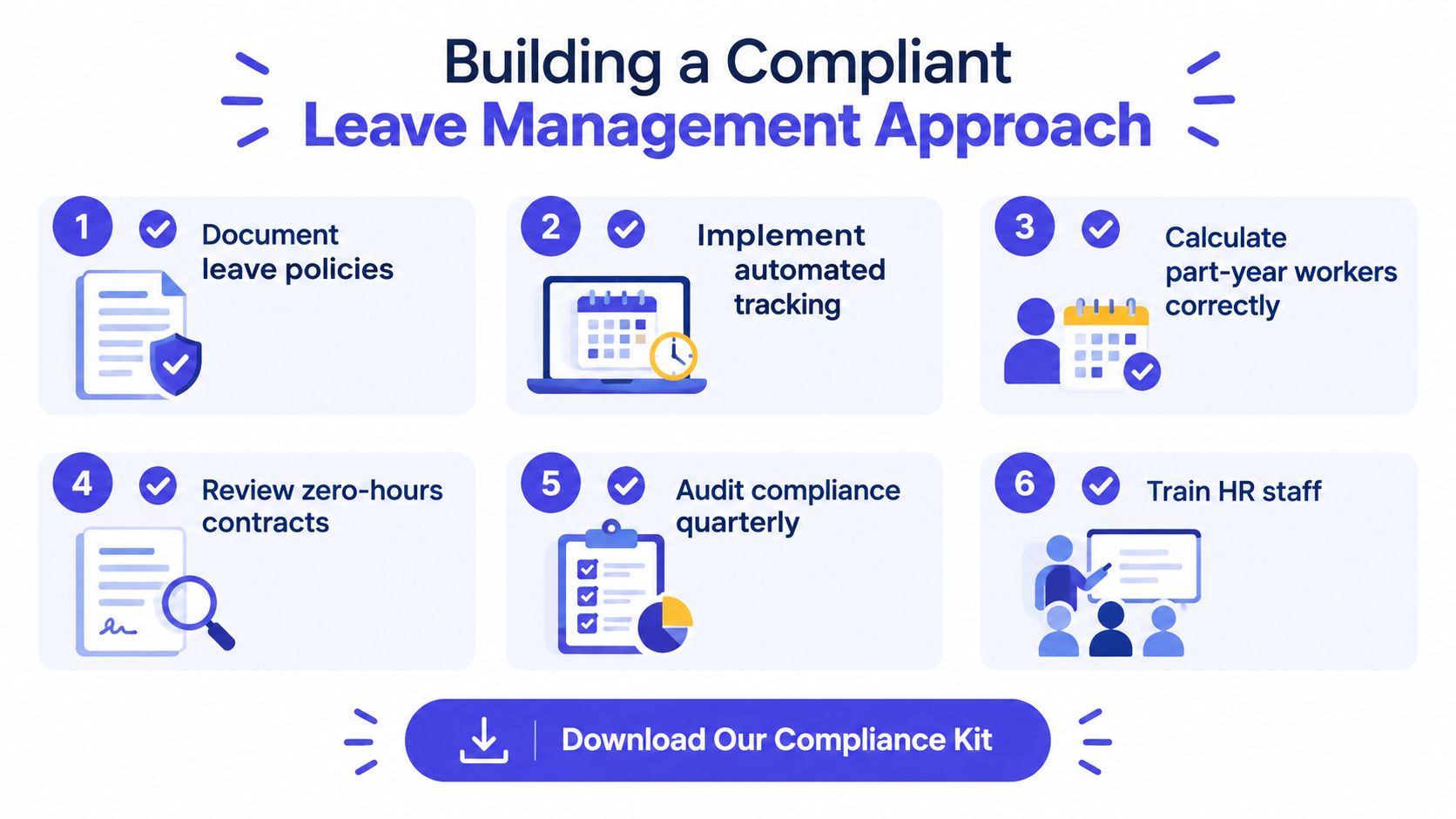
Document the entitlement rules. State the statutory minimum, any contractual enhancement, the leave year, public-holiday treatment, booking process and rules for changes in working pattern.
Classify workers accurately. Identify regular-hours, irregular-hours and part-year workers. Review zero-hours contracts instead of assuming that every worker can use the same calculation.
Connect hours to accruals. For eligible irregular-hours and part-year workers, use actual hours worked in each pay period and apply the correct rule for the relevant leave year. Keep evidence of the hours used.
Separate leave from sickness. Record sickness absence independently, then review whether statutory leave needs to carry over or whether the worker has chosen to take holiday during the absence.
Prepare the record trail. Store approvals, cancellations, adjustments, carry-over decisions, holiday pay and final calculations together. Set retention controls that support the six-year requirement taking effect in April 2026.
Train the people who approve leave. Line managers need to know that a worker's status affects the calculation and that a negative spreadsheet balance isn't automatically a valid deduction from pay.
Make the process auditable
Run a sample review using one worker from each working pattern. Check the contract, hours, accrued leave, approved bookings, pay calculation and current balance. Then ask another person to reproduce the result without relying on the original spreadsheet owner. If they can't, the process depends too heavily on individual knowledge.
Quarterly reviews should also look for operational warning signs:
- Unexplained negative balances: Check whether the issue comes from overbooking, a changed working pattern or a formula error.
- Unusual carry-over: Confirm that sickness-related decisions have been recorded and applied consistently.
- Unapproved manual changes: Require a reason and reviewer for adjustments to entitlement or pay.
- Unclear public-holiday treatment: Make sure contracts, policies and calendars use the same rule.
- Missing leaver calculations: Reconcile unused leave before final payroll approval.
HR managers often need to improve several compliance processes at once. If annual leave administration sits alongside wider workplace responsibilities, using an outsourced health and safety service can help separate specialist work from the internal leave workflow, provided the business keeps clear ownership of each obligation.
The practical standard is simple: an employee should be able to understand their balance, a manager should be able to plan coverage, payroll should be able to pay the right amount, and HR should be able to reproduce the calculation later.