An employee tells you she's pregnant, and the congratulations are quickly followed by practical questions. When might she leave? How long will she be away? What will payroll pay? Who'll cover her work? What happens if she wants to return earlier, work flexibly, or share leave with her partner?
These are normal questions, especially in a small business without a dedicated HR team. A clear set of maternity leave policies gives managers a reliable process instead of forcing them to improvise. It protects the employee's rights, helps the business plan cover, and makes sensitive conversations more predictable.

Think of the policy as a shared calendar with rules attached. It should show the leave timeline, explain pay separately, identify the documents needed, and set out how the employee and manager will stay in touch. It should also leave room for real life, because not everyone will take the same amount of leave or return under the same working pattern.
A useful starting point is this practical guide to the benefits of maternity leave, particularly when you're reviewing how family-friendly arrangements support both employees and the wider team. Your policy should then turn that principle into day-to-day actions, from the first notification through to the return-to-work conversation.
The UK framework is detailed, but it becomes manageable when you separate three questions: how much leave is available, how much of it is paid, and what information must be recorded. Once those questions are kept distinct, staffing and payroll decisions become much easier to organise.
Table of Contents
- Introduction to Maternity Leave Policies That Work
- Understanding the Core Legal Framework in the UK
- Pay Benefits and Eligibility Explained Clearly
- Essential Documentation and Notice Requirements
- Managing Leave and Supporting Return to Work
- Sample Policy Language and Template Building Blocks
- How to Track and Administer Policies with LeaveWizard
Introduction to Maternity Leave Policies That Work
Understanding the Core Legal Framework in the UK
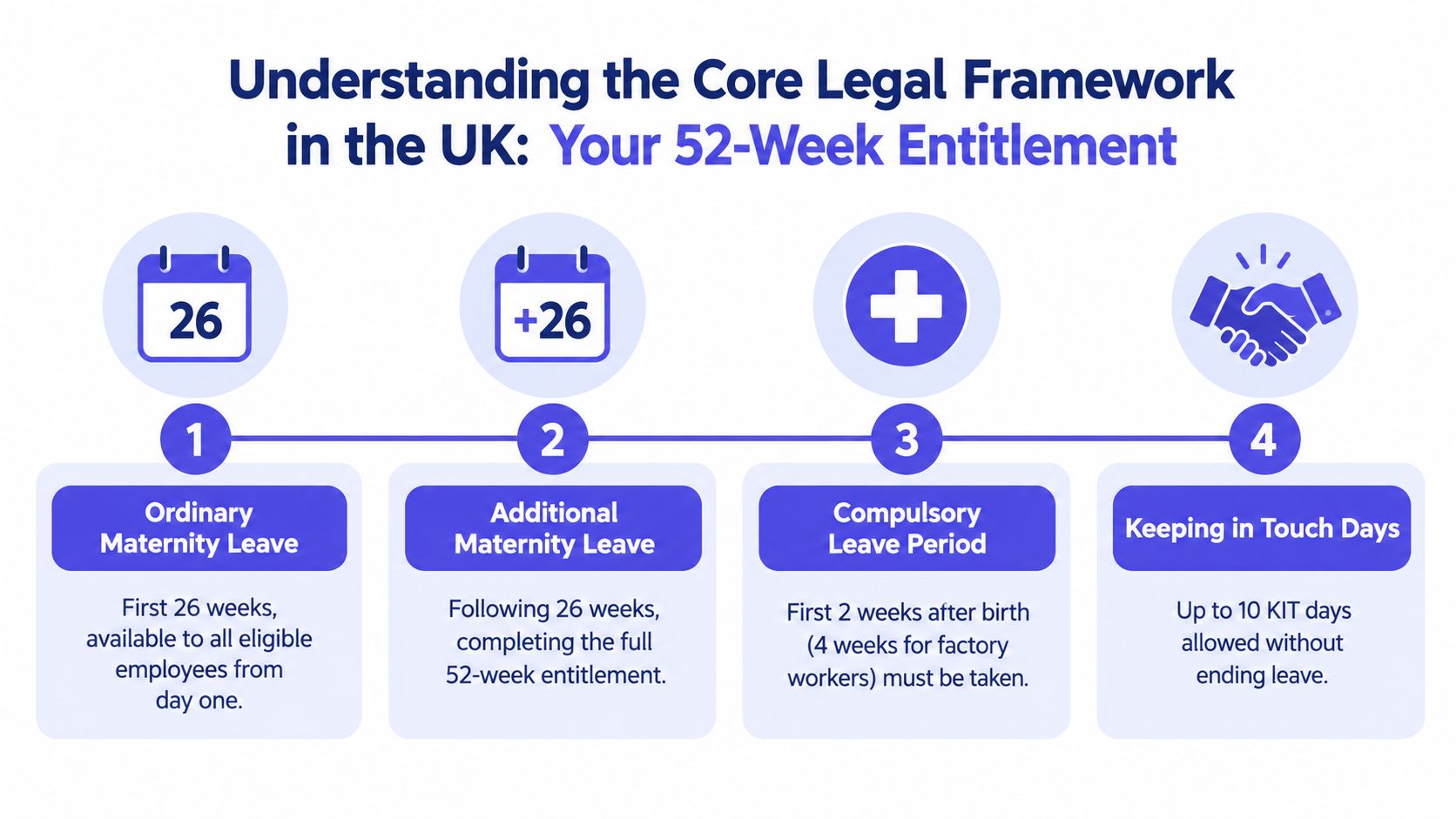
Start with the full timeline. Eligible employees can take up to 52 weeks of Statutory Maternity Leave, divided into 26 weeks of Ordinary Maternity Leave and 26 weeks of Additional Maternity Leave, as set out in current government guidance on maternity leave. The entitlement applies from the first day of employment for employed women, subject to notice requirements and birth-related triggers. It isn't a discretionary benefit that a small business can choose to offer.
A simple calendar makes the structure easier to apply:
- Weeks 1 to 26: Ordinary Maternity Leave.
- Weeks 27 to 52: Additional Maternity Leave.
- Before birth: Leave can normally begin up to 11 weeks before the expected week of childbirth.
- After birth: At least 2 weeks must be taken, or 4 weeks for factory workers.
The employee doesn't have to take the whole period, but your records should be capable of showing the full potential entitlement. The first two weeks after birth, or four weeks for a factory worker, are compulsory. That mandatory period is why a manager can't treat an employee's planned early return as an arrangement that overrides the statutory minimum.
Turn the law into a working timeline
Create one maternity record with the expected week of childbirth, intended leave start date, compulsory leave period, planned return date, and any agreed contact points. Keep the leave calendar separate from payroll, because the end of paid leave won't necessarily be the end of the employee's absence.
An employee can also use keeping-in-touch days without ending maternity leave. Government guidance permits up to 10 KIT days, although the employee and employer must agree the work and pay arrangements for each day. Record these separately so a KIT day doesn't accidentally appear as a return to work or cause payroll to stop incorrectly.
Small businesses also benefit from using the same disciplined approach when managing cross-border employment obligations. For example, a resource on compliance for LATAM hiring can help teams understand why local employment rules need their own records and processes rather than being copied from a UK policy.
Practical rule: Put every important date in one shared, access-controlled record, then give payroll and the line manager the information each needs.
The result is a policy that answers the employee's immediate questions without burying the manager in legal language. It also gives the business a dependable basis for cover planning, payroll instructions, and return-to-work discussions.
Pay Benefits and Eligibility Explained Clearly
A small business may plan cover for a full year, while the employee may return sooner because household income drops sharply after statutory pay ends. The key is to treat maternity leave and maternity pay as two connected timelines, not one entitlement. An employee can take up to 52 weeks of leave, but Statutory Maternity Pay is normally available for only 39 weeks, as explained in the employer guidance on maternity pay and leave.
Separate the pay phases
The statutory pay journey has three stages:
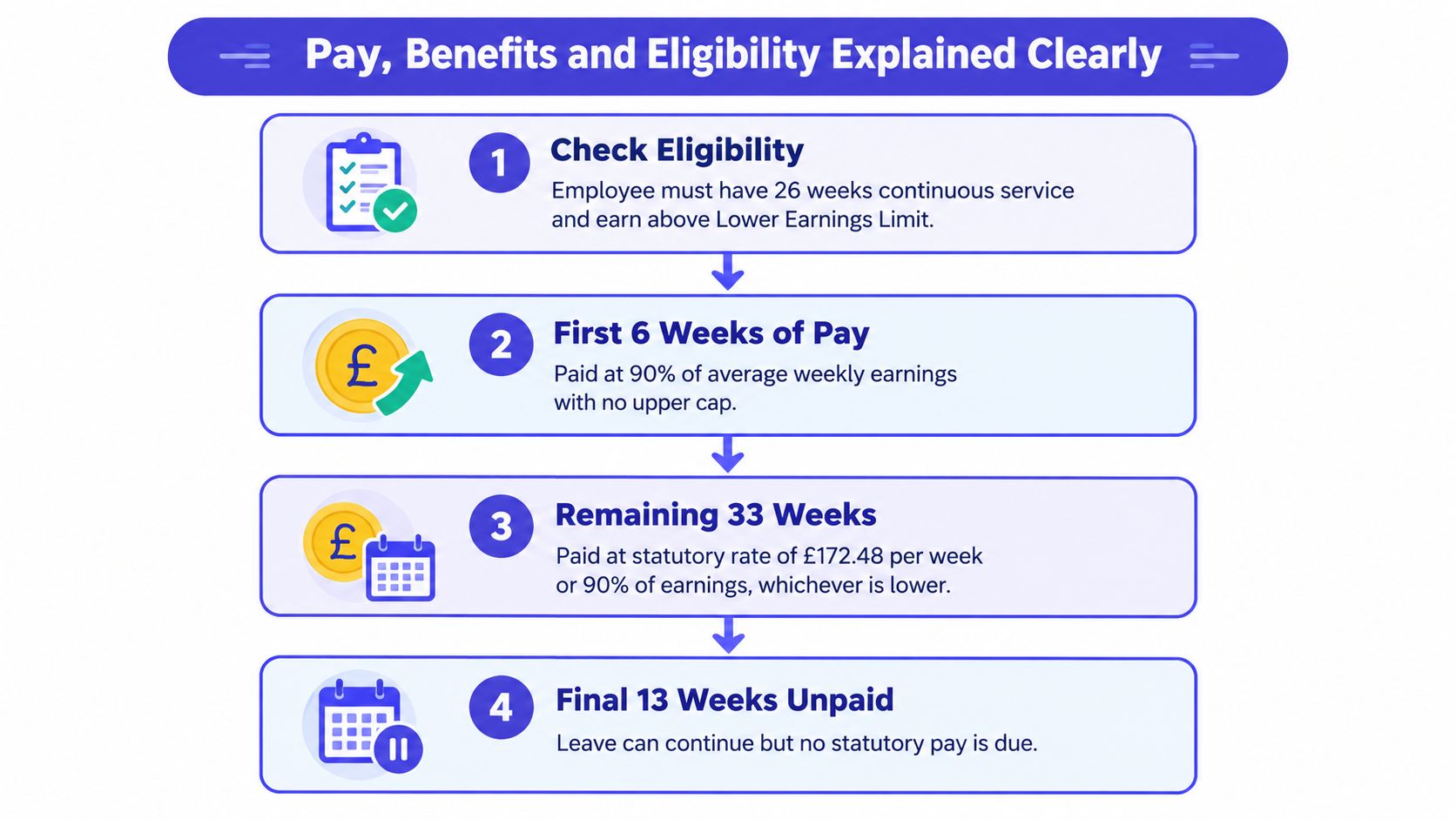
- First 6 weeks: Statutory Maternity Pay is 90% of average weekly earnings.
- Next 33 weeks: It is paid at the statutory rate, or 90% of average weekly earnings, whichever is lower.
- Final 13 weeks: Maternity leave can continue, but statutory maternity pay is unpaid.
For 2025 to 2026, the statutory rate is £194.32. Government material also states that Maternity Allowance ranges from £27 to £187.18 for 39 weeks where the employee does not qualify for Statutory Maternity Pay. The weekly Statutory Maternity Pay rate is stated to rise to £194.32 from 6 April 2026, so payroll teams should check the guidance for the relevant payroll year before calculating payments. The figures and the relationship between leave and pay appear in the government's parental leave and pay review material.
The practical pressure point is the week 39 cliff edge. Leave may continue after statutory pay stops, but household income can change suddenly. Campaign data cited by the CIPD maternity and family leave factsheet reports that 82% of mothers who shortened leave did so because they could not afford to stay off longer. This does not predict every employee's decision. It does show why staffing plans should allow for different return dates instead of assuming that everyone will take the full year.
For managers who need a plain-language explanation of the payment rules, this guide to what is Statutory Maternity Pay can support consistent conversations with employees.
Check eligibility with evidence
Statutory Maternity Pay uses two main tests:
- Continuous service: The employee must have at least 26 weeks of continuous service by the 15th week before the expected week of childbirth.
- Earnings: She must meet the relevant earnings threshold during the 8-week reference period.
The Pensions Regulator's maternity policy guidance shows why the qualifying-week calculation needs careful records. An incorrect reference date can lead to an underpayment or overpayment. If a return to work is not recorded, pay might continue when it should stop. Statutory Maternity Pay stops when the employee returns to work, except for keeping-in-touch days.
An employee who does not qualify for Statutory Maternity Pay may be able to claim Maternity Allowance. The policy should explain that the employer will confirm the eligibility position and provide the required documentation, rather than suggesting that every employee receives the same payment.
For planning, separate the budget lines for statutory pay, any contractual enhancement, employer National Insurance and pension handling, temporary cover, recruitment, and handover time. These costs differ by employee and business, but listing them before leave begins makes the affordability cliff easier to plan for.
This short explainer can help managers reinforce the difference between time away and statutory pay:
Use a two-column payroll check: “Is the employee still on maternity leave?” and “Is statutory pay still due?” Keeping those questions separate reduces avoidable errors and supports clearer staffing and budget decisions.
Essential Documentation and Notice Requirements
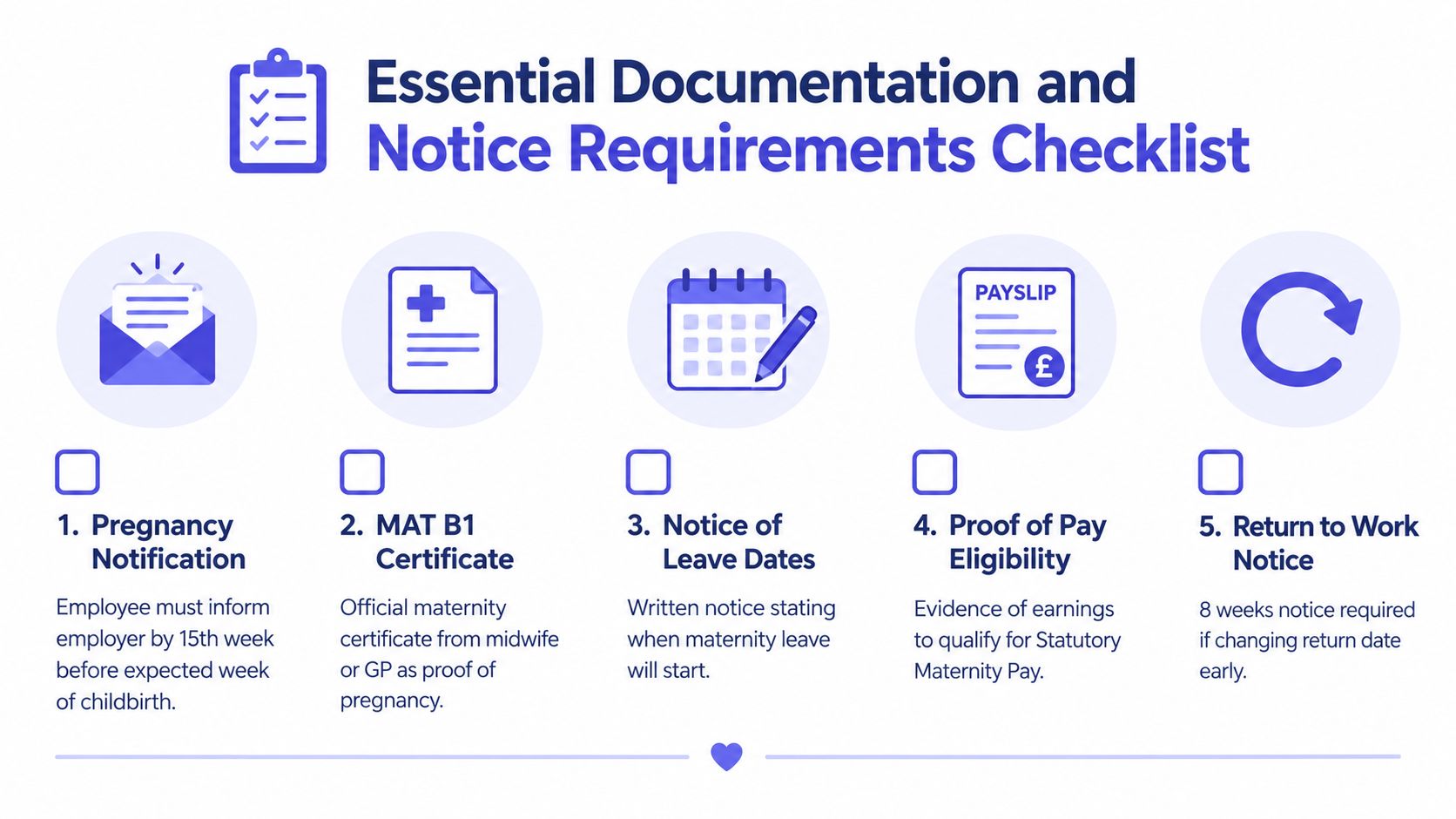
Good administration starts with a chronological file, not a last-minute request for paperwork. The employee should tell the employer about the pregnancy, provide the expected week of childbirth, and give the intended maternity leave start date by the relevant notice point. Government guidance sets the notification point at the 15th week before the expected week of childbirth.
The employer should respond in writing, confirming the expected return date based on the leave period selected. Written confirmation gives both sides something concrete to check if the dates change later.
Use a simple document sequence
- Pregnancy notification: Record when the employee informs the business and the expected week of childbirth.
- MAT B1 certificate: Request the maternity certificate from the midwife or GP when it becomes available. It supports the maternity pay process.
- Leave dates: Record the proposed start date, expected return date, and any later written changes.
- Pay evidence: Keep the earnings and service information used to assess Statutory Maternity Pay.
- Return arrangements: Document the planned return, any flexible working request, and any agreed changes to duties or hours.
Don't ask for medical details that aren't relevant to administering leave. Limit access to sensitive information, and explain who will see the dates and payroll information.
Keep contact useful and optional
Contact during leave should be agreed rather than assumed. Some employees may want occasional updates about organisational changes, training, or team news. Others may prefer minimal contact. Keeping-in-touch days can support a handover or help the employee refresh skills, but they don't end maternity leave and should be recorded separately from a formal return.
Shared Parental Leave provides another route where eligible parents want to divide care differently. The mother or adopter must end maternity or adoption leave and pay early, and eligible parents can convert the unused balance into up to 50 weeks of leave and up to 37 weeks of pay. In England, Scotland and Wales, Shared Parental Leave and Statutory Shared Parental Pay must be taken between birth and the child's first birthday, according to the employer guide to Shared Parental Leave and pay.
The policy should name the person responsible for receiving notices and explain how employees should submit them. A clear route prevents a manager from missing a deadline because a request arrived informally in a chat message or team meeting.
Managing Leave and Supporting Return to Work
A small accountancy practice may need to cover client deadlines, payroll queries and approvals while one employee is away. Treat absence, temporary cover and return as one operational process. List recurring responsibilities, key relationships, deadlines, systems access and decisions that cannot wait. Then decide what will be redistributed, paused, documented or assigned to temporary support.
For example, two colleagues could share client work while a temporary administrator handles routine tasks. A design studio might record approval authority and client contacts before leave begins, then review the arrangement if the employee considers returning sooner. These plans should allow for change. The legal leave period can last 52 weeks, but the employee may not take the full year, and statutory pay does not cover the whole leave period.
Plan for more than one return date
The end of statutory pay can create an affordability cliff for the household. Managers should discuss possible timings without treating an earlier return as greater commitment or a later return as lower interest. The practical question is how the business can prepare for more than one reasonable scenario.
Ask:
- What date is the employee currently considering?
- Would a phased or flexible return help?
- Which duties need refreshing before the first day back?
- Who owns each task during the transition?
- What cover is needed if the return date changes?
Keep the conversation neutral. The employee should not feel pressured to return for the business, and the business should not promise a working pattern before assessing the request properly. A clear staffing plan can support how to improve employee retention because employees see that flexibility is supported by dependable workplace arrangements.
Prepare for the 2026 to 2027 changes
Government and parliamentary timelines indicate that, from 6 April 2026, paternity leave and unpaid parental leave became day-one rights, the restriction on taking paternity leave after Shared Parental Leave was removed, and protections against dismissal for pregnant workers and employees returning from maternity leave were strengthened under the Employment Rights Act. The same timeline records the government's announcement of pregnancy-loss leave from April 2027.
For a small business, the response is practical. Review approval routes, train line managers, update absence codes and check that payroll and staffing records can distinguish family-related leave types. Redundancy planning should identify protected employees before decisions progress. Do not select someone for redundancy because they took maternity leave, or present a pregnancy-related disadvantage as a performance issue.
Review the staffing budget against several possible return dates rather than assuming a full year away. That makes it easier to plan temporary cover, handovers and recruitment without making promises the business cannot keep.
For managers: Plan the work early, while letting the employee control personal decisions about leave and return.
Sample Policy Language and Template Building Blocks
A policy should tell employees what will happen, who will do it and what information is needed. Avoid wording such as, “Maternity leave will be arranged with your manager.” It sounds friendly, but it doesn't explain notice, pay, documentation or the return process.
Use wording with defined actions instead:
| Policy area | Vague wording | Clearer wording |
|---|---|---|
| Purpose | “We support new parents.” | “This policy explains maternity leave, statutory pay, notification steps, contact arrangements and return-to-work planning.” |
| Leave | “Eligible employees may take maternity leave.” | “Eligible employees may take Statutory Maternity Leave under the applicable UK rules. The employee must provide the required notice and information.” |
| Pay | “Maternity pay will be provided.” | “The company will assess Statutory Maternity Pay separately from leave entitlement and will explain any contractual enhancement in writing.” |
| Contact | “Managers may keep in touch.” | “The employee and manager will agree reasonable contact during leave. Any keeping-in-touch work will be agreed in advance and recorded separately.” |
| Return | “Employees should return when ready.” | “The company will confirm the expected return date and will discuss any flexible working request or proposed change to the return date through the relevant process.” |
Include the clauses managers actually use
Your building blocks should cover the purpose of the policy, eligibility, leave structure, pay assessment, notice, MAT B1 evidence, contact, keeping-in-touch days, Shared Parental Leave and return arrangements. Add a confidentiality statement explaining how pregnancy, health and payroll information will be stored and shared.
For Shared Parental Leave, avoid promising an automatic transfer. State that eligibility, notices and available leave and pay will be assessed under the statutory rules. For enhanced maternity pay, define the amount, qualifying conditions, whether repayment applies, and what happens if the employee changes her return plan.
Have someone review the draft against current government guidance before publication. A clear policy doesn't replace individual advice, but it gives employees and managers a consistent starting point.
How to Track and Administer Policies with LeaveWizard
A spreadsheet often begins with one row for the employee and one expected return date. It becomes harder to control when the record must separate the 52-week leave timeline from the 39-week pay timeline, calculate changing pay phases, record KIT days, track an early return, and show cover requirements to several managers.
The risk isn't limited to a wrong date. A manual file can miss a service test, apply the wrong payroll instruction, leave a manager unaware of an earlier return, or overlook a new family-leave category. The 2026 to 2027 changes, including pregnancy-loss leave announced for April 2027, increase the need for real-time visibility across overlapping rights.
A purpose-built system can keep these records together while preserving the distinctions that matter. LeaveWizard is designed for small businesses to automate leave calculations, route approvals, provide shared calendars, support employee self-service through smartphone apps and web portals, and produce reports for planning and compliance. Its UK maternity leave calculator can help employers organise the statutory timing and the Ordinary and Additional Maternity Leave split.
Before automation, a manager may maintain one calendar, payroll may hold another record, and the employee may rely on email confirmations. After introducing a central workflow, the business can give each person the right view, record decisions consistently and identify staffing gaps earlier. That doesn't remove the need for judgement, but it reduces the administrative work that makes errors more likely.
Review your current maternity process now. Map the dates, documents, pay checks and approvals, then decide whether a shared spreadsheet is still reliable enough for the number of employees and leave types you manage.