
Figuring out holiday pay for someone on a zero-hours contract can feel like a headache, but the principle behind it is actually quite simple. Every single worker in the UK is entitled to 5.6 weeks of paid holiday a year. The tricky part is calculating what a 'week's pay' actually is for someone whose hours are always changing. Now, the law is very clear: you must use a 52-week average pay period. A good zero-hours contract holiday pay calculator is pretty much essential to get this right and stay compliant.
Understanding Your Zero-Hours Holiday Pay Obligations
One of the most stubborn myths about zero-hours contracts is that the workers have fewer rights to basic things like paid leave. That's just plain wrong. UK employment law makes no bones about it: anyone classified as a 'worker' starts earning holiday entitlement from their very first day on the job.
This right isn't a perk or a nice-to-have bonus; it's a statutory requirement. Everyone gets a minimum of 5.6 weeks of paid annual leave. For a standard employee working five days a week, that’s a straightforward 28 days. For a zero-hours worker, the 5.6 weeks still applies, but what that's worth in pounds and pence depends entirely on their recent pay.
The Shift to the 52-Week Reference Period
For years, many businesses got by using the "12.07% method" to work out holiday pay. While it was a quick way to estimate accrual, it's been largely pushed aside for calculating the actual pay itself, thanks to some key legal rulings. The government has now made the correct approach crystal clear to ensure people with irregular work patterns are paid fairly.
The only legally compliant method is the 52-week reference period. To calculate a 'week's pay' for your zero-hours worker, you have to look back over the last 52 weeks in which they actually earned money. You ignore any weeks they didn't work at all.
The bottom line is this: a zero-hours worker must receive holiday pay that truly reflects what they normally earn. The money they get for a week of leave should be the same as what they would have earned if they'd been working that week.
This change stops workers from being short-changed. Imagine someone works flat-out during a busy summer peak and then takes a holiday in a quiet autumn month. Their holiday pay should reflect those higher summer earnings, not the lower pay from just before their leave.
Why Getting This Right Is Non-Negotiable
Failing to calculate holiday pay correctly isn’t just a simple admin slip-up; it can land you in serious legal and financial hot water. Workers who have been underpaid can bring a claim for unlawful deductions from wages at an employment tribunal. And with recent legal cases highlighting employer responsibility, trying to do this manually is becoming a bigger and bigger risk.
Getting your head around this obligation is the first step to building a payroll process that's both fair and compliant. It all boils down to accepting that:
- All your workers get paid holiday: This absolutely includes people on casual or zero-hours arrangements.
- The calculation method is set by law: Using the 52-week average isn't an optional extra, it's the standard.
- 'Pay' is more than just the basic rate: Things like regular overtime and commission often need to be included when you work out their average pay.
Once you grasp these core principles, you're not just ticking boxes. You're actively making sure your team is treated equitably, which protects your business from disputes and builds a much-needed foundation of trust.
Calculating Holiday Pay Using the 52 Week Average
For a long time, the 12.07% method was the go-to shortcut, but it was always just an estimate. The legally correct approach for figuring out holiday pay for zero-hours workers is now firmly the 52-week reference period.
This method ensures a worker's holiday pay genuinely reflects what they typically earn. It’s about fairness, making sure the pay for a week off mirrors what they would have pocketed if they’d worked.
So, how does it work? You look back at the last 52 weeks where the employee actually got paid. Any weeks they didn't work are skipped entirely. You can go back as far as 104 weeks to gather your 52 weeks of pay data, but no further. Let's get into the practicalities.
This process diagram gives you a bird's-eye view, from confirming the right to paid leave to making sure your sums are compliant.
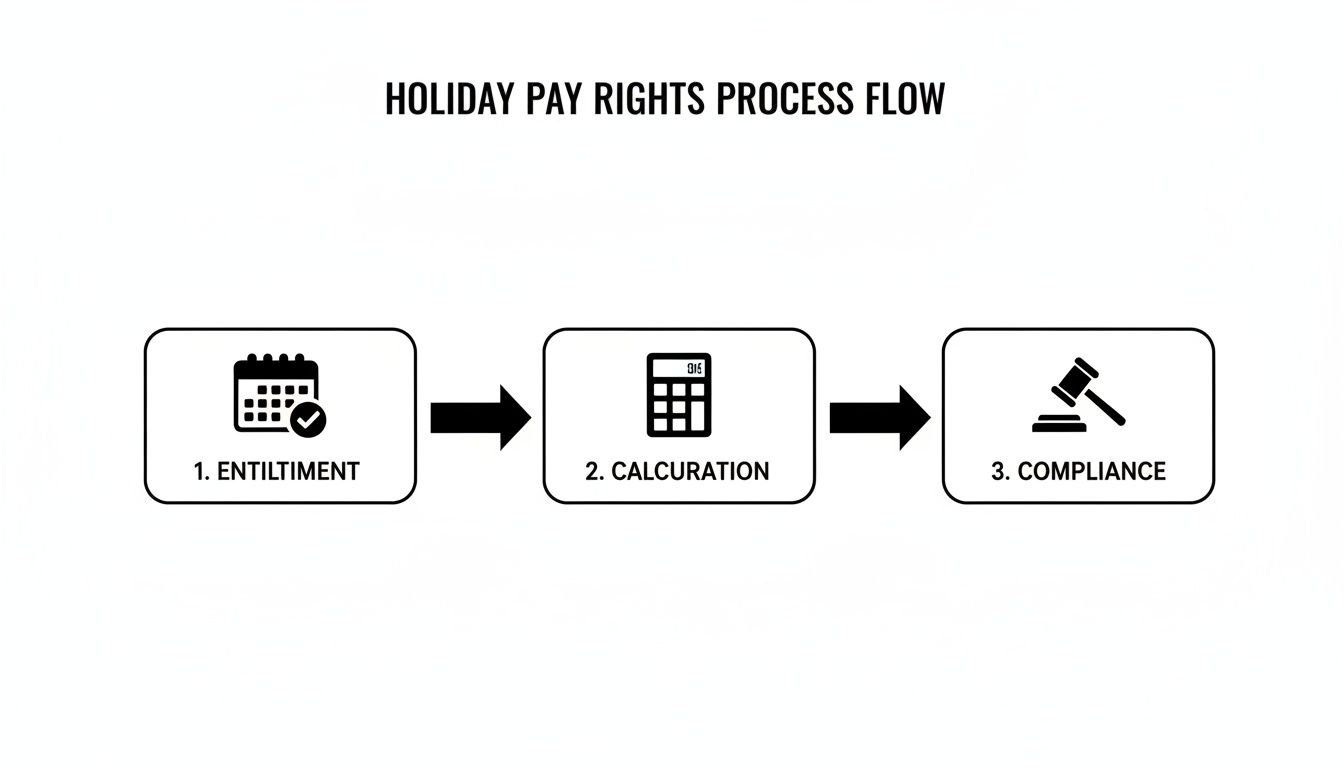
As you can see, it all starts with acknowledging the worker's entitlement. Then comes the critical calculation phase, and finally, the essential step of maintaining legal compliance.
What Actually Counts as a "Week's Pay"?
Before you can average anything out, you need to be clear on what actually counts as 'pay'. It’s not as simple as just their basic hourly rate. For the 52-week average, the law says you must include all payments intrinsically linked to the job they do.
That means you'll need to factor in things like:
- Regular overtime payments (it doesn't matter if it's compulsory or voluntary)
- Commission that's directly tied to the work they've done
- Performance-related bonuses that are a recurring part of their pay
Basically, if it's money they normally earn for doing their job, it has to be in the calculation. This is what guarantees the holiday pay is a true reflection of their average earnings, not just a bare-bones base pay. For a deeper dive into the specifics, check out our guide on how to calculate holiday pay accurately.
The table below provides a step-by-step worked example to show how this unfolds in practice.
Worked Example 52 Week Holiday Pay Calculation
| Step | Action | Example Data/Calculation | Notes |
|---|---|---|---|
| 1 | Gather Pay Data | Collect payslips for the last 104 weeks for an employee named Alex. | You need to find 52 weeks in which Alex was actually paid. |
| 2 | Filter for Paid Weeks | Identify 52 separate weeks where Alex received earnings. Discard 8 weeks where Alex had no shifts and earned £0. | Look back through the last 60 calendar weeks to find the 52 paid weeks. |
| 3 | Sum Total Earnings | Add up the total gross pay from those 52 identified weeks. | Total earnings = £9,100 |
| 4 | Calculate the Average | Divide the total earnings by 52 to find the average for one week's pay. | £9,100 ÷ 52 weeks = £175 |
| 5 | Determine Holiday Pay | The result is the amount Alex is entitled to for one week of paid holiday. | Alex's holiday pay for one week is £175. |
This example shows that by systematically working through the data, you can arrive at a fair and compliant figure for a week's holiday pay.
But What About Weeks with No Work?
This is one of the biggest points of confusion for employers. What do you do with weeks where a zero-hours worker wasn't offered any shifts or simply didn't work? The rule is crystal clear: you ignore them.
If an employee has a week with zero earnings, that week is completely excluded from the 52-week reference period. You simply skip over it and go back another week to find one where they were paid.
Let’s go back to our example. Imagine that over the last 60 calendar weeks, Alex had 8 weeks where they didn't get any shifts and so earned nothing.
- You would completely disregard those 8 empty weeks.
- You’d keep going back in time until you have pay data from 52 weeks where Alex did earn money.
- This is exactly why the law gives you a 104-week (two-year) window to find the data you need.
This safeguard is crucial. It stops a worker's holiday pay from being unfairly watered down by periods when they weren't working, ensuring the final figure is based purely on their actual earning pattern.
Key Rule Reminder: Only weeks in which an employee received pay can be counted towards the 52-week average. If they didn't work in a given week, you must exclude it from the calculation and look further back to build your 52-week data set.
Following this structured approach means you can confidently calculate holiday pay, whether you're using a dedicated calculator or doing it manually, knowing you're being fair and staying on the right side of UK employment law.
The 12.07% Method: When to Use It and When to Avoid It
For years, that 12.07% figure was the go-to shortcut for zero-hours holiday calculations. It’s a number many HR managers and small business owners know well, but its role has changed dramatically. Relying on it for the wrong reasons is now a major legal headache waiting to happen.
The logic behind it was always pretty straightforward. You get 5.6 weeks of statutory holiday. Take that away from the 52 weeks in a year, and you're left with 46.4 working weeks. A quick bit of maths ((5.6 ÷ 46.4) x 100) gives you 12.07%. The idea was that for every hour worked, a worker builds up a small slice of paid leave.
Where It Can Still Be Useful
While it's no longer the compliant way to calculate holiday pay, the 12.07% figure isn't entirely useless. Its main acceptable use today is for estimating holiday accrual for new starters or staff with very irregular work patterns.
Think of it as a simple way to keep a running tally of how much holiday time someone is earning.
- For New Starters: It gives you a straightforward way to track the leave a new team member is entitled to before they’ve built up a 52-week pay history.
- For Casual Staff: It’s handy for estimating the leave entitlement for someone who only works for a few weeks during a busy season.
- On Payslips: Showing the accrued hours using the 12.07% method can be a transparent way to let workers see how their entitlement grows as they work more hours.
So, if an employee works 30 hours one week, you can estimate they've accrued about 3.6 hours of holiday (30 hours x 12.07%). This is perfectly fine for tracking purposes, but that’s where its usefulness stops.
Here’s the critical distinction: The 12.07% method can be a tool to track the amount of time off a worker has earned. It must not be used to calculate the rate of pay they get for that time off.
The Clear Legal Risks of Using 12.07% for Pay
The big problem with using the 12.07% method for holiday pay is simple: it often leads to underpayment, and underpayment is unlawful. Landmark court rulings, especially the Harpur Trust v Brazel case, cemented the fact that holiday pay has to be based on a worker's average earnings over a 52-week reference period, not some fixed percentage.
Sticking with the 12.07% figure for pay creates a serious compliance gap.
Let’s look at a real-world scenario:
- Sarah, who works in hospitality, picks up lots of high-paying shifts with overtime during the busy summer months.
- She then books a holiday for a quiet week in October.
- If her holiday pay was calculated at 12.07% of her lower October earnings, it would be unfairly low and wouldn't reflect her true average pay from the summer rush.
This is exactly the situation the 52-week average method is designed to prevent. It ensures Sarah’s holiday pay is a genuine average of her recent earnings, including all those busy, higher-paying periods.
Relying on the 12.07% method for her pay would be a direct breach of the Working Time Regulations. It could easily land you in front of an employment tribunal facing a claim for unlawful deduction of wages. The perceived convenience just isn't worth that kind of risk.
Navigating Complex Pay Scenarios and Irregular Hours
Calculating holiday pay for zero-hours workers can feel like a minefield. Just when you think you've got the basics down, real-world payroll throws a curveball. What happens when a worker has long gaps between assignments? Or when you need to account for things like commission, bonuses, or even statutory sick pay?
These aren't rare edge cases; they're common scenarios that can leave even seasoned HR managers scratching their heads. This is where a solid grasp of the rules, backed up by a reliable zero hours contract holiday pay calculator, becomes absolutely essential.
The core principle never changes: holiday pay must reflect a worker's 'normal remuneration'. It’s all about fairness, ensuring the pay they get for a week off is a true reflection of what they typically earn.

Let’s walk through how to handle these trickier situations, making sure your calculations are both fair and legally sound.
Handling Variable Pay Elements
Lots of zero-hours roles, especially in sectors like sales or retail, come with pay components beyond a simple hourly rate. When you're working out the 52-week average, you have to include any payments that are intrinsically linked to the performance of their job.
This isn't optional. It includes things like:
- Commission Payments: If someone regularly earns commission, it’s part of their normal pay and must be factored into the weekly average.
- Performance Bonuses: Any bonuses tied directly to their work and paid with regularity need to be included.
- Regular Overtime: Even if overtime is voluntary, if it's worked often enough to be considered a normal part of their pay packet, it counts.
Leaving these out is a major compliance risk and will almost certainly lead to underpaying your staff. Your calculation has to capture the full picture of their typical earnings.
Gaps in Work and Statutory Pay
A classic headache with zero-hours contracts is dealing with long stretches where no work is offered. As we’ve covered, any week where someone earned nothing must be ignored in the 52-week reference period. You simply keep looking back, up to a maximum of 104 weeks, until you find 52 weeks of pay data.
But what about weeks where they received statutory pay, like Statutory Sick Pay (SSP) or Statutory Maternity Pay (SMP)?
Key Takeaway: Weeks where a worker only received statutory payments (like SSP or SMP) and no other company pay should also be excluded from the 52-week average calculation. Including these lower statutory amounts would unfairly drag down their average weekly pay.
This ensures a period of illness or parental leave doesn't penalise a worker by devaluing their holiday entitlement. You just skip over these weeks, exactly like you would for a week with zero earnings. This is particularly important in sectors like care and hospitality that rely heavily on flexible workers. For more on different work patterns, you might find our guide on calculating holidays for part-time workers useful.
Managing Holiday Pay on Termination
When a zero-hours worker leaves your business, you're legally required to pay them for any statutory holiday they've accrued but haven't taken. The calculation follows the same logic, making sure they get what they're owed based on their actual work patterns.
This scenario is especially common among younger staff. In the UK, a staggering 478,000 workers aged 16-24 are on zero-hours contracts, often juggling work and education in high-turnover sectors like hospitality and retail. Getting their final pay right is a critical last step.
Here’s how to calculate their final holiday payment:
- Work out their accrued leave: First, calculate the total holiday time they've earned up to their last day. For tracking purposes, the 12.07% accrual method is often used here.
- Calculate their average pay: Next, run the 52-week average calculation to find their average weekly pay rate, just as you would for a normal holiday period.
- Calculate the final payment: Finally, use that average pay rate to put a monetary value on their untaken holiday hours or days.
This process ensures the final payment is accurate and fair, allowing you to close out their employment on a compliant and professional note.
Automating Your Holiday Pay Calculations
Let’s be honest, manually calculating holiday pay for zero-hours workers is more than just a headache; it’s a minefield. Trying to keep track of variable hours and correctly apply the 52-week reference period can quickly become an administrative nightmare, especially for smaller businesses. It’s a process fraught with risk—one slip-up can lead to underpayments, staff disputes, or even an employment tribunal.
This is where automation steps in. Instead of wrestling with spreadsheets and digging through timesheets, modern HR software can turn this compliance headache into a smooth, reliable process. It’s about ditching the guesswork for precision and freeing up your time to actually run the business.
Reclaim Your Time and Guarantee Accuracy
The biggest win with automation? It gets rid of human error. A dedicated system like LeaveWizard is built to handle the fiddly details of UK employment law automatically. Every hour an employee works is tracked through a simple portal or app, building an accurate, real-time record without anyone having to key in data manually.
This brings immediate benefits right across your business:
- For HR Managers: Compliance becomes second nature. The system automatically applies the correct 52-week reference period and pulls in all the necessary pay elements, making sure every calculation is spot on.
- For Operations Managers: You get a crystal-clear view of staff availability and your holiday liability. That means better resource planning and scheduling, stopping operational hiccups before they happen.
- For Finance Controllers: Forecasting leave costs is no longer a dark art. You can see your accrued holiday pay liabilities at a glance, making financial planning far more reliable.
With the number of people on zero-hour contracts in the UK recently hitting 1.2 million, the scale of this admin challenge is massive. For any business owner, getting holiday pay right isn't just good practice—it's a legal must. Automation is your best defence against the accidental underpayments that can lead to costly legal battles.
How Does It Actually Work?
So, how does a system like LeaveWizard take the pain out of the process? It all starts by creating a single source of truth for all employee hours and leave data.
Instead of hunting through payroll records, managers can see everything in one place—from who is on leave to the financial impact of their accrued holiday. This instant access to data helps everyone make smarter decisions.
By automating these calculations, you’re not just buying a piece of software. You're investing in a more efficient, compliant, and transparent way of working. It builds trust with your team and shields your business from risk.
The system logs every single shift and automatically works out the average weekly pay based on the correct reference period. When a worker books a holiday, the pay is calculated instantly and accurately. For businesses looking to get their financial processes in order, it's worth looking into guides on automating complex payroll calculations for variable hours.
Ultimately, making the switch from manual spreadsheets to an automated system is a strategic move. It transforms a complex, high-risk task into a simple, reliable function that supports everyone, from your employees right up to the finance team. To see how this fits into your bigger picture, take a look at the benefits of automating your key HR processes.
Common Questions About Zero Hours Holiday Pay
Even when you feel you've got a handle on the rules, specific questions always seem to pop up with zero-hours contracts. It’s a tricky corner of employment law, so getting quick, clear answers is vital for staying compliant and, just as importantly, treating your workers fairly.
Let's break down some of the most common queries we see from employers navigating holiday pay for their flexible workforce.
Do Zero Hours Workers Get Sick Pay?
Yes, they absolutely can be eligible for Statutory Sick Pay (SSP). The key thing to remember is that it’s not their contract type that matters, but their earnings.
To qualify, a worker must meet the government's criteria, which includes earning, on average, at least the Lower Earnings Limit. For the 2024/2025 tax year, that’s £123 per week. If they meet this and the other SSP conditions, they're entitled to it just like any other employee.
Can a Zero Hours Worker Take Holiday Whenever They Want?
In a word, no. While zero-hours workers have the right to take the holiday they've accrued, the timing is still subject to your approval and what the business needs. The process should mirror how you handle requests from any other team member.
A worker needs to give proper notice—the standard rule of thumb is twice as long as the holiday they want to take. So, for one week of leave, they should give you two weeks' notice. You can decline a request if there's a genuine business reason, but you can't stop them from taking their holiday entitlement altogether.
A common myth is that the flexibility of a zero-hours contract means they can take leave at a moment's notice. In reality, standard leave request procedures are there to keep things running smoothly for everyone.
What Happens if a Worker Leaves Without Notice?
This is a tough one, but the law is crystal clear. A worker on a zero-hours contract is still entitled to be paid for any statutory holiday they’ve built up but not taken, regardless of whether they worked their notice period.
Their right to this pay isn't wiped out by how they leave. You'll need to calculate their final holiday payment using the 52-week average and include it in their last pay packet. You are not, however, required to pay them for the unworked notice period itself.
Can I Deduct Pay if They Have Taken Too Much Holiday?
It happens. Sometimes a worker takes more holiday than they’ve actually accrued by the time they leave. You can only reclaim this overpayment from their final wages if you have a clear, written agreement with them that allows it.
This clause needs to be explicitly laid out in their employment contract. Without that prior written consent, you can't legally make the deduction.
- Check the contract: Does it have a clause permitting deductions for excess holiday?
- Be transparent: Make sure workers understand this policy right from the start.
- Act fairly: If it's not in the contract, you can't reclaim the money.
Being proactive with solid contractual terms is the best way to protect your business from headaches down the line. Using a reliable zero hours contract holiday pay calculator or dedicated software helps you track accrual accurately, which can prevent this situation from happening in the first place.


