
Let's get one thing straight from the start: if you're on a zero hours contract in the UK, you have a legal right to paid holiday. It’s the biggest myth out there, but your irregular working pattern doesn’t disqualify you from paid time off. The system is just set up a bit differently—your holiday entitlement simply grows in line with the hours you actually work.
Your Core Rights to Paid Holiday on a Zero Hours Contract

Getting your head around holiday entitlement on a zero hours contract begins with a simple truth: you have the same fundamental rights as any full-time, permanent employee. UK law is crystal clear on this, guaranteeing all workers a minimum of 5.6 weeks of paid annual leave.
The real difference isn’t in the right to a holiday, but in how you earn it. A salaried employee usually gets their full allowance upfront at the start of the year. For a zero hours worker, it's a "pay-as-you-go" system.
Think of it like a holiday piggy bank. For every hour you put in, a little bit of paid leave gets added to your balance. The more you work, the more holiday time you build up. This pro-rata approach keeps things fair by directly linking your entitlement to your hours.
Why This Right Is So Important
Zero hours contracts are a huge part of the modern UK economy, offering flexibility that works for many. But with that flexibility comes a lot of confusion. Official figures from early 2024 showed around 1,030,000 people were on these contracts, making up roughly 3.1% of the workforce.
Despite being so common, there's a massive knowledge gap. One study shockingly found that half of all zero hours workers believed they weren't entitled to any paid holiday at all. You can learn more about the findings on zero-hours contracts from Avensure.com.
This widespread misunderstanding makes it vital for both employers and workers to know where they stand. For businesses, it's about staying compliant and creating a fair workplace. For workers, it’s about accessing a fundamental right designed to help you rest and recharge.
The core takeaway is simple: a zero hours contract does not mean zero holiday rights. The entitlement is enshrined in law, providing a safety net that ensures all workers get the paid rest they have earned, regardless of their working pattern.
Key Principles of Your Entitlement
To get on solid ground, let's quickly recap the essentials that govern your holiday rights. These principles are the bedrock for almost every worker in this position across the UK.
- Statutory Minimum: You are legally entitled to 5.6 weeks of paid holiday each year. This is the baseline for everyone.
- Pro-Rata Accrual: You earn your holiday based on the hours you have actually worked. It's not a fixed amount handed out on day one.
- Paid at Normal Rate: When you take your holiday, it should be paid at your normal rate of pay. This is worked out by calculating your average earnings over a specific reference period.
Nailing these basics is the first step to making sure you get the holiday entitlement you're owed.
How Holiday Pay for Zero Hours Staff Is Calculated
Figuring out holiday pay for your zero-hours staff isn't about tricky maths; it's about fairness. The whole point is to give them a fair, pro-rata version of the statutory 5.6 weeks' leave every full-time employee gets. But how on earth do you translate that into pounds and pence for someone whose hours are different every single week?
For a long time, many businesses leaned on what seemed like a simple fix: the 12.07% accrual rate. This number wasn't just plucked out of thin air; it had a certain logic to it.
The Old Standard: The 12.07 Percent Method
The percentage comes from a straightforward calculation. Take the 52 weeks in a year and subtract the statutory 5.6 weeks of holiday. You're left with 46.4 working weeks. If you then divide the holiday weeks by the working weeks (5.6 ÷ 46.4), you get 0.12068, which rounds up neatly to 12.07%.
This meant that for every hour someone worked, they'd build up holiday pay equal to 12.07% of that time. So, if a team member clocked 20 hours one week, they would accrue about 2.4 hours of paid holiday. It felt convenient, and many businesses used it to manage zero-hours contract holiday entitlement.
But while it looks simple on paper, this method has some serious flaws, especially for people whose hours aren't just irregular but also seasonal. A major Supreme Court ruling has since made it clear that this approach can be unfair, and it’s no longer the recommended—or legally safe—way to calculate holiday pay.
The Current Best Practice: The 52-Week Reference Period
Following recent legal updates, the government-backed method is now the 52-week reference period. This is now considered the most accurate and legally sound way to calculate holiday pay for workers with irregular hours, as it does a much better job of smoothing out the peaks and troughs of their work patterns.
The core idea is to figure out what a 'normal week's pay' looks like for that person by looking at their long-term average. This makes sure that a holiday taken after a really busy period is paid at a higher rate than one taken after a quiet spell, which truly reflects their typical earnings.
To do this, employers need to look back at the last 52 weeks where the employee actually got paid. You then work out their average weekly pay from that period.
Here’s how it breaks down in simple steps:
- Gather Pay Data: First, collect the total pay data for the last 52 weeks the employee actually worked and earned money.
- Ignore Unpaid Weeks: This is the crucial part. You must skip over any week where the employee didn't work and wasn't paid. If you have to, you can go back as far as 104 weeks to find 52 paid weeks.
- Calculate the Average: Divide the total earnings from those 52 paid weeks by 52. That number is their average 'week's pay'.
- Pay for Holiday: When the worker takes a week of annual leave, they get paid this calculated average amount.
Using the 52-week reference period ensures holiday pay is a true reflection of a worker’s average income, including any overtime or commission they might have earned. For a deeper dive into the specifics, check out our guide to calculate holiday pay in the UK, which offers more detailed examples. This method champions fairness and is the cornerstone of compliant holiday pay management today.
Calculating Holiday Pay: A Practical Walkthrough
Knowing the theory is one thing, but confidently working out holiday pay is something else entirely. Let's walk through the practical steps and examples you need to get it right, whether you're an employer focused on compliance or a worker checking your payslip.
We'll break down the two main methods you'll come across for zero-hours contract holiday entitlement. While one is now largely a thing of the past, understanding both gives you the complete picture.
This decision tree shows exactly which calculation method you should be using for workers with irregular hours.
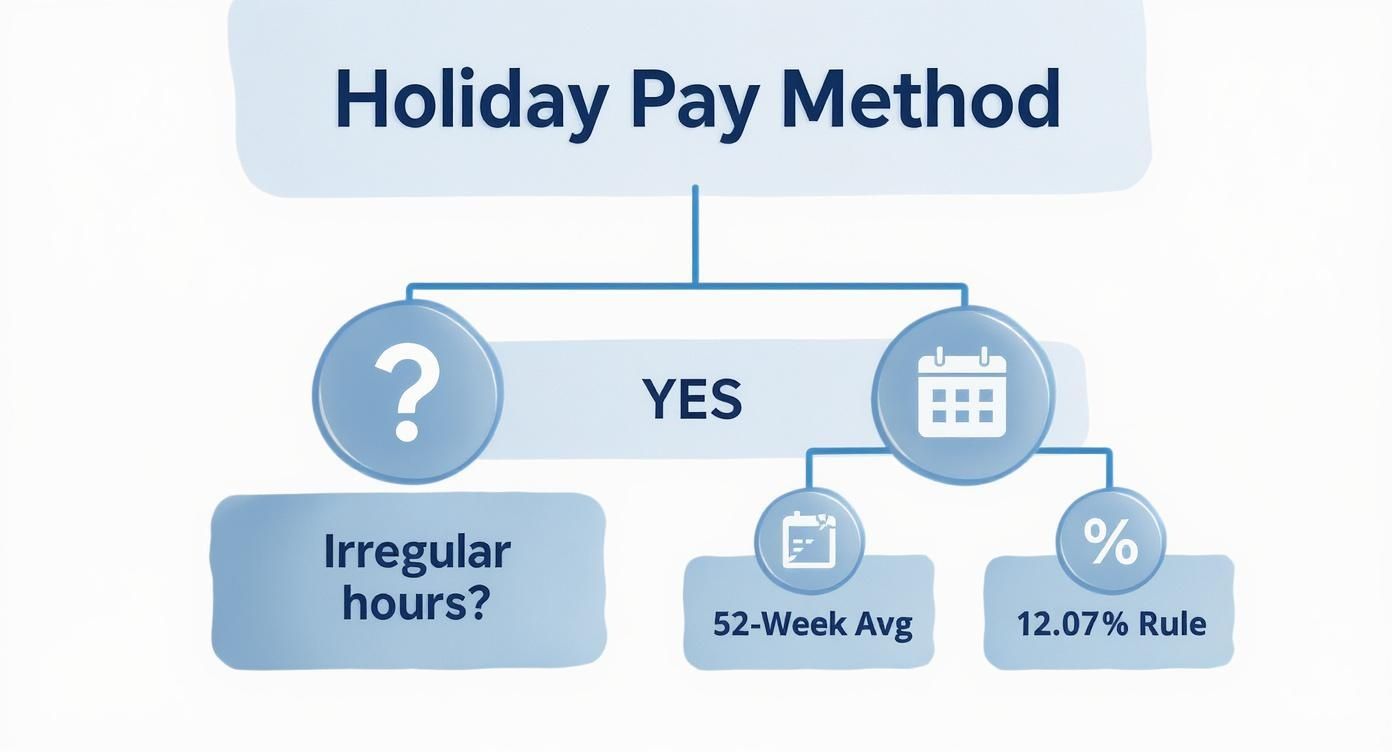
The key takeaway here is crystal clear: for anyone with irregular working patterns, the 52-week average method is the legally required standard.
The 12.07 Percent Method Explained
For years, the 12.07% method was the go-to shortcut for calculating holiday pay. The logic was simple: the statutory 5.6 weeks of holiday leave 46.4 working weeks in the year. If you divide the holiday by the working weeks (5.6 ÷ 46.4), you get 12.07%.
This meant a worker would accrue holiday pay equal to 12.07% of whatever they earned.
Worked Example: 12.07% Method
Let's say a worker earns £400 in a month.
- Calculation: £400 x 12.07% (or 0.1207)
- Holiday Pay Accrued: £48.28
While straightforward, this method was found to be legally flawed, especially for part-year workers like those on term-time contracts. Following a major Supreme Court ruling, it's no longer the recommended standard. Its use is now incredibly limited, and to stay compliant, employers should always default to the 52-week reference period.
The 52-Week Reference Period: Step-by-Step
This is the legally sound and most accurate method. It involves calculating a worker's average pay over a 52-week reference period, ensuring their holiday pay genuinely reflects their typical earnings, including any overtime or commission.
It might sound complicated, but breaking it down makes it much more manageable. For employers juggling these complexities, using professional payroll bookkeeping services can be a huge help in ensuring everything is calculated correctly and stays compliant.
Here’s how to do it properly.
Step 1: Gather 52 Weeks of Pay Data
First things first, you need to collect the worker's pay data. The crucial part is to look back and find the last 52 weeks in which they were actually paid.
This is a really important distinction. If a worker had a week where they didn't work and received no pay, that week does not count towards the 52. You must skip it and go further back in time to find a week where they did earn money. You can look back up to a maximum of 104 weeks to find those 52 paid weeks.
What counts as pay data?
- Basic wages
- Overtime payments
- Commission
- Performance-related bonuses
Step 2: Calculate the Total Earnings
Once you've identified the 52 paid weeks, simply add up the total gross pay the worker earned across all of them. This gives you a single figure for their total earnings over that period.
For example, let's say after looking back over the last 60 weeks, you found 52 weeks where the worker was paid. The total earnings from those 52 weeks came to £15,600.
Step 3: Find the Average Weekly Pay
Now, just divide the total earnings by 52. This gives you the average amount the worker earned per week, which becomes their statutory 'week's pay' for holiday purposes.
Calculation: Total Earnings ÷ Number of Paid Weeks = Average Weekly Pay
Using our example:
- £15,600 (Total Earnings) ÷ 52 (Paid Weeks) = £300 (Average Weekly Pay)
This means when this worker takes a full week of paid holiday, they should receive £300.
Step 4: Calculate Pay for a Single Day of Holiday
What if they only take a single day off? You just need one more simple calculation. Divide the average weekly pay by the number of days they typically work in a week.
If the worker doesn't have a set number of days, you should use an average calculated over the same 52-week period. For this example, let's assume they work an average of 4 days per week.
- £300 (Average Weekly Pay) ÷ 4 (Average Days Worked) = £75
So, for each day of holiday taken, the worker would be paid £75.
Trying to work out entitlements for different work patterns can be tricky, but a reliable tool can make it much easier. Our handy leave pro rata calculator is a great resource for this. Following this step-by-step approach ensures your holiday pay calculations are both fair and legally sound.
To make the differences even clearer, here's a direct comparison of the two methods.
Holiday Pay Calculation Methods Compared
| Feature | 12.07% Accrual Method | 52-Week Reference Period Method |
|---|---|---|
| How it Works | Calculates holiday pay as a fixed percentage (12.07%) of hours worked. | Calculates an average weekly pay based on the last 52 paid weeks. |
| Legal Standing | Largely unlawful since 2022; use is highly restricted and risky. | The legally required and correct method for irregular hours workers. |
| Best For | No longer recommended for general use due to legal challenges. | All workers with irregular hours, including zero-hours and part-year staff. |
| Accuracy | Often inaccurate, especially for part-year or term-time workers. | Provides a fair and accurate reflection of a worker's typical earnings. |
| Complexity | Very simple to calculate. | More complex, requires careful record-keeping of up to 104 weeks. |
Ultimately, while the 12.07% method might seem tempting for its simplicity, it's a relic of the past. The 52-week reference period is the only method that guarantees you're paying your people correctly and staying on the right side of the law.
Your Responsibilities as an Employer

Knowing how to calculate zero hours contract holiday entitlement is only half the battle. As an employer, you have a set of legal duties that are there to protect your workers and, frankly, to protect your business from headaches and disputes down the line.
Getting these responsibilities right from day one is about more than just ticking boxes; it builds trust and shows you’re serious about complying with UK employment law.
It all starts with clear, unambiguous communication. Your employment contracts need to be meticulously drafted, explaining exactly how holiday entitlement is handled. This means spelling out how holiday accrues, how people can request time off, and the method you’ll use for calculating holiday pay—which should always be the 52-week reference period. Any grey areas here are a breeding ground for disputes that a solid contract can easily prevent.
The Dangers of Rolled-Up Holiday Pay
Let's be very clear about one thing: the practice of 'rolled-up' holiday pay is a major legal pitfall. This is where an employer adds a little extra to a worker’s hourly rate, supposedly to cover their holiday pay, instead of paying them when they actually take leave.
While it might feel like a tidy administrative shortcut, this practice is unlawful in almost all cases. The law is crystal clear: holiday pay is for taking holidays. Its entire purpose is to allow workers to take paid time off to rest and recharge. Rolling it into their weekly wages completely defeats that purpose.
The risks of getting this wrong are huge. If an employment tribunal finds you’ve been using rolled-up holiday pay, they could order you to repay all the holiday pay owed for the entire period. Yes, even if you've already paid the uplift. This can add up to a substantial, and entirely avoidable, financial blow to your business.
The core principle is simple: workers must be paid for their holiday at the time they take it. Failing to separate holiday pay from regular wages doesn't just break the law—it undermines the very idea of paid annual leave.
Maintaining Meticulous Records
For any business that relies on a flexible workforce, keeping robust records isn’t just good practice; it's a legal necessity. You absolutely must maintain accurate, up-to-date records for every single zero-hours worker.
Your system needs to track several key data points. This ensures that whenever a worker takes leave, you can calculate their zero hours contract holiday entitlement and pay with complete accuracy.
Essential Records to Keep:
- Hours Worked: Log the precise number of hours worked in each pay period. No guesswork.
- Holiday Accrued: Keep a running total of the holiday time each worker has earned.
- Holiday Taken: Record every instance of annual leave taken, making sure it’s deducted from their accrued balance.
- Pay Records: Keep detailed payslips for at least two years. These should clearly show the calculations for their average weekly pay over the 52-week reference period.
This level of detail creates a transparent, auditable trail that protects everyone involved. It allows you to prove your compliance if ever questioned and gives your workers the confidence that they're being treated fairly. Managing this manually can become a huge administrative burden, which is why so many businesses turn to automated systems. If you're looking for ways to handle these tasks more efficiently, you can explore our detailed guide on managing https://www.leavewizard.com/uk-annual-leave-entitlement/.
Beyond zero-hours contracts, employers often evaluate various flexible staffing solutions. As part of a broader workforce strategy, you might also want to explore the considerations for employing IT contractors.
Ultimately, meeting your responsibilities is about more than just dodging legal trouble. It’s about building a positive, respectful working environment where every member of your team, regardless of their contract type, feels valued and understands their rights. This is how you build loyalty and create a more stable, productive workforce.
Common Zero Hours Holiday Pay Mistakes to Avoid
Getting to grips with holiday pay for zero-hours contracts can feel like walking through a minefield. The principles themselves are pretty straightforward, but a simple slip-up in how you apply them can land you in a world of legal and financial trouble. Knowing where the common tripwires are is the first step toward making sure your process is fair, compliant, and solid.
Many employers get caught out by simple misunderstandings that can quickly escalate into formal disputes or even employment tribunals. From messing up final pay calculations to getting bank holidays wrong, these mistakes are easily made—but thankfully, they're also easily avoided once you know what to look for.
Let’s break down the most frequent errors and get clear on the correct way to handle things, giving you a practical guide to staying on the right side of the law.
Mismanaging Bank Holidays
A huge point of confusion is how bank holidays fit into the statutory 5.6 weeks of annual leave. It's a classic mistake to think they are an extra entitlement on top of this, or that your zero-hours staff automatically get a paid day off.
- What Not to Do: Don't just assume bank holidays are separate from the 5.6 weeks, and definitely don't automatically grant paid leave for them. This can lead to you overpaying or creating policies that are all over the place.
- What to Do Instead: Make it crystal clear in your employment contract whether bank holidays are included within the statutory 5.6 weeks of leave. If a worker isn't normally scheduled to work on a day a bank holiday falls, they aren't automatically entitled to that day off with pay. Their holiday entitlement just keeps building up based on the hours they actually work.
Incorrect Final Pay on Termination
When a worker's contract ends, calculating their final holiday pay correctly isn't just good practice—it's a legal requirement. A common pitfall is using an outdated method or forgetting to account for all accrued, untaken leave, which can easily lead to underpayment and a potential claim against your business.
Holiday pay upon termination must be calculated based on all the leave a worker has accrued but not yet taken in the current leave year. This final payment is a fundamental right, and getting it wrong is one of the quickest ways to end up in a dispute.
What Not to Do: Avoid using the old 12.07% method as a default for working out final pay. And whatever you do, don't just ignore accrued leave or fail to pay it out promptly with their final wages.
What to Do Instead: You need to calculate all the holiday the worker has accrued right up to their last day. Use the 52-week reference period to work out their average rate of pay, then subtract any leave they've already taken during that leave year. The remaining balance has to be paid out, in full, with their final payslip.
Mishandling Carry-Over Rules
The rules around carrying over unused holiday can be another tricky area. While the general rule is "use it or lose it," there are some really important exceptions that employers have to honour. Failing to do so is a breach of the Working Time Regulations.
- What Not to Do: Don't enforce a rigid, blanket "no carry-over" policy under any circumstances. This is unlawful, especially when workers have been unable to take their leave for legally protected reasons.
- What to Do Instead: Get familiar with the legal exceptions. A worker has a right to carry over holiday if they couldn't take it because they were on long-term sick leave or statutory leave (like maternity). Your company policy can allow for carrying over a portion of the 5.6 weeks (usually the 1.6 weeks of additional leave) by agreement, but the core 4 weeks of statutory leave must generally be taken within the leave year.
Frequently Asked Questions
Even when you've got a good handle on the rules, certain situations can still throw a spanner in the works. Let's tackle some of the most common questions that pop up around zero-hours holiday entitlement. Think of this as your go-to guide for navigating those tricky real-world scenarios.
We’ll clear up everything from what to do when a worker has long gaps between shifts to exactly how holiday pay should show up on a payslip.
What Happens If a Worker Does Not Work for Several Weeks?
This is a big one. When you're using the 52-week reference period to calculate average pay, you absolutely must ignore any weeks where a worker earned nothing at all. Skipping this step is a critical mistake, as it would unfairly drag down their average pay.
Instead, you just keep going back in time until you’ve found 52 weeks where they did get paid. The law gives you a generous window to do this: you can look back up to a maximum of 104 weeks (that's two years) to find those paid weeks.
What if they haven't even worked 52 weeks in total over the last two years? No problem. You simply use whatever you can find. If you can only track down 40 paid weeks in the 104-week period, you'll calculate their average weekly pay based on those 40 weeks.
Are Zero Hours Workers Entitled to Paid Bank Holidays?
Here’s a common misconception: there's no automatic legal right for any UK worker to have paid bank holidays, and that includes people on zero-hours contracts. The statutory 5.6 weeks of annual leave can, and often does, include bank holidays.
It all comes down to what's in the employment contract. As the employer, it's your job to make this crystal clear. The contract needs to state whether bank holidays are counted as part of their 5.6 weeks or if they are given on top of it.
A frequent point of confusion is when a bank holiday falls on a day a zero-hours worker wouldn't normally be working anyway. If their shifts are typically midweek, they aren't automatically entitled to an extra day off or pay in lieu for a bank holiday Monday. Their holiday pot just continues to fill up as normal based on the hours they actually work.
How Should Holiday Pay Appear on a Payslip?
Transparency is everything. For both legal compliance and to keep things clear for your worker, holiday pay must be clearly itemised on their payslip. It should always be listed as its own line item, separate from their normal wages for hours worked.
This is non-negotiable. It's the only way to prove you aren't engaging in 'rolled-up' holiday pay, which is an unlawful practice. A well-detailed payslip prevents confusion for the employee and gives you a perfect, auditable record.
Make sure the payslip clearly shows:
- The total amount of holiday pay.
- The period the holiday pay covers.
- The rate it was paid at.
Getting this detail right from the start can save you from misunderstandings and potential disputes later on.
Can a Zero Hours Worker Carry Unused Holiday Over?
Under UK rules, workers have to take at least 4 weeks of their statutory leave within the leave year it was earned. Think of this as the 'use it or lose it' portion.
However, you can allow them to carry over the remaining 1.6 weeks into the next year if you have a formal agreement for this. This needs to be spelled out in a clear, written company policy so everyone knows where they stand.
There are also a few specific situations where carrying leave over is a legal right, not just a company perk. If a worker couldn't take their holiday because of a protected reason, like being on long-term sick leave or maternity leave, they are legally entitled to carry it over.


