
Right, let's talk about one of the most important parts of any employment contract: holiday time. For anyone working full-time in the UK, the law says you must get a minimum of 5.6 weeks of paid holiday each year.
If you're on a standard five-day week, that works out to a straightforward 28 days off. This isn't just a nice-to-have; it's a legal baseline designed to make sure everyone gets enough time to rest and recharge.
Understanding Your Core Legal Obligation
At its heart, the UK's statutory annual leave is a non-negotiable part of the deal. Think of it as a 'paid rest account' that the law requires every single employer to provide for their team. This fundamental right ensures that all workers, no matter their industry or job title, have the chance to take paid time off.
This legal floor of 5.6 weeks is the foundation your company's holiday policy must be built on. You can always offer more—and many companies do—but dipping below this number isn't an option and can land you in serious legal trouble. Getting this right from day one is crucial; a solid understanding of annual leave needs to be baked into your employment offers. There's some excellent guidance for hiring new candidates that can help you structure these offers correctly from the outset.
What About Bank Holidays?
This is where things can get a bit confusing for new employers. Do bank holidays count towards that 28-day minimum? The simple answer is: it's up to you.
You can either include the standard bank holidays as part of the statutory 28 days, or you can offer them on top of it. For example, a common approach is to offer 20 days of leave plus the 8 bank holidays, which neatly adds up to the 28-day requirement.
The most important thing is to be crystal clear. Your employment contracts must spell out exactly how bank holidays are handled to avoid any misunderstandings down the line. There's no legal requirement to give staff paid time off on the bank holiday itself, but they absolutely must receive their full holiday entitlement over the course of the year.
The statutory annual leave entitlement for full-time workers is set at a minimum of 28 days per year. This legal entitlement can include public (bank) holidays if the employer chooses, but there is no legal requirement for these to be separate from the leave allowance.
Statutory Minimum Annual Leave at a Glance
To make this immediately practical, the table below gives you a quick-reference guide for the minimum paid holiday entitlement based on how many days a week someone works. It’s a simple way to see your legal obligation for the most common working patterns.
This helps ensure fairness and consistency for everyone on your team, whether they work one day a week or five.
| Days Worked Per Week | Minimum Statutory Leave (Days) |
|---|---|
| 5 Days | 28 Days |
| 4 Days | 22.4 Days |
| 3 Days | 16.8 Days |
| 2 Days | 11.2 Days |
| 1 Day | 5.6 Days |
As you can see, the entitlement scales down proportionally. We'll dig into how to handle part-time calculations and those tricky fractions of a day in the next section.
Figuring Out Holiday for Different Work Patterns
Once you step away from standard full-time contracts, holiday calculations can feel a bit tangled. But don't worry, the principles are actually quite simple once you break them down. Let's walk through how to make sure every single member of your team gets their fair and correct holiday entitlement, no matter how they work.
The golden rule here is fairness. Part-time workers have the exact same legal right to paid holiday as their full-time colleagues. The only difference is that their entitlement is adjusted proportionally, or pro-rata, to match the hours they put in. This ensures everyone gets their 5.6 weeks of leave relative to their schedule.
Calculating for Part-Time Staff
Working out part-time holiday isn't a guessing game; it's just a bit of straightforward maths. You start with the full-time entitlement (which is usually 28 days for a standard 5-day week) and multiply it by the number of days your part-time employee works.
Let's say your full-time staff get 28 days for a 5-day week:
- An employee working 3 days a week: The calculation is (28 days / 5 days) x 3 days = 16.8 days of annual leave.
- An employee working 2 days a week: The calculation is (28 days / 5 days) x 2 days = 11.2 days of annual leave.
So, what do you do with those fractions, like 0.8 or 0.2 of a day? The law says employees are entitled to that time. To keep things simple and fair, most employers just round up to the nearest half or full day. For a more detailed look at these sums, check out our guide on holiday calculation for part-time workers.
This visual guide shows the basic structure of UK annual leave entitlement, separating the standard full-time allowance from the pro-rata basis used for part-time staff.
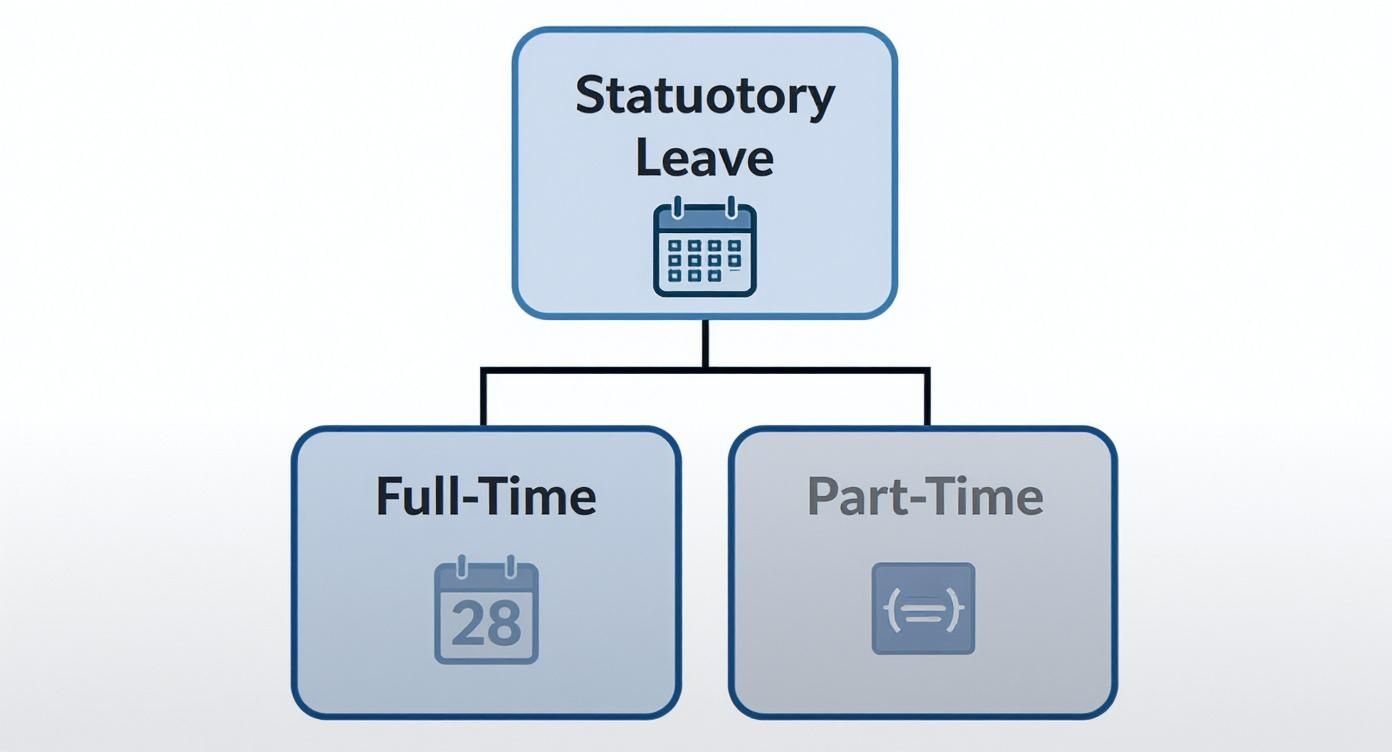
The key thing to remember is that while the final number of days might look different, that core entitlement of 5.6 weeks stays the same for everyone.
Leave for Irregular Hours and Zero-Hour Contracts
But what about team members whose hours change from one week to the next? For staff on irregular hours or zero-hour contracts, holiday entitlement is 'accrued' as they work. Think of it as them earning holiday credits for every hour they log. This system ensures nobody is penalised just because their schedule isn't fixed.
The standard way to handle this is by using the 12.07% figure. This number isn't just plucked from thin air; it represents the statutory 5.6 weeks of holiday as a percentage of the remaining working weeks in a year (52 weeks – 5.6 weeks = 46.4 weeks; so, 5.6 / 46.4 is roughly 12.07%).
To calculate the holiday they've earned, you just multiply the total hours they worked in a pay period by 12.07%. The answer is the number of holiday hours they now have in their 'pot'.
For example, if someone on a zero-hour contract works 60 hours in a month:
60 hours x 12.07% = 7.24 hours of paid holiday earned.
This method gives you a transparent and legally sound way to manage holiday for your most flexible workers. It guarantees their UK annual leave entitlement is calculated based on the actual hours they've put in, which is the fairest way to do it.
Getting Holiday Pay Calculations Right
Figuring out an employee's holiday entitlement is only half the battle. You’ve got to pay them correctly for that time off, and that’s just as crucial. A common but costly mistake is thinking holiday pay is simply an employee's basic salary. It's not.
UK law is clear on this: holiday pay has to reflect an employee’s ‘normal’ pay. The whole point is to ensure people aren’t financially penalised for taking the rest they're entitled to. Overlooking this can lead to underpayment claims and some pretty hefty financial penalties. It’s a detail many small businesses get wrong, but it’s simple enough to fix once you know how.
So, what actually counts as 'normal' pay? The legal definition has broadened over the years, and it now typically includes things like:
- Regular Overtime: If someone consistently works paid overtime, you have to factor that into their holiday pay. This applies even if the overtime isn't guaranteed in their contract.
- Commission Payments: For roles where commission is a regular and significant part of their earnings, this has to be included.
- Certain Bonuses: Bonuses that are directly linked to performance or the work an employee actually does often need to be part of the calculation.
Getting this right is a cornerstone of compliance. To help you navigate the complexities of holiday pay and avoid any legal tripwires, a comprehensive payroll compliance checklist can be an invaluable tool for covering all your duties.
The 52-Week Reference Period
To work out a week's pay for an employee with variable hours or fluctuating pay, you can't just guess. You need to use a specific reference period. The standard approach is to look back over the previous 52 weeks that the employee has actually been paid for.
This means you discount any weeks where they received no pay at all—for example, if they were on unpaid leave. If you find you have to go back further than 104 weeks to find 52 paid weeks, you just stop there and use whatever data you've managed to gather.
Legally, 'a week's pay' is the average amount an employee earned per week over the 52-week reference period. This ensures their holiday pay is a true reflection of their normal income, including variable elements like overtime and commission.
This method smooths out the peaks and troughs in their earnings, giving you a fair average that represents what they would have likely earned if they’d been at work.
A Worked Example of Holiday Pay
Let's make this real. Imagine you have an employee, Alex, who works irregular hours and often picks up paid overtime. To calculate his holiday pay for one week of leave, you need to look at what he earned over the last 52 weeks he was paid.
- Gather the Data: First, pull together Alex's total earnings for the last 52 paid weeks. Let's say this comes to £28,600.
- Calculate the Weekly Average: Next, you just divide this total by 52 to find his average weekly pay.
- £28,600 / 52 weeks = £550 per week.
- Determine Holiday Pay: That average of £550 is what you must pay Alex for each week of annual leave he takes. Simple as that.
What if Alex has only worked for 30 weeks? The process is the same, you just adapt to the data you have. You’d use his total pay from those 30 weeks and divide by 30 to get the average.
This calculation is absolutely fundamental to meeting your obligations around UK annual leave entitlement. For a deeper dive with more examples, you can learn more about how to calculate holiday pay accurately with our specialised guide. Better yet, automating this with software like LeaveWizard eliminates manual errors and keeps you compliant without the headache of fiddly spreadsheets.
Managing Leave Requests, Carry-Over, and Notice
Getting the numbers right for UK annual leave entitlement is one thing, but the day-to-day management of requests, notice periods, and carry-over is where the real headaches can start for a business. A clear, fair, and consistent approach isn't just nice to have; it's the bedrock of a smooth-running operation.
Nailing these processes prevents disputes, keeps things fair for everyone, and protects your business from being left short-staffed. It’s all about finding a balance. Your team needs to take their well-earned breaks, but you need to ensure the business can keep ticking over without them. Thankfully, UK law provides a solid framework to build upon, starting with straightforward rules on notice periods.

Understanding Notice Periods for Leave
The statutory rule for giving notice is surprisingly simple: an employee must give notice that is twice as long as the leave they want to take. So, if someone wants to book one week off, they need to give you at least two weeks’ notice. Simple.
This rule works both ways, too. If you need to turn down a holiday request, you must give notice that is at least as long as the leave requested. To refuse that one-week holiday, you’d need to let the employee know at least one week before their holiday was supposed to begin.
While these are the legal minimums, it’s always a good idea to set out your own specific requirements in your company holiday policy. This helps manage expectations and gives you more control. You might want to include things like:
- Longer notice periods for holidays of two weeks or more.
- Restrictions on taking leave during your busiest times of the year.
- A clear process for how requests are submitted, who approves them, and how quickly they'll get an answer.
The Rules on Carrying Over Unused Leave
One of the most common questions we hear is what happens to holiday days that aren't used by the end of the year. The default legal position for the 5.6 weeks of statutory leave is "use it or lose it." It has to be taken within the leave year and, except when an employee is leaving, it can't be paid out instead.
However, there are a few crucial exceptions where the law insists that leave must be carried over:
- Long-Term Sickness: If an employee is on long-term sick leave and simply can't take their holiday, they must be allowed to carry over up to four weeks of it. This carried-over leave must then be taken within 18 months from the end of the leave year it was accrued in.
- Maternity and Other Family Leave: It's the same story for someone on maternity, paternity, or adoption leave. If they can't take their holiday because of this, they must be able to carry it over to the next leave year.
It’s a common myth that holiday entitlement is automatically lost if not taken. While the 'use it or lose it' rule generally applies to statutory leave, legal protections for sickness and family leave ensure people aren't unfairly penalised for circumstances beyond their control.
For any extra contractual leave you offer above the statutory minimum, you get to set your own rules. Many employers allow staff to carry over a few days (say, up to five) into the next year as a goodwill gesture. It’s vital to get these details down in writing in your policy. To dive deeper into the specifics, check out our guide on whether you can carry over leave for an employee.
Of course, tracking all of this manually can be a nightmare. Using a system like LeaveWizard automates these rules, taking the administrative burden off your shoulders and ensuring carry-over is tracked accurately and fairly for every single person on your team.
Handling Leave During Sickness and Maternity
Life doesn't stop for a holiday rota. An employee's circumstances can change in an instant, creating genuine confusion around their UK annual leave entitlement. What happens when someone gets sick right before a planned holiday? How does leave build up during maternity leave? These are the real-world scenarios that can trip up even the most diligent employers.
Think of this section as your troubleshooting guide for these tricky but common situations. Once you're clear on the rules, you can handle these moments fairly, confidently, and in full compliance with UK law. It’s all about making sure your employees are treated correctly during pivotal life events.
How Parental Leave Affects Holiday Accrual
When an employee is on maternity, paternity, or adoption leave, their employment contract continues. It’s a simple but crucial point: all their contractual rights, including the accrual of annual leave, remain fully intact.
This means an employee on a year-long maternity leave will return to work with a full year's holiday entitlement waiting for them. That can feel a little daunting to manage, as it often means an employee has a significant amount of leave to take when they come back. Planning is everything here. It's a great idea to encourage employees to discuss how they might want to use this accrued holiday before they even start their parental leave.
Common ways to handle this include:
- Tagging it onto the end of their leave: Many new parents choose to use their accrued holiday to extend their time off before officially returning to work.
- Taking it throughout the next leave year: The employee could come back to work and then use the accrued leave in blocks over the following months.
- A combination of both: They might use some leave to push back their return date and save the rest for later in the year.
The most important thing to remember is that this leave cannot be lost. If they are unable to take it within the current leave year because of their absence, it must be carried over to the next.
Sickness During a Planned Holiday
Picture this: an employee is on a two-week holiday and comes down with a nasty case of the flu on day three. Legally, they are not on holiday anymore; they are on sick leave. An employee has the right to reclassify their annual leave as sick leave if they fall ill during a planned break.
To do this, they must follow your company's standard sickness reporting procedures, just as they would if they were scheduled to be at work. They'll then be entitled to any contractual or statutory sick pay they qualify for. The days they were sick can be reclaimed as annual leave to be taken at a later date.
An employee's right to paid holiday is fundamental to their health and well-being. If they are unwell, they aren't getting the rest and relaxation that annual leave is designed for, which is why the law allows them to reclaim it.
Calculating Final Holiday Pay on Resignation
When an employee leaves your company, you need to run one last holiday calculation. This ensures they are paid for any statutory leave they have accrued but not yet taken.
The calculation itself is pretty straightforward. You just need to figure out how much of the leave year they have worked and what proportion of their annual holiday they have earned up to their leaving date.
- Example Scenario: Sarah has a 28-day annual leave entitlement and leaves exactly six months into the leave year. She has worked 50% of the year, so she is entitled to 50% of her holiday, which is 14 days.
- If she has only taken 10 days, you owe her pay for the remaining 4 days in her final payslip.
- If she has taken 16 days, she has used two more days than she earned. You can usually deduct the value of those two days from her final pay, but only if this is clearly stated in her employment contract.
Interestingly, while employees seem to be taking their statutory leave more seriously, recent data shows a slight dip in usage. Between 2022 and 2023, the average number of leave days taken by full-time workers actually fell by 7.67%. You can dive into more industry-specific insights by checking out these UK annual leave trends on peoplehr.com. This makes accurate final pay calculations even more vital, as it's increasingly likely your departing employees will have unused days.


