
On average, you're looking at 20 to 22 working days in each month here in the UK, assuming a standard Monday to Friday work week. Of course, this number isn't set in stone. It shifts around depending on where the weekends land and how many public holidays pop up in any given month.
Understanding The Working Days Per Month
Getting a handle on the exact number of working days each month is crucial for everything from running payroll accurately to mapping out project timelines. The total changes every year because the calendar moves, and public holidays—especially Easter—don't always fall on the same dates. A month with no bank holidays might give you up to 23 working days, while months like May and December often have fewer.
For a clearer picture, let's break down what a typical year looks like month by month.
Typical Working Days Per Month In The UK
This table provides a quick reference for the usual number of working days you can expect each month in the UK. It's based on a standard Monday-to-Friday schedule and accounts for the main public holidays, though remember that the exact number can vary slightly from year to year.
| Month | Total Days | Typical Working Days (Excluding Public Holidays) |
|---|---|---|
| January | 31 | 21-22 |
| February | 28/29 | 20 (21 in a leap year) |
| March | 31 | 22-23 |
| April | 30 | 19-21 |
| May | 31 | 20-22 |
| June | 30 | 21-22 |
| July | 31 | 21-22 |
| August | 31 | 22 |
| September | 30 | 21 |
| October | 31 | 22 |
| November | 30 | 22 |
| December | 31 | 19-21 |
As you can see, months like April, May, and December often have fewer working days due to the concentration of bank holidays. It's also worth noting that businesses in Scotland and Northern Ireland will have regional variations that affect their final counts.
Looking at the monthly breakdown is great for short-term planning, but for the bigger picture, it helps to understand the annual total. This yearly figure gives you a much broader context for long-term resource allocation and financial forecasting. To see how it all adds up, you can check out our detailed guide on the total working days in a year.
How To Calculate Monthly Working Days Accurately
While quick-reference tables are handy, knowing how to calculate the exact number of working days in each month yourself is a vital skill for accurate planning. It’s a pretty straightforward process, relying on a simple formula you can apply to any month, in any year. Getting this right means you can move beyond rough estimates and work with precise figures for payroll, project timelines, and resource allocation.
The core formula is surprisingly simple:
Total Days in Month – (Total Weekend Days + Public Holidays) = Total Working Days
To put this into practice, you just need to find three key pieces of information for the specific month you're looking at.
The Step-By-Step Calculation Method
Let's break it down.
- Count the Total Days: Start with the basics – the total number of calendar days in the month (e.g., March has 31, April has 30).
- Subtract Weekend Days: Grab a calendar and count how many Saturdays and Sundays fall within that month. This is usually eight, but it can sometimes be nine or even ten depending on where the first and last days of the month land.
- Deduct Public Holidays: Identify any UK public holidays that fall on a weekday during the month. For instance, in May, you would need to subtract the Early May Bank Holiday and the Spring Bank Holiday.
To give you a real-world example, let's calculate the working days for May 2024 in England. You’d start with 31 days. Then, you'd subtract nine weekend days (four full weekends plus an extra Saturday) and two bank holidays (6th and 27th May). That leaves you with a total of 20 working days.
This chart gives you a great visual idea of how different factors, like public holidays or leap years, can shift the monthly totals around.
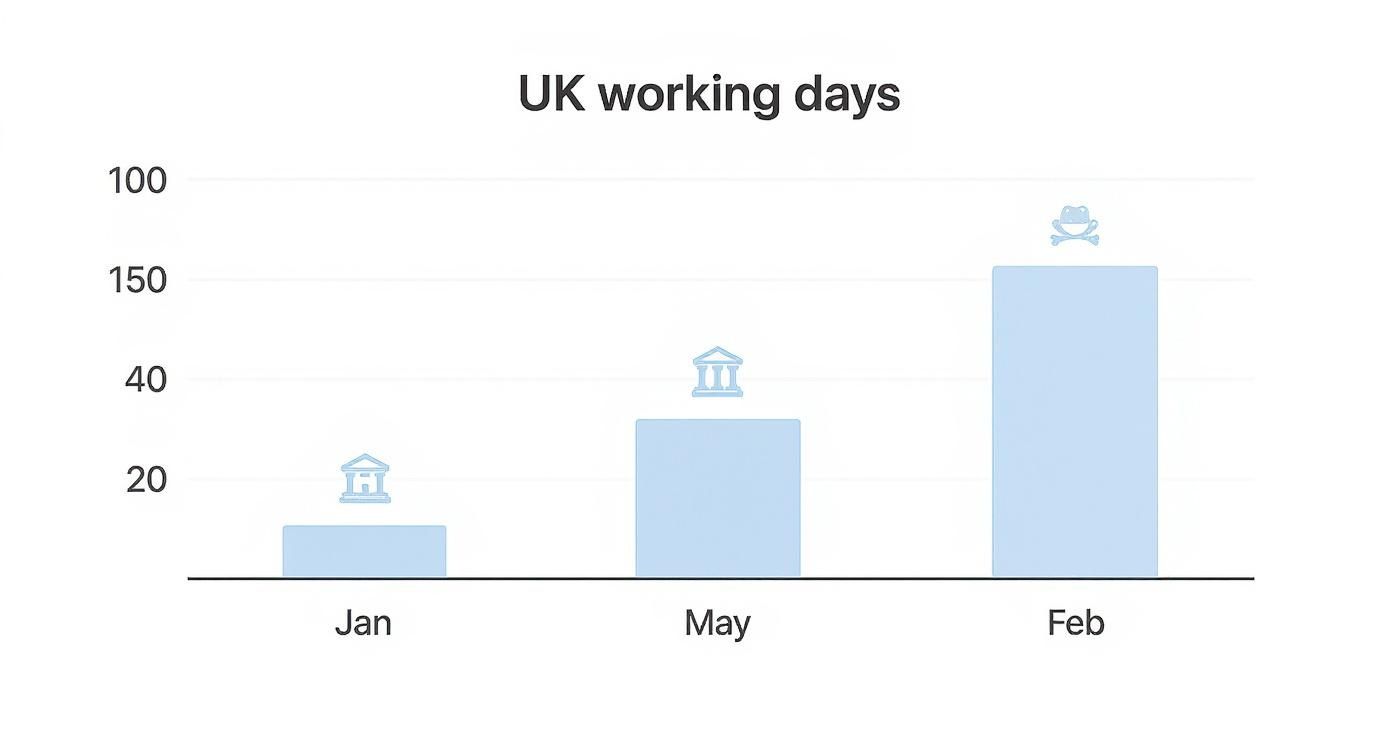
As the chart shows, there’s a lot of variability. It highlights how months like May and December often have fewer working days because of multiple bank holidays, compared to a more standard month like January or July.
Complete Guide To UK Public Holidays By Country
When you're trying to calculate the number of working days in each month, things can get a bit tricky. You might assume the UK has one single, unified list of public holidays, but that's not the case. While everyone gets dates like Christmas Day and New Year's Day off, many others are specific to England and Wales, Scotland, or Northern Ireland.
This regional variation is a massive factor for any business with offices or employees spread across different UK countries. These differences are rooted in unique historical, cultural, and legal traditions. For instance, Scotland celebrates its own bank holidays, like St Andrew's Day, while Northern Ireland observes St Patrick's Day and the Battle of the Boyne. If you don't account for these, you're setting yourself up for major headaches with payroll, project deadlines, and staff scheduling.
England And Wales Public Holidays
England and Wales operate on the same public holiday schedule, which typically adds up to eight days a year. These are the ones most people are familiar with: Good Friday, Easter Monday, and the bank holidays in May and August. Occasionally, a special event like a Royal Jubilee or Coronation might grant an extra bank holiday for the year.
Here is the official government list of the upcoming bank holidays for England and Wales.

This list is your go-to source because it clearly shows the specific dates. That's essential, especially for holidays like Easter that shift every year. Always double-check with an official source like this to make sure your information is completely up to date.
Scotland Public Holidays
Head north of the border, and you'll find Scotland has nine standard public holidays. They share some, like Christmas and New Year's Day, but have their own distinct dates.
The main differences to watch out for are:
- 2nd January: This is a public holiday in Scotland, giving them a longer New Year's break than the rest of the UK.
- St Andrew's Day: A day to celebrate Scotland's patron saint on 30th November.
- August Bank Holiday: This falls on the first Monday of August, unlike in England and Wales where it's the last Monday of the month.
Northern Ireland Public Holidays
Northern Ireland has the most public holidays in the UK, with a total of ten each year. On top of the more common UK-wide holidays, they also uniquely observe:
- St Patrick's Day: A major cultural and national holiday on 17th March.
- Battle of the Boyne (Orangemen's Day): Observed on 12th July.
Comparison Of UK Public Holidays By Country
To make it easier to see the differences at a glance, we've put together a simple comparison table. This should help clarify which holidays apply where, which is especially useful for businesses operating across the UK.
| Holiday Name | England & Wales | Scotland | Northern Ireland |
|---|---|---|---|
| New Year's Day (1 Jan) | ✓ | ✓ | ✓ |
| 2nd January | ✓ | ||
| St Patrick's Day (17 Mar) | ✓ | ||
| Good Friday | ✓ | ✓ | ✓ |
| Easter Monday | ✓ | ✓ | |
| Early May Bank Holiday | ✓ | ✓ | ✓ |
| Spring Bank Holiday | ✓ | ✓ | ✓ |
| Battle of the Boyne (12 Jul) | ✓ | ||
| Summer Bank Holiday | ✓ | ✓ | ✓ |
| St Andrew's Day (30 Nov) | ✓ | ||
| Christmas Day (25 Dec) | ✓ | ✓ | ✓ |
| Boxing Day (26 Dec) | ✓ | ✓ | ✓ |
As you can see, keeping track of these distinctions is vital for any national business. Managing staff leave across different countries requires careful planning, and it's also important to understand your legal responsibilities. For more on this, you can read up on what to do when you need your staff to work on public holidays.
Getting these dates right is the final piece of the puzzle for accurately calculating your monthly working days.
The Complication of Leap Years
It’s easy to forget, but every four years, February gets an extra day. This little quirk of the calendar can throw a spanner in the works when you're calculating monthly and annual working days.
Whether this extra day actually adds to your working day count depends entirely on which day of the week it lands. For instance, in 2020, the leap day fell on a Saturday, so it didn't change the number of working days in February. However, in 2024, the 29th of February is a Thursday, adding one more working day to the month's total.
- 2016: The leap day was a Friday, adding one working day.
- 2020: The leap day was a Saturday, resulting in no change.
- 2024: The leap day is a Thursday, adding one working day.
Adjusting Your Calculations for Leap Years
When a leap day falls on a weekday, you simply need to adjust your formula by adding one to February's total. You can always cross-reference our monthly lookup table to see how this extra day in February impacts the overall totals for working days in each month.
The total number of working days in a typical UK year hovers around 253. In a leap year, if that extra day is a weekday, the total bumps up to 254. It's a small change, but it's a crucial detail for accurate planning and payroll. It's also worth remembering the broader context of lost productivity; in 2023/24, an estimated 33.7 million working days were lost due to work-related ill health and injuries. You can find more details on this from the Health and Safety Executive: HSE statistics on days lost.
"A leap year’s extra day can increase annual working days from 253 to 254, affecting payroll by nearly 0.4%."
For a full monthly breakdown and a quick reference, check out our UK Working Days Per Month At A Glance section.
Putting Working Day Data to Work in Your Business
Figuring out the number of working days in each month is much more than just a calendar-filling exercise. Think of it as a strategic tool that has a real, direct impact on your company's efficiency and financial stability. When you apply this data correctly, it stops being a simple number and becomes a powerful asset for planning your operations and managing your resources.
This knowledge is absolutely fundamental for accurate project management. Let’s say you have a project estimated to take 45 working days. The completion date will look very different if it kicks off in a holiday-heavy month like December compared to a straightforward month like October. Getting this wrong can easily lead to blown deadlines and unhappy clients.
It also extends to crucial areas like managing your team's pay and making sure you have enough funding for payroll. Accurate day counts are essential for calculating salaries, especially for part-time or pro-rata staff whose pay is directly linked to the specific days they work.
Key Areas Where This Data Makes a Difference
Let's break down the most common business functions where this data gives you a significant edge. By building working day calculations into these processes, you can sharpen your accuracy and make far more informed decisions.

-
Project Timelines: Set realistic deadlines by using the exact number of available workdays, making sure to factor in all public holidays. For instance, a 20-day project starting on 1st May would finish much later than one starting on 1st June, simply because of May's two bank holidays.
-
Financial Forecasting: Use working day counts to predict your monthly revenue and expenses with greater precision. Any business with daily revenue targets will see a noticeable difference in potential income between a 23-day working month and a 19-day one.
-
Annual Leave Management: Streamline holiday planning by understanding how many days your team are actually available each month. This helps you avoid staffing shortages during popular holiday periods and ensures leave is distributed fairly.
Did you know? Knowing the precise working day count for a given month can improve the accuracy of a departmental budget by as much as 10%. It's the key to preventing overspending or tying up unnecessary cash reserves.
Ultimately, mastering the calculation of working days in each month helps you shift from reactive problem-solving to proactive, data-driven strategy. It's a small detail, but one that creates a ripple effect, improving everything from employee satisfaction right through to your bottom line.
Essential Tools And Resources For Tracking Working Days
Counting the working days in each month by hand is certainly one way to do it, but let's be honest, it's a real slog. Thankfully, there are plenty of tools out there that can take this off your plate, saving you precious time and cutting down on the risk of simple human error. The right choice really just boils down to your company's size, how complex your needs are, and what software you're already using.
For a quick, one-off check, you can't beat a simple online calculator. These web-based tools are perfect for when you just need a fast answer. You pop in a start and end date, and they'll spit out the number of working days, usually with an option to exclude UK public holidays. They’re ideal for a quick sanity check without firing up a whole spreadsheet.
Digital Calendars And Spreadsheets
Chances are, your business already relies on digital calendars like Google Calendar or Outlook. While they're not dedicated work-day calculators, they're brilliant for visual planning. They clearly mark out the weekends, and you can easily import public holiday calendars for your region, which makes a manual count much quicker and less error-prone.
Spreadsheets, on the other hand, bring a lot more power and flexibility to the table.
- Microsoft Excel: The
NETWORKDAYSfunction is an absolute game-changer here. It automatically calculates the workdays between two dates and even lets you specify a list of holidays to exclude. For instance,=NETWORKDAYS("01/05/2024", "31/05/2024", A1:A2)would figure out May's working days, making sure to skip the two bank holidays you've listed in cells A1 and A2. - Google Sheets: You'll find the exact same
NETWORKDAYSfunction here, making it a fantastic cloud-based option for teams that need to collaborate on planning documents from anywhere.
A word of caution: for businesses juggling multiple employees, tracking everything in spreadsheets can get messy, fast. As your team grows, so does the risk of a typo in a formula or a missed leave request, which can have a real knock-on effect on payroll and project deadlines.
Dedicated HR And Leave Management Software
Once you've outgrown your spreadsheets, dedicated software is the next logical step. These platforms are built from the ground up for workforce management, automating everything from calculating holidays to tracking every type of absence.
Specialised tools, for example, can effortlessly handle complex leave policies, calculate pro-rata entitlements for your part-time staff, and account for regional public holidays without you lifting a finger. If you're ready to ditch the manual methods for good, investing in a proper staff holiday tracker is by far the most efficient route to accuracy and compliance. These systems bring every part of leave management under one roof, creating a single source of truth for the whole company and freeing up your HR team to focus on more important things.
Frequently Asked Questions
When you get down to the brass tacks of counting working days in each month, a few specific questions always seem to pop up. This is especially true when you're juggling different contract types and legal duties. We've pulled together some of the most common queries we get from UK business owners and managers to give you clear, straightforward answers.
Think of this as the practical part of the guide. We’ll cover everything from part-time holiday pay to how freelancers should handle their invoicing, helping you apply these concepts in the real world.
How Do Part-Time Schedules Affect Monthly Calculations?
You can't just use the standard monthly working day count for part-time staff. It simply won't work. Instead, you have to look at the calendar and count the actual number of days they are contracted to work in that specific month.
For instance, someone who works only on Tuesdays and Wednesdays will have either eight or nine working days in a month. It doesn't matter if the month has 20 or 23 standard working days for a full-timer; their total is based purely on their own schedule. Getting this right is absolutely crucial for calculating pro-rata holiday entitlement and pay, so always double-check their contract against the calendar.
Are UK Bank Holidays Legally Paid Leave?
This is a common misconception. In the UK, there's no automatic legal right for an employee to have paid time off on a bank holiday. It all comes down to what's written in their employment contract.
Most full-time contracts will include bank holidays as part of the statutory minimum of 5.6 weeks of paid annual leave. However, for many sectors like retail, hospitality, and healthcare, it's business as usual on public holidays. In those situations, the contract must spell out what happens – whether that's an enhanced pay rate (like time-and-a-half) or if they get a day off in lieu at another time.
How Do Working Days Impact Freelancer Invoicing?
For freelancers and contractors who bill by the day, keeping a precise tally of working days is fundamental to their finances. It dictates their invoicing and is key to any kind of financial planning. Unlike salaried employees, freelancers don't invoice for bank holidays unless they've actually worked on them, and this has been agreed with the client beforehand.
For a freelancer, a month with 22 working days offers 10% more earning potential than a month with 20 working days. This kind of variance shows just how vital accurate tracking is for managing cash flow and forecasting income over the year.


